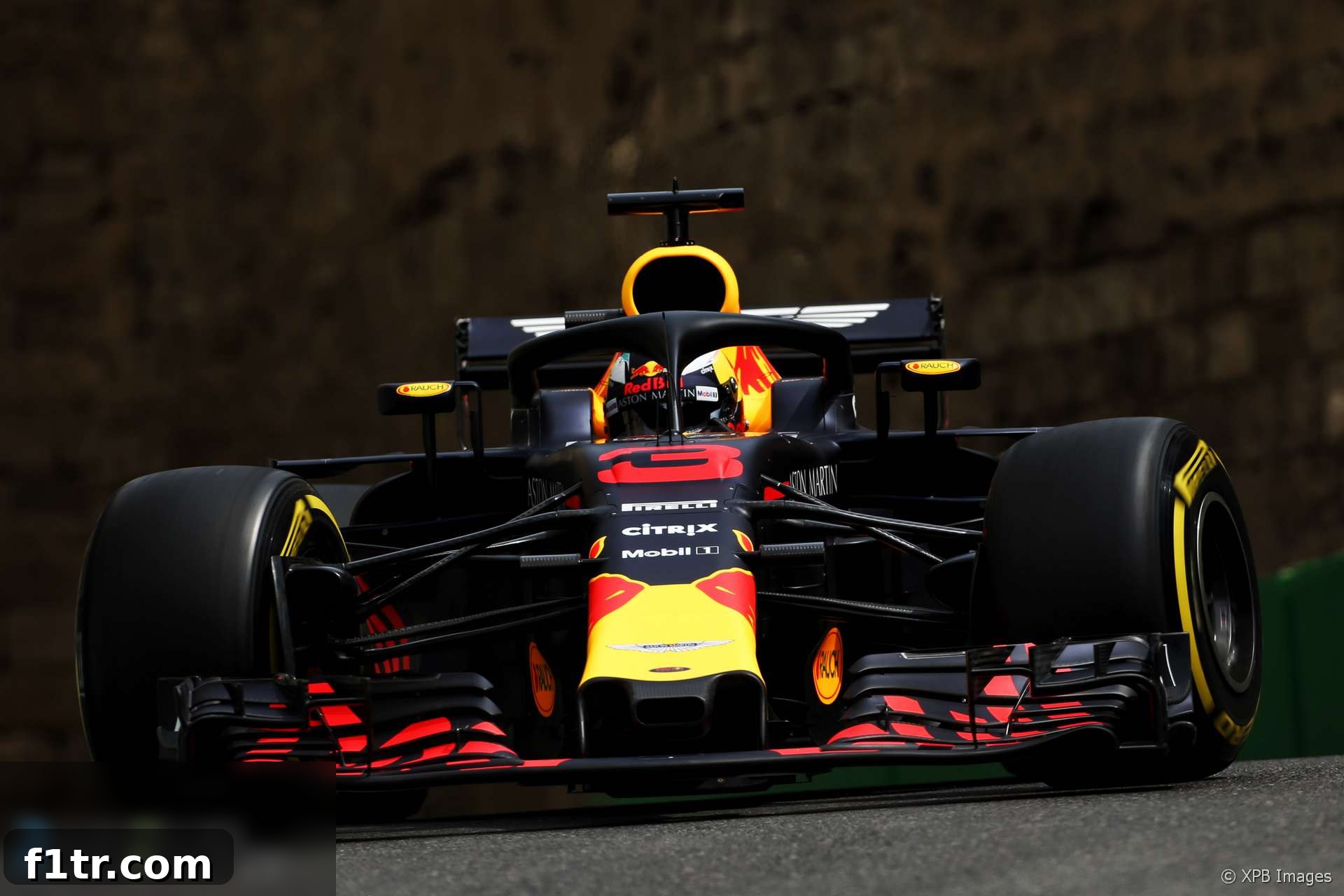
Daniel Ricciardo, the charismatic Red Bull driver, demonstrated exceptional pace during the second practice session for the Azerbaijan Grand Prix, narrowly clinching the fastest time. His impressive performance offered a glimpse into Red Bull Racing’s strong potential on the challenging Baku City Circuit, a track known for its dramatic and unpredictable races. The session, crucial for fine-tuning car setups and understanding tire behavior, saw a dynamic leaderboard, setting the stage for an enthralling weekend.
Ricciardo’s blistering lap time of 1’42.795 was achieved on the ultra-soft Pirelli tires, underscoring his comfort and the car’s balance on the high-speed street circuit. It wasn’t a one-off fluke; the Australian driver meticulously built up to his peak performance over several laps, allowing the tires to reach optimal temperature and grip as track conditions steadily improved. With temperatures dipping to a comparatively cool 26 degrees Celsius, optimizing tire performance was paramount, and Ricciardo, with his characteristic precision, extracted every ounce of speed from his RB14. This early advantage could prove pivotal, giving Red Bull valuable data as they prepare for the all-important qualifying session.
Right on Ricciardo’s heels was Kimi Raikkonen, the veteran Ferrari driver, who finished a mere 0.069 seconds behind. Raikkonen’s consistent speed highlighted Ferrari’s competitive package, suggesting they too are firmly in contention for pole position and a strong race result. However, it was a more challenging session for his teammate, Sebastian Vettel. The championship contender found himself in an unfamiliar 11th position, having suffered a minor off-track excursion down one of the circuit’s numerous escape roads. This setback likely disrupted his flow and limited his ability to extract the full potential from his SF71H, leaving him with work to do to catch up to the front-runners. Ferrari will be keen to analyze the data and ensure both cars are performing optimally come Saturday.
Max Verstappen, Ricciardo’s Red Bull stablemate, showed remarkable resilience to secure the third-quickest time. This came after a significant crash in the first practice session, which saw his car extensively damaged. His ability to quickly bounce back and clock a time just over a tenth of a second behind Ricciardo speaks volumes about his raw talent and the Red Bull team’s efficiency in repairing the car. Despite this impressive recovery, Verstappen’s session ended on a sour note, as he was forced to cruise back into the pits in the dying minutes, reporting what appeared to be a technical problem with his RB14. This recurring theme of reliability issues for Verstappen could be a cause for concern for Red Bull, despite their impressive outright pace.
Meanwhile, the Mercedes-AMG Petronas Motorsport team seemed to be grappling with the unique demands of the Baku circuit. Both silver cars lagged noticeably behind the leading Red Bulls. Valtteri Bottas, the quicker of the two, found himself over three-quarters of a second adrift of Ricciardo’s benchmark, signaling a potential struggle with either car balance or tire management. Lewis Hamilton, the reigning world champion, finished fifth, only a marginal tenth of a second ahead of Fernando Alonso’s McLaren. This indicated a puzzling lack of ultimate pace for Mercedes, a team usually at the sharp end of the grid. Whether this was a result of aggressive experimentation with car setups or genuine difficulty in finding the sweet spot for the Baku street circuit remains to be seen. Mercedes engineers will undoubtedly be working tirelessly overnight to analyze the data and unlock more performance from their W09.
The midfield battle, as expected, was fiercely competitive and incredibly tightly packed, showcasing the unpredictable nature of the Azerbaijan Grand Prix. Fernando Alonso’s sixth-place finish for McLaren was a standout performance, demonstrating the progress of the team and Alonso’s undiminished skill. He led a diverse group of cars, with only fractions of a second separating many contenders. Esteban Ocon continued to impress for Force India, securing seventh position and highlighting the capabilities of his VJM11 on this unforgiving circuit. Kevin Magnussen, known for his aggressive driving style, placed his Haas in ninth, while both Renaults also made it into the top ten, with Carlos Sainz Jnr demonstrating superior pace compared to his teammate, Nico Hulkenberg. Sainz’s strong showing was a significant improvement from his first practice session, where he had been slowest, indicating a successful adjustment to the track and car setup. This intense midfield fight promises thrilling action throughout the weekend, with crucial championship points at stake.
Further down the grid, some teams also showed glimpses of potential. Despite expressing concerns about his car’s balance, Lance Stroll managed to guide his Williams to a respectable 14th-quickest time. This placed Williams ahead of both Toro Rosso and Sauber cars, a small but significant victory for the Grove-based outfit, which has often struggled for pace this season. The Baku City Circuit, with its unique blend of high-speed straights and intricate, narrow sections through the old city, presents a considerable challenge for every team and driver. Finding the optimal compromise between aerodynamic efficiency for the straights and downforce for the tight corners is key, as is managing the high risk of incidents.
The second practice session, therefore, provided a fascinating preview of the weekend’s proceedings. While Ricciardo’s performance was a clear highlight, the close margins across the grid, the surprising struggles of Mercedes, and the consistent reliability concerns for Verstappen paint a complex picture. The street circuit nature of Baku guarantees excitement, with walls ready to punish the slightest error and the potential for safety cars to completely reshape race strategies. Teams will now delve into the data, analyzing every sector, every corner, and every tire compound to unlock further performance before Saturday’s crucial qualifying session. The implications for championship points and team morale are immense, making every tenth of a second found in practice invaluable.
As the teams regroup and prepare for the final practice session and qualifying, the question of who truly holds the advantage remains open. Red Bull has certainly laid down a marker, but Ferrari’s raw pace with Raikkonen and Mercedes’ proven ability to turn things around mean that predictions are premature. The Azerbaijan Grand Prix promises to be another memorable chapter in the Formula 1 season, brimming with strategic battles, daring overtakes, and unexpected twists.
Azerbaijan Grand Prix Practice 2: Full Results
| Pos. | No. | Driver | Car | Best lap | Gap | Laps |
|---|---|---|---|---|---|---|
| 1 | 3 | Daniel Ricciardo | Red Bull-TAG Heuer | 1’42.795 | 35 | |
| 2 | 7 | Kimi Raikkonen | Ferrari | 1’42.864 | 0.069 | 33 |
| 3 | 33 | Max Verstappen | Red Bull-TAG Heuer | 1’42.911 | 0.116 | 27 |
| 4 | 77 | Valtteri Bottas | Mercedes | 1’43.570 | 0.775 | 25 |
| 5 | 44 | Lewis Hamilton | Mercedes | 1’43.603 | 0.808 | 31 |
| 6 | 14 | Fernando Alonso | McLaren-Renault | 1’43.700 | 0.905 | 34 |
| 7 | 31 | Esteban Ocon | Force India-Mercedes | 1’43.814 | 1.019 | 30 |
| 8 | 55 | Carlos Sainz Jnr | Renault | 1’43.834 | 1.039 | 36 |
| 9 | 20 | Kevin Magnussen | Haas-Ferrari | 1’43.977 | 1.182 | 29 |
| 10 | 27 | Nico Hulkenberg | Renault | 1’44.091 | 1.296 | 33 |
| 11 | 5 | Sebastian Vettel | Ferrari | 1’44.127 | 1.332 | 38 |
| 12 | 11 | Sergio Perez | Force India-Mercedes | 1’44.142 | 1.347 | 31 |
| 13 | 8 | Romain Grosjean | Haas-Ferrari | 1’44.425 | 1.630 | 27 |
| 14 | 18 | Lance Stroll | Williams-Mercedes | 1’44.459 | 1.664 | 31 |
| 15 | 10 | Pierre Gasly | Toro Rosso-Honda | 1’44.712 | 1.917 | 39 |
| 16 | 16 | Charles Leclerc | Sauber-Ferrari | 1’44.940 | 2.145 | 30 |
| 17 | 35 | Sergey Sirotkin | Williams-Mercedes | 1’45.007 | 2.212 | 33 |
| 18 | 28 | Brendon Hartley | Toro Rosso-Honda | 1’45.051 | 2.256 | 36 |
| 19 | 2 | Stoffel Vandoorne | McLaren-Renault | 1’45.288 | 2.493 | 29 |
| 20 | 9 | Marcus Ericsson | Sauber-Ferrari | 1’46.042 | 3.247 | 9 |
Second Practice Visual Gaps: Driver Performance Overview
Daniel Ricciardo – 1’42.795
+0.069 Kimi Raikkonen – 1’42.864
+0.116 Max Verstappen – 1’42.911
+0.775 Valtteri Bottas – 1’43.570
+0.808 Lewis Hamilton – 1’43.603
+0.905 Fernando Alonso – 1’43.700
+1.019 Esteban Ocon – 1’43.814
+1.039 Carlos Sainz Jnr – 1’43.834
+1.182 Kevin Magnussen – 1’43.977
+1.296 Nico Hulkenberg – 1’44.091
+1.332 Sebastian Vettel – 1’44.127
+1.347 Sergio Perez – 1’44.142
+1.630 Romain Grosjean – 1’44.425
+1.664 Lance Stroll – 1’44.459
+1.917 Pierre Gasly – 1’44.712
+2.145 Charles Leclerc – 1’44.940
+2.212 Sergey Sirotkin – 1’45.007
+2.256 Brendon Hartley – 1’45.051
+2.493 Stoffel Vandoorne – 1’45.288
+3.247 Marcus Ericsson – 1’46.042
Note: Drivers more than ten seconds off the pace have been omitted from this visual representation for clarity.
Go ad-free for just £1 per month>> Find out more and sign up
Further Reading: 2018 Azerbaijan Grand Prix Insights
- 2018 Azerbaijan Grand Prix Star Performers
- Top ten pictures from the 2018 Azerbaijan Grand Prix
- Baku provides another race to remember – but not for luckless Bottas
- Leclerc is first points-scorer from Monaco in 978 races
- Paddock Diary: Azerbaijan Grand Prix day four
Browse all 2018 Azerbaijan Grand Prix articles