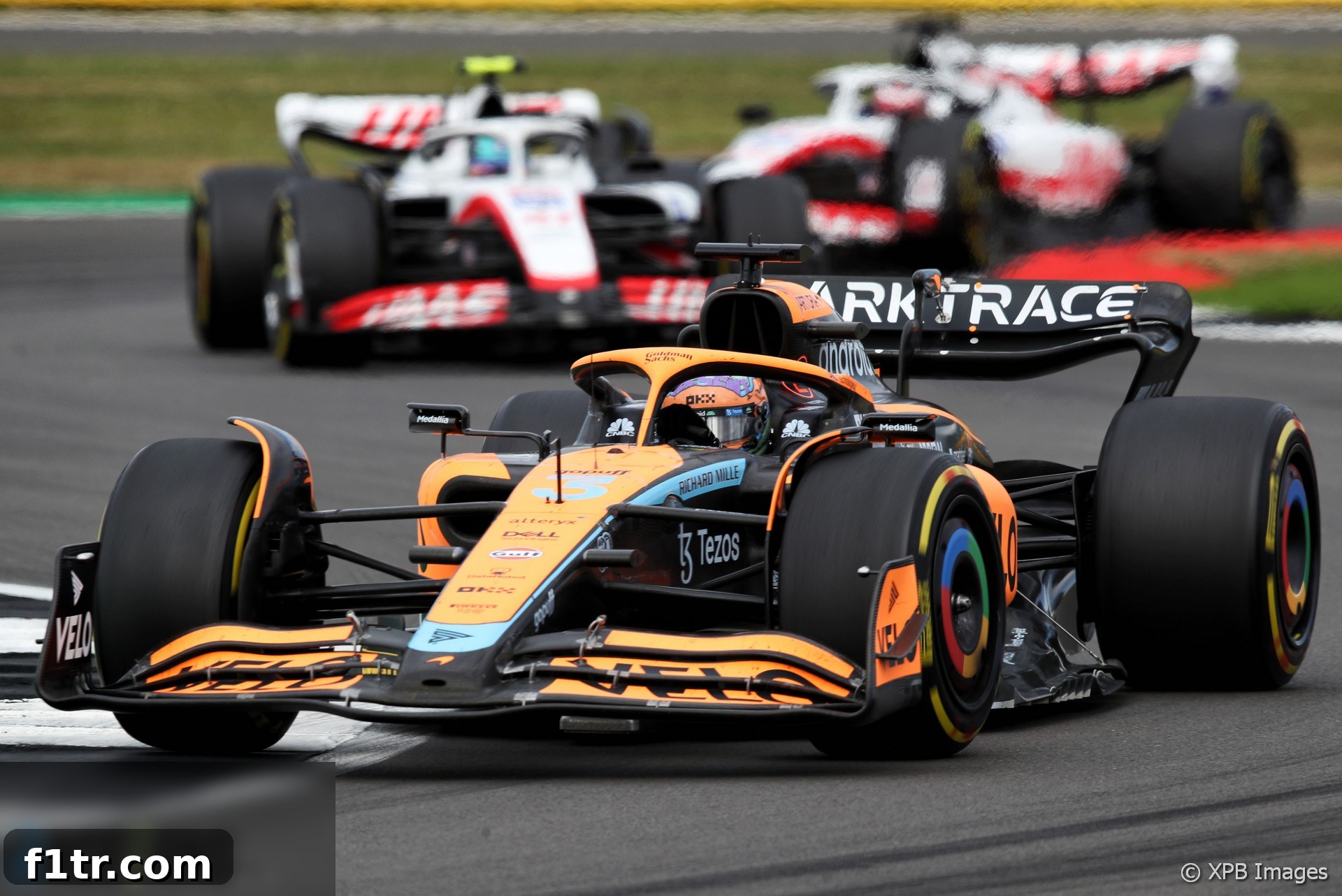
Daniel Ricciardo found himself baffled by the significant performance deficit of his McLaren MCL36 during the recent British Grand Prix. The seasoned Formula 1 driver expressed deep frustration, noting that the alarming lack of grip he experienced at Silverstone bore an unsettling resemblance to the struggles he encountered just four races prior at the Spanish Grand Prix in Barcelona. This recurring issue hinted at a deeper, more persistent challenge for both Ricciardo and the McLaren team, casting a shadow over their competitive aspirations in the 2022 season.
Advert | Become a Supporter & go ad-free
The Australian driver’s weekend culminated in a disappointing 13th-place finish, a stark contrast to his teammate Lando Norris, who secured a respectable sixth position. Ricciardo himself summed up the race as “pretty sad,” a sentiment that underscored the profound difficulties he faced throughout the event. From the moment the race restarted following an early red flag, it became clear that the McLaren driver was fighting an uphill battle against his car’s fundamental instability and a critical deficiency in tyre adhesion, leaving him unable to contend effectively within the competitive midfield pack.
Daniel Ricciardo’s Puzzling Performance: Unpacking McLaren’s Struggles at the British Grand Prix
The British Grand Prix at Silverstone is a circuit renowned for its high-speed corners and demanding characteristics, where optimal grip and aerodynamic performance are paramount. For Daniel Ricciardo, however, the experience was one of constant struggle and baffling underperformance. He recounted to media, including RaceFans, the immediate and stark contrast in car feel after the initial restart.
A Mysterious Lack of Grip Plagues the MCL36
“Once the race got restarted, I was just struggling with grip,” Ricciardo explained, painting a vivid picture of his predicament. “It simply didn’t feel like I was operating at the same level of grip as the others.” This statement highlights a fundamental discrepancy that made it impossible for him to push the car to its limits or even maintain a consistent pace. The lack of tyre bite translated directly into reduced cornering speeds, compromised braking zones, and an inability to carry momentum through the sweeping turns of Silverstone. Drivers around him were seemingly able to extract far more from their machinery, leaving Ricciardo vulnerable to overtakes and unable to mount any meaningful defense or attack.
He continued, expressing the helplessness he felt as competitors easily bypassed him. “I was getting eaten up and couldn’t really do anything about it. Then that seemed to be our pace for the race.” This sentiment is particularly troubling for a driver of Ricciardo’s calibre, known for his aggressive driving style and strong racecraft. To be reduced to a passenger, unable to influence his own performance or the outcome, points to deep-seated issues within the car’s setup or inherent characteristics. The inability to generate heat in the tyres, or perhaps an inherent aerodynamic instability, could be contributing factors to this pervasive lack of grip, robbing him of the confidence needed to attack the circuit.
The DRS Malfunction: A Critical, Race-Altering Setback
Compounding the grip issues, Daniel Ricciardo’s race was further hampered by a critical mechanical failure involving his Drag Reduction System (DRS). This crucial aerodynamic aid, designed to facilitate overtaking by reducing drag on specific straight sections of the track, failed at a pivotal moment. “I remember braking into Turn 6 [Brooklands] and the car was all over the place, I thought I had a puncture,” Ricciardo recounted, describing the alarming instability caused by the malfunction. The unexpected behavior of the car led him to instinctively check his rear tyres, only to discover the root cause: “I saw the DRS was open.”
A DRS system stuck in the open position creates immense drag instability, especially under braking and through corners, making the car incredibly difficult and dangerous to control. This failure necessitated an urgent return to the pits for repairs. While the McLaren mechanics swiftly addressed the issue, fixing the mechanism, the incident had lasting ramifications for Ricciardo’s race. “So we had a failure there, we came back to the pits to fix it, but then obviously we couldn’t use it for fear that it would get stuck open again. So at the end then on the restart I couldn’t really attack the cars.” The strategic decision to deactivate the DRS for the remainder of the race effectively stripped Ricciardo of a vital tool for overtaking, especially on the long straights of Silverstone where DRS provides a significant speed advantage. This put him at an insurmountable disadvantage against rivals who could freely deploy their DRS, further contributing to his inability to make progress through the field.
Despite the clear impact of the DRS failure, Ricciardo’s intuition suggested that the problems ran deeper than this isolated incident. He firmly believes there was likely another underlying issue preventing his car from performing as expected. “Simply we weren’t fast, so hopefully we find something,” he stated, emphasizing the urgent need for a thorough investigation. With the Austrian Grand Prix looming large on the calendar, the turnaround time for McLaren was incredibly tight, putting immense pressure on the engineering team to diagnose and rectify any potential hidden flaws before the next race weekend. The hope was that a comprehensive analysis would uncover the true culprits behind the car’s perplexing lack of pace.
Echoes of Barcelona: A Persistent Problem for Daniel Ricciardo and McLaren
The most concerning aspect of Ricciardo’s British Grand Prix experience was the chilling sense of déjà vu. The pronounced loss of grip, a feeling of his car operating at a distinctly inferior level compared to the competition, was not an unfamiliar sensation. “Something I felt in Barcelona as well,” he revealed, drawing a direct parallel to his struggles at the Spanish Grand Prix earlier in the season. This recurring theme indicates a potential systemic issue, either with the car’s fundamental design characteristics, its setup philosophy, or how it interacts with the Pirelli tyres across different circuit layouts and conditions.
Déjà Vu on the Track: A Pattern of Underperformance
Ricciardo elaborated on the specific manifestations of this grip deficiency: “Just basically corner speed, the way you’re able to roll the car just with the tyres not biting, not gripping.” In Formula 1, corner speed is paramount, and the ability to maintain high velocity through turns directly translates into faster lap times. When tyres fail to generate sufficient grip, drivers are forced to slow down more, coast through corners, and apply throttle later, losing precious tenths of a second at every turn. This creates a vicious cycle where a lack of confidence in the car further exacerbates the problem, preventing the driver from pushing the limits.
The McLaren driver’s car had also run over a significant amount of debris during the chaotic opening lap of the British Grand Prix, which included a multi-car collision. While such incidents can undoubtedly cause damage that affects performance, Ricciardo confirmed that the team had conducted extensive checks. “We ran over quite a bit of debris with the accident in the beginning. But obviously, the team checked, we had a lot of time to check the car. So unless we find something that we missed, otherwise we’ll have to keep digging.” This suggests that visible or easily identifiable damage was ruled out, pointing towards a more insidious problem that requires deeper investigation beyond a simple physical inspection. The team’s inability to immediately pinpoint the issue only adds to the complexity and frustration surrounding Ricciardo’s recent performances.
Advert | Become a RaceFans supporter andgo ad-free
McLaren’s Mid-Season Conundrum: The Road Ahead for Daniel Ricciardo
Daniel Ricciardo’s ongoing struggles at McLaren have become a prominent narrative in the 2022 Formula 1 season. The stark contrast between his performances and those of his highly-rated teammate, Lando Norris, has fueled speculation and raised questions about his future with the team. While Norris has consistently delivered strong results, often punching above the car’s weight, Ricciardo has frequently found himself out of the points and battling at the tail end of the midfield. This performance gap is a critical factor for McLaren, a team with ambitions to challenge for podiums and ultimately race victories.
Team Dynamics: Ricciardo vs. Norris – A Growing Chasm
The consistency of Lando Norris’s performance underscores the potential of the MCL36, suggesting that the car itself possesses a reasonable level of competitiveness. However, Ricciardo’s inability to extract similar performance points to a significant disconnect between driver and machine, or perhaps a struggle to adapt to the car’s specific characteristics. This dynamic creates immense pressure on Ricciardo, who joined McLaren with a stellar reputation and multiple Grand Prix wins under his belt. The team needs both drivers to be operating at their peak to maximize constructors’ championship points and progress up the grid. The current situation, where one driver consistently outshines the other by a wide margin, is unsustainable in the long run for a top-tier team.
The Hunt for Answers: Urgent Diagnosis Ahead of Austria
With the F1 calendar moving at a relentless pace, McLaren had precious little time between Silverstone and the upcoming Austrian Grand Prix at the Red Bull Ring. The team’s engineers faced an intensive period of data analysis, simulation work, and potential component testing. Their task was multifaceted: not only to thoroughly investigate the DRS failure to ensure it wouldn’t recur but, more importantly, to understand the fundamental reasons behind the chronic lack of grip reported by Ricciardo. This investigation would likely involve examining everything from aerodynamic efficiency and floor integrity (especially given the debris incident) to suspension kinematics, brake bias, and tyre temperature management. Every aspect of the car’s interaction with the track had to be scrutinized to find the elusive solution.
For Daniel Ricciardo, the immediate future hinges on McLaren’s ability to provide him with a car that instils confidence and allows him to demonstrate his true pace. The pressure to perform is immense, not just from the team but from within himself and the demanding world of Formula 1. The hope is that the team can indeed “find something” – a breakthrough in understanding the car’s behavior that allows for a more tailored setup or even identifies a minor, yet impactful, manufacturing or assembly flaw. Without such discoveries, the struggle for pace and grip could continue to define his season, impacting both his personal morale and his standing within the sport.
The Road Ahead: Challenges and Opportunities for McLaren and Ricciardo
The 2022 season presented a new set of technical regulations for Formula 1, and McLaren, like all teams, faced the challenge of adapting to these significant changes. While they’ve shown flashes of brilliance, the inconsistency, particularly on Ricciardo’s side of the garage, indicates that there are still fundamental areas where they need to improve their understanding of the new ground-effect aerodynamics. The British Grand Prix served as a stark reminder that even a single race weekend can expose deep-seated issues that require comprehensive solutions.
Looking beyond Austria, McLaren’s trajectory for the remainder of the season will depend heavily on their ability to develop the MCL36 effectively and ensure both drivers can extract its maximum potential. For Daniel Ricciardo, overcoming these challenges is not just about points; it’s about rebuilding confidence, reaffirming his talent, and securing his long-term future in Formula 1. The resilience and technical prowess of the McLaren team, combined with Ricciardo’s renowned driving skill, will be put to the ultimate test as they strive to turn these perplexing performances into consistent competitive results.
2022 British Grand Prix
- How many victory chances did Hamilton have in his first winless F1 season?
- New rule added on drivers abandoning cars after Russell’s Silverstone retirement
- Hamilton told Leclerc ‘I didn’t want to clip you and send you off’ after Copse scrap
- Sainz: Ferrari accepted I was right not to follow “10 car lengths” instruction
- Zhou says Silverstone crash force exceeded roll hoop impact test
Browse all 2022 British Grand Prix articles