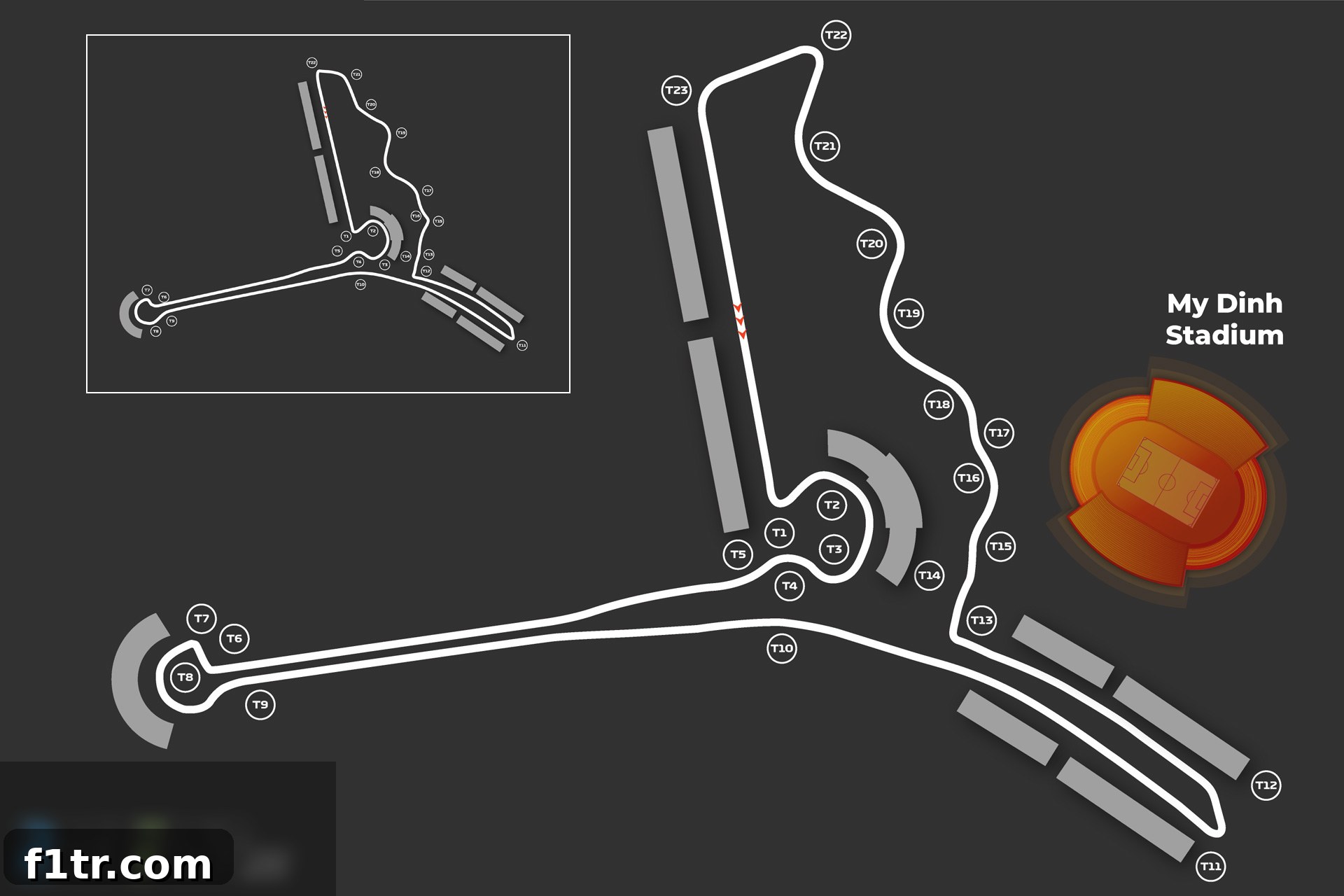
In a significant development for the eagerly anticipated 2020 F1 calendar, the Hanoi Street Circuit in Vietnam, set to host its inaugural Grand Prix, has undergone a notable track alteration. This modification aims to enhance the circuit’s characteristics, promising an even more thrilling spectacle for drivers and fans alike.
Vietnam Grand Prix Circuit Unveils Strategic Track Modifications
The Hanoi Street Circuit, a groundbreaking addition to the Formula 1 season, has confirmed a critical modification to its layout. Specifically, the penultimate corner of the challenging 23-turn circuit has been reconfigured. This change, which involved widening the corner to 15 metres, was implemented “after further consideration of the surrounding geographical conditions,” according to the race promoters. While specific details of the geographical factors weren’t extensively detailed, such adjustments often account for local terrain, drainage, or potential safety enhancements discovered during the final stages of construction and simulation.
This revision underscores the meticulous planning and adaptive approach involved in creating a new Formula 1 venue. Circuit designers continuously refine layouts to ensure optimal racing conditions, driver safety, and an engaging spectator experience. A wider corner can significantly impact racing lines, potentially allowing for multiple approaches, encouraging overtakes, and adding a strategic dimension for drivers as they navigate the closing stages of a lap.
The Hanoi Street Circuit has been lauded for its ambitious and innovative “unique hybrid design,” a concept that masterfully fuses the high-octane characteristics of a traditional street circuit with the advanced infrastructure and technical precision typically found in a permanent race track. This pioneering design was brought to life through a collaborative effort between the renowned Tilke Engineering, a firm synonymous with modern Formula 1 circuit architecture, and Formula 1 Management. Tilke’s expertise in crafting circuits that offer a blend of high-speed sections, technical corners, and challenging braking zones is evident in Hanoi’s layout, which aims to provide both a stern test for the drivers and an exhilarating show for the global audience. The hybrid nature promises the close-quarters racing and dramatic backdrop of urban environments combined with the flow and safety standards of purpose-built facilities, marking a new era in F1 circuit design.
Advert | Become a RaceFans supporter andgo ad-free
Connecting with the Fans: F1 on Social Media
In the digital age, social media platforms serve as vital conduits for Formula 1 to engage with its global fanbase, offering immediate updates, behind-the-scenes glimpses, and direct interaction with teams and drivers. The announcement of the Hanoi track changes, like all significant F1 news, resonated across various platforms, generating discussions, reactions, and analyses among enthusiasts worldwide. Platforms like Twitter and Instagram are indispensable for sharing breaking news, official announcements, and candid moments that bring fans closer to the sport. The following Instagram post offers a glimpse into the kind of content shared by official channels, often featuring visual updates on circuit construction, team preparations, or driver activities:
https://www.instagram.com/p/B55ZDEsHDRw/
- For fans looking to stay comprehensively connected, a comprehensive directory of official F1 accounts across various platforms is invaluable. Find more official F1 accounts to follow in the F1 Twitter Directory, ensuring you don’t miss out on any critical updates or exciting content.
F1 and Motorsport News Roundup: Key Headlines and Insights
Beyond the immediate news of the Hanoi circuit, the world of motorsport continues to generate a multitude of interesting stories, affecting drivers, teams, and the broader sporting landscape. Here’s a curated selection of notable developments and discussions from around the globe:
Advert | Become a Supporter & go ad-free
Autocar meets… Max Verstappen (Autocar)
Red Bull Racing’s star driver, Max Verstappen, offered intriguing insights into the anticipated changes for the 2021 Formula 1 season. With new technical regulations poised to revolutionize the sport, discussions around car performance and racing spectacle are at an all-time high. Verstappen candidly stated, “Probably the (2021) cars will be quite a lot slower – four or five seconds (per lap). For me, it’s probably a bit too slow, because at the moment I think the cars are great to drive. But if it will help overtaking and excitement in general, for us it’s a lot better, because some races are just not great; you’re just following.” This perspective highlights the inherent tension between raw speed, which drivers naturally crave, and the overarching goal of Formula 1 management to improve the racing product. The 2021 regulations were primarily designed to create closer racing by simplifying aerodynamics and making it easier for cars to follow each other, potentially at the expense of outright lap times. Verstappen’s comments reflect a pragmatic understanding that while a reduction in speed might not be ideal for the pure sensation of driving, a more competitive and entertaining series ultimately benefits everyone involved, especially the drivers who often find themselves stuck in DRS trains during current races.
WADA could extend Russia drugs ban to include all sports (The Telegraph)
The global sporting community faced significant repercussions as the World Anti-Doping Agency (WADA) intensified its stance against Russia following a persistent doping scandal. Reports indicated that WADA’s athlete committee was pushing for an unprecedented extension of Russia’s ban to encompass all sports, intensifying the “Groundhog Day” scenario of continuous sanctions. This move threatened to exile Russia completely from major international competitions, including the Olympics and World Championships, sending a clear message about integrity in sport. The controversy stems from allegations of state-sponsored doping and manipulation of laboratory data. While the ban has sweeping implications across numerous disciplines, there has been much discussion about how it might affect Formula 1. The unique structure of F1, which involves international teams and drivers rather than national representations in the same way as other sports, suggests that the direct impact on the F1 championship itself might be limited. However, the broader implications for Russian-affiliated events or sponsorships remain a point of interest and ongoing analysis within the sport.
- For a deeper dive into this complex issue, specifically exploring why Russia’s worldwide sporting ban is unlikely to affect F1, an insightful analysis is available here: Analysis: Why Russia’s worldwide sporting ban is unlikely to affect F1.
Pietro Fittipaldi returns to Super Formula with Motopark (Formula Scout)
Brazilian-American driver Pietro Fittipaldi, grandson of two-time Formula 1 world champion Emerson Fittipaldi, announced his return to the highly competitive Super Formula series in Japan, joining B-MAX Racing with Motopark. This strategic move is pivotal for the Haas Formula 1 test driver as he continues his ambitious pursuit of accumulating the necessary FIA Superlicence points required to compete in Formula 1. The Super Formula championship is recognized as one of the fastest single-seater categories outside of F1, offering a critical platform for drivers to demonstrate their talent and earn valuable Superlicence points. The FIA Superlicence system is a stringent requirement designed to ensure that only the most skilled and experienced drivers can enter Formula 1, with points awarded based on performance in various feeder series. Fittipaldi’s dedication to competing in a high-calibre championship like Super Formula underscores the demanding pathway young talents must navigate to reach the pinnacle of motorsport.
2019 Libby Awards (PETA)
Beyond the racetracks, Formula 1 drivers are increasingly using their platforms to advocate for causes they believe in. Lewis Hamilton, the reigning Formula 1 World Champion, has become a prominent voice for animal rights and environmental causes. His commitment to a vegan lifestyle and his outspoken advocacy for animal welfare earned him the ‘Best Gram for Animals’ award at the 2019 Libby Awards, presented by PETA (People for the Ethical Treatment of Animals). This recognition highlights Hamilton’s significant influence on social media, where he frequently shares posts promoting compassion for animals and raising awareness about ethical choices. His off-track activism showcases a growing trend among athletes to leverage their global reach for social and ethical impact, adding another dimension to their public persona.
We always endeavour to credit original sources. If you have a tip for a link to feature in the next RaceFans round-up please send it in via the contact form.
Advert | Become a RaceFans supporter andgo ad-free
Comment of the Day: The Enduring Pirelli Tyre Debate in F1
The performance and characteristics of Formula 1 tyres are a perennial topic of discussion, often sparking passionate debates among fans, drivers, and team personnel. Today’s featured comment by @Stefmeister thoughtfully challenges Ross Brawn’s recent defence of Pirelli, the sport’s sole tyre supplier.
Brawn says teams didn’t like the aero effect but doesn’t say anything about the drivers who were also critical of them.
“Most of the one-make series I’m aware of, they’re always moaning about one set of tyres are better than another set of tyres. We never hear that in Formula 1.”
I disagree with that.
I can think of a few occasions where a driver has complained about one set of tyres feeling/acting different to another of the same compound. Charles Leclerc in Mexico for instance said that his second set of mediums felt completely different to the first set which was something his pace at the time showed.
And i’m not been critical of Pirelli with that as your always going to get these differences at times and it’s the same elsewhere. I just don’t think it’s right to suggest the Pirellis in F1 are fantastic and that tyres used elsewhere aren’t as good.
@Stefmeister
Ross Brawn, F1’s Managing Director of Motorsports, had previously suggested that the resistance from teams towards Pirelli’s proposed 2020 tyres was primarily due to the aerodynamic implications rather than the inherent performance of the rubber itself. He posited that the aerodynamic properties of the new tyres required significant design changes to the cars, which teams were reluctant to undertake given the extensive development already invested in their existing designs. Brawn also made a comparative claim, asserting that F1 rarely sees complaints about discrepancies between different sets of the same compound, unlike other one-make series.
However, @Stefmeister’s insightful critique directly addresses these points. They highlight a crucial omission in Brawn’s argument: the drivers’ perspective. While teams might focus on aero effects, drivers are the ones experiencing the tyres directly on track. @Stefmeister points out that drivers frequently voice concerns about the consistency of Pirelli tyres, even within the same compound batch. The example of Charles Leclerc in Mexico, whose pace visibly suffered after switching to a second set of medium tyres that felt “completely different,” serves as a strong rebuttal to Brawn’s claim. This illustrates that inconsistencies, whether perceived or real, can significantly impact race strategy and driver confidence.
The debate around Pirelli tyres in F1 is multifaceted. Pirelli is tasked with designing tyres that degrade sufficiently to create strategic variability, offer high performance, and ensure safety, all while being durable enough for intense racing. Achieving this balance is incredibly challenging, especially when factoring in the diverse demands of different cars, driving styles, and track conditions. @Stefmeister acknowledges that variations can occur and are not necessarily a direct criticism of Pirelli’s overall quality. Instead, the comment emphasizes that denying these inconsistencies, particularly from the drivers’ viewpoint, simplifies a complex issue. The ongoing dialogue underscores the critical role tyres play in Formula 1, influencing everything from race dynamics to championship outcomes, and remaining a focal point for discussion and potential improvement.
Happy Birthday to Our Motorsport Enthusiasts!
We extend our warmest birthday wishes to Andrew Hey, Christian Andrade, Rigi, and Topher Smith! We hope you all have a fantastic day celebrating your special occasion, filled with joy, and perhaps a touch of motorsport excitement. It’s always a pleasure to celebrate the milestones of our dedicated readers who share a passion for Formula 1 and racing.
If you’d like to receive a birthday shout-out in our future round-ups, please don’t hesitate to inform us of your special day via the contact form or by adding your details to our comprehensive list here. We love to acknowledge and celebrate our community members!
On This Day in F1 History: Celebrating Legends and Milestones
- Sixty years ago today, Formula 1 witnessed a truly historic moment: Jack Brabham secured his first-ever World Championship title, etching his name into the annals of motorsport history. That same unforgettable day also marked Bruce McLaren’s maiden Formula 1 victory, achieved during F1’s only race ever held at the challenging Sebring International Raceway. These events collectively signify a golden era of racing, highlighting the incredible talent and daring spirit of pioneers who shaped the sport into what it is today. Brabham’s triumph was a testament to his engineering prowess and driving skill, while McLaren’s win laid the foundation for one of F1’s most iconic teams.