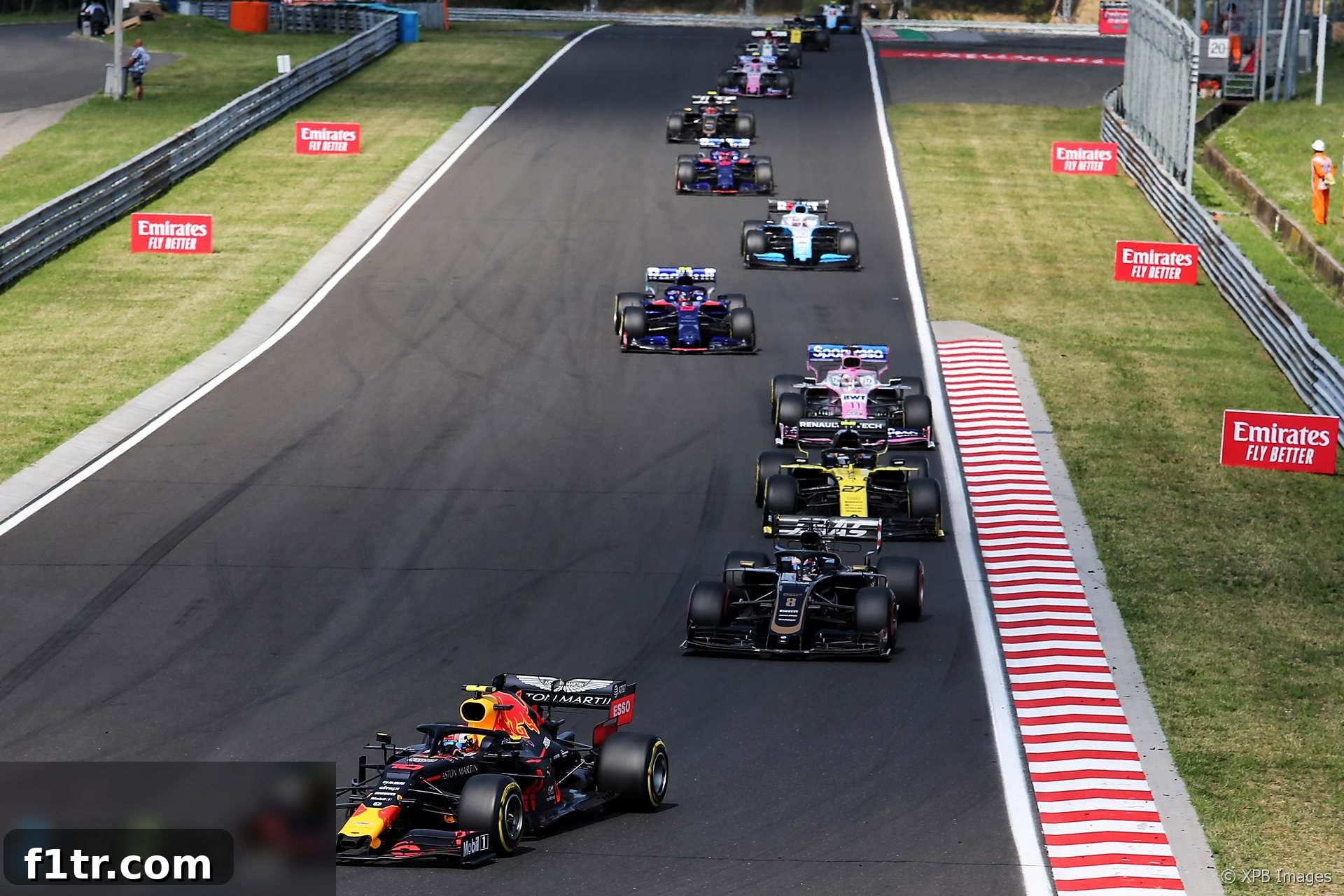
In the high-stakes world of Formula 1, where every tenth of a second and every championship point is meticulously fought for, the performance of both drivers in a top team is paramount. Following the 2019 Hungarian Grand Prix, Red Bull Racing Team Principal Christian Horner made it unequivocally clear that the team “desperately” required an improvement in form from their French driver, Pierre Gasly. This stark assessment underscored the mounting pressure on Gasly, whose struggles to match the pace and consistency of his teammate, Max Verstappen, were becoming increasingly evident and impactful on Red Bull’s championship aspirations.
The Pressure Cooker: Pierre Gasly’s Red Bull Challenge Intensifies
Stepping into the senior Red Bull squad from its sister team, Toro Rosso (now AlphaTauri), had presented a significant step up for Pierre Gasly at the start of the 2019 season. The expectations were immense, not only to perform at the pinnacle of motorsport but also to support Max Verstappen in challenging the dominant Mercedes-AMG Petronas F1 Team and Scuderia Ferrari for victories and championship honours. However, the first half of the season had been fraught with challenges for Gasly, marked by a noticeable disparity in pace compared to Verstappen. This gap was not merely a matter of a few tenths; it often manifested as entire seconds per lap, leaving Gasly fighting in the midfield rather than at the front alongside his teammate.
The F1 paddock is a relentless environment, and the demands on a Red Bull driver are perhaps among the most intense. The team, known for its aggressive pursuit of performance and its history of promoting and demoting drivers swiftly, requires its talent to consistently deliver at the highest level. Horner’s direct comments after the Hungarian Grand Prix highlighted that Gasly’s current output was falling short of these critical expectations, signaling a crucial period for the young driver as the summer break approached.
Hungarian Grand Prix: A Stark Reality Check for Gasly
The Hungarian Grand Prix weekend served as a vivid illustration of the challenges Pierre Gasly was facing. While Max Verstappen delivered a stellar performance, battling Lewis Hamilton for the victory until the very end and showcasing the true potential of the Red Bull RB15 chassis, Gasly’s race unfolded far differently. He ultimately took the chequered flag in sixth position, a full lap down on his teammate, Verstappen. This outcome was particularly concerning for the team, as it meant Gasly was not only off the pace of the front-runners but also significantly behind the other Red Bull car on the same track and strategy.
Advert | Become a Supporter & go ad-free
Horner’s frustration was palpable when discussing Gasly’s performance. “It’s been a frustrating weekend for Pierre,” he stated, pointing out that Gasly’s start and first lap were subpar. The Red Bull Team Principal stressed the fundamental issue: “We shouldn’t be racing Saubers and McLarens. We need him to be racing Ferraris and Mercedes.” Gasly’s sixth-place finish saw him nestled between Carlos Sainz Jnr’s McLaren and Kimi Räikkönen’s Sauber-run Alfa Romeo – competitors that, from Red Bull’s perspective, their second driver should comfortably be out-performing. This sentiment highlights the chasm between where Gasly was performing and where Red Bull needed him to be to compete effectively against the sport’s other top-tier teams.
The act of being lapped by one’s own teammate is a particularly damning statistic in Formula 1, especially within a team that aspires to championship glory. It signifies a profound difference in speed, car comfort, and overall performance. For Red Bull, who had built a reputation on nurturing young talent and extracting maximum performance from their drivers, Gasly’s struggles presented a significant strategic and competitive handicap.
Tactical Limitations and the Crucial Constructors’ Championship Impact
Beyond the individual driver’s performance, Gasly’s difficulties had tangible and detrimental effects on Red Bull Racing’s overall team strategy and its standing in the Constructors’ Championship. A strong second driver is not merely a bonus; it’s a critical component of a championship-contending team. As Christian Horner elaborated, Gasly’s absence from the sharp end of the field severely limited the team’s tactical options during races. In a sport where strategy can often dictate outcomes, having two cars capable of running at the front provides immense flexibility – allowing for strategic pit stops, defensive maneuvers against rival teams, or even splitting strategies to cover different scenarios.
Advert | Become a RaceFans supporter andgo ad-ad-free
Horner articulated this perfectly when he noted, “The problem is he’s not in the mix at all. So it’s not like if Lewis [Hamilton] said he was going to come out, you know, behind him or anything like that. But today both Mercedes and Red Bull had ‘one-legged’ races with the teammates out of contention.” This ‘one-legged’ race scenario meant that Verstappen was left to fight single-handedly against two Mercedes cars, or against two Ferraris, severely diminishing Red Bull’s ability to mount a collective challenge. Without Gasly in a position to act as a strategic buffer or an attacking wingman, Verstappen’s efforts, no matter how heroic, were often isolated.
The impact on the Constructors’ Championship was equally, if not more, concerning. At the time, Red Bull found themselves 44 points behind second-placed Ferrari. A significant portion of this deficit could be directly attributed to the stark contrast in points scored by Red Bull’s two drivers. Max Verstappen had accumulated an impressive 181 points, consistently delivering podium finishes and a race win. In stark contrast, Pierre Gasly had managed a mere 63 points. This considerable disparity underscored how much the team was missing out on valuable points that could otherwise have seen them much closer to, or even ahead of, Ferrari.
“Obviously not having two cars running at the front does hurt us,” Horner confirmed. He further lamented the missed opportunity at the Hungarian Grand Prix specifically: “Particularly in the Constructors’ Championship where we’ve scored the same amount of points as Ferrari today at a track we should have taken more out of them.” Hungary, with its twisty layout, was generally considered a circuit that suited the Red Bull chassis well. To only match Ferrari’s points haul, rather than capitalize and extend their lead, was a bitter pill to swallow, amplifying the need for Gasly to perform at a higher level.
The Path Forward: Summer Break and Second Half Expectations
With the traditional Formula 1 summer break immediately following the Hungarian Grand Prix, Christian Horner identified this period as a critical juncture for Pierre Gasly. It presented a rare opportunity for the young driver to step away from the immediate pressures of race weekends and engage in deep self-reflection. Horner’s advice was clear: Gasly needed to “take some time out during the summer break, reflect on the first half of the season and take the lesson from that into the second half of the year.” This wasn’t merely a suggestion but a directive, underscoring the urgency of the situation. The break was meant to be a reset, a chance for Gasly to analyze his driving, his approach, and his mental state, and return with a renewed sense of purpose and improved performance.
The stakes for the remainder of the season were incredibly high, both for Gasly’s career and for Red Bull’s championship ambitions. “It is vital for us, if we’re to stand any chance of catching Ferrari, that we have him finishing further ahead,” Horner asserted. The message was unambiguous: Red Bull needed Gasly to consistently be in contention for podiums and strong points finishes, not just to pick up scraps in the midfield. His performance in the second half of the 2019 season would be under intense scrutiny, with every race becoming a de facto test of his ability to adapt, improve, and meet the exacting standards of a top Formula 1 team.
Red Bull’s Stance: Commitment vs. Performance Demands
Despite the very public concerns about Pierre Gasly’s performance, Christian Horner also provided clarity on the team’s immediate plans regarding their driver lineup. In the often-volatile world of driver contracts and team changes, speculation about Gasly’s future had been rife. However, Horner confirmed that Red Bull’s intention was to keep Gasly in the car until the end of the year. This statement offered a degree of stability and support, suggesting that the team was committed to giving Gasly the opportunity to turn his fortunes around, rather than making a knee-jerk decision.
Advert | Become a RaceFans supporter andgo ad-free
However, this commitment came with a significant caveat and an underlying demand: “But we desperately need to see him realising more of the potential of the car.” This phrase, “potential of the car,” is critical. It implies that Red Bull engineers and management believed the RB15 chassis was capable of significantly more than Gasly was currently extracting from it. It placed the onus squarely on Gasly to unlock that performance, suggesting that the tools were there, but the driver needed to maximize them. The message was clear: the team was offering its support, but Gasly ultimately held the key to his own future by needing to deliver results that matched the car’s capabilities and the team’s expectations. The second half of the 2019 season would therefore serve as a crucial crucible for Pierre Gasly, determining not only Red Bull’s final standing in the Constructors’ Championship but also the trajectory of his burgeoning Formula 1 career.
More from the 2019 F1 Season
- Crying in the Melbourne car park at 2019 grand prix was my career low – Ocon
- McLaren Racing reports reduced £71 million loss in 2019
- Kvyat: Hockenheim podium last year was “my biggest achievement” so far
- How the FIA’s new encrypted fuel flow meter targets Ferrari’s suspected ‘aliasing’ trick
- “He smashed my office door”: 23 must-see moments from ‘Drive to Survive’ season two
Browse all 2019 F1 season articles