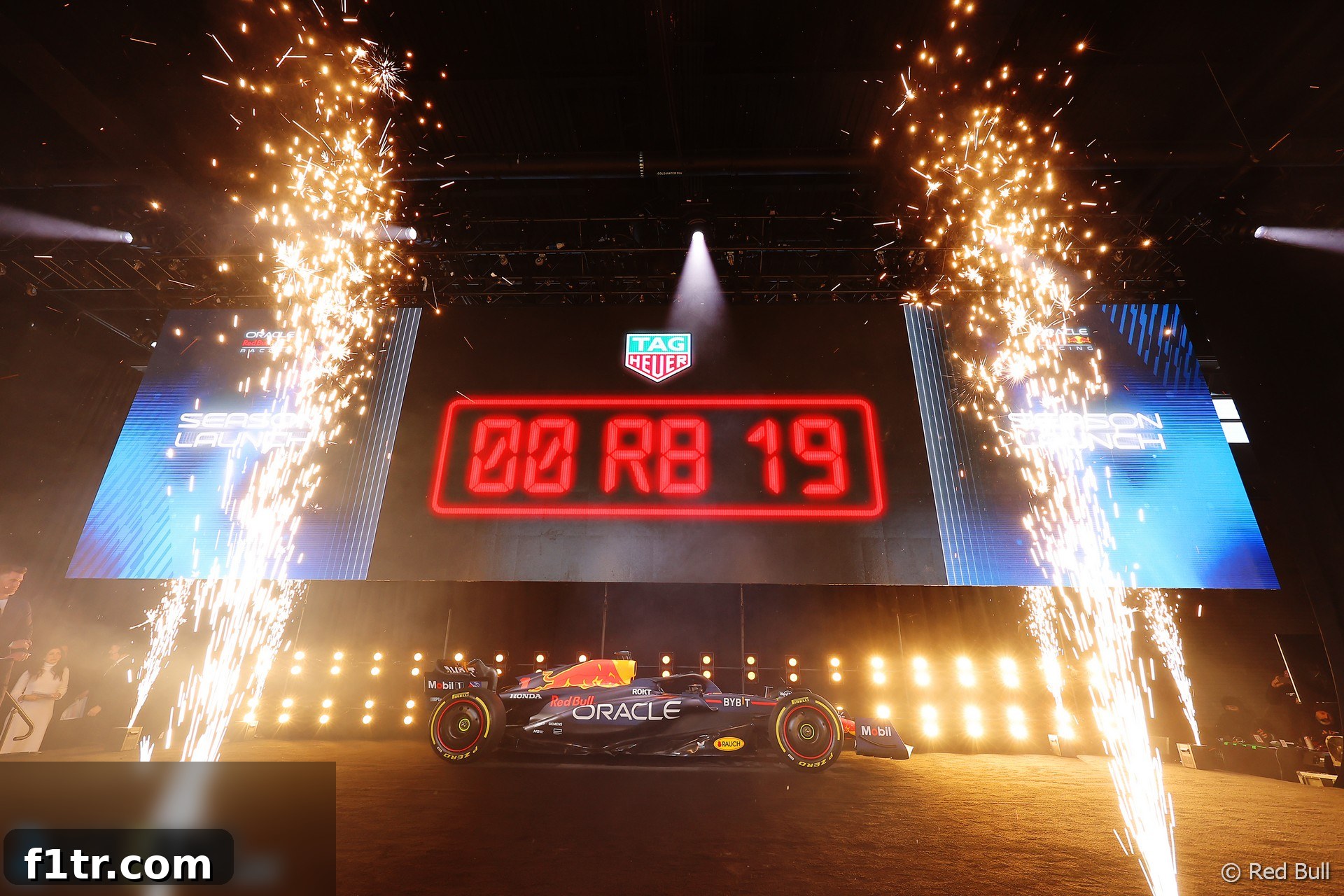
As the reigning two-time Formula 1 world champion, Max Verstappen finds himself in a familiar yet uniquely anticipated position: poised to defend his title for a third consecutive year. However, the exact machinery designed to propel him to that unprecedented achievement remains, for now, a closely guarded secret. Verstappen himself has yet to lay eyes on the genuine article – the Red Bull RB19, the car he hopes will conquer the 2023 F1 season.
The highly anticipated launch event for Red Bull Racing’s 2023 campaign, held in the vibrant setting of New York, showcased what the team referred to as the ‘RB19’. Yet, as is often the strategic practice in the cutthroat world of Formula 1, this public reveal was less about unveiling radical aerodynamic innovations and more about presenting the team’s striking new livery and robust commercial partnerships. Red Bull team principal Christian Horner made it clear: the true RB19, in its ultimate racing form, will emerge from the shadows only during the crucial pre-season testing, just weeks away.
The Art of the F1 Car Launch: Secrecy and Strategy
Formula 1 team launches have evolved significantly over the years, becoming elaborate spectacles designed to generate maximum buzz, satisfy sponsors, and rally the fanbase. Red Bull’s New York event perfectly exemplified this modern approach. While presented as the ‘RB19’, the car on display bore a strong resemblance to last year’s championship-winning design, the RB18. Keen observers and technical analysts quickly noted the absence of certain details mandated by the latest technical regulations, such as the enlarged wing mirrors, signaling that this was indeed a ‘show car’ rather than the definitive racing challenger.
This strategic decision to withhold the actual car is a common ploy among top F1 teams. The reasons are multifaceted:
- Competitive Secrecy: In a sport where marginal gains dictate success, revealing groundbreaking aerodynamic solutions too early can hand rivals valuable time to analyze and potentially replicate or counter those innovations. Teams prefer to keep their cards close to their chest until the very last moment.
- Continuous Development: F1 car development is a relentless process. The design presented at a launch event might still be undergoing significant revisions and upgrades right up until the final moments before pre-season testing, and even beyond, into the first races of the season.
- Marketing Focus: Launch events are often more about branding, sponsor activation, and reaching new markets. For Red Bull, launching in the US underscored their commitment to a rapidly growing F1 audience in North America, perfectly timed with their significant new partnership announcement.
Max Verstappen’s Unwavering Focus: Performance Over Aesthetics
Following the New York spectacle, Max Verstappen offered a refreshingly candid perspective that highlights his single-minded dedication to winning. “To be honest I haven’t seen it,” he told media, including RaceFans, referring to the actual RB19. “I’ve only spoken about the performance upgrades in terms of lap time of the car.”
This statement encapsulates the mindset of a true champion. For Verstappen, the aesthetics of the car are entirely secondary to its ultimate capability on track. “I haven’t seen any pictures or renderings because I’m not interested in these kind of things. I only want the fast car and it doesn’t matter how it looks like to me,” he asserted. This ‘form follows function’ philosophy is crucial in F1, where every millisecond counts, and visual appeal holds no sway over lap times.
Verstappen’s focus on “performance upgrades in terms of lap time” underscores the iterative and highly technical nature of F1 car development. Drivers are deeply involved in providing feedback on handling, balance, and overall feel, even if they aren’t privy to the specific aerodynamic shapes or mechanical components until much closer to the racing debut. Their input is vital in translating abstract engineering concepts into a tangible competitive advantage on the circuit.
Christian Horner’s Confirmation: The Real RB19 Awaits Bahrain
Echoing the sentiments of tactical secrecy, Red Bull team principal Christian Horner openly confirmed that the car displayed in New York was not the final version destined for the race track. “The car that was shown today obviously will be somewhat different when you see it in Bahrain,” he stated, leaving no room for doubt about the ‘show car’ status.
Horner elaborated on the true purpose of the high-profile launch: “Today was really about launching the team’s aspirations for the year ahead, the partners that we have and of course the exciting announcement with the Ford partnership. And to do it here in the US, in this market, is the first time obviously ever for Red Bull Racing.”
This clarification highlights the strategic priorities beyond raw technical revelation. The event served as a powerful platform to:
- Outline Season Aspirations: Set the tone for the 2023 campaign, reinforcing the team’s ambition for continued success.
- Showcase Partners: Provide invaluable exposure for existing and new sponsors, a critical aspect of F1’s commercial ecosystem.
- Announce Ford Partnership: This was arguably the most significant revelation of the day, signaling a major long-term strategic alliance for Red Bull Powertrains and the broader Red Bull brand.
- Capitalize on the US Market: With Formula 1’s soaring popularity in the United States, hosting the launch in New York was a masterstroke to engage American fans and potential future talent.
“So what you’ve seen today obviously isn’t a total reflection of what will hit the track in Bahrain in a couple of weeks’ time,” Horner concluded, setting the stage for the genuine unveiling at pre-season testing.
The Landmark Ford Partnership: A New Era for Red Bull
Beyond the car itself, the most impactful news from the New York launch was the official announcement of Red Bull’s partnership with Ford for the 2026 Formula 1 season and beyond. This collaboration sees Ford returning to Formula 1 after a long hiatus, aligning with Red Bull Powertrains to develop the next generation of hybrid power units under the sport’s new engine regulations.
This partnership is immensely significant for several reasons:
- Technological Synergy: Ford brings extensive expertise in engine development and electrification, which will be crucial for the 2026 regulations emphasizing sustainable fuels and increased electrical power.
- Brand Power: The union of Red Bull’s racing prowess and Ford’s global automotive reach creates a formidable commercial and sporting entity, promising significant marketing opportunities for both brands worldwide.
- Long-term Stability: Securing a major automotive partner like Ford provides Red Bull Powertrains with vital resources and technical backing as it transitions from its current Honda support to becoming a fully independent engine manufacturer.
- American Market Penetration: For F1’s continued growth in the US, the return of an iconic American manufacturer like Ford is a massive boost, enhancing the sport’s appeal to a domestic audience.
The Ford deal underscores Red Bull’s forward-thinking approach, not just for the upcoming season, but for the fundamental shift in powertrain technology expected in the middle of the decade. This strategic alliance positions Red Bull as a long-term powerhouse in Formula 1, capable of not only developing world-class chassis but also producing its own championship-contending power units.
Pre-Season Testing in Bahrain: The Crucible of Truth
The wait for the real RB19 will conclude when testing for the new season commences at the Bahrain International Circuit on February 23rd. This three-day session is an intensely critical period for all teams on the grid.
Pre-season testing is far more than just a shakedown; it’s a brutal reality check for months of meticulous design and development. Teams aim to achieve several crucial objectives:
- Reliability: The primary goal is to ensure the car can complete race distances without mechanical failures, stress-testing every component under race conditions.
- Data Collection: Engineers meticulously gather data on aerodynamics, tire wear, engine performance, and suspension setup, correlating real-world performance with simulator predictions.
- Understanding New Regulations: With evolving technical rules, teams must understand how their designs interact with the new parameters, identifying areas for improvement or potential non-compliance.
- Driver Familiarization: Drivers like Max Verstappen will spend extensive time in the cockpit, adapting to the new car’s characteristics, providing feedback, and building confidence.
- Performance Baselines: While outright lap times are often misleading during testing, teams establish internal performance baselines and get a preliminary sense of where they stand against competitors.
The shift to Bahrain for pre-season testing offers several advantages, including more consistent weather conditions compared to European venues and a track layout that provides a representative sample of various corner types. For Red Bull, it will be the ultimate proving ground for the RB19, where the car’s true potential will begin to unfurl, silently, away from the glitz of New York, but under the watchful eyes of their rivals.
The Road to a Third Consecutive World Championship
For Max Verstappen, the prospect of a third consecutive world championship is a monumental challenge and a historic opportunity. While the RB19’s true form remains unseen, the expectation is that Red Bull, under the masterful guidance of Adrian Newey and his technical team, will once again deliver a formidable package.
Verstappen’s unwavering confidence and relentless pursuit of performance will be key. His preference for a “fast car” above all else perfectly aligns with the competitive ethos of Formula 1. The journey to another title begins not with a grand reveal, but with the quiet, diligent work in the garage, the rigorous analysis of data, and the relentless pursuit of perfection that will unfold in Bahrain.
The F1 world waits with bated breath. Will the real RB19 be another dominant machine, or will the field close up? Only the track, starting in Bahrain, will provide the definitive answers.
Bringing Independent F1 Insights From the Source
RaceFans is dedicated to providing its readers with authentic, independent insights and news directly from the heart of Formula 1. This commitment to original journalism is made possible, in part, by the invaluable support of our RaceFans Supporters.
By contributing a modest amount, such as £1 per month or £12 per year (or the equivalent in your local currency), you play a crucial role in funding the essential work behind creating unique content. Your contributions directly cover the costs involved in travelling to races, extensive writing and research, content creation, website hosting, maintaining contact with key figures, and ongoing development.
For over a decade, our readers have proudly supported our mission. If you appreciate our independent coverage and in-depth analysis of Formula 1, please consider joining our community of RaceFans Supporters today. As an added benefit, all our Supporters enjoy an ad-free browsing experience across the site. Learn more or sign up via the links below:
- Become a RaceFans Supporter
- RaceFans Supporter FAQ
Explore More on the 2023 F1 Season
- FIA president cleared of alleged interference in two 2023 races
- First week viewing figures for new Drive to Survive season fall again
- Max who? Drive to Survive season six prefers its favourite faces
- RaceFans’ complete 2023 season review
- The F1 drivers who pulled off the 10 biggest charges through the field in 2023
Browse all 2023 F1 season articles