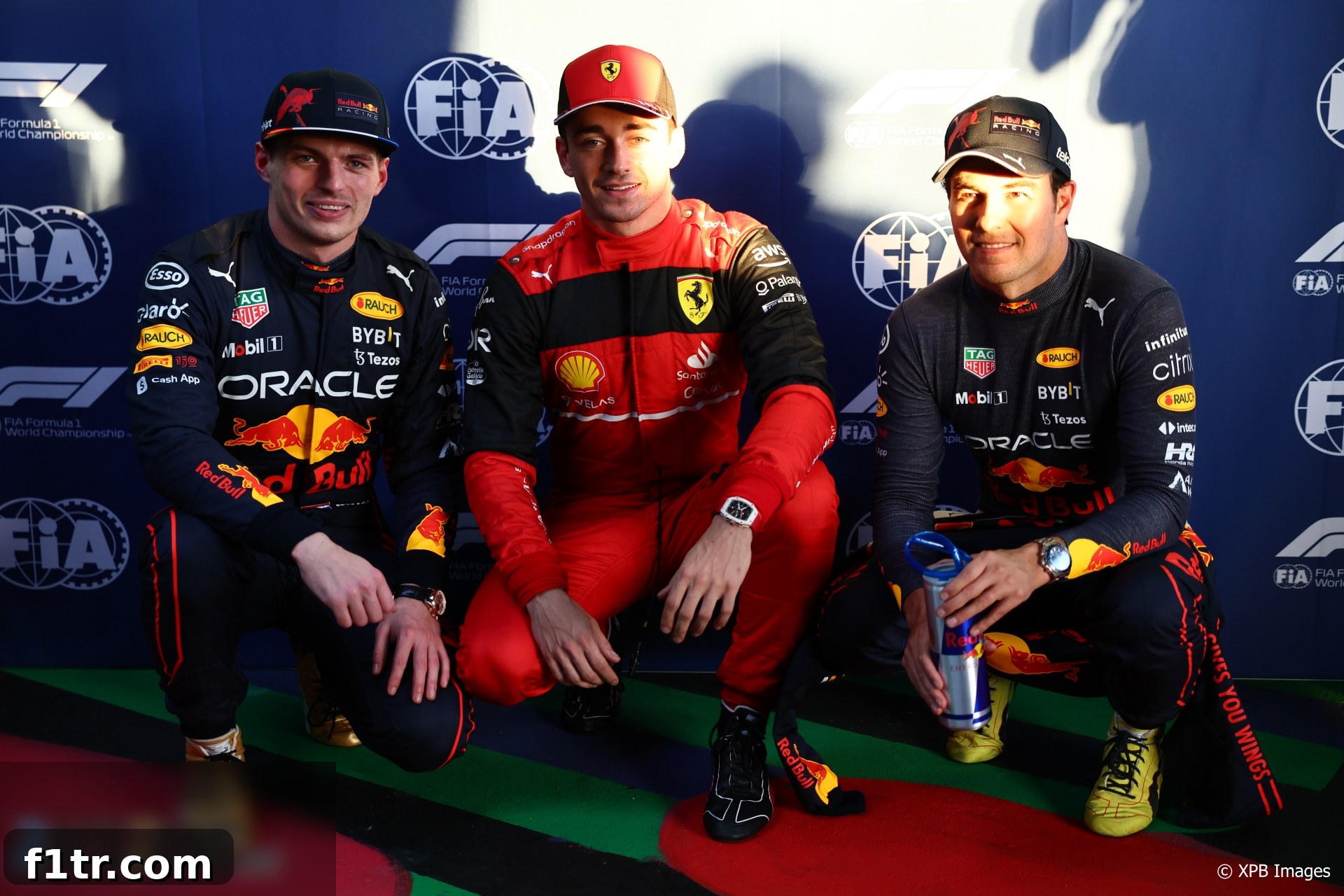
For the third race of the thrilling 2022 Formula 1 season, the iconic Albert Park Circuit in Melbourne sets the stage for what promises to be another gripping encounter. As the grid forms for the Australian Grand Prix, Charles Leclerc and Max Verstappen once again command the front row, reigniting their fierce rivalry that has defined the early stages of this championship. This marks the second time in three races that these two titans of the sport will start side-by-side, each hungry for victory.
Leclerc, piloting his formidable Ferrari F1-75, secured a dominant pole position, establishing a significant lead of almost three tenths of a second over Verstappen. In the intensely competitive 2022 season, such a margin is a testament to Ferrari’s raw pace and Leclerc’s exceptional skill. However, the Monegasque driver faces a formidable strategic challenge: while he stands alone on the front row for Ferrari, the Red Bull Racing team has strategically placed both of its cars within the top three. Verstappen starts P2, with his teammate Sergio Perez lining up directly behind him in P3. This numerical advantage for Red Bull could prove pivotal over the 58 laps of Albert Park, forcing Leclerc into what could be his third consecutive race battling prolonged assaults from the reigning world champion.
“It would have been easier for us to have both cars in the front,” Leclerc candidly admitted after a demanding qualifying session. “But it’s the way it is, and we’ll try to maximize it anyway.” His statement underscores the strategic dilemma Ferrari faces, with the absence of his teammate, Carlos Sainz Jnr, from the leading pack amplifying the pressure on Leclerc to fend off a concerted Red Bull attack.
Carlos Sainz’s Uphill Climb: A Critical Test for Ferrari and F1’s New Era
The Australian Grand Prix presented a stark contrast in fortunes for the two Ferrari drivers. While Leclerc soared to pole, Carlos Sainz endured a frustrating qualifying session, managing only ninth place on the grid. After what was arguably his most promising Friday and Saturday morning of the young season, Sainz did not hide his disappointment. A mistake during his crucial Q3 lap saw him lose time, plummeting him down the order from a potential front-row contender to the middle of the pack.
Sainz’s compromised starting position sets up a compelling subplot for the race. With a race-winning Ferrari relegated to the midfield, his charge through the field will serve as an “acid test” for both the new 2022 technical regulations and the extensive modifications to the Albert Park circuit. The 2022 regulations were designed to facilitate closer racing and easier overtaking, primarily through ground-effect aerodynamics that reduce turbulent air for following cars. Albert Park itself has undergone significant changes, featuring reprofiled corners and a new layout intended to create more overtaking opportunities.
This year, with cars theoretically easier to follow, a much faster circuit, and the initial plan for multiple DRS zones, the Ferrari F1-75 should have far greater opportunities than ever before to pick off cars ahead on track. However, even with these enhancements, Sainz remains cautiously optimistic about his ability to slice through the field. “I’ll obviously try to recover as much as possible, but without the fourth DRS zone, the circuit hasn’t changed that much from the old one, and it will be tricky to overtake,” Sainz remarked. The late decision to remove one of the planned DRS zones, located between turns eight and nine, could indeed complicate his recovery drive, making the task of gaining positions more challenging than initially anticipated.
Red Bull’s Strategic Advantage: Strength in Numbers
While Carlos Sainz focuses on damage limitation and a recovery drive, Charles Leclerc will likely spend a significant portion of tomorrow’s race monitoring his mirrors. With Sergio Perez starting P3, Red Bull possesses a crucial strategic advantage: two cars at the sharp end of the grid against Ferrari’s lone front-runner. This “strength in numbers” could allow Red Bull to deploy diverse strategies, putting immense pressure on Leclerc and forcing Ferrari to react rather than dictate terms.
Red Bull’s top speed potential, consistently demonstrated by Perez’s presence among the top names in the speed trap rankings across all three sectors, is a particular concern for Ferrari. Ferrari racing director Laurent Mekies acknowledged the formidable challenge ahead: “The threat is maximum tomorrow with Red Bull. They have been as fast as us all weekend – sometimes they have been faster in some situations, sometimes we have been faster.” This evenly matched pace, combined with Red Bull’s strategic flexibility, suggests Leclerc is in for a long and demanding day. Mekies further elaborated, “So it’s going to be as intense as one can imagine – not only between Max and Charles, but I’m sure also with Sergio and hopefully Carlos will be getting back in the fight. So there could be a lot of surprises tomorrow. It can go either way based on how the race goes.” This highlights Ferrari’s awareness of the multi-pronged assault they face, hoping Sainz can quickly re-enter the battle to support Leclerc.
Tyre Strategy and the Shadow of the Safety Car
The strategic landscape of the 2022 Australian Grand Prix is further shaped by tyre choices and the ever-present threat of a Safety Car. For the second race weekend in a row, the soft tyre compound may play a minimal role in the race strategy, thanks in part to the elimination of the Q2 tyre rule for this season. This rule change grants teams greater flexibility, allowing drivers to start the race on any compound they choose, rather than being mandated to start on the tyre used to set their fastest Q2 time.
Pirelli head of motorsport Mario Isola is confident that teams will again predominantly prefer the medium and hard compounds. “What we have seen so far in qualifying shows that it was the right choice to come here with two steps between the soft and the medium compounds, which has enabled the performance gaps between hard, medium and soft to be about equal,” Isola explained. This suggests a balanced tyre allocation, favoring durability and consistent performance over outright speed for longer stints.
The most obvious route to the finish would be a one-stop strategy, starting on the medium compound and then switching to the hards to complete the remaining laps. This approach mirrors what Max Verstappen and Charles Leclerc, along with indeed all of the top eight finishers, successfully executed in Saudi Arabia. However, a one-stop race at a street circuit like Albert Park carries inherent risks. As Sergio Perez’s unfortunately timed pit stop in Jeddah demonstrated, there’s a significant risk of being caught out by a sudden Safety Car period. Such an incident could severely compromise a driver’s race, particularly if they have already made their single stop. This elevated risk might encourage some teams to extend their first stint as long as possible, hoping to benefit from a late Safety Car or to simply have more strategic options available.
The Safety Car risk is especially high at a demanding street circuit like Albert Park, and likely even more so with the new generation of 2022 cars. These cars, while designed for closer racing, are also reportedly more challenging to drive at the limit. As Lando Norris noted on Friday, it’s “pretty easy to make mistakes” in the 2022 cars. With cars potentially running closer together than ever before in Melbourne, all it takes is one poorly judged move or a minor error to trigger an incident that transforms the entire race, bringing out the Safety Car and shuffling the strategic deck.
Sergio Perez: Red Bull’s Key Strategic Weapon
The strategic importance of Sergio Perez for Red Bull cannot be overstated. If the battle at the front indeed unfolds as a direct confrontation between the season’s two race winners, Charles Leclerc and Max Verstappen, then Perez could emerge as a decisive weapon for his team. By running an alternate strategy to Ferrari’s lead car, and potentially even to his own teammate, Red Bull could significantly enhance their chances of capitalizing on unforeseen race developments or simply exploiting Ferrari’s potential inability to cover off two different strategic plays simultaneously, especially with Sainz needing to recover from further back.
Perez’s strong pace, particularly his impressive top speed as evidenced in the speed traps, positions him perfectly to either attack Leclerc directly or act as a defensive barrier against any cars attempting to undercut Verstappen. His role will be to provide strategic depth, either by holding up Leclerc, forcing Ferrari into an early pit stop, or extending his own stint to react to a Safety Car. This dual threat from Red Bull is a luxury Ferrari currently lacks at the very front of the grid.
Max Verstappen’s Confidence: Taming the RB18 for Race Day
Despite a qualifying session where he acknowledged not feeling entirely comfortable with the balance of his RB18, Max Verstappen appears notably confident about his car’s performance for the race. The reigning world champion has been battling with the car’s handling throughout the weekend, but he believes the RB18 will exhibit greater consistency and predictability in race conditions.
“Normally in the race, the car stabilises a bit more, and it’s not so peaky, compared to finding the grip in qualifying,” Verstappen explained. This suggests a setup philosophy from Red Bull that prioritizes race pace and tyre management over single-lap qualifying heroics. He further added, “So, it naturally should be a little bit better. And I think my long run yesterday looked quite good in terms of how I felt. So hopefully, it will be the same tomorrow.” Verstappen’s optimism, stemming from promising long-run data, indicates that the battle for victory on Sunday will be fiercely contested, with Red Bull likely to challenge Ferrari’s front-running pace throughout the Grand Prix.
2022 Australian Grand Prix: Key Storylines and Predictions
The 2022 Australian Grand Prix is perfectly poised for a strategic thriller. The primary narrative revolves around Charles Leclerc’s solo defense against the dual Red Bull assault of Max Verstappen and Sergio Perez. Can Leclerc maintain his qualifying dominance over a full race distance, or will Red Bull’s numerical advantage and strategic flexibility prove too potent?
Equally compelling is the recovery mission of Carlos Sainz. His ability to navigate the midfield and rejoin the fight at the front will be a crucial factor in Ferrari’s overall team performance and could dictate whether they can truly challenge Red Bull’s strategic options. The circuit modifications and new regulations promise improved overtaking, but Sainz’s cautious stance reminds us that it won’t be a straightforward charge.
Furthermore, the ever-present risk of a Safety Car at Albert Park looms large, threatening to upend even the most meticulously planned strategies. Tyre degradation, pit stop timing, and driver errors in the unforgiving 2022 cars will all play their part in what could be an unpredictable and exhilarating race.
Will Red Bull deny Leclerc a victory, just as they did in Saudi Arabia? How far can Carlos Sainz and Fernando Alonso (who starts from the fifth row after a strong Q2 but no Q3 time) climb through the field? The answers await on race day.
Qualifying Times in Full
| Driver | Car | Q1 | Q2 (vs Q1) | Q3 (vs Q2) | |
| 1 | Charles Leclerc | Ferrari | 1’18.881 | 1’18.606 (-0.275) | 1’17.868 (-0.738) |
| 2 | Max Verstappen | Red Bull | 1’18.580 | 1’18.611 (+0.031) | 1’18.154 (-0.457) |
| 3 | Sergio Perez | Red Bull | 1’18.834 | 1’18.340 (-0.494) | 1’18.240 (-0.100) |
| 4 | Lando Norris | McLaren | 1’19.280 | 1’19.066 (-0.214) | 1’18.703 (-0.363) |
| 5 | Lewis Hamilton | Mercedes | 1’19.401 | 1’19.106 (-0.295) | 1’18.825 (-0.281) |
| 6 | George Russell | Mercedes | 1’19.405 | 1’19.076 (-0.329) | 1’18.933 (-0.143) |
| 7 | Daniel Ricciardo | McLaren | 1’19.665 | 1’19.130 (-0.535) | 1’19.032 (-0.098) |
| 8 | Esteban Ocon | Alpine | 1’19.605 | 1’19.136 (-0.469) | 1’19.061 (-0.075) |
| 9 | Carlos Sainz Jnr | Ferrari | 1’18.983 | 1’18.469 (-0.514) | 1’19.408 (+0.939) |
| 10 | Fernando Alonso | Alpine | 1’19.192 | 1’18.815 (-0.377) | |
| 11 | Pierre Gasly | AlphaTauri | 1’19.580 | 1’19.226 (-0.354) | |
| 12 | Valtteri Bottas | Alfa Romeo | 1’19.251 | 1’19.410 (+0.159) | |
| 13 | Yuki Tsunoda | AlphaTauri | 1’19.742 | 1’19.424 (-0.318) | |
| 14 | Zhou Guanyu | Alfa Romeo | 1’19.910 | 1’20.155 (+0.245) | |
| 15 | Mick Schumacher | Haas | 1’20.104 | 1’20.465 (+0.361) | |
| 16 | Alexander Albon | Williams | 1’20.135 | ||
| 17 | Kevin Magnussen | Haas | 1’20.254 | ||
| 18 | Sebastian Vettel | Aston Martin | 1’21.149 | ||
| 19 | Nicholas Latifi | Williams | 1’21.372 | ||
| 20 | Lance Stroll | Aston Martin |
Sector times
| Driver | Sector 1 | Sector 2 | Sector 3 |
|---|---|---|---|
| Charles Leclerc | 26.740 (1) | 17.786 (5) | 33.342 (1) |
| Max Verstappen | 26.762 (2) | 17.782 (4) | 33.497 (3) |
| Sergio Perez | 26.845 (3) | 17.760 (2) | 33.480 (2) |
| Lando Norris | 27.047 (9) | 17.971 (8) | 33.665 (4) |
| Lewis Hamilton | 26.975 (7) | 18.000 (12) | 33.810 (6) |
| George Russell | 27.033 (8) | 17.985 (10) | 33.846 (9) |
| Daniel Ricciardo | 27.074 (10) | 17.981 (9) | 33.823 (7) |
| Esteban Ocon | 26.960 (6) | 17.919 (7) | 33.921 (10) |
| Carlos Sainz Jnr | 26.929 (5) | 17.772 (3) | 33.687 (5) |
| Fernando Alonso | 26.856 (4) | 17.753 (1) | 34.020 (11) |
| Pierre Gasly | 27.254 (13) | 18.049 (14) | 33.823 (7) |
| Valtteri Bottas | 27.129 (12) | 17.990 (11) | 34.039 (12) |
| Yuki Tsunoda | 27.079 (11) | 18.044 (13) | 34.247 (16) |
| Zhou Guanyu | 27.625 (17) | 18.112 (15) | 34.081 (13) |
| Mick Schumacher | 27.352 (14) | 18.258 (19) | 34.236 (15) |
| Kevin Magnussen | 27.822 (18) | 18.237 (18) | 34.097 (14) |
| Sebastian Vettel | 27.994 (19) | 18.148 (16) | 35.007 (18) |
| Nicholas Latifi | 27.536 (16) | 18.192 (17) | 35.461 (19) |
| Lance Stroll | 35.103 (20) | 20.806 (20) | 42.088 (20) |
| Alexander Albon | 27.401 (15) | 17.888 (6) | 34.582 (17) |
Speed trap
| Pos | Driver | Car | Engine | Speed (kph/mph) | Gap |
|---|---|---|---|---|---|
| 1 | Sergio Perez | Red Bull | Red Bull | 322.6 (200.5) | |
| 2 | Fernando Alonso | Alpine | Renault | 322.2 (200.2) | -0.4 |
| 3 | Max Verstappen | Red Bull | Red Bull | 320.6 (199.2) | -2.0 |
| 4 | Esteban Ocon | Alpine | Renault | 320.5 (199.1) | -2.1 |
| 5 | Lando Norris | McLaren | Mercedes | 319.5 (198.5) | -3.1 |
| 6 | Nicholas Latifi | Williams | Mercedes | 318.0 (197.6) | -4.6 |
| 7 | Yuki Tsunoda | AlphaTauri | Red Bull | 317.9 (197.5) | -4.7 |
| 8 | Alexander Albon | Williams | Mercedes | 317.7 (197.4) | -4.9 |
| 9 | George Russell | Mercedes | Mercedes | 316.9 (196.9) | -5.7 |
| 10 | Valtteri Bottas | Alfa Romeo | Ferrari | 316.4 (196.6) | -6.2 |
| 11 | Pierre Gasly | AlphaTauri | Red Bull | 316.0 (196.4) | -6.6 |
| 12 | Mick Schumacher | Haas | Ferrari | 316.0 (196.4) | -6.6 |
| 13 | Daniel Ricciardo | McLaren | Mercedes | 315.2 (195.9) | -7.4 |
| 14 | Lewis Hamilton | Mercedes | Mercedes | 315.1 (195.8) | -7.5 |
| 15 | Zhou Guanyu | Alfa Romeo | Ferrari | 314.4 (195.4) | -8.2 |
| 16 | Carlos Sainz Jnr | Ferrari | Ferrari | 314.1 (195.2) | -8.5 |
| 17 | Kevin Magnussen | Haas | Ferrari | 314.0 (195.1) | -8.6 |
| 18 | Charles Leclerc | Ferrari | Ferrari | 313.9 (195.0) | -8.7 |
| 19 | Sebastian Vettel | Aston Martin | Mercedes | 313.1 (194.6) | -9.5 |
| 20 | Lance Stroll | Aston Martin | Mercedes | 311.8 (193.7) | -10.8 |
2022 Australian Grand Prix
- Aston Martin’s porpoising “does not allow us to exploit the progress the guys have made”
- Wolff puts Mercedes’ odds of championship victory at “two to eight”
- FIA responds to Verstappen’s criticism of Safety Car performance
- “So this is the end of our race, I guess?” How Alonso’s luckless Australian GP unfolded
- Two-degree temperature rise led to Hamilton’s “difficult position” radio message
Browse all 2022 Australian Grand Prix articles