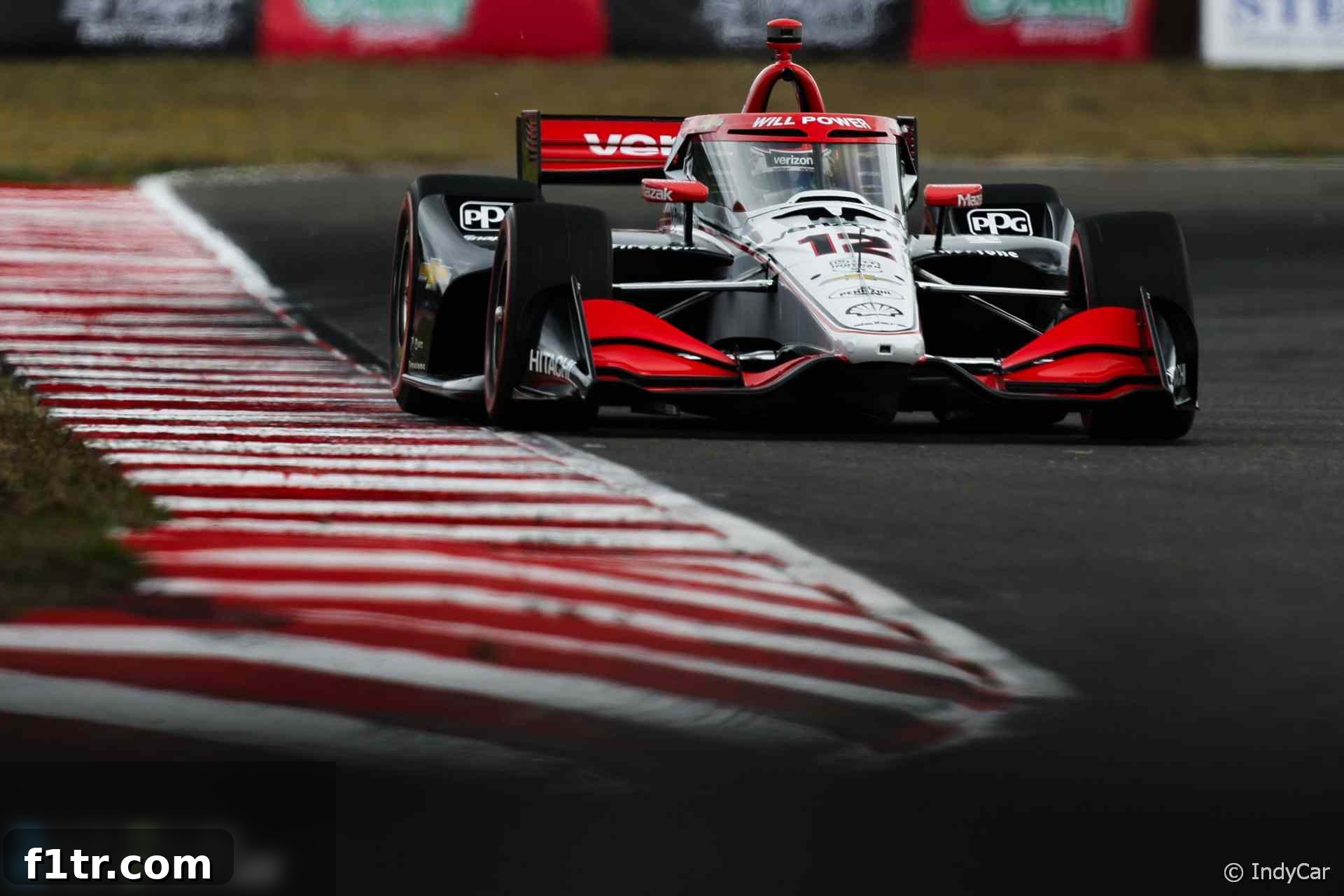
Will Power Dominates Grand Prix of Portland, Igniting Championship Fireworks
Will Power showcased a masterclass performance at the Grand Prix of Portland, securing his third NTT IndyCar Series victory of the season. His dominant run saw him cross the finish line almost ten seconds ahead of championship leader Alex Palou, effectively setting the stage for a thrilling conclusion to the season with just three oval races remaining.
The Australian veteran’s win was not merely a display of speed but also strategic brilliance and unwavering control, solidifying his position as a formidable contender for the overall championship title. Power’s victory at Portland International Raceway added another significant chapter to an already exciting IndyCar season, underscoring the fierce competition at the top.
A Masterclass Victory: Power’s Untouchable Performance from the Start
The race began with immediate drama as Will Power, starting from pole, made a decisive move on Santino Ferrucci into the first corner. The two drivers, representing Penske and its technical partner Foyt respectively, made slight contact at the inside of turn two. What made this opening skirmish particularly intriguing was Ferrucci’s candid post-race admission: he had openly discussed his race start intentions with Power beforehand.
“I told Will where I was going to go and I’d try, if I got the jump and I could get in front of him, I would, and I would kind of string him along and pull him down into turn one,” Ferrucci explained. “He was going to go up the inside and just block and give me into two. I don’t think he expected me to brake as early as I did and I definitely didn’t mean to either.” This unusual pre-race strategy conversation, while perhaps not fully executed as Ferrucci intended, highlighted the tactical intricacies and driver relationships within the paddock.
From that initial exchange, Power asserted his authority and was never seriously threatened throughout the 110-lap contest. He demonstrated remarkable pace and consistency, pulling away from the chasing pack with every lap. His ability to maintain such a significant lead under various conditions, including a single early caution period, underscored his complete command of the race. The veteran driver skillfully managed his tires and fuel, proving why he remains one of the sport’s most successful figures. This commanding performance was a testament to both his driving skill and Team Penske’s impeccable strategy, delivering a near-perfect race execution.
Championship Dynamics: Palou Strengthens Grip, Penske’s Double Podium
While Power celebrated his impressive victory, the underlying narrative of the championship battle continued to unfold. Alex Palou, the championship leader, drove a calculated and intelligent race to secure a crucial second-place finish. After navigating through the initial chaos and passing Santino Ferrucci on lap eight, Palou settled into a rhythm that allowed him to extend his points advantage heading into the season’s final three oval races. His strategic approach, prioritizing championship points over risky maneuvers, was evident throughout the event.
Josef Newgarden, Power’s teammate at Team Penske, completed a fantastic day for the Chevrolet-powered squad by finishing third, some 13 seconds behind Palou. This double podium finish for Penske not only boosted their constructors’ championship aspirations but also underscored their formidable presence at the front of the IndyCar grid. Newgarden’s consistent performance keeps him within striking distance of the leaders, ensuring that the championship fight remains a multi-driver affair.
The points standings now show Palou with an increased lead, maintaining a comfortable but not insurmountable gap as the series heads towards its traditional oval showdowns. Power’s win propelled him to second in the standings, 54 points adrift of Palou, transforming the championship into a two-horse race with outside chances for others. Colton Herta sits third, 13 points behind Power, while Scott McLaughlin’s hopes took a hit after a challenging weekend. The final three races, all on challenging oval circuits, promise a thrilling climax to the season, where strategy, car setup, and nerves of steel will be paramount.
Controversies and Costly Errors: The Race’s Defining Incidents
The Grand Prix of Portland was not without its moments of controversy and driver misfortune, adding layers of drama to an already eventful race.
Herta’s Hybrid Hiccup and Unprecedented Penalty
Colton Herta’s fourth-place finish came with a dose of good fortune and an unusual penalty. During his final pit stop, Herta’s engine stalled. In a moment of quick thinking, he used his car’s hybrid system to restart it in the pit lane. IndyCar regulations explicitly forbid the use of the hybrid system for engine restarts in the pit lane, a rule designed to prevent gaining an unfair advantage. Race control’s response to this new violation was unexpected: instead of a typical time penalty or drive-through, Herta was instructed to allow the lapped Pietro Fittipaldi to repass him. This unique ruling sparked considerable discussion among fans and pundits about its fairness and proportionality, especially given that Herta narrowly held onto fourth place, just under a second ahead of Marcus Armstrong.
Dixon’s Early Retirement and Championship Heartbreak
Perhaps the most significant incident in terms of championship implications was Scott Dixon’s first-lap retirement. The Ganassi driver’s hopes of a seventh championship took a severe blow after a chaotic sequence of events at the start. Kyle Kirkwood initiated the drama by diving past Dixon at turn seven, forcing Dixon onto the grass. As Dixon attempted to rejoin the track, Pietro Fittipaldi, aggressively trying to pass, rode the exit kerb at turn eight. The ensuing contact sent Dixon’s car into the barrier, ending his race prematurely. Race control correctly penalized Fittipaldi for the incident, but the damage to Dixon’s championship aspirations was already done. Now 101 points behind his teammate Alex Palou, Dixon faces an almost impossible task to recover in the remaining races.
Grosjean’s Misfortune and Other Penalties
The race also saw a significant setback for Juncos Hollinger Racing and their driver Romain Grosjean. On lap 62, while running in a promising fifth position, Grosjean spun away his chances at the same turn one corner that had claimed others. His hasty rejoin attempt led to contact with Christian Rasmussen, resulting in a puncture and, subsequently, a penalty from race control. Grosjean ultimately finished a disappointing 27th, ahead of only the retired Dixon. Pietro Fittipaldi, in addition to his early incident with Dixon, received a second penalty later in the race for knocking Conor Daly into a spin at turn one, highlighting a particularly challenging day for the RLL driver.
Varied Fortunes Across the Grid: Notable Performances and Struggles
Beyond the podium finishers and incident makers, the Grand Prix of Portland offered a diverse narrative of performances across the IndyCar field.
Santino Ferrucci, who started from a surprising pole position, gradually slipped down the order after his initial tussle with Will Power. Despite his strong qualifying, he finished the race in eighth place, nearly 45 seconds adrift of the winner. While a top-ten finish from pole might seem disappointing, it still represents a solid points haul for the Foyt team and a demonstration of their potential.
Further up the field, Marcus Armstrong and Marcus Ericsson delivered commendable drives. Armstrong finished fifth, closely trailing Colton Herta, showcasing consistent pace and effective race management. Ericsson, starting from tenth on the grid, steadily worked his way through the field to secure a strong sixth-place finish, adding valuable points to his campaign.
Scott McLaughlin’s championship aspirations took a hit even before the race began due to a poor qualifying session that left him starting 20th. However, the Penske driver managed to limit the damage by fighting his way up to seventh place, a testament to his resilience and car performance. This recovery was crucial in keeping his slim championship hopes alive, even as Palou extended his lead.
Conversely, McLaren endured a weekend to forget. Despite their considerable resources and talent, poor qualifying performances translated into a challenging race day for all their drivers. Alexander Rossi could only manage 12th place, behind Rinus Veekay, while Pato O’Ward finished 15th, and rookie Nolan Siegel came in 21st. The team will undoubtedly be reviewing their strategy and setup from this event as they look to rebound in the remaining races.
Graham Rahal and Kyle Kirkwood rounded out the top 10, each securing valuable points for their respective teams in a race that saw a significant spread in performance across the grid.
Race Statistics and Final Standings
The Grand Prix of Portland was characterized by intense competition and strategic depth, with only a single caution period early in the race. This allowed for long green-flag runs, favoring drivers who could maintain consistent pace and manage their resources effectively. Will Power’s dominant victory, coupled with Alex Palou’s strong second-place finish, has dramatically reshaped the championship narrative as the series heads towards its climactic oval events. The stage is now set for a thrilling battle for the NTT IndyCar Series title.
Race Result: Grand Prix of Portland
| P. | No. | Driver | Team | Engine |
|---|---|---|---|---|
| 1 | 12 | Will Power | Penske | Chevrolet |
| 2 | 10 | Alex Palou | Ganassi | Honda |
| 3 | 2 | Josef Newgarden | Penske | Chevrolet |
| 4 | 21 | Colton Herta | Andretti/Curb-Agajanian | Honda |
| 5 | 11 | Marcus Armstrong | Ganassi | Honda |
| 6 | 23 | Marcus Ericsson | Andretti | Honda |
| 7 | 3 | Scott McLaughlin | Penske | Chevrolet |
| 8 | 13 | Santino Ferrucci | Foyt | Chevrolet |
| 9 | 14 | Graham Rahal | RLL | Honda |
| 10 | 22 | Kyle Kirkwood | Andretti | Honda |
| 11 | 18 | Rinus VeeKay | Carpenter | Chevrolet |
| 12 | 7 | Alexander Rossi | McLaren | Chevrolet |
| 13 | 27 | Christian Lundgaard | RLL | Honda |
| 14 | 29 | Felix Rosenqvist | Meyer Shank | Honda |
| 15 | 5 | Pato O’Ward | McLaren | Chevrolet |
| 16 | 4 | Kyffin Simpson | Ganassi | Honda |
| 17 | 28 | Toby Sowery | Coyne/WR | Honda |
| 18 | 26 | Sting Ray Robb | Foyt | Chevrolet |
| 19 | 34 | Juri Vips | RLL | Honda |
| 20 | 30 | David Malukas | Meyer Shank | Honda |
| 21 | 6 | Nolan Siegel | McLaren | Chevrolet |
| 22 | 20 | Conor Daly | DRR-Cusick | Chevrolet |
| 23 | 8 | Linus Lundqvist | Ganassi | Honda |
| 24 | 16 | Jack Harvey | Coyne | Honda |
| 25 | 24 | Pietro Fittipaldi | RLL | Honda |
| 26 | 25 | Christian Rasmussen | Carpenter | Chevrolet |
| 27 | 32 | Romain Grosjean | Juncos Hollinger | Chevrolet |
| 28 | 9 | Scott Dixon | Ganassi | Honda |
Related IndyCar Content
- IndyCar driver McLaughlin cleared of injury after crashing through barrier at Barber
- Schumacher says his IndyCar feels like ‘an F2 car, just with better tyres’
- IndyCar “way faster than Formula 1” in some corners, says Grosjean
- FIA to award more F1 superlicence points to IndyCar drivers from 2026
- Schumacher to race full-time in IndyCar with RLL in 2026
Browse all IndyCar articles