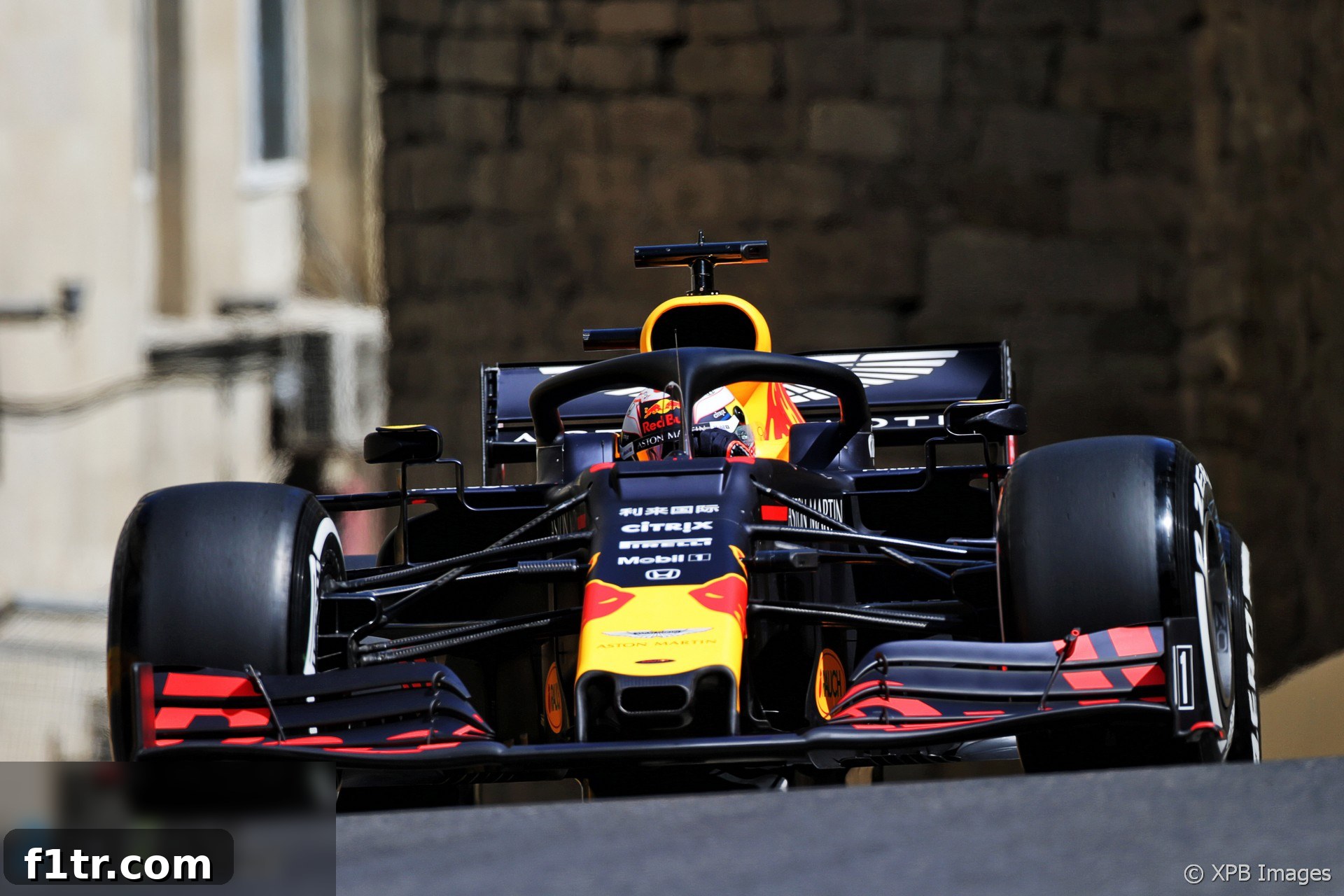
In the thrilling world of Formula 1, races are often decided by razor-thin margins and unpredictable circumstances. The 2019 Azerbaijan Grand Prix on the Baku City Circuit was no exception, delivering a compelling narrative of what-ifs for Red Bull Racing’s prodigious talent, Max Verstappen. The Dutch driver expressed significant frustration, claiming that a Virtual Safety Car (VSC) period, triggered by his then-teammate Pierre Gasly, robbed him of a genuine opportunity to challenge Sebastian Vettel for a podium finish.
Verstappen’s assertion sheds light on the critical role of race incidents and strategic nuances in F1, particularly concerning tyre management and track position. His journey towards the sharp end of the grid in Baku was a testament to his relentless pace and the strategic prowess of Red Bull, but ultimately, an external factor dictated his ceiling for the day.
Verstappen’s Podium Charge Halted by VSC
The incident in question occurred on lap 39 of the Azerbaijan Grand Prix. Pierre Gasly, driving the sister Red Bull RB15, was forced to retire due to a suspected driveshaft failure. This sudden stoppage necessitated the deployment of a Virtual Safety Car, a crucial measure designed to neutralize the race and ensure competitor safety during on-track incidents. For Max Verstappen, who had been meticulously closing the gap to Ferrari’s Sebastian Vettel, this VSC came at the most inopportune moment.
Prior to Gasly’s retirement, Verstappen had been in a strong rhythm, demonstrating exceptional pace and gradually eating into Vettel’s advantage. He had managed to slash a significant seven to eight seconds off the gap during that particular stint, positioning himself just over three seconds behind the four-time world champion. The momentum was clearly with Verstappen, and the prospect of a late-race charge for third place looked increasingly viable, promising a captivating conclusion to the Baku showdown.
The Critical Impact on Tyre Temperature and Performance
However, the VSC effectively brought Verstappen’s charge to an abrupt halt. As drivers are mandated to significantly reduce their speed under VSC conditions, the tyres cool down rapidly. In Formula 1, maintaining optimal tyre temperature is paramount for grip and performance. Any significant drop can render even the best compounds ineffective, turning a finely tuned racing machine into a sliding challenge.
“I was catching up seven, eight seconds over that stint so that was all good,” Verstappen reflected post-race. “But as soon as we got to the Virtual Safety Car I lost a lot of [tyre] temperature.” This loss of temperature proved to be the Achilles’ heel for Verstappen’s Red Bull. The intricate balance required to extract peak performance from Pirelli’s tyres was disrupted, and despite his best efforts, the car simply wasn’t the same thereafter.
Verstappen further elaborated on the team’s ongoing struggle with tyre sensitivity, a recurring theme for various teams on different circuits. “It seems like our car is maybe a bit more sensitive or we’re just not on top of the tyres. I don’t know otherwise we would of course fix that,” he admitted. This candid observation underscores the constant engineering challenge teams face in F1: understanding and mastering the complex thermodynamics of racing tyres across diverse track conditions and ambient temperatures.
Once the VSC period concluded and racing resumed, Verstappen found himself in a significantly compromised position. “It was a lot more difficult after that. We were just sliding around a lot and around here if you don’t have the grip you can’t take the speed into the corner and you lose a lot of lap time,” he explained. The Baku City Circuit, renowned for its long straights interspersed with tight, technical sections, demands absolute precision and maximum grip. Without the tyres operating in their optimal window, the crucial cornering speed necessary for competitive lap times simply wasn’t there.
Baku’s Unique Challenges and Tyre Management
The slippery nature of the Baku circuit itself often compounds tyre management issues. Its temporary street circuit characteristics, featuring varying asphalt surfaces and often dusty conditions, mean drivers are constantly battling for traction. For Red Bull, whose chassis typically excels in high-downforce, twisty sections, any loss of grip translates directly into a significant performance deficit, especially when competing against rivals like Ferrari and Mercedes known for their strong straight-line speed.
Verstappen acknowledged this particular aspect of the venue: “I think it’s just something on this track where it’s already very slippery. It seems like we are just not on top of it yet.” This statement highlights that while Red Bull continuously strives for improvement in tyre optimization, certain circuits present unique and persistent challenges. The fine line between understeer and oversteer, and the impact on tyre wear and temperature, becomes even more pronounced on tracks like Baku.
Ultimately, Verstappen crossed the finish line almost six seconds behind Sebastian Vettel, a stark contrast to the mere three-second gap he was closing in on before the VSC. “It was all looking good for us if there was no Virtual Safety Car,” he reiterated, a sentiment that undoubtedly resonated with the Red Bull pit wall. The incident served as a powerful reminder of how quickly fortunes can turn in Formula 1, and how a seemingly minor intervention can have profound race-altering consequences.
The Broader Implications for Red Bull in 2019
The 2019 season was a transitional one for Red Bull, as they embarked on their new partnership with Honda as their engine supplier. While the season saw flashes of brilliance, including Verstappen’s dominant victory in Austria, consistency in challenging Mercedes and Ferrari remained a key objective. Tyre management, a perennial puzzle in F1, was often a crucial factor in their performance fluctuations.
Incidents like the one in Baku underscore the immense pressure on teams to not only develop a fast car but also to understand and adapt its characteristics to every variable imaginable – from track surface and ambient temperature to the specific tyre compounds on offer each weekend. While a VSC is an external, uncontrollable event, a team’s ability to minimize its negative impact, such as rapidly reheating tyres post-VSC, can be a differentiator.
Max Verstappen, known for his relentless pursuit of perfection and his uncompromising driving style, rarely leaves anything on the table. His frustration in Baku was palpable because he genuinely believed a podium challenge was within reach. This incident, while unfortunate, provided Red Bull with valuable data and insight into their car’s tyre sensitivity and handling characteristics under varying conditions, fueling their continuous development efforts.
The 2019 Azerbaijan Grand Prix ultimately became a ‘what if’ race for Max Verstappen, a testament to the unpredictable drama of Formula 1. It showcased his determination, Red Bull’s potential, and the critical influence of factors beyond a driver’s immediate control. While the podium eluded him on that specific day, the lessons learned from such events contribute to the relentless pursuit of championship glory, pushing teams and drivers to constantly refine their strategies and understanding of the sport’s intricate technical challenges.
2019 F1 season: Related Articles
- Crying in the Melbourne car park at 2019 grand prix was my career low – Ocon
- McLaren Racing reports reduced £71 million loss in 2019
- Kvyat: Hockenheim podium last year was “my biggest achievement” so far
- How the FIA’s new encrypted fuel flow meter targets Ferrari’s suspected ‘aliasing’ trick
- “He smashed my office door”: 23 must-see moments from ‘Drive to Survive’ season two
Browse all 2019 F1 season articles