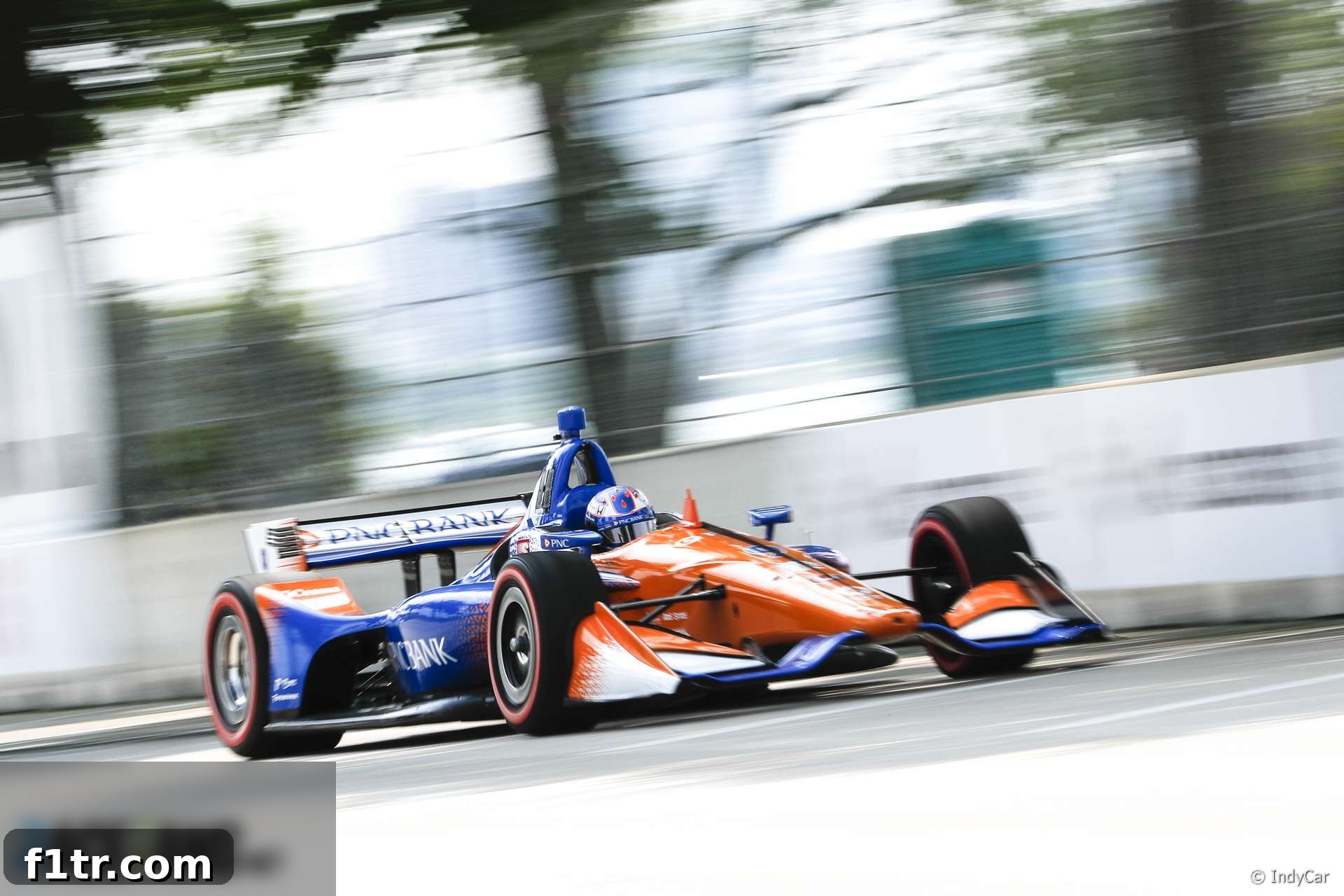
Scott Dixon Dominates Detroit: A Masterclass in IndyCar Strategy and Redemption
In a thrilling display of strategic brilliance and unwavering determination, Scott Dixon, the five-time NTT IndyCar Series champion, clinched his first victory of the 2019 season at the demanding Detroit Grand Prix on Sunday. The win represented a powerful redemption for the Chip Ganassi Racing driver, who had suffered a frustrating crash out of Saturday’s race on the unforgiving Belle Isle street circuit. Less than 24 hours later, Dixon transformed that disappointment into triumph, delivering a masterful performance that underscored his legendary status in open-wheel racing.
The Detroit Grand Prix, renowned for its challenging urban layout, tight corners, and proximity to concrete barriers, consistently delivers high-octane drama, and the Sunday event was no exception. Dixon’s path to victory was not merely a testament to raw speed but a meticulous execution of shrewd strategy, impeccable tire management, and a keen ability to capitalize on the chaotic unfolding of events that characterized the 70-lap contest.
Early Race Mayhem and Dixon’s Bold Gambit
The race began with immediate and significant drama, a recurring theme on the narrow confines of the Belle Isle street course. As the formidable field powered into Turn 3 on the very first lap, a multi-car incident erupted, instantly reshaping the race’s landscape. Patricio O’Ward, Tony Kanaan, and Simon Pagenaud found themselves entangled in the melee, their races brought to an abrupt halt. This early collision necessitated the deployment of the first full-course caution of the day and presented an immediate strategic crossroads for many teams, particularly those who had opted to start on the softer, alternate compound tires.
While a considerable portion of the grid, especially drivers on the more fragile alternate tires, opted to pit under the early caution to switch to the more durable primary compound, Scott Dixon and the Chip Ganassi Racing team made a bold and ultimately pivotal decision: they chose to stay out. This calculated gamble propelled Dixon to the front of the field, albeit with the caveat that he would have to manage his tires with surgical precision until the delicate rubber inevitably degraded. It was a quintessential Dixon move, showcasing his profound trust in his car control and his team’s strategic foresight to secure crucial track position from the outset.
Navigating the Cautions: Strategic Gains Amidst Chaos
Dixon’s hard-won early lead, however, was far from secure. The Belle Isle circuit continued to exert its unforgiving nature, claiming more victims and creating additional opportunities for strategic maneuvers. The initial caution period eventually concluded, only for another to be triggered shortly thereafter. This time, Spencer Pigot, another driver attempting to prolong his stint on the alternate tires, became involved in an unfortunate incident. As Pigot attempted to enter the pit lane, he was collected from behind by Sébastien Bourdais. The impact sent Pigot’s Carpenter Racing machine careening into the unyielding barrier that delineates the pit entrance from the main circuit, prompting yet another full-course caution.
These recurring cautions, though disrupting the race flow, consistently played into Dixon’s strategic advantage. Each yellow flag period allowed him to conserve vital fuel and mitigate tire degradation, effectively lessening the inherent disadvantage of his early tire choice. The ability to maintain track position through these intermittent periods of neutralization was paramount, as overtaking on the tight and twisty Detroit circuit is notoriously challenging.
Mid-Race Mayhem: The Dramatic Dance of Newgarden, Rossi, and Hinchcliffe
Following the sequence of early cautions, the race resumed with Santino Ferrucci temporarily at the head of the pack, closely pursued by Graham Rahal, and two formidable championship contenders who had started on the front row: Josef Newgarden and Alexander Rossi. The battle for supremacy intensified as Rahal’s pace began to wane, prompting Rossi to execute a strategic pit stop. Newgarden, ever vigilant to the threat posed by his rival, followed suit, managing to emerge from his pit stop just fractions of a second ahead of the Andretti Autosport driver, thus maintaining a critical advantage in their burgeoning championship duel.
However, the mid-race action dramatically escalated during James Hinchcliffe’s pit stop. Hinchcliffe, rejoining the track after his service, inadvertently emerged directly in front of Newgarden, forcing the reigning series champion to momentarily lift off the throttle to avert a collision. This brief check-up instantly brought Rossi right onto the tail of both drivers, setting the stage for an unforgettable sequence of events. As the trio hurtled into the challenging Turn 3, Rossi made an aggressive lunge down the inside of Newgarden but lost control, spinning wildly. In a desperate and evasive maneuver to avoid both Rossi and the slow-moving Hinchcliffe, Newgarden also spun. Miraculously, only Rossi’s car emerged relatively unscathed from the chaotic incident, while Newgarden’s race was significantly compromised by the lost time and track position. This dramatic clash immediately triggered yet another full-course caution, injecting a fresh layer of unpredictability into an already thrilling contest.
Dixon Regains Control as Power Stages a Remarkable Comeback
The numerous incidents and subsequent caution periods continued to play a pivotal role in shaping the race, enabling Scott Dixon to expertly regain the lead once the track was deemed clear for green flag racing. He now found himself once again at the forefront of the pack, with Marcus Ericsson, Takuma Sato, Ryan Hunter-Reay, and Marco Andretti trailing in his wake. While Dixon meticulously managed his lead, another compelling narrative unfolded further down the order: Will Power, who had been involved in the Lap 1 crash and even briefly came to a complete stop during the initial caution period, was staging an incredible comeback drive. The Penske driver showcased exceptional pace and aggressive, calculated driving, making an insurgent run through the field. He steadily climbed into the top three, positioning himself as a serious contender for a podium finish despite his early misfortunes.
A Red Flag Sets the Stage for a Grandstand Finish
Just as Scott Dixon appeared to be settling into a comfortable rhythm, seemingly on course for an uncontested run to the checkered flag, the Detroit Grand Prix delivered yet another unexpected twist. With only six laps remaining in the race, his Chip Ganassi Racing teammate, Felix Rosenqvist, spun and made contact with the Turn 1 barrier. Although the damage to Rosenqvist’s car was not severe, the incident was significant enough to necessitate the deployment of the red flags, temporarily halting the race. This critical decision was made to ensure the track could be cleared and deemed safe for a final, exhilarating dash to the finish line, setting up a thrilling three-lap shootout for ultimate victory.
The red flag period, while undoubtedly tense for all the drivers and teams, provided a brief opportunity for strategic regrouping and final preparations for the impending sprint. For Dixon, it meant focusing on executing a perfect restart to defend his lead. When the green flag finally dropped for the climactic final laps, Dixon demonstrated precisely why he is consistently ranked among the greatest drivers in IndyCar history. He executed a flawless restart, effortlessly pulling away from the chasing pack. Despite the immense pressure of a short, intense sprint to the finish, he commanded the remaining laps with absolute precision, expertly fending off any potential challenges to comfortably cross the finish line in first place.
Race Results: Dixon Triumphs, Ericsson and Power Impress with Podium Finishes
Scott Dixon’s dominant drive to the checkered flag culminated in his highly anticipated first victory of the 2019 NTT IndyCar Series season. It was a testament to his unparalleled experience, sharp strategic acumen, and formidable raw talent. Marcus Ericsson, in a truly impressive showing, secured a commendable second-place finish, marking a significant and career-best achievement for the rookie driver. Will Power completed his remarkable comeback by securing the final podium spot in third, a testament to his resilience, blistering pace, and ability to recover from an early race setback.
Ryan Hunter-Reay finished a solid fourth, leading a strong contingent of Andretti Autosport drivers who showcased consistent performance throughout the challenging race. His teammates Alexander Rossi, who demonstrated impressive recovery skills after his mid-race spin, secured fifth position, with Marco Andretti following closely in sixth. Graham Rahal battled hard throughout the demanding event to claim seventh place, just ahead of the fourth Andretti car of Zach Veach, who had started an promising third but struggled to maintain pace with the leaders in the latter half of the race. Sébastien Bourdais, despite his earlier involvement in the Pigot incident, managed to salvage a respectable ninth-place finish, showcasing his veteran skill and determination, while Santino Ferrucci rounded out the top ten after a competitive run.
Significance of the Victory: Momentum and Championship Aspirations
This victory for Scott Dixon was far more than just another race win on his illustrious resume; it was a profound statement of intent for the remainder of the 2019 NTT IndyCar Series season. Coming directly on the heels of a disappointing Saturday performance, Sunday’s triumph powerfully underscored Dixon’s incredible ability to bounce back from adversity and extract maximum performance when it truly matters most. The win provided a significant boost to his championship aspirations and injected invaluable momentum into the entire Chip Ganassi Racing team as they continued their campaign. The Belle Isle victory further solidified Dixon’s long-held reputation as “The Iceman,” a driver who can maintain unwavering composure and execute flawlessly under the most extreme pressure.
The Enduring Thrill of IndyCar Racing
The 2019 Detroit Grand Prix Sunday race will undoubtedly be remembered as a classic IndyCar encounter, rich with dramatic incidents, strategic masterstrokes, and a thoroughly deserving victor. It perfectly encapsulated everything that makes the NTT IndyCar Series so captivating: the thrilling blend of high-speed action, the unpredictable challenges of street circuit racing, and the sheer, unadulterated talent of its drivers. Scott Dixon’s compelling story of redemption served as a perfect illustration of why fans flock to witness the spectacle and excitement of open-wheel racing.
Explore More IndyCar Action
For more in-depth analysis, exclusive driver interviews, and the latest news from the exhilarating world of open-wheel racing, dive into our extensive archive of IndyCar articles:
- IndyCar driver McLaughlin cleared of injury after crashing through barrier at Barber
- Schumacher says his IndyCar feels like ‘an F2 car, just with better tyres’
- IndyCar “way faster than Formula 1” in some corners, says Grosjean
- FIA to award more F1 superlicence points to IndyCar drivers from 2026
- Schumacher to race full-time in IndyCar with RLL in 2026
Browse all IndyCar articles