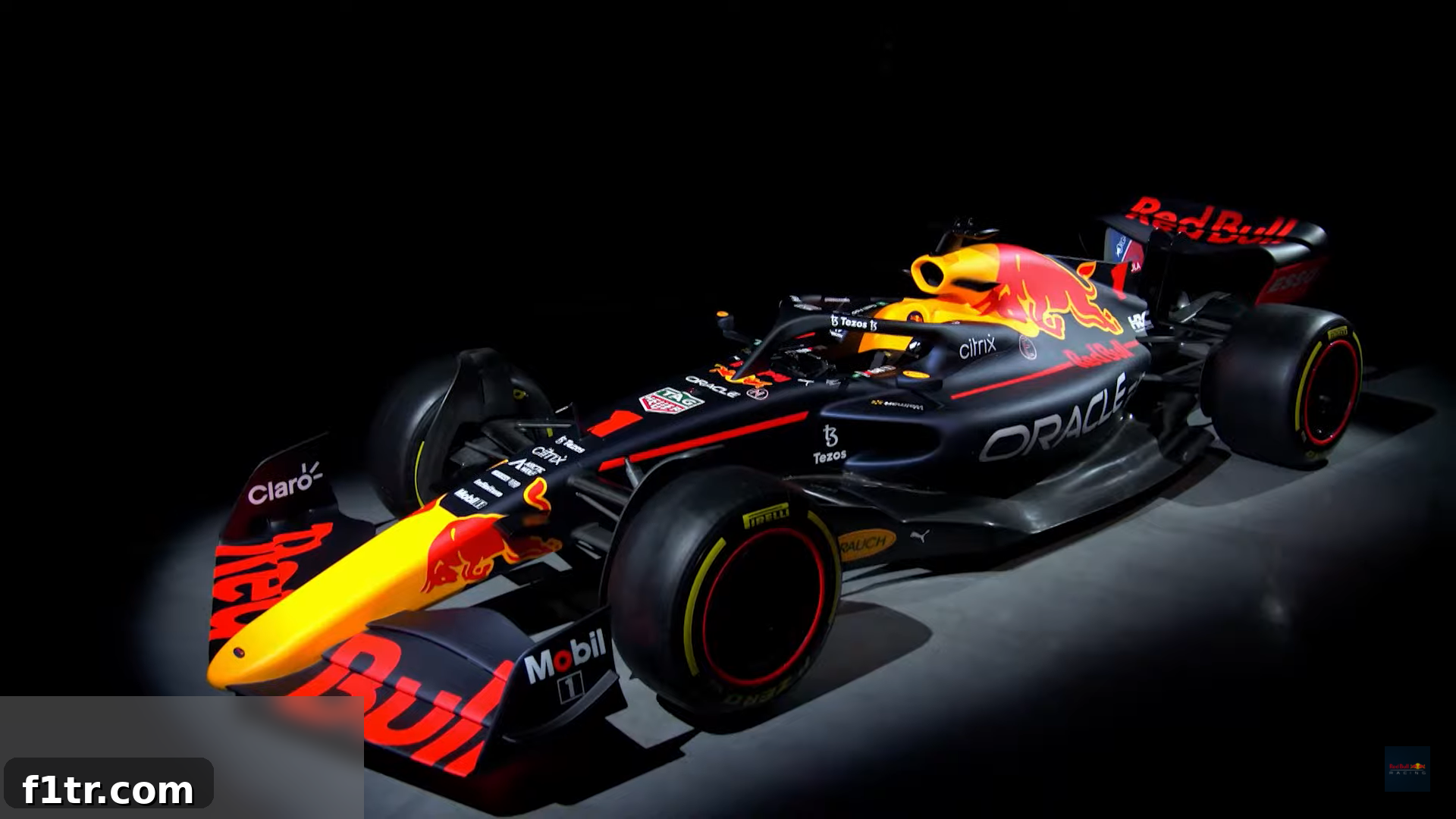
The dawn of a new era in Formula 1 racing, marked by the radical 2022 technical regulations, promised a significant shake-up in car design and performance. Among the most anticipated changes was a projected increase in top speeds, a prediction confidently made by Red Bull Racing’s technical director, Pierre Waché. He highlighted that the innovative approach to generating downforce would lead to a substantial reduction in aerodynamic drag, consequently unlocking higher straight-line velocities for the new generation of F1 cars.
The 2022 regulations represented arguably the most profound aerodynamic overhaul Formula 1 had witnessed in decades. Designers were granted the opportunity to extensively reintroduce and leverage the ‘ground effect’ phenomenon, a concept that had not been a primary design pillar in F1 since its prominent, yet controversial, heyday in the early 1980s. This shift away from complex front and rear wing designs towards underbody aerodynamics was a deliberate move to reshape the sport.
Adrian Newey, Red Bull’s revered chief technology officer, echoed the sentiment of a monumental transformation. He articulated the magnitude of the change, describing it as “a huge regulation change, the biggest one we’ve had since 1983, when the venturi [tunnel] cars were banned and flat bottomed cars introduced.” This historical context underscores the ambitious nature of the 2022 rulebook, which sought to bring back a sophisticated aerodynamic philosophy that had been shelved for safety and competitive reasons years ago.
The Resurgence of Ground Effect in Formula 1
Ground effect, at its core, is an aerodynamic principle where the proximity of a moving body (like an F1 car) to a fixed surface (the track) significantly influences its aerodynamic characteristics. In the context of the 2022 Formula 1 cars, this translates to designing the underbody with carefully sculpted venturi tunnels. These tunnels accelerate the airflow beneath the car, creating a low-pressure area that effectively sucks the car towards the ground. This suction generates massive amounts of downforce, crucial for high-speed cornering and stability, without relying heavily on large, drag-inducing wings.
Newey elaborated on the theoretical benefit of this ground effect design, particularly concerning its impact on the following cars. He explained, “The theory is that if you create a shape where, as the downforce is produced, that always kind of produces up-wash at the back of the car, so you get this kind of rooster tail coming up at the back.” This ‘rooster tail’ effect is critical. “However,” he continued, “if that then back fills or side fills from underneath, then the wake from the car goes above the car that’s following it. So therefore, the car behind keeps its downforce much better than it does currently.” This intricate design aims to channel the turbulent air (wake) generated by the lead car upwards, allowing the following car to operate in cleaner air and maintain more of its own aerodynamic performance.
From Wings to Underbody: A Paradigm Shift
For decades, Formula 1 car design had been dominated by the intricate interplay of front and rear wings, along with complex bargeboards and diffusers, to generate downforce. While effective, this approach produced a significant amount of ‘dirty air’ – highly turbulent airflow that severely disrupted the aerodynamics of a trailing car, making close following and overtaking incredibly challenging. The 2022 regulations fundamentally shifted this paradigm. Waché highlighted this, stating, “What they wanted to do is clearly to create downforce from the ground compared to before was generated by the ground, but also mainly by the front wing, rear wing and the bodywork.” This change represented a philosophical pivot, moving away from draggy appendages towards a more integrated and efficient underbody design.
Boosting Straight-Line Performance and Reducing Drag
One of the most exciting consequences of this aerodynamic revolution, as predicted by Red Bull’s technical leadership, was a notable increase in the cars’ straight-line speed. The primary objective of the 2022 regulations was to foster closer racing by mitigating the debilitating effects of dirty air. However, a significant side effect emerged: a substantial reduction in aerodynamic drag. Traditional wing-generated downforce inherently comes with a drag penalty – the larger and more complex the wings, the more air resistance they create. Ground effect, by contrast, generates downforce much more efficiently, with less inherent drag.
Pierre Waché underscored this efficiency, explaining, “Because this generation of downforce is quite efficient, then this type of car should be lots quicker on the straight at usual level of downforce.” This efficiency means that for a given level of downforce required for cornering, the cars would experience considerably less air resistance on the straights. This wasn’t merely a theoretical advantage; it translated directly into higher top speeds and potentially more potent overtaking opportunities where pure engine power and slipstream dynamics could play a more decisive role.
Strategic Implications for the Sport
The prospect of higher top speeds had profound strategic implications for teams and drivers. On tracks with long straights, the drag reduction would allow cars to reach higher terminal velocities, making braking zones more critical and potentially opening up new overtaking spots. This aerodynamic efficiency also presented new challenges for car setup. Teams had to balance the need for high downforce in corners with minimizing drag for optimal straight-line performance. The emphasis shifted from brute-force wing angles to fine-tuning underbody flow and suspension characteristics to extract maximum performance from the ground effect.
Enhancing the Racing Spectacle: Closer Following
While increased top speeds were an exciting byproduct, the core motivation behind the radical 2022 F1 regulations was to enhance the quality of racing by enabling cars to follow each other more closely. For years, the prevailing aerodynamic designs created a wide, turbulent wake that effectively robbed following cars of significant downforce, making it difficult for them to get close enough to launch an attack. The ground effect concept was specifically chosen to address this fundamental problem.
Adrian Newey’s explanation of how the new regulations manage the car’s wake perfectly illustrates this goal. By designing the underbody to consistently produce an ‘up-wash’ at the rear, the intention is for the turbulent air to be directed upwards and away from the following car’s critical aerodynamic surfaces. This ‘cleaner air’ theoretically allows a car trailing behind to retain more of its own downforce, thereby reducing the performance deficit when following closely. The ultimate vision was to reduce the dependence on DRS (Drag Reduction System) and promote more organic, wheel-to-wheel battles throughout a race.
Technical Challenges and Driver Adaptation
The transition to ground effect aerodynamics was not without its complexities and challenges. Waché noted that the new downforce generation method would “affect, for sure, the ride of the cars and mechanical grip and the driver of the car.” The inherent nature of ground effect means the car’s aerodynamic performance is extremely sensitive to its ride height and pitch. This sensitivity led to a phenomenon that became synonymous with the early part of the 2022 season: ‘porpoising’.
The ‘Porpoising’ Phenomenon
‘Porpoising’ refers to the violent, high-frequency bouncing of the car at high speeds, particularly on straights. This occurs when the ground effect seals and unseals as the car’s ride height fluctuates, causing a rapid gain and loss of downforce. While not explicitly mentioned in the initial briefing, porpoising became a defining characteristic and a significant engineering hurdle for teams in 2022. It affected not only performance by disrupting aerodynamic flow but also driver comfort and safety, leading to potential long-term health concerns for the drivers. Teams had to work tirelessly to mitigate this effect through suspension tuning, chassis stiffness adjustments, and aerodynamic revisions, often compromising other performance aspects in the process.
Furthermore, the altered aerodynamic characteristics demanded a different driving style. Drivers had to adapt to a car that behaved differently under braking, through corners, and over bumps. The mechanical grip, influenced by how the ground effect interacts with the suspension, also required a recalibration of driving inputs. This blend of new technical challenges and driver adaptation underscored the truly revolutionary nature of the 2022 Formula 1 regulations, pushing the boundaries of engineering and human skill.
A New Chapter for Formula 1
The 2022 Formula 1 season undeniably opened a new chapter for the sport. The radical regulations, spearheaded by the return of ground effect aerodynamics, aimed to achieve a delicate balance: faster cars and more competitive, wheel-to-wheel racing. Predictions from seasoned engineers like Pierre Waché and Adrian Newey at Red Bull Racing painted a vivid picture of cars that were not only quicker in a straight line due to vastly improved aerodynamic efficiency but also fundamentally designed to improve the racing spectacle. While the journey was fraught with technical hurdles like porpoising, the overarching goal of invigorating Formula 1 for both competitors and fans remained central, promising an exciting future for motorsport’s pinnacle series.
2022 F1 Season Insights & Analysis
- Mercedes told me “you’re wrong” about 2022 car’s problems – Hamilton
- FIA confirms all 10 F1 teams complied with 2022 cost cap
- Steiner “not ashamed” of panning “slow” Schumacher in Drive to Survive
- Albon believes year out of F1 improved him as a driver
- Hamilton sees diversity gains in F1 years on from his ‘traumatising’ experience of racism
Explore More 2022 F1 Season Articles