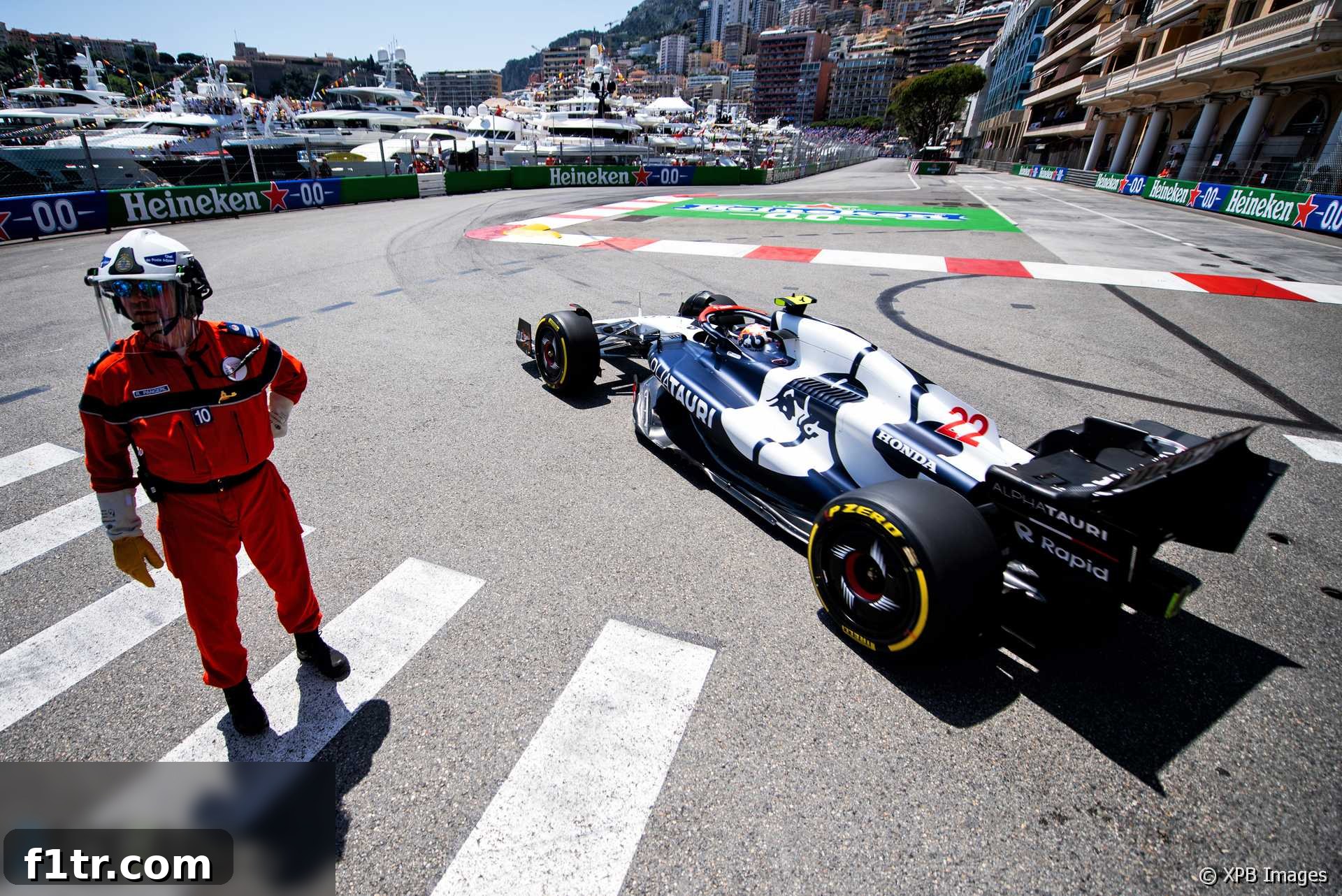
In the high-stakes world of Formula 1, where every millisecond counts and safety is paramount, adherence to regulations is non-negotiable. During a crucial practice session for the 2023 Monaco Grand Prix, Yuki Tsunoda, the spirited driver for AlphaTauri, found himself under the scrutiny of the race stewards. The young Japanese driver received an official warning, and his team faced a significant fine, after an incident involving exceeding the pit lane speed limit. This particular infraction, while seemingly minor, carried deeper implications given the unique circumstances and the inherent dangers of the Monaco circuit.
Advert | Become a Supporter & go ad-free
The incident occurred earlier today, during a free practice session where teams and drivers push their limits to fine-tune their cars for the challenging street circuit. Tsunoda was found to have exceeded the pit lane speed limit, which is strictly set at 60 kilometers per hour (kph) for the Monaco event. His telemetry data showed a speed of 16.2 kph above the stipulated limit, a considerable breach in a confined and high-traffic area. In line with the standard penalties issued for such infringements during practice sessions, AlphaTauri was promptly fined €1,000, equivalent to approximately £868. This financial penalty serves as a deterrent, emphasizing the importance of respecting pit lane regulations, designed primarily for the safety of personnel, mechanics, and other drivers.
However, what made Tsunoda’s situation distinct was the additional measure taken by the stewards: a rare official warning issued directly to the driver. This decision was prompted by the discovery that Tsunoda had failed to activate his pit lane speed limiter upon entering his garage. The circumstances surrounding his pit entry further amplified the stewards’ concerns. Tsunoda had entered the pits with suspected damage to his car, having made contact with the barrier at Turn 11, commonly known as the chicane. The combination of an unconfirmed car condition and an excessive pit lane speed presented a potentially hazardous scenario, warranting a more severe response than a mere financial penalty for the team.
The official statement from the stewards underscored their rationale: “Car 22 exceeded the pit lane speed limit which is set at 60 kph for this event by 16.2 kph. The car was entering the pits having struck the barrier at Turn 11 [chicane] and the stewards were concerned that speeding in a pit lane by over 16 kph when there was unknown damage to the car was potentially dangerous.” This highlights the stewards’ primary focus on safety. A car with compromised integrity, potentially suffering from steering, suspension, or tire damage, travelling at an uncontrolled speed in the pit lane poses a significant risk. Such a situation could lead to further incidents, endangering pit crew members, other drivers, and even marshals. The pit lane, despite its controlled environment, remains a dynamic area, and maintaining strict speed limits is critical to prevent accidents.
During the subsequent hearing, Tsunoda reportedly acknowledged his oversight. He admitted that he had failed to engage his pit speed limiter, a crucial safety mechanism designed to automatically restrict a car’s speed to the mandated limit within the pit lane. Furthermore, he demonstrated an understanding of the potential gravity and danger of the situation. This admission and display of comprehension likely played a role in the stewards’ decision-making process, leading them to issue a warning in addition to the standard team fine. The warning serves as a direct admonition to the driver, urging greater vigilance and adherence to safety protocols in the future.
It is important to distinguish between a “warning” and a “reprimand” in the context of Formula 1 penalties. While both are official sanctions, their implications differ significantly. Last year, Yuki Tsunoda gained notoriety for becoming the first driver to accrue five reprimands over the course of a single season, a threshold that automatically triggered a 10-place grid penalty. Reprimands are generally issued for minor infringements, such as impeding another driver in practice or crossing the white line at pit entry/exit, and they accumulate towards potential grid penalties. However, warnings, like the one issued to Tsunoda in Monaco, do not contribute to this cumulative system. They are typically reserved for specific incidents where driver responsibility is clear and the potential for danger is elevated, but they do not lead to larger grid penalties or race bans based on accumulation. This nuance clarifies that while the incident was serious enough to warrant direct driver admonition, it won’t directly impact his standing for future grid penalties based on a series of minor infractions.
Pit lane regulations are a cornerstone of Formula 1 safety. The pit lane is a unique environment where high-performance racing machines interact in close proximity with personnel, all operating under immense time pressure. Speed limits are strictly enforced to minimize the risk of collisions, protect mechanics working on cars, and ensure the smooth flow of traffic. The Monaco pit lane, in particular, is notoriously tight and often bustling, making any deviation from safety protocols even more perilous. Drivers are equipped with a pit lane speed limiter button on their steering wheel, a simple yet vital tool that, when engaged, takes over throttle control to maintain the designated speed. The failure to activate this system, especially when a car’s integrity is compromised, underscores a momentary lapse in concentration that carries serious implications.
Tsunoda’s incident, while significant due to the added warning, was not the only pit lane speed violation of the day. George Russell, the Mercedes driver, also slightly exceeded the pit lane speed limit during the practice session. However, Russell’s infraction was minimal, by a mere 0.2 kph. As a result, Mercedes was fined a proportionate €100, equivalent to approximately £86. This contrast highlights the scale of Tsunoda’s breach and the stewards’ judgment in distinguishing between minor technical infringements and those that pose a more substantial safety risk, reinforcing the severity of the Japanese driver’s particular circumstances.
This incident serves as a stark reminder to all drivers about the unwavering importance of vigilance and strict adherence to safety protocols, even during seemingly less intense practice sessions. In a sport where margins are razor-thin, and the consequences of error can be catastrophic, every rule, especially those pertaining to safety, must be respected without compromise. The stewards’ decision to issue a warning to Tsunoda, beyond the standard fine, underlines their commitment to upholding the highest safety standards in Formula 1, ensuring that the integrity of the sport and the well-being of all involved are continuously protected.
Don’t miss anything new from RaceFans
Follow RaceFans on social media:
- Join RaceFans on Facebook
- Follow RaceFans on Twitter
- Get daily email updates from RaceFans
Advert | Become a RaceFans supporter andgo ad-free
2023 Monaco Grand Prix
- Mercedes ready to “grind” their way to competitiveness after major W14 update
- Verstappen surpasses Vettel as winner of most races for Red Bull
- How the first team to fit intermediate tyres in Monaco got the call right
- Verstappen’s Monaco pole run was the completion of his 2021 Jeddah lap – Horner
- Haas thrilled as upgrade performance exceeds wind tunnel predictions
Browse all 2023 Monaco Grand Prix articles