Sergio Perez’s Tactical Genius: How He Mastered the VSC to Overtake Grosjean in Japan
A Deep Dive into the Force India Driver’s Astute Exploitation of Formula 1’s Virtual Safety Car Procedure
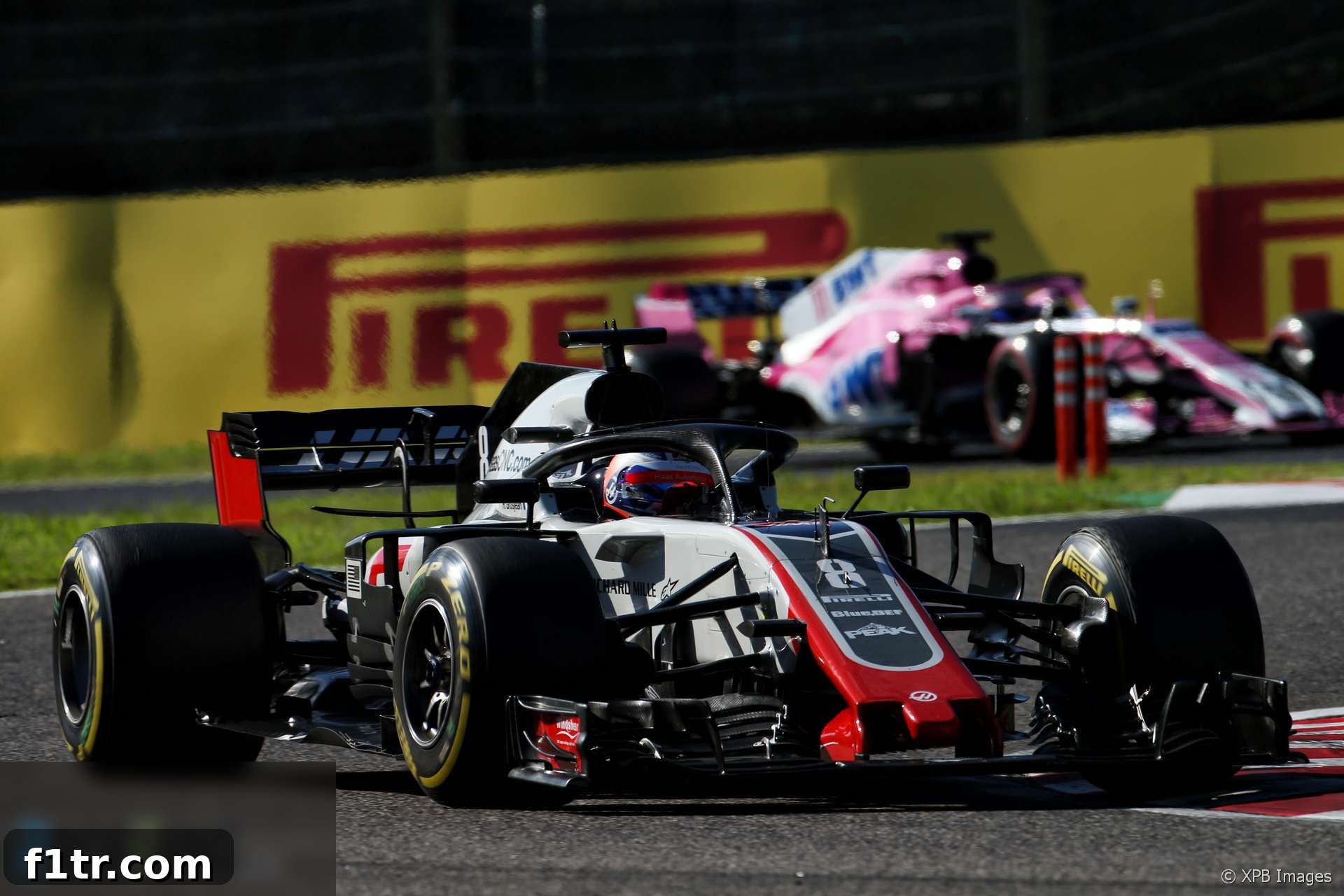
In a thrilling display of strategic acumen and deep understanding of Formula 1 regulations, Sergio Perez executed a stunning overtake on Romain Grosjean during the Japanese Grand Prix. This move, which saw Perez snatch seventh place from the Haas driver, was not merely about raw pace but a calculated exploitation of the Formula 1 Virtual Safety Car (VSC) procedure, leaving his rival utterly bewildered.
The incident unfolded on lap 41, moments after the VSC was deployed following Charles Leclerc’s Sauber stopping at the side of the track. Before the VSC period, Grosjean held a comfortable two-second lead over Perez, seemingly in control of his position. Yet, what followed was a testament to Perez’s sharp race craft and his Force India team’s meticulous preparation.
Advert | Become a Supporter & go ad-free
Understanding the Virtual Safety Car: A Rulebook Masterclass
The Virtual Safety Car system is a crucial safety mechanism in Formula 1, designed to slow down cars on track without deploying the physical Safety Car, which can often bunch up the field and distort race strategies. When the VSC is activated, drivers are instantly given a “delta time” – a target lap time approximately 30% slower than a normal racing lap. The objective is to maintain this reduced pace across the entire circuit, ensuring safety personnel can attend to incidents without high-speed traffic.
However, the genius in Perez’s move lay in understanding the nuances of how this reference time is monitored and enforced. For timing purposes, each circuit is intricately divided into numerous marshalling sectors. At Suzuka, a track known for its complexity and demanding nature, there are as many as 30 such sectors. Compliance with the VSC lap time is not measured continuously but at precise 50-meter intervals throughout these sectors.
The rules stipulate that drivers must be slower than (or ‘positive to’) the reference VSC time at least once within each marshalling sector. This ensures they do not gain an unfair advantage or drive dangerously fast during a VSC period. Crucially, however, for the remainder of that sector, they are permitted to be quicker than (or ‘negative to’) the reference time. This subtle allowance provides a window of opportunity for drivers who meticulously manage their delta time – a window Perez exploited with surgical precision.
It’s this interplay between being ‘positive’ and ‘negative’ within the same sector that becomes a strategic goldmine. A driver can build up speed, going ‘negative’ on their delta, knowing they have to hit ‘positive’ once within the sector to avoid a penalty. This careful calibration of speed allows a cunning driver to be on the attack the moment the VSC period concludes.
Perez’s Calculated Strike: The Overtake Unfolds
As the VSC period commenced, with both Grosjean and Perez beginning their lap, the Force India pit wall sprung into action. Perez’s race engineer, Tim Wright, played a pivotal role, constantly feeding him crucial intelligence. Wright meticulously kept Perez informed about the progress marshals were making in moving Leclerc’s stranded car, and consequently, how imminent the VSC restart was. This real-time communication was vital, allowing Perez to anticipate the precise moment to unleash his strategy.
Advert | Become a RaceFans supporter andgo ad-free
“This could be a short one,” Wright advised Perez with urgency as the Mexican driver entered marshalling sector 10. The engineer’s voice was calm but firm, relaying key information: “Positive plus 3.5, they are moving the car.” This confirmed that Perez was adhering to the VSC delta while simultaneously indicating that the track was being cleared. As Perez powered through Dunlop corner, the critical instruction came: “VSC ending soon.” This was the cue. Perez, already positioned optimally, began to subtly close the gap to Grosjean, building momentum.
Wright continued to guide him: “Stay positive, stay positive,” ensuring Perez remained within the rules until the last possible second. Perez, driving with laser-like focus, was already taking significant chunks out of the Haas’s lead. With a stroke of strategic brilliance and a touch of race luck, the VSC period concluded just as both cars were approaching the challenging Degner two corner. This timing was impeccable, enabling Perez to carry the advantage of his carefully accumulated extra speed directly into the corner and close in on Grosjean as they headed towards the tight hairpin.
Perez wasted no time, diving down the inside of the Haas as they rounded the corner. Grosjean, completely caught off guard, saw the distinctive pink Force India looming large in his mirrors. His immediate reaction, broadcast over the team radio, perfectly captured his disbelief and fury: “Mate he’s jumped the restart,” exclaimed Grosjean, his voice laced with shock, “he’s in my arse!” His engineer, Gary Gannon, acknowledged: “Passed on, understood.”
As they accelerated up the hill towards Spoon Curve, both drivers activated higher engine modes, pushing their machines to their limits. But Grosjean faced another critical disadvantage: his medium compound tires. He had already been struggling with their performance even before the VSC, exacerbated by reported issues with his tire sensors. In stark contrast, Perez was on softer tires, which were now rapidly coming up to optimal operating temperature, providing superior grip and traction precisely when it mattered most.
The momentum was irreversibly with Perez. “He cheated,” insisted an utterly unimpressed Grosjean, convinced of foul play as they rounded the iconic 130R bend, where Perez expertly teed him up for the decisive pass. The Force India driver then made his move, diving boldly down the outside at the final chicane, completing the overtake and securing a well-deserved seventh place. It was a move born of meticulous planning and flawless execution.
Go ad-free for just £1 per month>> Find out more and sign up
Aftermath and Reflections: A Debate on the Rules
Grosjean’s frustration simmered long after the race. “Mate this is not possible I was plus 0.3,” he fumed, referencing his own delta time adherence. “He has got to give me the position.” However, Perez held his ground, and the position was not relinquished. Post-race, Grosjean conceded that the Haas team would be scrutinizing the incident closely.
“We need to analyse what happened with the Virtual Safety Car restart,” he stated, clearly still perplexed. “I was right on my delta time and Perez, when the gap was 2.4 seconds before, overtook me straight away. We need to check and see if there is not a problem in the system there. I thought I had done the job on my side. We did our best.” His comments highlighted a potential perceived loophole or ambiguity in the VSC rules from the perspective of a driver who felt he had correctly followed procedure.
Perez, predictably, remained tight-lipped about the intricate details of his strategic move, preferring to keep his competitive edge a secret. When questioned, he offered a modest, yet confident, explanation: “At the restart with the Virtual Safety Car I managed to get really close to Grosjean and just when I saw the opportunity I went for it.” His brief statement underscored the opportunistic nature of racing, but behind it lay a profound understanding of the regulations.
This incident at Suzuka served as a compelling reminder of the depth of strategy involved in Formula 1. It showcased how drivers and their engineering teams are constantly pushing the boundaries of the rules, seeking every legal advantage within the sport’s complex framework. Perez’s overtake was not merely a moment of individual brilliance but a testament to the symbiotic relationship between driver skill, technical understanding, and meticulous team communication. It underscored that in F1, winning often comes down to who can master the rulebook as much as master the track.
Advert | Become a RaceFans supporter andgo ad-free
Related 2018 F1 Season Articles
- F1 feared “death knell” for Drive to Survive after Ferrari and Mercedes snub
- McLaren staff told us we were “totally crazy” to take Honda engines in 2018 – Tost
- ‘It doesn’t matter if we start last’: How Red Bull’s junior team aided Honda’s leap forward
- Honda’s jet division helped F1 engineers solve power unit problem
- McLaren Racing losses rise after Honda split
Browse all 2018 F1 season articles