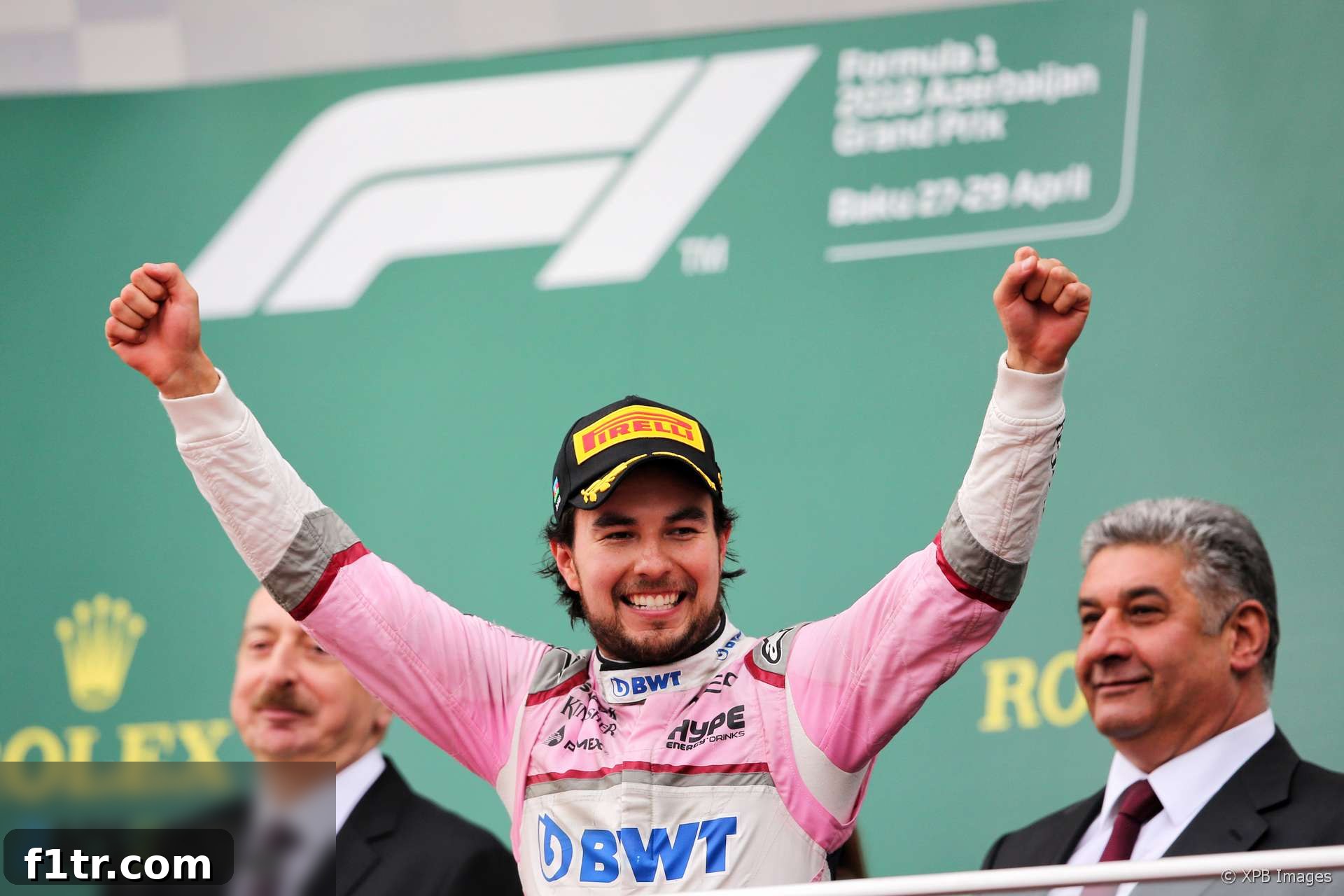
The 2018 Formula 1 Azerbaijan Grand Prix delivered a spectacle of unpredictable drama, with its street circuit renowned for throwing curveballs at even the most seasoned competitors. Amidst the chaos, an unlikely hero emerged: Sergio Perez. Driving for Force India, Perez secured a sensational podium finish, a result that sent ripples through the paddock and delighted fans. However, his journey to the third step of the rostrum was far from straightforward, intertwined with a controversial penalty and a crucial, yet often overlooked, shift in the sport’s regulatory landscape. Perez’s incredible feat in Baku can be attributed not just to his undeniable skill and resilience, but also to a stroke of strategic fortune regarding the timing of a five-second time penalty he incurred early in the race.
Advert | Become a Supporter & go ad-free
The very beginning of the race set the tone for the tumultuous afternoon. The opening lap saw a series of incidents, and Perez found himself an unfortunate casualty of the early skirmishes. His Force India car sustained contact from Sergey Sirotkin’s Williams, prompting an immediate response from his team. On just lap two, with the Safety Car already deployed to manage the debris and recover cars from earlier incidents, Force India opted to bring Perez into the pits. The primary objective was to assess any potential damage to his car and, if necessary, fit a fresh set of tyres, hoping to mitigate the impact of the early knock.
It was during this initial Safety Car period, on his way into the pit lane, that Perez inadvertently committed an infringement that would lead to a penalty. As he navigated the circuit towards his pit box, he overtook Lance Stroll’s Williams before the first Safety Car line. The regulations are crystal clear on this: overtaking under Safety Car conditions before the designated line is strictly forbidden, regardless of whether a car is heading to the pits. The stewards, ever vigilant, noted the incident, but their verdict would not be immediate.
Approximately 40 minutes later, as the race unfolded and Perez skillfully worked his way up the field, the stewards issued their decision. Perez was handed a five-second time penalty for the unsafe overtake under Safety Car conditions, an additional two penalty points were added to his super licence. By this point, the Mexican driver had already displayed remarkable recovery pace, climbing to a respectable seventh position. However, the shadow of the penalty loomed large. Just four seconds behind him was Romain Grosjean’s Haas, a car that had shown competitive pace throughout the Grand Prix. Further back, Carlos Sainz Jnr was also closing in, promising a fierce battle for those vital midfield positions.
Under normal circumstances, a five-second time penalty could be a race-ender for a driver fighting for points, especially if it’s to be served at the end of the race. Had the race concluded without further Safety Car interruptions, Perez would likely have completed the Grand Prix on his existing tyres, without the need for another pit stop. In this scenario, the five seconds would have been appended to his final race time, almost certainly dropping him behind Grosjean and quite possibly also behind the charging Sainz. This penalty, therefore, had the potential to erase all the hard work he had put in to recover his track position, costing him valuable championship points and relegating his strong performance to a mere footnote.
However, the chaotic nature of the Azerbaijan Grand Prix had another dramatic twist in store, one that would fundamentally alter the trajectory of Perez’s race and, indeed, his penalty. The much-anticipated clash between the two Red Bull Racing teammates, Daniel Ricciardo and Max Verstappen, spectacularly ended their races and triggered another Safety Car deployment. This incident, a defining moment of the Grand Prix, provided a pivotal opportunity for all the front-runners. Seizing the moment, virtually every leading driver dived into the pits for a fresh set of tyres, keen to exploit the reduced time loss under Safety Car conditions.
This widespread pit activity was the game-changer for Perez. He duly took advantage of the opportunity to serve his five-second time penalty during this Safety Car period. The key was not just serving the penalty, but doing so efficiently enough to maintain track position. Through a combination of rapid pit work by the Force India crew and Perez’s precise execution, he managed to buy himself just enough time during his stop to exit the pit lane still ahead of Grosjean’s Haas. This seemingly small margin was colossal, effectively neutralising the detrimental impact of his earlier infringement and preserving his hard-fought track position, allowing him to remain firmly in contention.
The ability to serve a time penalty during a Safety Car period, however, was not always the case in Formula 1. Indeed, a significant rule interpretation change had occurred since a similar incident involving Jules Bianchi during the 2014 Monaco Grand Prix. Bianchi, during that race, had attempted to serve a five-second time penalty under Safety Car conditions. The stewards, strictly adhering to the regulations at the time, deemed this impermissible and consequently slapped him with a further five-second time penalty for his actions. This historical precedent highlighted a rigid interpretation where such penalties had to be served either during normal race conditions (requiring an additional pit stop for a stop-and-go penalty) or at the end of the race by adding time to the total result.
Yet, by the time of the 2018 Azerbaijan Grand Prix, the understanding and application of these rules had evolved. As FIA race director Charlie Whiting lucidly explained following the race, drivers were now permitted to serve time penalties, such as a five-second or ten-second penalty, during Safety Car periods. This shift represented a pragmatic approach to regulation, acknowledging that the essence of the penalty – the five-second delay – remained the same, regardless of the on-track conditions.
Whiting’s rationale was straightforward and unambiguous: “Five seconds is five seconds whatever you do. It doesn’t matter if it’s done under Safety Car or what.” He further elaborated on the procedural aspect, stating, “It has to be done the next time the car comes into the pits. So whether he just waits five seconds and does a tyre change, five seconds is five seconds, it doesn’t matter when it’s done.” This clarification underscored a significant regulatory evolution, allowing for greater flexibility and preventing instances where a penalty might unfairly disproportionately affect a driver due to unforeseen race circumstances. It meant that a penalty’s impact was about the time lost, not necessarily the specific on-track context during which it was served.
The strategic advantage afforded by this rule interpretation and the fortuitous timing of the Safety Car was undeniable. When the race restarted for the final sprint, Sergio Perez found himself in a remarkable fifth position. From this vantage point, he was perfectly poised to capitalise on the high-octane drama that unfolded in the closing laps. The subsequent misfortunes of race leaders, particularly Valtteri Bottas, who suffered a heartbreaking puncture while leading, and Sebastian Vettel, who locked up attempting to overtake Bottas, created an opening Perez ruthlessly exploited. These late-race incidents shuffled the pack dramatically, propelling Perez onto the podium, securing his first top-three finish since the very same race two years prior, a testament to his opportunistic driving and the team’s unwavering strategy.
However, even after crossing the finish line in a jubilant third place, Perez’s podium finish was not immediately confirmed. His result came under renewed threat when stewards launched an investigation into his use of the Drag Reduction System (DRS) during the race. Allegations surfaced that he, along with two other drivers, had deployed DRS incorrectly. For a tense period after the race, the Force India garage and Perez himself had to await the stewards’ verdict, fearing that a post-race penalty could strip him of his hard-earned trophy. Fortunately, after deliberation, all three drivers were cleared of any wrongdoing, with stewards ruling that the infringement did not warrant a penalty. This final clearance solidified Perez’s third place, confirming one of the most unexpected and strategically fascinating podiums in recent Formula 1 history.
Perez’s podium at the 2018 Azerbaijan Grand Prix stands as a vivid reminder of Formula 1’s intricate blend of raw speed, calculated strategy, and the unpredictable hand of fate. It perfectly encapsulated how a team and driver’s ability to adapt, understand, and leverage the rulebook can turn adversity into triumph. From an early incident and a seemingly crippling penalty, to a fortuitously timed Safety Car and a crucial rule interpretation, Perez and Force India masterfully navigated the challenges of Baku, etching their names into the annals of Grand Prix history with a truly memorable third-place finish.
Advert | Become a RaceFans supporter andgo ad-free
2018 F1 season – Relive the moments
- F1 feared “death knell” for Drive to Survive after Ferrari and Mercedes snub
- McLaren staff told us we were “totally crazy” to take Honda engines in 2018 – Tost
- ‘It doesn’t matter if we start last’: How Red Bull’s junior team aided Honda’s leap forward
- Honda’s jet division helped F1 engineers solve power unit problem
- McLaren Racing losses rise after Honda split
Browse all 2018 F1 season articles and analysis