Australian Grand Prix Stewards’ Decisions: Unpacking the Post-Race Rulings
The Australian Grand Prix, a cornerstone event on the Formula 1 calendar, consistently delivers high-octane drama and intense competition. Beyond the thrilling on-track action, the role of the race stewards is paramount in ensuring fair play, safety, and adherence to the sport’s intricate regulations. Following a particularly eventful race day at the Albert Park circuit, the stewards meticulously reviewed a series of incidents, ranging from aggressive wheel-to-wheel combat to crucial procedural lapses. Their ultimate decisions, delivered after extensive analysis, largely concluded with no further action against most drivers, underscoring the nuanced distinction between hard racing and rule infringement within the pinnacle of motorsport.
The rigorous process undertaken by the F1 stewards is a testament to the meticulous nature of motorsport governance. Each incident is subjected to an exhaustive review, leveraging a wide array of resources including real-time telemetry, high-definition video footage from multiple camera angles, and direct testimony from the drivers and team representatives involved. This diligent and impartial approach is vital for ensuring that all rulings are not only equitable but also consistently applied in accordance with established guidelines, most notably the updated 2026 Driving Standards Guidelines. These guidelines are continually refined to reflect the dynamic evolution of Formula 1, striking a crucial balance between encouraging thrilling racing and maintaining uncompromising safety standards across all circuits.
Virtual Safety Car Protocol Under Scrutiny: Esteban Ocon Cleared
One of the initial points of post-race contention centered on Haas driver Esteban Ocon, who impressively navigated his way to an 11th-place finish, narrowly missing out on championship points. Ocon came under investigation for a potential failure to comply with the Virtual Safety Car (VSC) delta time. The VSC system is a critical safety mechanism deployed when an incident occurs on track that requires drivers to significantly reduce their speed, but does not necessitate a full Safety Car deployment. Drivers are mandated to maintain a specific delta time, ensuring a controlled, slower pace across the circuit, thereby neutralizing the field and, most importantly, safeguarding marshals and personnel on the track.
The stewards conducted a thorough examination of the telemetry data and engaged directly with Ocon to gain a comprehensive understanding of his actions during the VSC period. Their detailed review led to the conclusion that Ocon had not driven “unnecessarily slowly.” This decision highlights the inherent complexities drivers face in precisely managing their pace under VSC conditions, where maintaining the stipulated delta time while simultaneously keeping tires within an optimal temperature window and avoiding other potential on-track hazards demands immense focus and skill. The investigation unequivocally confirmed Ocon’s adherence to both the spirit and the letter of the VSC regulations, ultimately clearing him of any infraction. This outcome not only validates his precise driving but also underscores the stewards’ commitment to a fair and exhaustive analytical process.
High-Stakes Duel: Ocon and Gasly Collide at Turn 3
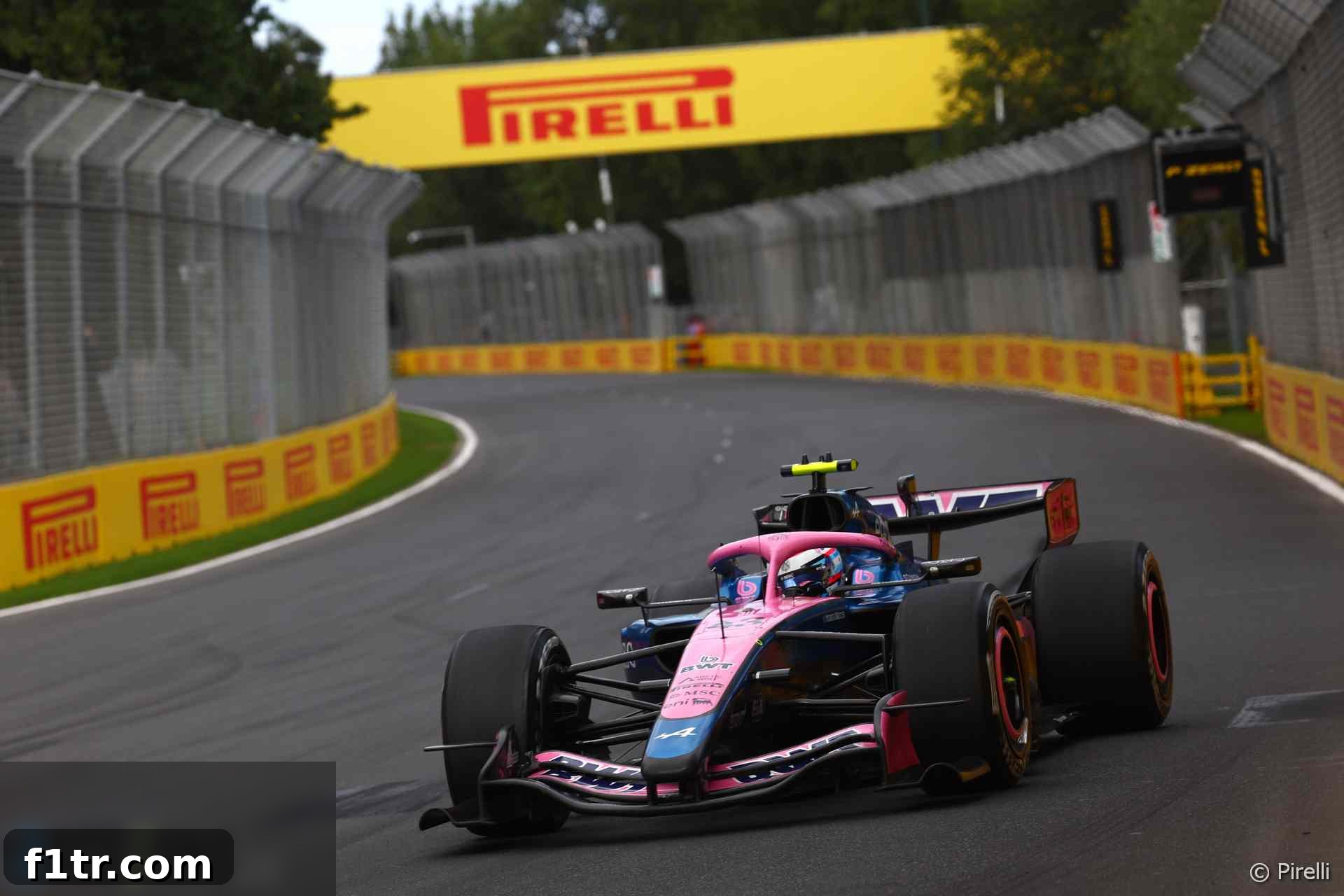
The Australian Grand Prix delivered its customary share of exhilarating wheel-to-wheel racing, with a particularly notable incident unfolding at Turn 3 between Esteban Ocon and Pierre Gasly. The two highly competitive drivers made contact as they fiercely battled for track position. Gasly, attempting an ambitious overtaking maneuver on the inside, inadvertently collided with Ocon’s Alpine, resulting in discernible damage to the Alpine’s front-left endplate. Such contact in high-speed, demanding corners is frequently a catalyst for extensive steward investigations, given its potential to critically impact a driver’s race outcome and raise significant safety considerations.
In their assessment, the stewards undertook a meticulous analysis of the incident, cross-referencing all available data and video evidence with the aforementioned 2026 Driving Standards Guidelines. These guidelines serve as the authoritative framework for determining fault in racing incidents, establishing clear parameters for when a driver is legitimately “entitled to racing room.” Their official findings meticulously stated: “The evidence showed that the front axle of [Gasly’s] car was ahead of the mirror of [Ocon’s] car prior to and at the apex and car 10 [Gasly] was driven in a fully controlled manner.” This crucial observation firmly established Gasly’s legitimate claim to a portion of the track, indicating that he had sufficiently positioned his car alongside his competitor to warrant space.
However, the stewards’ analysis further elucidated a critical dimension of the incident: “Applying the Driving Standards Guidelines, Gasly was entitled to racing room through turn three. However, Ocon had already turned-in and was committed to the corner at the point where the collision occurred.” This dual assessment perfectly encapsulates the inherent complexity of adjudicating racing incidents. While Gasly had indeed established a rightful position, Ocon was simultaneously committed to his chosen racing line, creating an unavoidable convergence point where preventing contact became exceptionally challenging for both drivers. Consequently, the stewards rendered a judgment that “no driver was wholly or predominantly to blame for the collision and for that reason took no further action.” This finely balanced decision reflects a sophisticated understanding of racing dynamics, acknowledging the aggressive, no-quarter-given nature of Formula 1 while steadfastly upholding the principles of fair competition. Such rulings are crucial in encouraging drivers to push the limits of racing without the fear of disproportionate penalties for unavoidable racing incidents that are an intrinsic part of the sport.
Perez and Lawson’s Turn 3 Encounter: Another Fair Ruling
Indeed, Turn 3 at Albert Park proved to be a hotbed for intense, close-quarter racing throughout the Grand Prix weekend. In another incident, Sergio Perez and Liam Lawson found themselves embroiled in a wheel-to-wheel battle at this same challenging corner. Lawson, driving for Racing Bulls, initiated an ambitious overtaking attempt on the outside of Perez. During the maneuver, the two cars made contact at the apex of the corner, which subsequently led to Lawson running wide off the track and rejoining behind Perez. Incidents of this nature frequently hinge on the precise positioning of each car at critical points and the judicious application of rules pertaining to track limits and entitlement to racing room.
Once again, the stewards meticulously applied the comprehensive Driving Standards Guidelines to thoroughly evaluate this specific incident. Their findings were articulated with precision: “Lawson’s front axle was not ahead of [Perez’s] front axle at the apex and applying the Driving Standards Guidelines, the stewards determined that Lawson was not entitled to space at the exit of turn three and therefore he was not forced off by Perez.” This ruling is profoundly significant in delineating the accepted boundaries of fair overtaking maneuvers. To be legitimately “entitled to space” when attempting an overtake on the outside of a corner, a driver typically needs to be substantially alongside the defending car at either the corner’s entry or its apex. In this particular instance, Lawson had not fulfilled that specific criterion. As such, Perez was not deemed to have illegally forced Lawson off the track. This decision, mirroring the nuanced Ocon-Gasly ruling, powerfully reinforces the emphasis on clear, objective, and consistent criteria when assessing racing incidents, thereby ensuring an equitable and predictable playing field for all competitors in Formula 1.
Nico Hulkenberg’s Non-Start: A Technicality Without Penalty
Not all post-race investigations at the Australian Grand Prix pertained to on-track skirmishes. Nico Hulkenberg also triggered a stewards’ review, albeit for an entirely different, albeit unfortunate, reason: his inability to start the race. The stewards’ report clearly indicated that his car “did not reach the grid under its own power and could therefore not start the race from the grid.” Such circumstances typically lead to stringent penalties for infringements of the starting procedure, which are meticulously regulated to ensure a fair and safe commencement to the race for all participants.
However, in Hulkenberg’s specific case, the situation was resolved without any penalty being issued. The stewards’ official notation highlighted a critical distinction: “as Audi withdrew Hulkenberg’s car and he did not start, no infringement occurred.” This is a profoundly important nuance within the F1 regulations. While a failure to reach the grid under one’s own power would ordinarily constitute a breach, the team’s proactive and formal decision to withdraw the car from the race before the start lights were extinguished meant that the specific regulations governing the act of “starting” the race from either the grid or the pit lane were not technically violated. This outcome underscores the paramount importance of procedural clarity within Formula 1; a car that is formally withdrawn and consequently does not start is not subject to the rules that govern the start itself, provided the withdrawal procedure is correctly followed. While undoubtedly a source of profound disappointment for the seasoned German driver and his team, the ruling confirmed that, despite the unfortunate scenario, no formal rules were actually broken.
The Sole Sanction: Franco Colapinto’s Mandatory Stop-and-Go Penalty
In contrast to the series of “no further action” rulings, only one driver was subjected to a significant penalty during the Australian Grand Prix: Franco Colapinto. The Alpine driver was handed a severe 10-second stop-and-go penalty, which stands as one of the harshest and most impactful sanctions a driver can incur in Formula 1. This penalty mandates that the driver enters the pit lane, comes to a complete halt for ten seconds, and then rejoins the race, an action that almost invariably results in a substantial loss of track position and precious race time.
Crucially, this severe penalty was not a discretionary decision by the stewards but rather a mandatory consequence of a critical procedural lapse by the Alpine team. The stewards’ report explicitly stated: “Team personnel were touching car 43 on the grid after the 15-second signal had been shown and the car failed to start the race from the pit lane in breach of Article B5.5.5 a) i) of the FIA F1 Regulations.” This specific regulation unequivocally dictates that all team personnel must be clear of the car within a predetermined timeframe prior to the commencement of the start sequence, typically 15 seconds before the formation lap. A failure to comply with this vital safety protocol, compounded by the subsequent failure to start the race from the pit lane as required, automatically triggers this specific and unappealable penalty. Such stringent rules are primarily in place to guarantee the utmost safety of pit lane personnel and to ensure an orderly, fair, and consistent start procedure for all competitors. Colapinto’s penalty, while undoubtedly tough and race-altering, serves as a powerful and unambiguous reminder of the exacting operational demands placed upon F1 teams and drivers, where even seemingly minor procedural oversights can lead to major sporting repercussions.
Conclusion: Upholding Integrity Through Consistent Application of Rules
The post-race decisions emanating from the Australian Grand Prix stewards provided a profound and clear demonstration of how Formula 1’s complex regulatory framework is applied in high-stakes, high-pressure competitive environments. The exhaustive investigations into the incidents involving Esteban Ocon, Pierre Gasly, Sergio Perez, and Liam Lawson powerfully underscored the sport’s unwavering commitment to fair and exhilarating wheel-to-wheel racing, all meticulously guided by continuously updated driving standards. The measured handling of Nico Hulkenberg’s non-start highlighted the intricate nuances of procedural rules, while Franco Colapinto’s mandatory stop-and-go penalty served as a stark and powerful reminder of the stringent compliance required from all teams during the critical pre-race grid procedures.
Ultimately, these meticulously reasoned rulings serve to reinforce the foundational pillars of sporting integrity within Formula 1. By diligently reviewing each individual case, rigorously applying objective guidelines, and transparently explaining their rationale, the stewards play an indispensable role in ensuring that the competitive spirit and thrilling spectacle of the sport are meticulously maintained, all while upholding the absolute highest standards of safety, fairness, and governance. As the Formula 1 season progresses, these specific precedents will undoubtedly contribute significantly to the ongoing narrative of hard but fair racing that so distinctively defines this unparalleled motorsport championship.
More from the 2026 Australian Grand Prix
- Briatore “not happy at all” with Alpine’s “very weak” performance
- Drivers want rules changes to cut “dangerous” risk of crash at start
- Russell becomes the 68th different Formula 1 driver to lead the world championship
- Hadjar told Red Bull his car’s performance was “embarrassing” and “just c***”
- “How did you not call the pit?” Ups and downs in Hamilton’s first race with new engineer
Browse all 2026 Australian Grand Prix articles