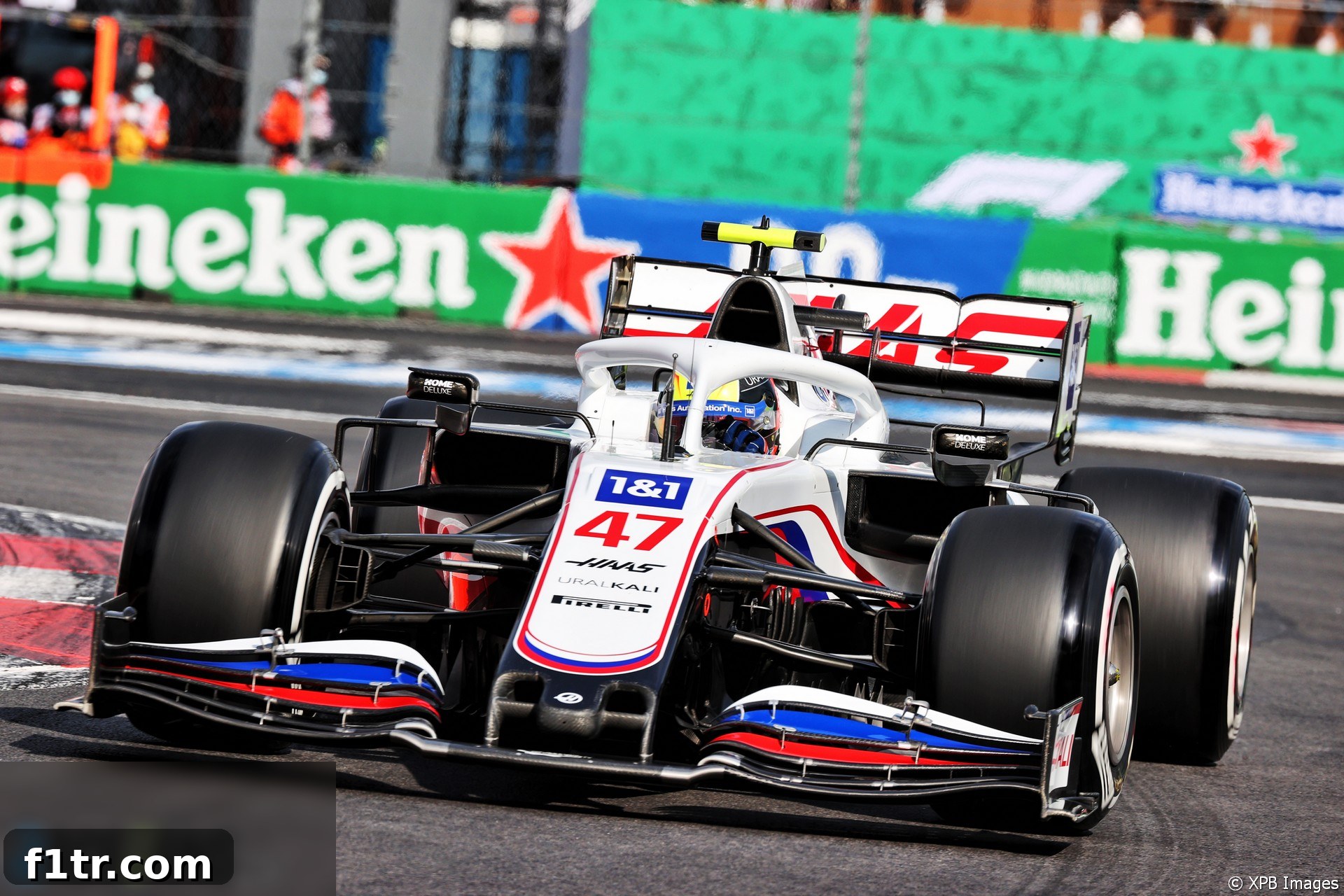
The intricate dynamics within the Haas F1 Team were once again thrust into the spotlight following an on-track incident involving drivers Mick Schumacher and Nikita Mazepin during the crucial Q1 session of the Mexico City Grand Prix. This clash, reminiscent of previous tensions, highlighted the perennial challenge of managing driver expectations and adhering to strict team directives in the high-stakes environment of Formula 1 qualifying.
High Stakes in Q1: The Mexico City Incident Unfolds
As the Q1 session restarted, the pressure was palpable. Every driver aimed to find a clear window and optimal tyre temperature for their flying lap. Mazepin, finding himself trailing his teammate Schumacher, radioed his race engineer, Dominic Haines, with an urgent request. “Okay, I need to overtake Mick, because he’s going too slow,” Mazepin asserted, indicating a clear desire to manage his own out-lap pace.
However, the response from the pit wall was swift and unequivocal. “Negative. Stay behind, stay behind, please,” Haines instructed, reinforcing the pre-established team strategy. Mazepin’s incredulous reply – “Are you having a laugh?” – immediately conveyed his frustration and disbelief at being denied what he perceived as a crucial opportunity to prepare his tyres effectively.
The situation escalated quickly, prompting the intervention of Ayao Komatsu, Haas’s chief race engineer, who took a more stern tone. “I am not having a laugh, Nikita,” Komatsu firmly stated, underscoring the seriousness of the team’s command. He then added a pragmatic instruction: “If you want to make a space now, make a space now,” implying that if Mazepin felt his current position was untenable, he should create the necessary gap without disrupting Schumacher’s preparation or defying team orders.
This radio exchange, broadcast globally, immediately sparked discussions about team hierarchy, driver cooperation, and the fine line between individual ambition and collective strategy.
Drivers and Team Principal Weigh In on the Controversy
Following the qualifying session, both drivers and team principal Guenther Steiner were pressed for their perspectives on the incident, revealing differing interpretations of the events and the underlying team protocols.
Mick Schumacher’s Perspective: Adherence to Plan
Mick Schumacher, often seen as the more compliant and methodical of the two rookies, expressed a clear understanding of the team’s strategy. “From our side, everything happened as normal and as planned,” he explained, suggesting that his out-lap pace was precisely what had been agreed upon. He acknowledged the presence of other cars, specifically the Williams, which were on a faster out-lap, but reiterated that Haas stuck to its own script. “We just did our normal out-lap, really.”
When questioned about Mazepin’s evident frustration, Schumacher maintained his position, emphasizing the clarity of team instructions. “I think that the team set out clear instructions and I think those instructions were held in from both sides, from my side,” he stated. For Schumacher, the situation was straightforward: adhere to the plan, and there should be no cause for alarm or resentment. “So I think there’s no real reason to be upset in any ways.” This perspective underscored his professional approach and his trust in the team’s strategic decisions, even if it meant sacrificing a perceived advantage for a teammate.
Nikita Mazepin’s Grievance: A Recurring Theme
For Nikita Mazepin, the Mexico City incident was not an isolated event but rather a continuation of a pattern, particularly referencing a similar dispute two weeks prior during qualifying for the Dutch Grand Prix at Zandvoort. “It’s a bit of an ongoing topic,” Mazepin conceded, highlighting his growing frustration with what he perceived as inconsistent application of team rules.
He elaborated on the Zandvoort situation: “Last time we had this was in Zandvoort, where it was said that there is a circumstance that might overrule the rule, which the other side of the team decided to use at that time. And at that time, I felt that it screwed my qualifying.” This strong language indicated a deep-seated belief that he had been disadvantaged in the past due to team decisions or actions taken by the other side of the garage, implying a lack of equitable treatment.
Regarding the Mexico City incident, Mazepin explained his rationale for wanting to overtake: “So I felt like today, in a rushed case like it was, a team mate of mine had a free space in front and wasn’t going as quick as he could have, so I felt that maybe that’s what he needs for the tyres. I needed to go quicker in order to bring my tyres in and tried to get ahead but got a ‘no’.” His concern was purely performance-driven – achieving optimal tyre temperature for his own flying lap. Despite his strong feelings, he acknowledged, “I respect the orders that the team gives me and stayed behind, so it’s not a big deal, it just seems like the rules are different on the sides of the team.” This concluding remark perfectly encapsulated his feeling of an uneven playing field within the same garage, a sentiment that could be detrimental to team cohesion.
Guenther Steiner’s Strategic Defense: Avoiding Internal Conflict
Haas Team Principal Guenther Steiner, known for his no-nonsense approach, provided the team’s official stance, explaining the strategic decision behind the instruction to Mazepin. Steiner asserted that despite Mazepin’s perceived disadvantage, the outcome was ultimately beneficial for him. “He had no traffic on his lap and his tyres were back up to temperature anyway,” Steiner explained, suggesting that Mazepin’s concerns about tyre temperature were ultimately unfounded or mitigated by the subsequent clear track.
Steiner also offered insight into the team’s reasoning for preventing the overtake, emphasizing the broader strategic picture that drivers might not fully appreciate from inside the cockpit. “So I think in the end, he asked the question, but they don’t see what is in front, because he maybe can go past Mick and then he’s stuck again, you know? So why would we do it?” This highlighted the risk of Mazepin overtaking Schumacher only to encounter further traffic, potentially compromising both cars’ laps rather than just one.
Crucially, Steiner underscored the team’s proactive approach to preventing a repeat of past incidents. “Because the risk is always that they race between them again, like we had in Zandvoort. So we stopped it before it goes to that one.” This statement was a clear admission that the team was actively managing the potentially volatile relationship between its two rookie drivers, prioritizing team harmony and optimal collective performance over individual grievances. The memory of Zandvoort, where a similar situation led to on-track skirmishes, was clearly a significant factor in the team’s decision-making process.
The Dynamics of a Rookie Pairing in a Challenging Season
The recurring tension between Schumacher and Mazepin is not merely a reflection of personality clashes but also a symptom of their unique positions as rookie drivers in a team struggling at the back of the grid. Haas F1, in its 2021 campaign, was largely focused on driver development and preparing for new regulations, with limited performance ambitions. In such a scenario, the internal battle between teammates often becomes the primary competitive outlet.
Both drivers are eager to prove their worth, not just to Haas but to the wider F1 paddock. Consistently out-qualifying a teammate, particularly in a car that isn’t capable of challenging for points, becomes a crucial metric for demonstrating talent and potential. Mick Schumacher has largely held the upper hand in this internal contest, with the Mexico City qualifying marking the 16th time he has out-qualified Mazepin in the season when both drivers set representative lap times. This consistent performance gap may contribute to Mazepin’s frustration and his desire to challenge team orders, as he seeks any marginal gain to close the performance gap to his teammate.
Managing two ambitious rookie drivers requires a delicate balance from the team principal. While encouraging healthy competition, Guenther Steiner and his engineers must ensure that this rivalry does not devolve into detrimental on-track conflicts or undermine the team’s overall strategy. The incidents in Zandvoort and Mexico City serve as stark reminders of the challenges in maintaining this balance, especially when drivers perceive an unfair distribution of opportunities or inconsistent application of rules.
Ultimately, the team’s decision to prioritize a controlled out-lap and avoid internal racing during qualifying is a standard practice designed to maximize the chances of at least one car getting a clean run. While Mazepin’s frustration is understandable from a driver’s perspective, the team’s responsibility extends to the collective outcome and the prevention of avoidable incidents. As Schumacher and Mazepin prepared to start Sunday’s race from 14th and 15th positions respectively, the incident served as a potent illustration of the ongoing learning curve for both drivers in navigating the complex world of Formula 1 team dynamics.
2021 Mexico City Grand Prix: Further Reading
- No one will win more F1 races than Verstappen this year
- Alfa Romeo’s misjudgement which prompted Giovinazzi’s sarcastic radio ‘thanks’
- “Nice catch”: How Verstappen’s canny bid to thwart Bottas almost succeeded
- 2021 Mexico City Grand Prix Star Performers
- Wolff “surprised” stewards did not investigate Ricciardo over Bottas collision
Browse all 2021 Mexico City Grand Prix articles