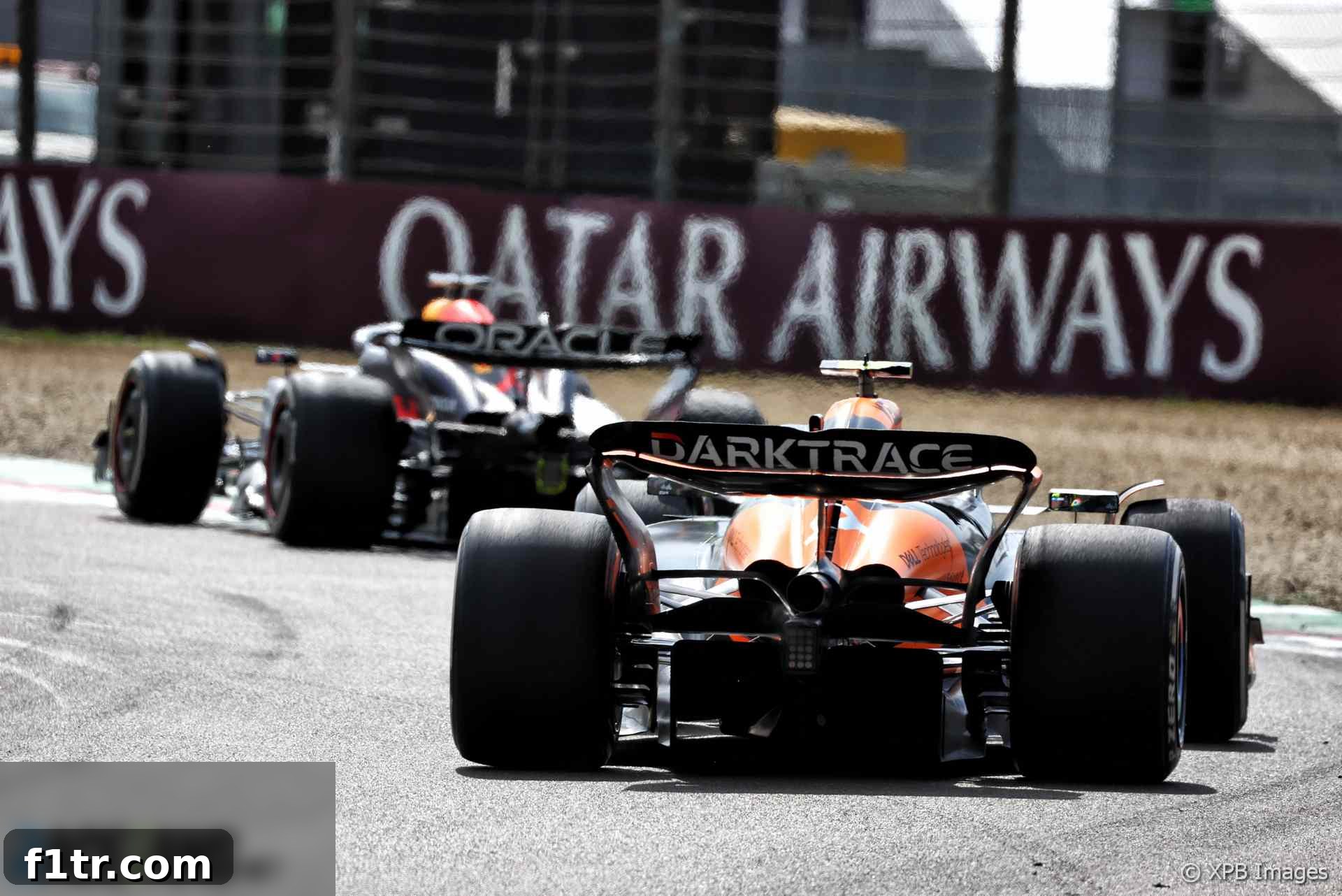
Lando Norris’s Mid-Race Masterclass: How Radical Car Adjustments Flipped the Script at Imola
In a display of remarkable adaptability and strategic acumen, Lando Norris revealed that a series of radical, mid-race adjustments to his McLaren MCL38 were the key to unlocking a significantly improved pace. This crucial transformation allowed him to not only escape pressure from behind but also mount an audacious chase for the race leader, Max Verstappen, during the nail-biting Emilia Romagna Grand Prix.
Become a Supporter & go ad-free
Initial Struggles and a Search for Balance
The race at Imola saw the McLaren driver initially fall behind Verstappen. Both competitors started on the medium compound tyres, with the Red Bull appearing to hold a comfortable advantage. The gap between them widened, and Norris found himself battling not just the reigning champion ahead, but also a challenging car balance. Upon switching to the hard tyres for his second stint, Norris’s discomfort only intensified.
“I was slow on the medium relative to Max,” Norris explained post-race. “And I wasn’t comfortable as soon as I came out on the hard tyre.” His initial laps on the hard compound were far from ideal, prompting him to query his team about his struggles, especially as Charles Leclerc began to close in from behind.
While his engineers initially suggested others were simply “pushing more,” Norris sensed a deeper issue with his car’s behaviour. “I was asking because I just felt slow and I didn’t feel like I could push a lot more,” he elaborated. “As soon as I started to push, I felt like I’d oversteer, I’d understeer, lock tyres. It was just the tyres were not in a good window.”
This critical observation underscores the delicate relationship between driver, car, and tyres in modern Formula 1. When tyres aren’t operating within their optimal temperature and performance window, drivers lose confidence, and the ability to extract maximum performance vanishes. Norris’s sentiment echoed similar comments from Verstappen, highlighting a shared challenge across the grid. “It’s clear,” Norris noted, “with Max saying a similar thing, that as soon as they’re not in the right window, you just can’t push. You don’t have the confidence with the car.”
In such scenarios, a driver’s primary task becomes damage limitation and meticulous management. “So I had to just manage things as best I could,” Norris stated. “When I say I’m pushing, it doesn’t mean you’re 110%. Pushing can still be 90%. You’re just pushing to the limit of what you want to do.” This reflects a mature approach, prioritizing consistent performance over risky, unrewarded aggression.
The Pivotal Adjustments: A Technical Turnaround
The turning point for Norris came approximately 20 laps into his second stint. Faced with a car that was reluctant to cooperate and mounting pressure from Leclerc, he took matters into his own hands. Utilizing the intricate array of switches and dials on his steering wheel, Norris initiated a comprehensive re-calibration of his car’s handling balance.
“I basically changed all my switches on the steering wheel to try and help the rear tyres and try to kill the fronts, because I just had too much front at that point,” he revealed. This wasn’t a minor tweak but a significant alteration to the car’s setup, aimed at shifting the aerodynamic and mechanical balance. “Killing the fronts” in F1 parlance means reducing the grip and responsiveness of the front end, often to alleviate oversteer tendencies or to better preserve the front tyres, allowing the rears to work more effectively.
The adjustments went beyond simple settings, encompassing critical elements like the differential and brake balance. The differential controls how power is distributed between the rear wheels, influencing stability and traction out of corners. Brake balance, meanwhile, dictates the distribution of braking force between the front and rear axles, profoundly impacting stability under braking and turn-in characteristics. By meticulously fine-tuning these parameters, Norris aimed to bring his tyres back into their “good window” – the ideal operating temperature and pressure range where they deliver peak performance.
Become a RaceFans supporter andgo ad-free
“Maybe five, 10 laps later, things started to come back to me,” Norris recounted. The effect wasn’t instantaneous but gradual, building confidence with each passing lap. “So making all these changes and changing the differential and the brake balance and all of those things really allowed me to bring the tyres back into a good window. As soon as I got there, I felt confident enough to push and as soon as I felt like I could push, it kind of spiralled in the right direction.” This profound shift in the car’s behaviour allowed Norris to unleash the inherent pace of the McLaren, which had been lurking beneath the surface.
Leclerc’s Challenge and Norris’s Breathing Room
Norris considered it a “coincidence” that these critical adjustments coincided with him fending off pressure from Charles Leclerc. The Ferrari driver was hot on Norris’s heels, pushing hard to overtake. “When Charles was behind me, I didn’t have a lot more than what I had,” Norris admitted, acknowledging the fine margins. “And if I did, I probably would have made a mistake and went off track. So it was tricky.”
However, the dynamic shifted decisively when Leclerc made a crucial error at Variante Alta, running wide and losing ground. This unexpected reprieve provided Norris with invaluable “breathing room,” allowing him to fully exploit his re-tuned car without the immediate threat of an attack. “As soon as Charles made the mistake, it gave me a bit of breathing room,” said Norris. “I was like, ‘okay, maybe now I can try to push it a little bit more’ and it started to come back to me.”
Become a RaceFans supporter andgo ad-free
The inherent sensitivity of the tyres on circuits like Imola means that handling can fluctuate dramatically within a few laps. “It’s tough. It’s so tricky on this kind of circuit, you have a couple laps where you don’t oversteer and things feel better but then you oversteer and then things feel worse, so you can feel very quickly up and down,” Norris explained. This constant battle for consistency further highlights the importance of hitting the tyre window. While Norris believes McLaren has a strong understanding of these dynamics, he conceded, “it’s just today we probably didn’t do the best job especially in the first half of the race.”
Weather Misjudgment and Setup Implications
Adding another layer of complexity to McLaren’s early race struggles was the unexpected shift in weather conditions. Original forecasts for Sunday had predicted cooler, potentially wet weather. However, race day unfolded under dry and notably warmer conditions. This divergence had significant implications for the car’s setup.
Norris indicated that the higher track temperatures did not favour the McLaren’s pre-race configuration. “We were expecting it to be a little bit colder today than what it was so we set up the car more for colder conditions rather than hot,” he confirmed. A car set up for colder conditions often prioritizes front-end grip and aggression to generate tyre temperature. When faced with warmer asphalt, this setup can lead to an abundance of front-end grip, causing the “too much front” issue Norris experienced, and subsequently overheating the front tyres while failing to bring the rears into their optimal window.
In hindsight, Norris felt a more aggressive reduction in front wing angle would have better balanced the car for the actual conditions. “I would probably take out like four holes of front wing and do the same again,” he reflected, highlighting the challenge of making such drastic changes during a race. “Once the tyres are where they are, you can’t actually do a lot.”
This pre-race gamble on weather forced Norris into a conservative driving style during the initial phase of the race. “I paid the price in general,” he admitted. “So that’s why I had to do so much of an introduction to the tyres and bring them up so gently and look after them because if I didn’t, I just would have fallen off a cliff like the others did.” This cautious approach meant enduring longer periods under pressure, especially from Leclerc, than he would have preferred. “My only chance was to drive my race and that meant being under pressure from Charles for more laps than I would have liked.”
However, once he navigated this initial period, cleared traffic, and found his rhythm with the re-balanced car, Norris’s performance soared. “But as soon as I cleared the traffic and got back into my own rhythm, then I felt good with the car, the tyres came back to me and I could push and I was happy. So from then on, the pace was amazing.”
The Final Pursuit: Chasing Verstappen
Become a RaceFans supporter andgo ad-free
The improved performance during the latter half of the race was undoubtedly “a good sign” for Norris and McLaren. “It’s always a good thing to have is good race pace,” he affirmed. Yet, he also acknowledged a lingering area for improvement: “Clearly when it’s hotter and there’s more degradation to the rear tyres, we start to struggle a lot more. This is something we know and maybe we could have prepared for a little bit more but nevertheless, I’m happy with the outcome.”
In the closing laps, Norris dramatically slashed Verstappen’s lead, bringing the gap down to a mere seven-tenths of a second by the chequered flag. This incredible surge brought him tantalizingly close to mounting an overtake, but the final hurdle proved to be the turbulent air, or “dirty air,” generated by the Red Bull ahead. Following another car closely in F1 disrupts the airflow over the chasing car’s aerodynamic surfaces, severely reducing downforce and grip.
Norris came within seven-thousandths of a second of activating DRS (Drag Reduction System) on the penultimate lap – a crucial tool for overtaking on straights. He finally managed to activate it on the final tour, but the opportunity to make a concrete attempt to pass the Red Bull never fully materialized. “I was just praying for one more lap,” Norris confessed, articulating the universal sentiment of a driver on the cusp of victory. “I was just praying for someone to say ‘one more lap’. I don’t know why.”
His determination was unwavering. “I just did everything I could. I was pushing like hell to get there and catch up and have a chance.” However, the laws of aerodynamics are unforgiving. “As soon as you get within two seconds, you start to lose downforce and grip. The tyres start to overheat again.” This effect created a fresh challenge, forcing Norris to adapt his driving style yet again. “I kind of struggled for a couple laps, but once I understood how I had to drive again, like the last lap I managed to get there.”
The narrow margin of seven-tenths left a bittersweet taste. “Seven tenths, like one more lap, at least he would have had to defend into turn one and maybe something could have come from that. But one lap too late. It’s a shame, but it is what it is, and we just struggled too much in the beginning of the race.” Despite the disappointment of narrowly missing out on victory, Norris’s performance at Imola stands as a testament to his evolving skill, technical understanding, and unwavering resolve, cementing his reputation as one of F1’s most formidable talents.
Become a RaceFans Supporter
RaceFans is run thanks in part to the generous support of its readers. By contributing £1 per month or £12 per year (or the same in whichever currency you use) you can help cover the costs of creating, hosting and developing RaceFans today and in the future.
Become a RaceFans Supporter today and browse the site ad-free. Sign up or find out more via the links below:
- Become a RaceFans Supporter
- RaceFans Supporter FAQ
More from the 2024 Emilia-Romagna Grand Prix
- Ferrari expect qualifying gain after spotting rivals’ power strategy tactics
- How Alonso and Stroll copied Verstappen’s tactic plus more unheard Imola radio
- Verstappen beats Hamilton’s winning rate with Emilia-Romagna GP victory
- How Russell resisted losing position to Hamilton “for no reason” with extra stop
- “Lando’s found some pace”: Unheard radio from Verstappen-Norris Imola duel
Browse all 2024 Emilia-Romagna Grand Prix articles