Spanish Grand Prix Stewards’ Decisions Spark Debate: Perez’s Blue Flag Outcry and Giovinazzi’s Overtake Scrutiny
The exhilarating world of Formula 1 often brings with it not just thrilling on-track action but also contentious decisions from race stewards that spark widespread debate among drivers, teams, and fans alike. The 2020 Spanish Grand Prix at the Circuit de Barcelona-Catalunya was no exception, as several key incidents led to penalties and investigations, notably involving Sergio Perez, Daniil Kvyat, and Antonio Giovinazzi. These rulings reignited discussions about the clarity and consistency of F1 regulations and their enforcement, casting a spotlight on the challenges of officiating in a sport where split-second decisions can significantly impact a race outcome.
At the heart of the controversy were two five-second time penalties issued for failing to respond adequately to blue flags, a decision that left one prominent driver vocal in his dissatisfaction. Concurrently, a robust on-track battle saw one driver investigated for allegedly forcing another off the circuit, ultimately concluding with a ‘racing incident’ verdict.
The Blue Flag Brouhaha: Perez and Kvyat Penalized at the Spanish Grand Prix
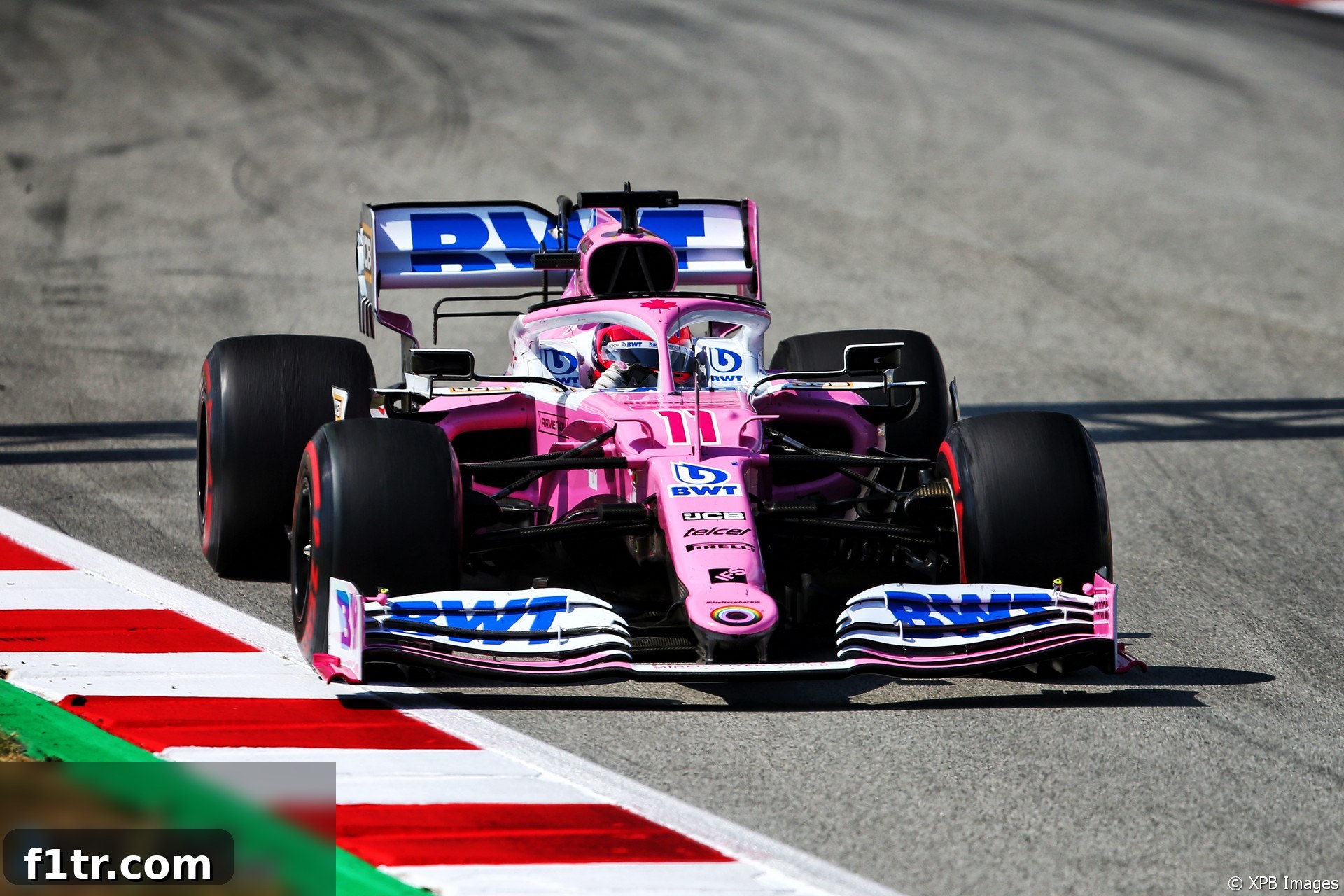
One of the most talked-about incidents of the Spanish Grand Prix involved then-Racing Point driver Sergio Perez, who received a five-second time penalty for an alleged failure to yield to eventual race winner Lewis Hamilton under blue flags. Perez, known for his tenacious driving and strategic prowess, did not mince words in his criticism of the sanction, expressing profound disagreement with the stewards’ interpretation of the event.
Sergio Perez’s Spirited Defense Against Blue Flag Sanction
Perez’s frustration was palpable after the race. Addressing the media, the Mexican driver articulated his confusion, stating, “I don’t understand where I should have moved.” His argument centered on the timing and location of Lewis Hamilton’s approach. According to Perez, Hamilton, in his dominant Mercedes, caught him “very late in the lap,” specifically in the notoriously tight and narrow final sector of the Circuit de Barcelona-Catalunya. Perez emphasized the inherent danger of attempting to move aside in such a constricted section of the track.
“So I didn’t have anywhere,” Perez explained, highlighting the lack of safe yielding opportunities. He believed that any attempt to create space for Hamilton in that particular sequence of corners would have been “very unsafe” for both drivers. Despite his strong conviction that he acted appropriately given the circumstances, the penalty stood. “Still I got a penalty which I feel was very unfair, but it’s how it is,” he concluded, a sentiment echoing the powerlessness drivers often feel when faced with a steward’s final decision.
Understanding Formula 1 Blue Flag Regulations
To fully grasp the context of Perez’s penalty, it’s essential to understand the intricacies of Formula 1’s blue flag regulations. Blue flags are deployed to signal to a lapped driver (a backmarker) that a faster car, typically a race leader or someone on a different lap, is approaching from behind and needs to pass. The primary purpose of these regulations is to ensure safety and prevent slower cars from unduly impeding the progress of faster competitors, thereby maintaining the integrity of the race. The FIA International Sporting Code (Appendix L, Chapter IV, Article 2.5.5) states that “any driver who is about to be lapped must allow the faster car past at the first available opportunity.” Historically, this has been interpreted as within three corners of seeing the blue flag, though precise timing and safe execution are always paramount.
The rules dictate that a driver shown a blue flag must not defend their position against the approaching car and must make it clear that they are allowing the car through. Failure to do so can result in penalties ranging from time additions to points on a driver’s super license. The subjective element often lies in determining what constitutes “allowing the faster car past” and whether a driver has “appreciably slowed down” or “impeded” a competitor. This subjectivity frequently leads to debates like the one initiated by Perez.
Stewards’ Stance and the Weight of the Penalties
In Perez’s case, the stewards were unequivocal in their judgment. Their official statement indicated that both Perez and AlphaTauri’s Daniil Kvyat, who received an identical penalty in a separate incident, “ignored blue flags from at least turn six to turn one of the following lap.” This suggests that the stewards perceived a prolonged period of non-compliance, spanning multiple corners, where opportunities to yield safely should have been taken. The stewards’ interpretation clearly differed from Perez’s assessment of the track conditions and the safety implications.
The ramifications of these penalties extend beyond just the five-second time additions to their race times. Both Perez and Kvyat also incurred one penalty point each on their super licenses. While this was Perez’s first penalty point within the current 12-month period, it marked Kvyat’s fourth. Accumulating 12 penalty points within a rolling 12-month period results in an automatic race ban, making these points a significant concern for drivers, particularly those who frequently find themselves in the stewards’ crosshairs.
Daniil Kvyat’s Parallel Case
Daniil Kvyat’s situation mirrored Perez’s, highlighting a consistent application of the blue flag rule by the stewards during the Spanish Grand Prix. The AlphaTauri driver was also deemed slow to respond when being lapped, leading to his five-second time penalty and an additional penalty point. While the specifics of Kvyat’s incident might have differed in terms of which leading car he was impeding or the exact section of the track, the underlying offense – failure to comply with blue flag directives – remained the same. This dual application of the penalty underscored the FIA’s strict stance on respecting blue flag protocols, even if drivers like Perez felt the circumstances warranted a more lenient view.
Giovinazzi vs. Grosjean: A Close Call and a Racing Incident Verdict
Beyond the blue flag controversies, another incident requiring steward intervention involved Antonio Giovinazzi of Alfa Romeo and Haas driver Romain Grosjean. Their skirmish, characterized by close-quarters racing and a moment where one car went off track, prompted an investigation that ultimately concluded with no further action taken against either driver.
The Incident Unfolds at Turn 1
The incident occurred during a direct battle for track position, a common sight in the competitive midfield of Formula 1. Giovinazzi attempted an overtake on Romain Grosjean at Turn 1, a key braking zone and corner at the Circuit de Barcelona-Catalunya. As Giovinazzi moved to the inside to complete the pass, Grosjean found himself in a precarious position, ultimately having to leave the track to avoid a collision. This kind of maneuver often triggers an immediate review by race control, as forcing another car off the track can result in severe penalties, including time penalties or grid drops.
Stewards’ Investigation and Rationale for No Action
Following a thorough review, including video footage from multiple angles and telemetry data, the stewards decided against taking any action against the Alfa Romeo driver. Their ruling provided a clear rationale for their decision. They determined that “Giovinazzi had substantially completed the overtake on the inside at turn one and had the right to the line.” This phrase is crucial in F1 officiating, indicating that Giovinazzi had established a significant portion of his car alongside Grosjean’s and was ahead enough to claim the racing line through the corner.
Furthermore, the stewards acknowledged Grosjean’s actions: “Grosjean avoided a collision by going off track and correctly followed the race director’s instructions rejoining at turn three.” This highlighted that Grosjean’s departure from the track was a defensive measure to prevent an accident, and his re-entry was executed in compliance with F1 rules, ensuring he did not gain an unfair advantage. The stewards’ ability to dissect the incident into these component parts allowed them to make an informed judgment, recognizing the split-second decisions drivers must make in wheel-to-wheel combat.
The Nuance of a “Racing Incident”
The ultimate conclusion that “Neither driver was predominantly at fault” classified the event as a “racing incident.” In Formula 1, a racing incident is a common term used when an on-track collision or dangerous maneuver occurs where no single driver can be held solely or primarily responsible. It implies that the event was a consequence of aggressive racing, close proximity, and the inherent risks of motorsport, rather than a clear breach of sporting regulations by one party. Such verdicts are often welcomed by drivers and fans, as they allow for hard racing to continue without unnecessary penalization, recognizing that not every contact or off-track excursion warrants a penalty. This particular decision underscored the stewards’ commitment to allowing drivers to race hard, provided the moves are largely fair and within the spirit of competition.
Broader Implications: F1 Officiating, Consistency, and Driver Perspectives
The steward decisions at the Spanish Grand Prix, particularly the blue flag penalties, served as a fresh reminder of the ongoing debates surrounding officiating in Formula 1. Drivers frequently voice concerns about the consistency of penalties applied across different races and incidents, creating an environment where it can be challenging to predict how a specific maneuver will be judged. The subjective nature of interpreting rules like “impeding” or “forcing off track” means that nuances in execution can lead to vastly different outcomes, often to the frustration of those involved.
The Perpetual Debate on Consistency
The calls for greater consistency in stewarding are a constant refrain in the F1 paddock. While the FIA strives for uniformity, the unique circumstances of each incident, combined with the human element of decision-making, inevitably lead to perceived discrepancies. These debates are crucial for the sport, pushing governing bodies to refine rules and provide clearer guidelines, not just for stewards but also for drivers, helping them understand the boundaries of permissible racing.
Challenges of Modern F1 Officiating
Modern F1 officiating is an incredibly complex task, aided by advanced technology like high-definition camera feeds from every angle, telemetry data, and real-time audio from team radios. Yet, even with these tools, making instantaneous and fair judgments in a sport where cars move at over 300 km/h and decisions are made in fractions of a second remains a formidable challenge. Stewards must balance the need for safety, fair play, and the preservation of competitive racing, often under immense pressure and intense scrutiny from the global F1 audience.
Conclusion: A Glimpse into the Complexities of F1 Rule Enforcement
The 2020 Spanish Grand Prix provided a microcosm of the challenges inherent in Formula 1’s rule enforcement. From Sergio Perez’s indignant protests against a blue flag penalty to the nuanced ‘racing incident’ verdict in the Giovinazzi-Grosjean battle, the race underscored the fine line between aggressive driving, sporting fairness, and regulatory compliance. These incidents are not merely footnotes in a race report; they are integral parts of the F1 narrative, shaping driver reputations, impacting championship standings, and continuously fueling the passionate discussions that define the sport. As F1 evolves, so too will the conversations around its rules, ensuring that the pursuit of fair and exciting competition remains at the forefront.
Explore More from the 2020 F1 Season
- Grosjean to make F1 test return tomorrow for first time since Bahrain horror crash
- Pictures: Wrecked chassis from Grosjean’s Bahrain fireball crash to go on display
- Bottas vs Rosberg: Hamilton’s Mercedes team mates compared after 78 races each
- F1 revenues fell by $877 million in Covid-struck 2020 season
- Hamilton and Mercedes finally announce new deal for 2021 season
Browse all 2020 F1 season articles