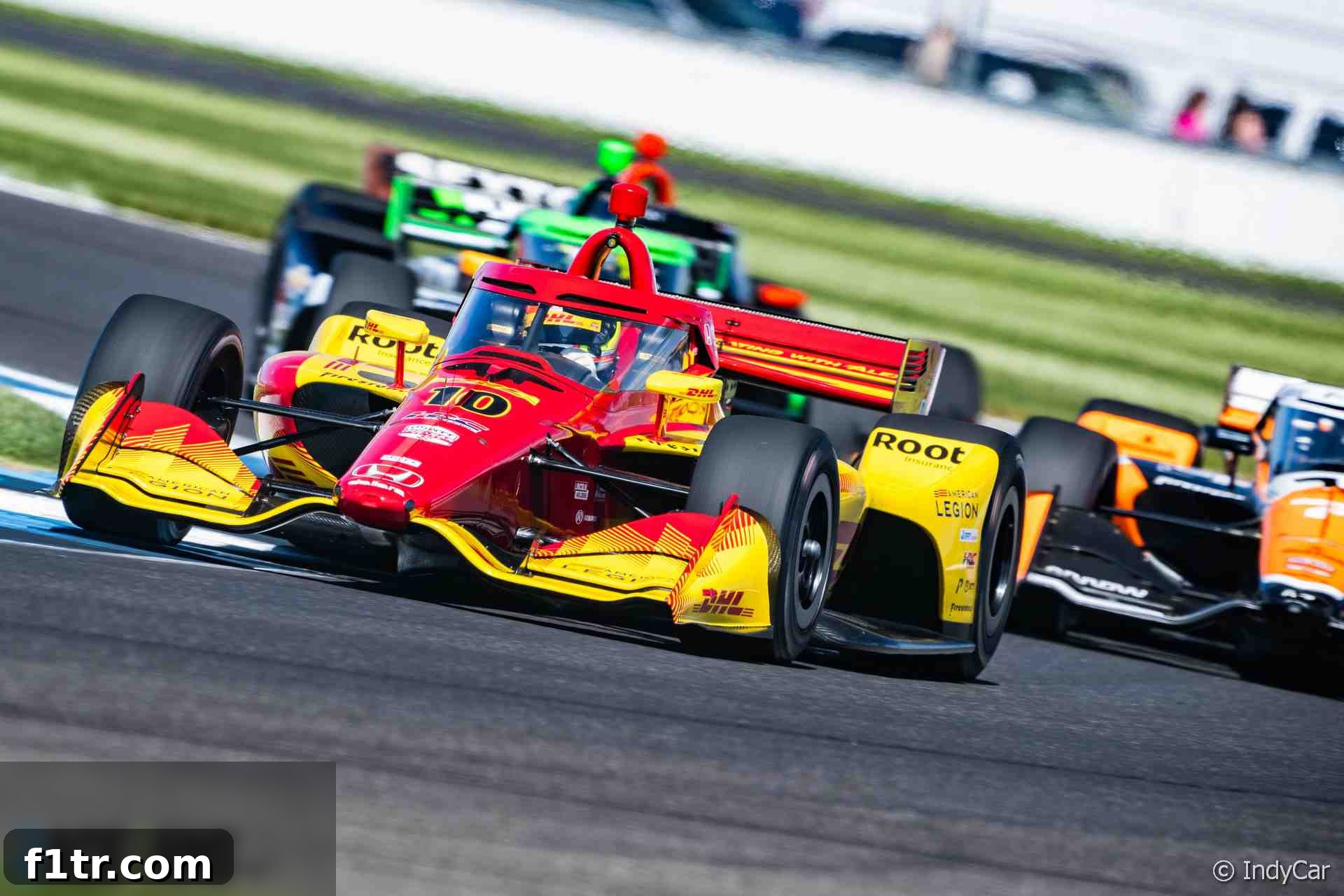
Alex Palou Claims First Season Victory in Electrifying IndyCar Showdown
Reigning IndyCar Series champion Alex Palou delivered a commanding performance to secure his inaugural victory of the season, starting from pole position. While the final margin suggested dominance, the Ganassi Racing driver endured a demanding afternoon, marked by relentless pressure, crucial strategic decisions, and intense on-track battles. This pivotal win not only broke his season’s duck but also propelled him to the top of the championship standings, signalling a strong resurgence for the Spanish talent.
Early Race Dynamics: Lundgaard’s Surprise Challenge
Palou entered the race weekend demonstrating superior pace, translating into a well-earned pole position. However, the initial phase of the race proved anything but straightforward. Christian Lundgaard, starting on the harder primary tires, mounted a surprising and highly effective challenge from the very first lap. Despite Palou’s advantage on the softer alternate tires, Lundgaard seized the lead with a bold move. The Ganassi driver attempted a robust defense into Turn 1 but carried too much speed, running deep and opening the door for Lundgaard to sweep around the outside of Turn 2, securing the inside line for the subsequent sequence of corners and firmly establishing himself at the front.
Lundgaard’s choice of primary tires for the opening stint initially seemed counter-intuitive against Palou’s softer compound but paid dividends in the early stages, allowing him to maintain a consistent lead. Palou, recognizing the unexpected strength of his rival, settled into a strategic rhythm, carefully managing his softer tires and biding his time. The gap between the leaders remained tight, with the race unfolding as a fascinating chess match of tire degradation and fuel management. As the first pit window approached, the tension mounted, with every lap playing a crucial role in shaping the forthcoming strategy.
Strategic Masterclass: The Pivotal Pit Stop Battles
The first round of pit stops proved to be a critical juncture that redefined the race narrative. When Palou and Lundgaard pitted simultaneously, it initially appeared that Lundgaard’s lead would be preserved. However, the strategic landscape was complicated by the swift actions of Will Power, who had been lurking just behind and managed to split the two front-runners during the stops, showcasing the competitive depth of the IndyCar field. Palou, while temporarily third, remained unperturbed, understanding the long game involved in tire conservation and optimal strategy. He methodically worked through his stint on the primary tires, minimizing any time loss and positioning himself for a later charge.
As the second stint progressed, traffic became a significant factor, particularly impacting Lundgaard and Power. This provided Palou with an opportunity to close the gap. Power, sensing a chance to gain an advantage, made an early dive into the pits a lap ahead of Lundgaard. His aggressive strategy almost paid off, but a crucial moment unfolded on his out-lap when he encountered Marcus Ericsson, slowing his progress. Lundgaard, pitting a lap later, emerged from the pit lane narrowly ahead of Power, retaining his hard-fought second place. Yet, it was Palou who truly capitalized on the complex interplay of pit stops and traffic. By extending his run for an extra lap on track, the Spaniard executed a flawless overcut, leapfrogging both Lundgaard and Power to seize a lead he would not relinquish. This strategic masterstroke underscored his team’s precision and his own racecraft.
Caution, Restart, and Palou’s Unassailable Dominance
With Palou now in control, he began to build a significant lead over his rivals, who were forced to contend with their second stint on the primary tires. Lundgaard, still running on the harder compound, found himself losing precious seconds to Palou, while Will Power loomed large in his mirrors, intensifying the battle for second place. The trio eventually pitted together on Lap 63, a coordinated move designed to reset their strategies. However, misfortune struck Lundgaard during his exit from the pits; he was forced to swerve around Power, losing valuable time and, critically, conceding second place to the Penske driver. This incident firmly established Power as Palou’s primary challenger.
The race dynamic was abruptly altered on Lap 66 when Luca Ghiotto’s retirement from his second IndyCar start triggered the race’s sole caution period. This full-course yellow brought the field together, erasing Palou’s hard-earned lead and setting the stage for a dramatic restart. Will Power, known for his prowess in restarts, executed an immaculate launch, placing immense pressure on Palou. The reigning champion, however, displayed steely resolve, defending robustly into Turn 1. Despite Power’s aggressive maneuver, Palou skillfully edged him wide, effectively thwarting his hopes of snatching victory. From that moment, Palou asserted his authority, pulling away from the chasing pack to secure a dominant victory by a margin of over five seconds, leaving Lundgaard to stalk Power to the checkered flag.
Beyond the Podium: Key Performances and Setbacks
While Palou celebrated a well-deserved victory, the race offered numerous compelling storylines throughout the field. His Ganassi teammates, Scott Dixon and Marcus Armstrong, delivered solid performances to complete the top five, showcasing the strength of the Honda-powered team. Scott McLaughlin of Team Penske secured sixth place, making it three New Zealanders in a row within the top six positions. McLaughlin was perhaps the biggest beneficiary of the caution period, having been in the pits just as Ghiotto’s car ground to a halt, allowing him to gain track position relative to some rivals.
Championship leader Colton Herta, who arrived at Indianapolis at the top of the points standings, faced an uphill battle after qualifying a disappointing 24th. His race was further complicated by an early incident with teammate Marcus Ericsson, which sent him wide. Undeterred, Herta’s Andretti Autosport team opted for an aggressive alternative pit stop strategy, making an early first stop on Lap 12 to discard his primary tires. He then ran three impressive stints on fresh alternate tires, showcasing exceptional pace and strategic brilliance to climb all the way back up to a remarkable seventh place. While a stellar recovery, it wasn’t quite enough to prevent Alex Palou from leapfrogging him to take over the championship lead.
Alexander Rossi was the highest-placed McLaren driver, finishing a commendable eighth. His teammate Pato O’Ward endured a significantly more challenging afternoon. O’Ward had been forced to take a fresh engine after a failure in final practice, and he struggled throughout the race with a noticeable lack of power, slowly sinking from his starting position of fifth to a disappointing 13th by the checkered flag. The McLaren team will undoubtedly be analyzing the power unit issues closely.
Rounding out the top ten were Graham Rahal and Felix Rosenqvist, the latter demonstrating a strong recovery after a poor start to his race. Kyle Kirkwood finished 11th, just ahead of Romain Grosjean, who expressed considerable frustration after an early-race entanglement with Santino Ferrucci sent him off-track. Josef Newgarden, another championship contender, had an afternoon to forget, finishing 17th after tangling with Jack Harvey during the crucial restart period, highlighting the fine margins and high stakes of IndyCar racing.
Championship Landscape Shifts After Palou’s Victory
Alex Palou’s triumphant win marks a significant turning point in the IndyCar Series championship. This first victory of the season provides him with immense momentum and, more importantly, propels him to the top of the driver standings, replacing Colton Herta. His strategic prowess and ability to perform under pressure have firmly established him as a formidable force once again, setting the stage for an enthralling championship battle throughout the remainder of the season. With strong performances from Ganassi teammates and renewed challenges from Power and Lundgaard, the 2024 IndyCar season promises to deliver more captivating racing.
Race Result
| P. | No. | Driver | Team | Engine |
|---|---|---|---|---|
| 1 | 10 | Alex Palou | Ganassi | Honda |
| 2 | 12 | Will Power | Penske | Chevrolet |
| 3 | 45 | Christian Lundgaard | RLL | Honda |
| 4 | 9 | Scott Dixon | Ganassi | Honda |
| 5 | 11 | Marcus Armstrong | Ganassi | Honda |
| 6 | 3 | Scott McLaughlin | Penske | Chevrolet |
| 7 | 26 | Colton Herta | Andretti/Curb-Agajanian | Honda |
| 8 | 7 | Alexander Rossi | McLaren | Chevrolet |
| 9 | 15 | Graham Rahal | RLL | Honda |
| 10 | 60 | Felix Rosenqvist | Meyer Shank | Honda |
| 11 | 27 | Kyle Kirkwood | Andretti | Honda |
| 12 | 77 | Romain Grosjean | Juncos Hollinger | Chevrolet |
| 13 | 5 | Pato O’Ward | McLaren | Chevrolet |
| 14 | 30 | Pietro Fittipaldi | RLL | Honda |
| 15 | 4 | Kyffin Simpson | Ganassi | Honda |
| 16 | 28 | Marcus Ericsson | Andretti | Honda |
| 17 | 2 | Josef Newgarden | Penske | Chevrolet |
| 18 | 18 | Jack Harvey | Coyne | Honda |
| 19 | 6 | Theo Pourchaire | McLaren | Chevrolet |
| 20 | 20 | Christian Rasmussen | Carpenter | Chevrolet |
| 21 | 78 | Agustin Canapino | Juncos Hollinger | Chevrolet |
| 22 | 41 | Sting Ray Robb | Foyt | Chevrolet |
| 23 | 66 | Tom Blomqvist | Meyer Shank | Honda |
| 24 | 8 | Linus Lundqvist | Ganassi | Honda |
| 25 | 51 | Luca Ghiotto | Coyne | Honda |
| 26 | 21 | Rinus VeeKay | Carpenter | Chevrolet |
| 27 | 14 | Santino Ferrucci | Foyt | Chevrolet |
Related IndyCar Content
- IndyCar driver McLaughlin cleared of injury after crashing through barrier at Barber
- Schumacher says his IndyCar feels like ‘an F2 car, just with better tyres’
- IndyCar “way faster than Formula 1” in some corners, says Grosjean
- FIA to award more F1 superlicence points to IndyCar drivers from 2026
- Schumacher to race full-time in IndyCar with RLL in 2026
Browse all IndyCar articles