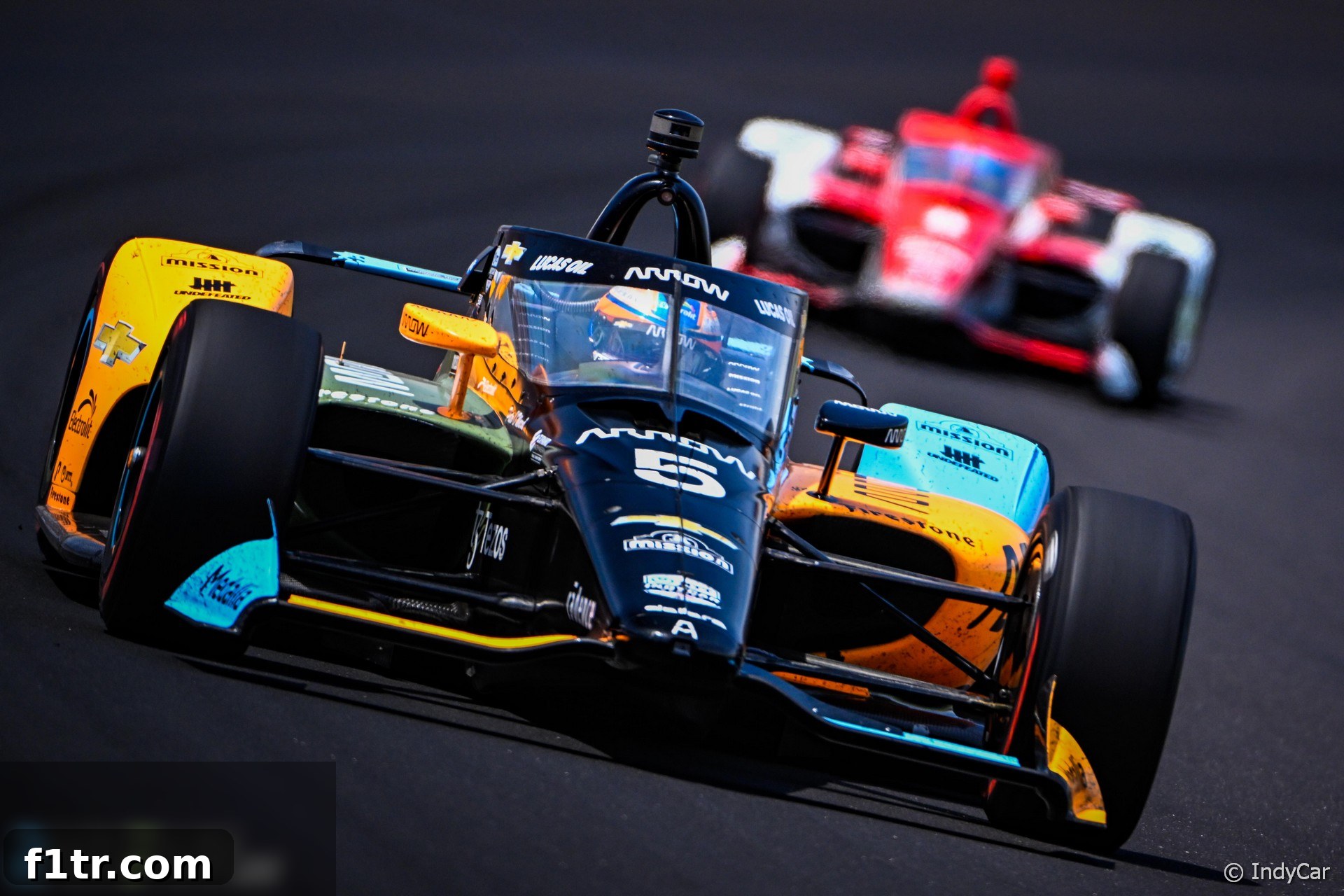
Pato O’Ward’s Indianapolis 500 Dream: A Valiant Effort for History
The roar of the engines, the fervent crowd, and the palpable tension of the Indianapolis Motor Speedway set the stage for one of the most iconic events in motorsports: the Indianapolis 500. In a race filled with drama, strategic brilliance, and breathtaking speed, Mexican driver Pato O’Ward came tantalizingly close to etching his name in the annals of history. While a maiden victory at the “Greatest Spectacle in Racing” ultimately eluded him, O’Ward delivered a stellar performance, securing a career-best second-place finish and showcasing the immense talent that has quickly made him one of IndyCar’s brightest stars. This near-triumph, a testament to his skill and McLaren SP’s growing prowess, marked a significant milestone in his burgeoning career.
A Strong Foundation: McLaren SP’s Formidable Presence
Pato O’Ward’s journey to the runner-up spot was a collective effort, spearheading a robust three-car challenge from McLaren SP. The team demonstrated exceptional synergy and strategic foresight throughout the grueling 500-mile race. O’Ward was ably supported by his teammates, with Felix Rosenqvist delivering a strong fourth-place finish, underscoring the team’s depth and competitive edge. Veteran racer Juan Pablo Montoya, a two-time Indy 500 champion, added further experience to the lineup, navigating his way to an eleventh-place finish. This comprehensive team performance highlighted McLaren SP’s ambition and their relentless pursuit of top honors in the NTT IndyCar Series, solidifying their position as a formidable force on the grid.
“They gave me a really, really good car,” O’Ward stated, beaming with pride for his crew’s hard work. “I was so happy with the handling. We did everything perfectly, we did the fuel perfect, no mistakes were done. We positioned ourselves perfectly to have a shot at it.” These words reflect not only the quality of his machinery but also the flawless execution of the team’s race strategy, which placed him in prime contention for victory from the outset.
Strategic Brilliance and Sustained Pace: O’Ward’s Race Unfolds
From the moment the green flag waved, Pato O’Ward asserted his presence at the front of the field. He consistently ran inside the top five, a remarkable feat that speaks volumes about his pace, consistency, and race craft. His strategic acumen was particularly evident during the pit stop sequences, where McLaren SP’s quick work and O’Ward’s precise driving allowed them to gain crucial track position. In a pivotal moment, O’Ward executed a brilliant overcut on rival Scott Dixon during the penultimate round of pit stops, a move that propelled him into serious contention for the lead and put him firmly in the hunt for the ultimate prize.
The final round of pit stops, however, introduced a new dynamic. O’Ward pitted on lap 177, but teammate Felix Rosenqvist, who had stopped five laps earlier, managed to undercut him. This subtle shift in track position created a fascinating intra-team battle and set the stage for the dramatic closing stages of the race. The ebb and flow of pit stop strategies often dictate the outcome at Indianapolis, and while O’Ward’s team had been near perfect, the timing of these crucial stops would prove to be a defining factor in the ultimate classification.
The Emergence of a Rival: Marcus Ericsson’s Unstoppable Charge
Just as O’Ward was working to regain his rhythm after the final pit sequence, a new and unexpected threat emerged. The formidable Marcus Ericsson, driving with astonishing speed, began to close the gap rapidly. Ericsson’s car appeared to possess an almost unparalleled straight-line pace, making his progress through the field relentless and decisive.
“When we got done with that last pit stop, Felix undercut us,” O’Ward explained, recounting the tense moments. “Then when I pitted and started catching up to him – then Marcus, out of nowhere, just came out with insane speed. He got by me like I was standing still.” This candid admission from O’Ward highlighted the sudden and overwhelming advantage Ericsson seemed to possess, which fundamentally altered the complexion of the race’s leading battle. Despite O’Ward’s valiant efforts to match his pace, Ericsson proved to be a force to be reckoned with.
Following this setback, O’Ward managed to re-pass Rosenqvist, reaffirming his position as the lead McLaren SP driver. However, the challenge of keeping pace with Ericsson remained significant, especially as the leaders began to encounter lapped traffic. Navigating slower cars on the high-speed oval demands precision and careful timing, and for O’Ward, it exacerbated his struggle to close the gap to the leader. “I had nothing for him,” he confessed, acknowledging Ericsson’s superior speed. “I said, ‘I need a yellow to try and have a shot.'” The hopes for a caution period, which could neutralize Ericsson’s advantage and bunch up the field, became O’Ward’s primary focus in the closing stages.
Adding to the pressure, veteran Tony Kanaan was also charging hard from behind, showcasing impressive speed. O’Ward noted, “Tony [Kanaan] was also really quick coming behind me. I know he was catching me faster than what I was catching Marcus.” The potential threat from Kanaan underscored the competitive intensity of the Indy 500, where challenges can emerge from multiple directions right until the very end.
The Dramatic Climax: Red Flag and a Shot at Glory
As if in response to O’Ward’s wish, the racing gods intervened. With just four laps remaining, a dramatic crash involving Jimmie Johnson brought out the yellow flag, which quickly turned into a red flag, halting the race and setting up a thrilling sprint to the finish. This unexpected turn of events provided O’Ward with precisely the opportunity he had hoped for: a chance to reset, regroup, and launch one final assault on the leader.
When the race resumed, O’Ward restarted from second position, directly behind Ericsson and ahead of Kanaan, perfectly poised to challenge for victory. The tension was palpable as the cars roared back to life, knowing that only a handful of laps remained to decide the winner of the 106th running of the Indy 500.
As the leaders took the white flag, signaling one lap to go, O’Ward unleashed his attack. He slipstreamed Ericsson, taking full advantage of the aerodynamic tow, despite aggressive weaving from the race leader designed to break the suction and prevent an overtake. With nerves of steel and absolute determination, the Mexican driver lined up a bold move around the outside heading into Turn One. It was a high-risk, high-reward maneuver, typical of an Indy 500 hero.
However, despite his valiant effort, O’Ward ultimately lacked the sheer straight-line speed to complete the pass. Ericsson, deftly defending his position by holding the inside line, managed to keep O’Ward at bay. “When the restart happened, I said, ‘I have one shot, I have to go flat.’ And it still wasn’t enough,” O’Ward lamented after the race. “Sadly, they have the faster car. I was surprised with how much more pace they had in a straight line, with quite a bit more downforce. I was just trying to time it as good as possible.”
O’Ward also acknowledged the effectiveness of Ericsson’s defensive tactics: “Obviously the weaving helped him. Staying on the inside helped him. I got alongside him, but we all know how that ends up in the last lap. No way he would have backed off.” He later told the IndyCar Radio Network that while Ericsson was defending very aggressively, he “would have done the same thing” if the roles were reversed, showcasing his sportsmanship and understanding of the high stakes involved in an Indy 500 final lap.
Reflections, Future, and Long-Term Commitment
The emotions following such a near-miss are complex – a mixture of pride, disappointment, and a renewed determination. O’Ward succinctly captured this sentiment, “I’m proud of the job we did today. It’s my best result in the 500. Just… It’s a bit of a tough pill to swallow after such a long race, and doing everything correctly.” His words encapsulate the agony of coming so close after a seemingly flawless execution.
Despite the heartbreak, O’Ward remains pragmatic and forward-looking. He conceded that he and the entire McLaren SP team still have room to improve as they continue their collective pursuit of their first Indianapolis 500 victories. This continuous drive for perfection is what defines championship-contending teams and drivers.
Looking to the future, there is ample time for O’Ward and McLaren SP to achieve their ultimate goal. Just days before the race, O’Ward officially committed his future to the team, signing a three-year contract extension that will see him remain with McLaren SP through the 2025 season. This long-term commitment underscores the confidence both O’Ward and the team have in each other’s potential and their shared ambition for success.
“We need to do a better job,” O’Ward declared, already looking ahead. “We need to come back next year and give it hell again.” This statement serves as a powerful promise to fans and a clear message to rivals: Pato O’Ward and McLaren SP are not deterred by this second-place finish; they are fueled by it. The pursuit of Indy 500 glory will continue with renewed vigor and determination in the coming years, with O’Ward firmly at the helm of McLaren SP’s challenge.
His performance, marked by strategic brilliance, unyielding speed, and commendable sportsmanship, not only garnered respect but also cemented his status as one of IndyCar’s most exciting talents. For Pato O’Ward, the dream of becoming the first Mexican driver to win the Indianapolis 500 remains a powerful driving force, and with his commitment to McLaren SP, he is undoubtedly positioned to challenge for that historic victory again and again.
More from IndyCar
- IndyCar driver McLaughlin cleared of injury after crashing through barrier at Barber
- Schumacher says his IndyCar feels like ‘an F2 car, just with better tyres’
- IndyCar “way faster than Formula 1” in some corners, says Grosjean
- FIA to award more F1 superlicence points to IndyCar drivers from 2026
- Schumacher to race full-time in IndyCar with RLL in 2026
Browse all IndyCar articles