Advert | Become a Supporter & go ad-free
Advert | Become a Supporter & go ad-free
Esteban Ocon’s Costly Q1 Crash: A Weekend Defined by Adversity and the Yellow Flag Domino Effect
The high-stakes world of Formula 1 qualifying often delivers drama, and a recent session proved no exception as Esteban Ocon’s unfortunate contact with a barrier during his final flying lap led to his premature exit from Q1. This incident not only curtailed his own qualifying hopes but also inadvertently impacted a championship contender, underscoring the razor-thin margins and unpredictable nature of top-tier motorsport.
Ocon’s mishap, which saw him damage his Alpine, meant he failed to progress beyond the first round. However, the ripple effect of his error extended to Lando Norris. As Ocon cautiously navigated his damaged car back to the pits, the resulting yellow flags forced Norris to abandon his own competitive lap, sealing his fate and ensuring his elimination from Q1 as well. This chain of events highlighted how one driver’s misfortune can dramatically alter the fortunes of another, particularly in the pressure cooker of a qualifying session.
A Weekend Plagued by Technical Woes for Alpine and Ocon
The qualifying crash was, unfortunately, the culmination of an exceptionally challenging weekend for Esteban Ocon and his Alpine team. From the outset, their preparations were severely hampered by a series of reliability issues, leaving the French driver with significantly limited track time – a crucial element for any F1 driver aiming to extract maximum performance from their car and fine-tune its setup.
The Crucial Role of Practice Sessions
The weekend began on a sour note during the first practice session (FP1), where Ocon’s running was abruptly cut short due to a problem with his MGU-H unit. The Motor Generator Unit – Heat (MGU-H) is a complex component of the hybrid power unit, responsible for recovering energy from exhaust gases. A malfunction in this system not only deprives a driver of crucial hybrid power but also disrupts overall engine performance, leading to a significant loss of lap time and forcing the car back to the garage for repairs.
While Ocon was able to participate in the second practice session (FP2), giving him some much-needed laps, reliability issues resurfaced with a vengeance in the final practice session (FP3) just hours before qualifying. Another technical snag, this time concerning his high-pressure fuel system, brought his car to a halt on the circuit. Such an issue can be critical, disrupting fuel delivery to the engine and rendering the car immobile.
Alpine’s Battle with Reliability and the Impact on Performance
The accumulation of these mechanical failures meant Ocon had minimal valuable running throughout the entire weekend. “It’s been a very difficult weekend, for sure,” Ocon conceded to the official F1 channel. “I had pretty much no laps, maybe six valuable laps in the whole weekend. So it’s been extremely complicated to miss FP1 and FP3.” This severe lack of track time is a significant handicap in Formula 1, where every minute on track is used to gather data, test setup changes, and for the driver to build confidence and rhythm with the circuit and car.
The absence of sufficient practice laps inevitably left Ocon dissatisfied with his car’s balance heading into qualifying. “I went to quali with no laps and no set-up adjustment, really, with the car,” he explained. “The car was difficult to drive, not really like I would have liked it to be.” Driving a Formula 1 car on the limit demands absolute precision and a symbiotic relationship between driver and machine. When the car’s balance is off – perhaps suffering from unpredictable oversteer or persistent understeer – it becomes a formidable challenge to push to the required extreme without making a mistake. This predicament set the stage for the dramatic events of Q1.
The Perils of Pushing Limits: Ocon’s Qualifying Crash
With limited data and an unsettled car, Ocon was under immense pressure to find time on his final qualifying attempt. He knew he had to extract every ounce of performance, pushing the boundaries to secure a spot in Q2. This relentless pursuit of lap time, combined with an imperfect car setup, ultimately led to his downfall.
The Defining Moment: Turn 4 Incident
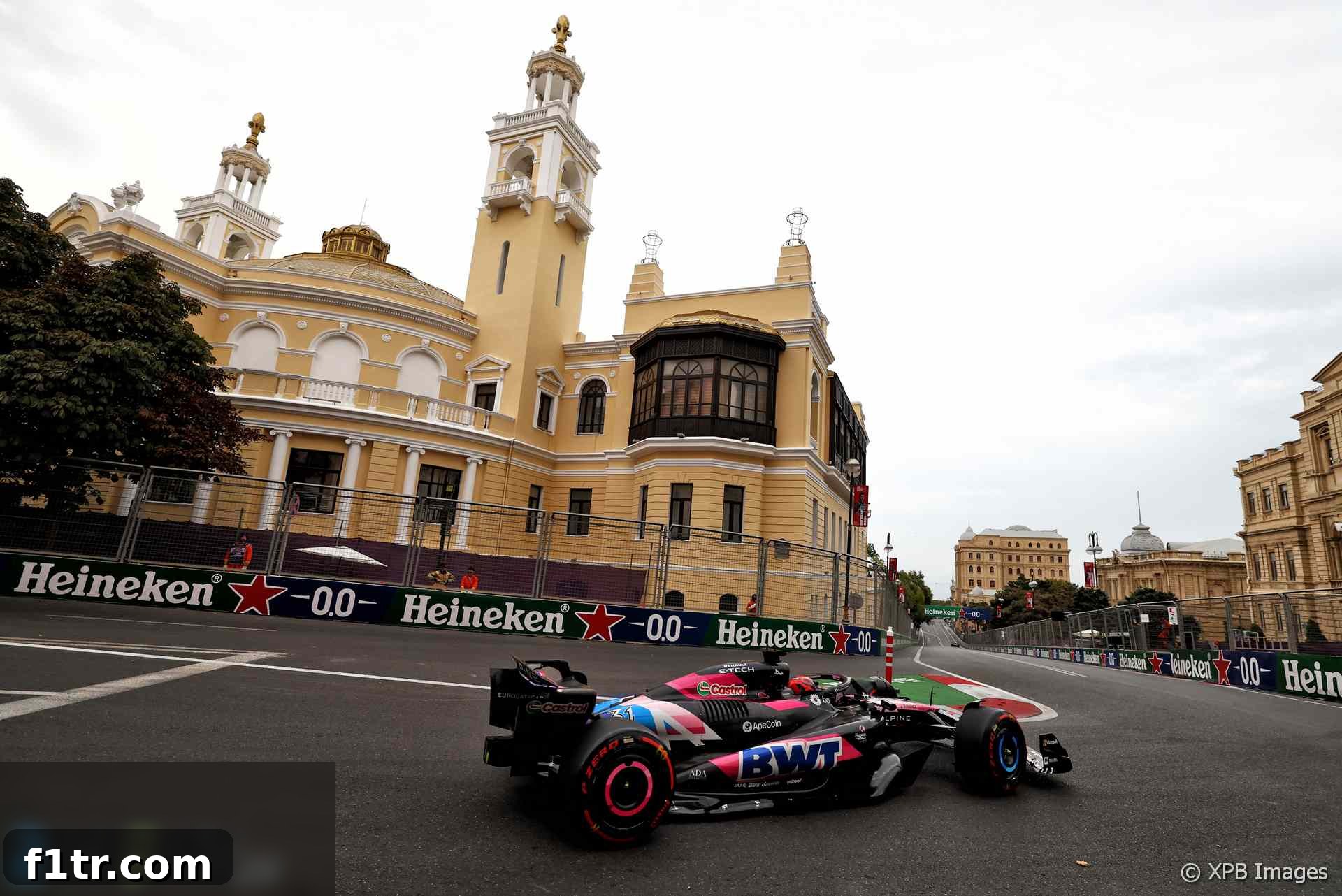
The incident occurred as Ocon was attempting to improve his lap time. At the exit of Turn 4, a corner that demands both precision and confidence, he inadvertently touched the barrier with his car’s left-rear wheel. Even a slight brush at high speed can have catastrophic consequences for the delicate aerodynamics and suspension components of a Formula 1 car. The impact immediately compromised the car’s handling and potentially inflicted structural damage, making it impossible to continue at a competitive pace.
Following the contact, Ocon’s car became uncontrollable, forcing him to run onto the run-off area at Turn 6. Recognizing the damage and the futility of continuing his lap, he then began to drive slowly back to the pit lane. It was during this slow return that the incident took on broader implications.
The Domino Effect: How Yellow Flags Impacted Norris
As Ocon’s compromised Alpine limped back to the garage, race marshals swiftly deployed yellow flags to warn other drivers of the stationary or slow-moving vehicle and potential debris on track. Under Formula 1 regulations, drivers are mandated to significantly reduce their speed in yellow flag zones and must not set a competitive lap time. For Lando Norris, who was also on a crucial flying lap trying to secure his passage to Q2, this timing was devastating.
Norris, adhering to the safety regulations, had no choice but to back off, effectively destroying his lap time. This unavoidable compliance with the yellow flag rules meant that his best efforts were negated, resulting in his elimination from the first round of qualifying. The incident starkly illustrated how the actions of one driver, even unintentionally, can directly influence the performance and qualifying outcome of others, particularly when safety measures are rightly invoked.
Driver’s Perspective: Frustration and Self-Reflection
In the aftermath, Ocon was candid about the circumstances leading to his error. “Obviously I pushed the limits on that last lap and hit the wall and that was it,” he explained. His statement perfectly encapsulates the mindset of an F1 driver in qualifying: constantly pushing the absolute maximum, flirting with the edge of grip and control, where the smallest misjudgment can have massive repercussions.
Ocon on Car Balance and Setup Challenges
Despite the crash, Ocon believed he was on an improving lap, which further highlights the fine margins in Q1. However, he also admitted, “it would have been a tricky one to get through anyway.” This sentiment underscores the deep-seated issues with his car’s setup and balance, which had been exacerbated by the lack of practice time. A driver’s confidence stems from a predictable and well-balanced car; without that, even their utmost effort can lead to an unforced error. The weekend had truly tested his resolve, forcing him into a corner where taking extreme risks felt like the only option to advance.
The frustration for Ocon must have been palpable. To have a weekend consistently derailed by mechanical issues, then to compound it with a qualifying error, puts an immense psychological burden on a driver. His comments paint a picture of a driver fighting not just the stopwatch and his competitors, but also a car that was not cooperating and a string of bad luck.
Looking Ahead: An Uphill Battle from the Back of the Grid
The consequence of Ocon’s Q1 exit is a daunting starting position for the upcoming race: the back row of the grid. From such a disadvantageous spot, scoring points becomes an incredibly challenging task, requiring a combination of strategic brilliance, flawless driving, and a significant dose of fortune.
Strategic Implications for the Race
Starting at the rear of the field compels teams to adopt different strategic approaches. Ocon mentioned a potential silver lining: “We kept some [fresh] tyres for the race tomorrow in case something happens.” Saving fresh tire sets can be a shrewd move, offering more grip and performance during crucial stints of the race, or providing flexibility for alternative strategies such as an early pit stop or a longer first stint. These tires could be deployed during safety car periods or other race interruptions to gain an advantage over competitors who have used up their allocation.
However, simply having fresh tires is often not enough. Ocon will need to navigate the chaotic opening laps, avoid further incidents, and meticulously manage his pace and tire degradation. The Alpine team will be hoping for a safety car or even a red flag period to bunch up the field, giving Ocon an opportunity to unlap himself or make up positions through clever pit lane timing.
Alpine’s Hopes for a Turnaround
“We’ll trying to build on the best we can and hopefully have a decent race tomorrow,” Ocon stated, reflecting the team’s pragmatic approach. For Alpine, the objective will shift from aiming for high points to simply maximizing their chances and salvaging whatever they can from a weekend that has gone wrong. Every position gained, every car overtaken, will be a small victory in itself. The team will undoubtedly analyze the technical issues that plagued Ocon’s weekend, aiming for immediate solutions to prevent similar occurrences in future races.
The Broader Championship Narrative
While Ocon’s incident directly impacted his own race, the implications for Lando Norris, a key figure in the championship battle, cannot be overlooked. Losing a valuable qualifying position due to an unavoidable yellow flag is a blow to any driver, especially one vying for top honors. Every point, and every grid position, can prove critical over a long season. While Norris’s Q1 exit may not be catastrophic, it certainly adds an unnecessary layer of difficulty to his race weekend, forcing him to fight through traffic rather than capitalize on a potentially strong starting position. This incident serves as a stark reminder that in Formula 1, the championship is not just won through raw speed, but also through resilience against unforeseen circumstances and capitalizing on every opportunity.
Conclusion: Resilience in the Face of Adversity
Esteban Ocon’s weekend was a testament to the unpredictable and often cruel nature of Formula 1. Plagued by persistent technical problems and culminating in a Q1 crash that also affected Lando Norris, it was a harsh lesson in the compounding effects of bad luck and the pressure to perform. As Ocon prepares to start from the back, his and Alpine’s focus will be on damage limitation, tactical brilliance, and hoping for the kind of fortune that has so far eluded them. The road ahead for Ocon will be challenging, but the true spirit of a Formula 1 driver is often revealed not in victory, but in their ability to fight back from adversity.
Further Reading from RaceFans
Browse all 2024 Azerbaijan Grand Prix articles