In the high-stakes world of Formula 1, every race weekend presents a crucial opportunity for teams to refine their machinery and gain a competitive edge. For the Mercedes-AMG Petronas Formula 1 Team, the United States Grand Prix marked a pivotal moment, as they introduced what Lewis Hamilton himself described as their “last big update” for the W14 chassis. This wasn’t merely about current race performance; it was a critical litmus test, designed to affirm the team’s developmental trajectory and instill confidence for the design philosophy of their highly anticipated 2024 challenger.
The 2023 season has been a challenging odyssey for Mercedes, a team accustomed to championship dominance. They began the year with a bold, yet ultimately flawed, ‘zero sidepod’ concept – a design philosophy they had stubbornly adhered to despite initial difficulties in 2022. This radical approach, intended to unlock significant aerodynamic gains, instead proved to be a fundamental limitation, preventing the W14 from consistently challenging for victories. Recognizing the need for a drastic shift, Mercedes courageously abandoned this novel concept mid-season, initiating a complete overhaul of their car’s aerodynamic platform. Since that significant conceptual pivot, the team has diligently pursued a path of incremental improvements, each upgrade a painstaking step towards understanding and optimizing their new direction. This latest, substantial update represented the culmination of months of dedicated effort, a decisive statement on where Mercedes believes its future lies.
The journey back to the top has been made even more arduous by the intensifying competition within the Constructors’ Championship. While Red Bull Racing has maintained an almost unassailable lead, the battle for ‘best of the rest’ has become fiercely contested. McLaren, in particular, has emerged as a formidable threat, undergoing a remarkable mid-season transformation. Their comprehensive upgrade package, initially introduced at the Monaco Grand Prix and further refined in subsequent races, propelled them from midfield obscurity to genuine podium contenders. This meteoric rise sent shockwaves through the paddock, placing immense pressure on Mercedes to respond. Similarly, Ferrari, after a somewhat inconsistent start to the season, rediscovered a strong vein of form following the summer break. Their triumphant victory in Singapore, breaking Red Bull’s undefeated streak, underscored their potential and further complicated Mercedes’ championship aspirations. As a direct consequence of these resurgent rivals, Mercedes found itself under increased pressure in the constructors’ standings, with every point becoming vital. The previous round in Qatar offered a fleeting respite, being the first time in six races that Mercedes managed to out-score Ferrari, a result partly aided by Carlos Sainz Jnr’s unfortunate failure to start due to a technical issue. This tight competitive landscape amplified the importance of the W14’s final major upgrade, making it not just about performance, but about maintaining their position in the pecking order.
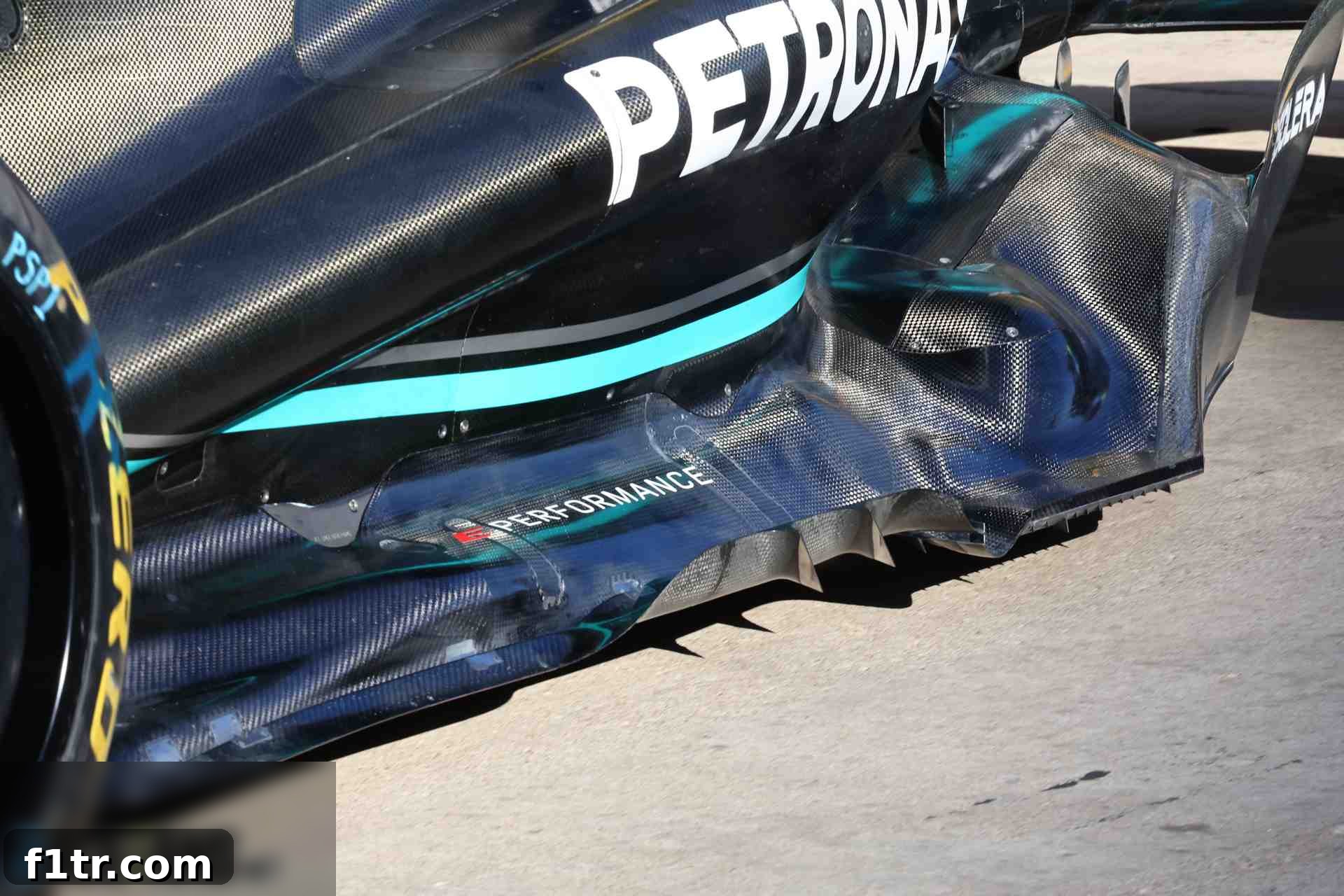
The core of Mercedes’ crucial upgrade for the Circuit of the Americas focused on a meticulously revised floor. In modern Formula 1, under the current ground-effect regulations, the floor is arguably the single most critical aerodynamic component of a car. It is responsible for generating the vast majority of downforce, effectively sucking the car to the track surface and allowing for incredible cornering speeds. Small changes to its design can yield disproportionately large performance gains or, conversely, introduce significant instability. Speaking earlier in the week, Mercedes Technical Director James Allison expressed cautious optimism about the new component, suggesting it could be worth up to a tenth of a second per lap around the challenging Circuit of the Americas. While a tenth of a second might sound marginal, in the hyper-competitive world of F1, it can be the difference between pole position and several grid spots, or between a podium finish and no points at all. This significant investment of resources and engineering effort underscored the team’s commitment to extracting every last ounce of performance from the W14, with an eye firmly fixed on what this data would mean for the W15.
For seven-time world champion Lewis Hamilton, this update carried profound significance, extending beyond the immediate race result. “It’s been a huge amount of work back at the factory,” Hamilton acknowledged, his words carrying the weight of the immense effort expended by hundreds of engineers and designers. He emphasized the scale of the undertaking, describing it as “our last big update, or the biggest of the large updates through the season.” His excitement was palpable, driven by the anticipation of how the car would feel and perform with these changes. Hamilton articulated the core hope behind the update: “All the amazing people back at the factory have worked incredibly hard during the whole season and hopefully this really kind of tips the needle a little bit and helps us in the right direction of where we want to pursue next year.” This “tipping the needle” metaphor perfectly encapsulates the delicate balance of F1 development – making incremental gains that ultimately coalesce into a significant performance advantage. For Hamilton, a driver renowned for his acute understanding of car dynamics and his ability to push machinery to its absolute limit, feeling this positive shift was paramount for validating Mercedes’ long-term vision and for building a strong foundation for a more competitive W15.
Mercedes was not alone in bringing new hardware to Austin. The United States Grand Prix, often positioned towards the latter half of the season, frequently serves as a crucial testing ground for teams looking to evaluate concepts for the following year. Aston Martin, Alfa Romeo, and Haas were among several other teams who had also indicated their plans to trial new parts. This widespread introduction of upgrades highlighted a common strategy across the paddock: leveraging the final races to gather vital data and validate design theories for their 2024 contenders. However, the unique sprint weekend format at COTA presented a significant challenge for all teams. With only a single practice session available before qualifying, the window to assess the benefit of these new changes was severely limited. Engineers and drivers had to work under immense pressure to quickly understand the nuances of the new components, optimize the car’s setup, and extract maximum performance in a drastically reduced timeframe. This compressed schedule magnified the stakes for Mercedes, making their floor update not just an engineering exercise, but also a test of their operational efficiency and ability to adapt rapidly.
Hamilton’s expectations for the upgrade were clear, even if he couldn’t pinpoint specific sections of the circuit where he would feel the improvement most. “I don’t know exactly all the different parts of the circuit that I’ll feel it,” he admitted, “But hopefully it’s a global improvement and hopefully puts us a little bit closer to the guys ahead.” This desire for a “global improvement” underscores the complexity of modern F1 aerodynamics, where changes in one area can have ripple effects across the entire car. The aim was not just a gain in a specific corner type but an overall enhancement of the car’s balance, stability, and efficiency – qualities that translate into faster lap times across a diverse track like COTA. This iconic track, with its challenging S-curves, high-speed straights, and dramatic elevation changes, offers an excellent proving ground for evaluating aerodynamic performance across a wide range of car attitudes and speeds. A positive performance here would provide invaluable data, confirming the direction for the 2024 car and offering a psychological boost as the team works towards recapturing its championship-winning form.
Pictures: Mercedes’ floor update at Circuit of the Americas
Ultimately, the performance of the W14’s new floor at COTA was more than just a quest for immediate race results; it was a profound statement about Mercedes’ strategic direction for the future. The data gathered, the feedback from Hamilton, and the overall feel of the car with this significant update were all crucial pieces of the puzzle for the W15. The team’s commitment to pushing the boundaries of development, even in a challenging season, highlights their relentless pursuit of excellence. As Lewis Hamilton rightly pointed out, every small improvement is a step in the “right direction of where we want to pursue next year.” The journey back to the pinnacle of Formula 1 is long and arduous, but with this final significant update, Mercedes laid down a marker, signaling their unwavering intent to return to championship contention in the seasons to come.
2023 United States Grand Prix Related News
- US GP was Mercedes’ best race of 2023 despite disqualification – Wolff
- Singapore and Austin retirements cost me top 10 championship place – Ocon
- United States Grand Prix result unchanged as FIA rejects Haas’ call for review
- Sargeant admits he’s ‘struggled to use all the downforce at times’ in F1
- Mercedes’ Brazilian GP set-up was “conservative” after US GP disqualification
Browse all 2023 United States Grand Prix articles