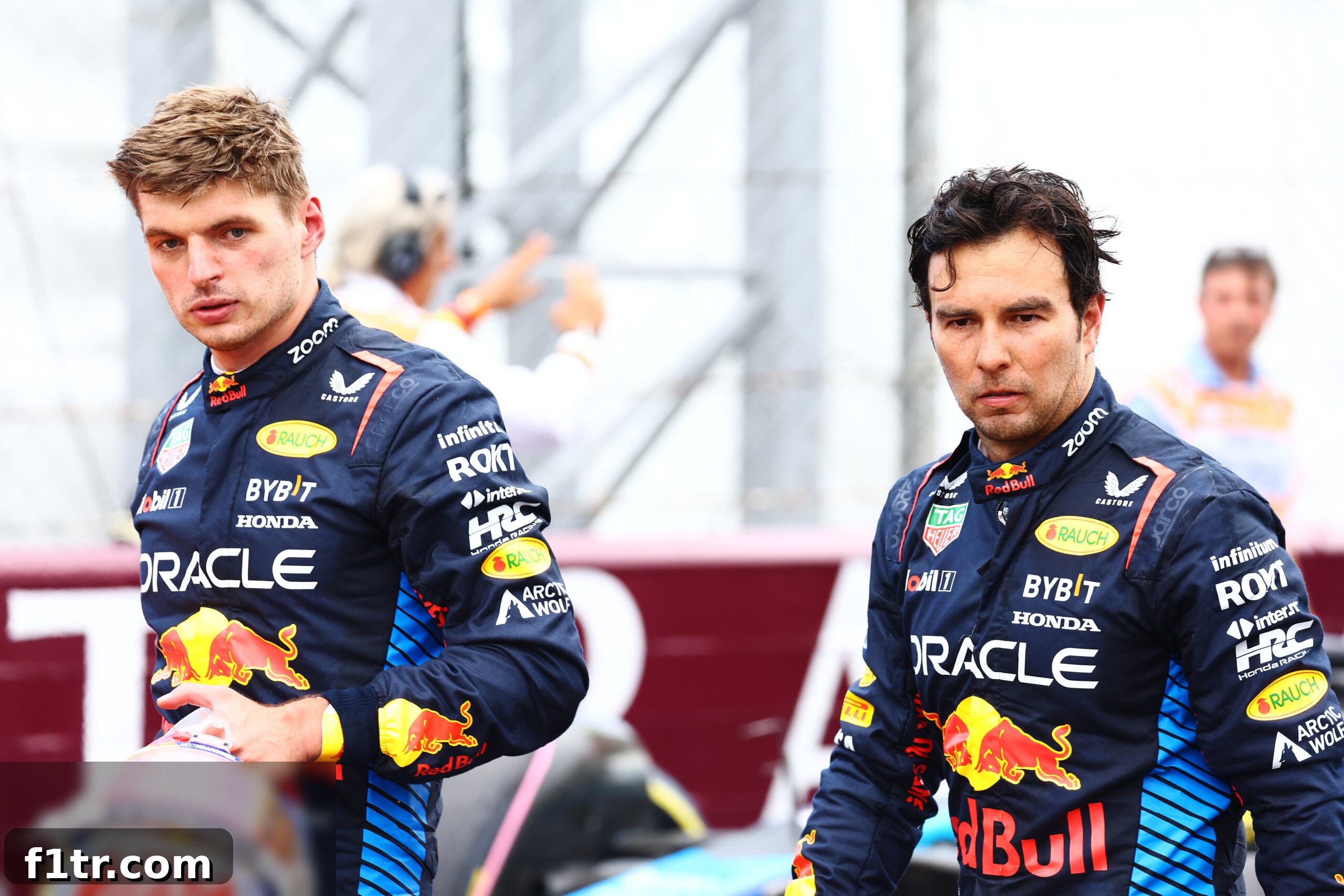
Sergio Perez Insights: Max Verstappen Now Grappling with Red Bull’s Familiar Car Challenges
Red Bull Racing’s Formula 1 season has taken an intriguing turn, as Sergio Perez has openly suggested that his teammate, reigning world champion Max Verstappen, is now confronting the very same car performance issues that have significantly challenged Perez for much of the current campaign. This revelation comes amidst a period of unexpected struggle for the once-dominant Red Bull team, sparking widespread discussion about the underlying dynamics of their machinery and its impact on both drivers’ ability to extract maximum performance.
The recent race weekend underscored this shift, with both Red Bull drivers lining up on the fourth row of the grid – an unusually low starting position for a team accustomed to front-row dominance. While Verstappen managed to finish two places ahead of Perez at the chequered flag, the margins separating them were notably smaller than the substantial gaps observed throughout much of the year. This convergence in performance, coupled with the team’s overall dip, has prompted Perez to vocalize his belief that the car’s inherent characteristics, which he has diligently battled for months, are now manifesting for Verstappen as well.
A Shifting Narrative: Perez’s Early Season Form vs. Recent Decline
For a significant portion of the early F1 season, Sergio Perez demonstrated impressive consistency and strong competitive form. Prior to the seventh round of the championship at Imola, the Mexican driver consistently secured finishes within the top five in every single race. During this period, Perez often found himself contending for podiums, and on occasion, even pushing for victories. This initial phase of the season highlighted Perez’s apparent comfort with the RB20, as he seemingly adapted well to its characteristics, effectively managing tire degradation and extracting competitive lap times.
However, a noticeable and concerning shift occurred following the Imola Grand Prix. Perez’s consistent top-five finishes evaporated, replaced by a series of results that saw him frequently outside the upper echelons of the grid. His subsequent struggles were often attributed to a growing disconnect with the car as it evolved through various upgrade packages, or perhaps a progressively narrower operating window that made it increasingly difficult for him to find the optimal setup. Recurring issues such as unpredictable rear stability, challenges during corner entry, and elevated tire degradation became frequent themes in his post-race analyses. These frustrations often left Perez feeling out of sync with the car’s behavior, affecting his confidence and lap times.
This stark contrast between his promising early season performance and his subsequent decline had naturally raised questions about his adaptability and his long-term future within the highly competitive Red Bull team. Yet, throughout this challenging period, Perez maintained a remarkably consistent narrative: the car presented specific and complex challenges that he was working tirelessly with his engineering team to overcome. Now, observing Max Verstappen’s recent experiences, Perez sees striking parallels, suggesting a deeper, more systemic issue within the overall Red Bull package, rather than merely driver-specific setup preferences.
Verstappen Encounters Familiar Demons: “Similar Issues” Plague the Champion
Sergio Perez articulated his current perspective with clear and direct candor, stating, “I really feel like I’m in the same boat as I’ve been in the last 10 races. But now, all of a sudden, Max has come to similar issues.” This declaration carries immense significance within the Formula 1 paddock, as it suggests a clear convergence of experiences between the two Red Bull drivers. It strongly indicates that the car itself might be presenting universal difficulties, rather than just challenges specific to an individual driver’s style, setup preferences, or unique driving technique.
For Max Verstappen, a driver renowned for his exceptional ability to adapt, drive around any car imperfections, and consistently extract the absolute maximum performance from his machinery, encountering “similar issues” signals a critical juncture for Red Bull. These problems, while not explicitly detailed by Perez, are highly likely to be related to the overall balance, handling characteristics, and inherent stability that have so profoundly troubled Perez throughout his recent races. This could manifest as an extremely narrow setup window, making it challenging to optimize the car for varying track conditions, or perhaps an inherent aerodynamic instability that makes pushing the limits risky and prone to errors or loss of grip.
Perez further elaborated on the team’s ongoing understanding of the complex situation: “So there’s a little bit of confusion there. But it’s clear in the data where the problem is.” The acknowledgement of “confusion” highlights the significant complexity involved in accurately diagnosing and effectively resolving these deep-seated issues, even for a team as technically advanced and successful as Red Bull. However, the affirmation that “it’s clear in the data” offers a crucial glimmer of hope. It indicates that while the ultimate solution might remain somewhat elusive, the core problem itself is quantifiable and understood at a fundamental level through extensive telemetry, engineering analysis, and simulation data. This data-driven approach is absolutely crucial in modern Formula 1, where every tenth of a second and every minute detail of vehicle behavior is meticulously scrutinized by engineers.
Red Bull’s Technical Quandary: Searching for Solutions
The team’s principal, Christian Horner, largely echoed some of these sentiments in his post-qualifying remarks, openly acknowledging the persistent and challenging nature of their car’s problems. He revealed a telling detail: even an attempt to revert Max Verstappen to an older car specification during the preceding Dutch Grand Prix failed to yield the desired improvements in performance or stability. This is a highly significant piece of information, as reverting to a known, stable baseline is a common and often effective troubleshooting step employed by F1 teams when new developments introduce unforeseen complications or worsen existing issues.
The fact that an older specification did not alleviate the issues for Verstappen suggests that the underlying problem might be more fundamental, deeply ingrained, or broadly systemic than initially perceived. It could potentially be related to the car’s core aerodynamic philosophy, subtle interactions between various interdependent components, or perhaps an inherent characteristic that has been inadvertently exacerbated by recent track layouts, specific cornering demands, or the evolving performance envelope of the latest generation of Pirelli tires. The relentless and high-stakes pace of Formula 1 development means that even seemingly minor changes can have profound ripple effects throughout the entire car package, sometimes leading to unintended consequences that necessitate extensive analysis, recalibration, and occasionally, a complete rethinking of design principles.
The core of Red Bull’s current technical quandary appears to revolve around their struggle to find and maintain a consistently stable and predictable platform that both drivers can effectively exploit across a diverse range of conditions and circuit types. While the RB20 has unquestionably demonstrated flashes of brilliant performance, particularly in Max Verstappen’s hands during its most dominant phases, its recent inconsistency points towards a potentially fragile or overly narrow operating window. Engineers are likely grappling with intricate aerodynamic balance issues, complex suspension kinematics, or perhaps the critical interaction between the car’s overall setup and the highly sensitive Pirelli tires, which can be extremely susceptible to temperature and pressure variations. Resolving these multifaceted challenges will require a comprehensive and innovative approach from Red Bull’s technical department.
Race Day Reflections: Perez’s Disappointment and Strategic Contribution
Finishing in a challenging eighth position after a difficult race, Sergio Perez made no effort to hide his profound disappointment. “I’m pretty disappointed,” he admitted candidly in his post-race interviews. “I was expecting it to be difficult, but not this bad. We basically were slow and high degradation, especially on the medium [tyre compound].” This forthright assessment paints a vivid and clear picture of the struggles he encountered throughout the race. Being simultaneously “slow and high degradation” represents a devastating double blow in the intensely competitive world of Formula 1; it signifies not only a significant lack of outright pace but also a critical inability to maintain that pace consistently over a stint. Such a predicament often forces drivers into suboptimal or reactive strategies, making them highly vulnerable to competitors who exhibit superior tire management and sustained performance.
The medium tire compound, often a crucial element for strategic flexibility and mid-race performance, proved particularly problematic for Perez, highlighting a potential inherent weakness in the car’s ability to operate efficiently across different tire compounds or within specific thermal windows. This issue, if it continues to persist, could severely hamper Red Bull’s strategic options in upcoming races, particularly on circuits where tire management is unequivocally paramount to achieving strong results.
Despite his personal disappointment and the challenging performance of his car, Perez highlighted a crucial strategic contribution he made during the race, specifically his lengthy and hard-fought battle with George Russell of Mercedes. While he ultimately could not keep the rapidly advancing Mercedes driver behind him for the entire race, Perez’s defensive efforts were far from futile. “I compromised a little bit my race, I think, to keep George behind,” he explained. “That worked quite well for us because we were able to hold George behind for a little bit.” This act of self-sacrifice, where Perez effectively traded his personal race pace and potentially a slightly higher individual finish for the greater benefit of the team, powerfully underscores the demanding nature of team orders and the collaborative spirit that is absolutely required for success in modern Formula 1.
Perez’s strategic efforts directly impacted Max Verstappen’s race, offering invaluable support: “In the end he came really close to Max so I think it made a difference to the team in terms of points that we secured today.” By holding Russell at bay, even if only for a few critical laps, Perez effectively bought Verstappen crucial track position and valuable time. This strategic defensive driving prevented Russell from directly challenging or potentially overtaking Verstappen, thereby protecting valuable championship points for the team. In a tightly contested championship battle, every single point, every track position, and every well-executed strategic maneuver can prove to be decisively impactful. Perez’s ability to act as a crucial defensive barrier, even when his own car was not performing optimally, demonstrated his deep understanding of team objectives and his unwavering commitment to Red Bull’s overall success, despite his individual frustrations on a challenging day.
The Broader Championship Implications for Red Bull
The current struggles faced by both of Red Bull’s drivers, particularly the newly shared experience of car instability and performance limitations, carry significant and potentially profound implications for both the constructors’ and drivers’ championships. As recently indicated by various reports and standings, Red Bull has, for the first time in two years, lost its commanding lead in the constructors’ championship. This unexpected and notable dip in form arrives at an absolutely critical juncture in the Formula 1 season, especially as rival teams, most notably McLaren and Ferrari, are demonstrating consistent improvement and are strategically capitalizing on every vulnerability presented by Red Bull.
A racing car that proves difficult for both drivers to consistently extract maximum performance from poses a significant dual threat to a team’s championship aspirations. It not only hinders individual race results and potential victories but also critically reduces the team’s overall points haul, making them highly susceptible to being outscored by competitors who can reliably bring both of their cars home in strong, points-scoring positions. The competitive landscape of the 2024 Formula 1 season is proving to be exceptionally intense and closely fought, with various reports suggesting it is F1’s most competitive season in 47 years. This year has already seen an unprecedented scenario where four different teams have each secured three wins. This level of parity at the very front of the grid means there is virtually zero margin for error, and any prolonged period of underperformance could prove to be utterly detrimental to Red Bull’s aspirations of retaining their hard-won titles.
The pressure is now firmly and squarely on Red Bull’s highly skilled technical team to not only accurately identify the precise root cause of these shared and persistent car issues but also to implement effective, timely, and comprehensive solutions with utmost swiftness. The inherent complexity of modern F1 cars means that quick fixes are exceptionally rare, and fundamental performance issues often necessitate comprehensive redesigns or significant shifts in the team’s setup philosophy. How Red Bull navigates this formidable technical challenge in the coming races will undoubtedly shape the trajectory of their championship campaigns and ultimately determine whether they can successfully regain their dominant form or be decisively overtaken by their rapidly improving and highly motivated rivals.
Conclusion: A Critical Juncture for Red Bull’s Title Aspirations
Sergio Perez’s candid assessment regarding Max Verstappen’s recent struggles has shed considerable light on the current state of affairs at Red Bull Racing. It powerfully underlines a significant shift from individual driver challenges to what appears to be a more fundamental and systemic issue with the RB20 car itself. The shared experience of battling car balance, unpredictable handling, and high tire degradation across both sides of the garage signifies a crucial inflection point for the team as they navigate the latter stages of the F1 season.
While the data reportedly points to the precise source of the problem, the comprehensive solution remains somewhat elusive, demanding intense and collaborative effort from Red Bull’s formidable engineering department. The implications for both the drivers’ and constructors’ championships are profound, with the team facing stiff and consistent competition from a resurgent and highly competitive field. Perez’s strategic contribution in the last race, despite his personal disappointment, highlights the collective spirit and teamwork needed to overcome these significant obstacles.
As the Formula 1 season progresses, all eyes will undoubtedly be on Red Bull to see if they can effectively diagnose and decisively remedy these persistent car challenges. The ability to return to a car that is consistently predictable, universally competitive, and performs optimally for both drivers will be absolutely paramount if they are to successfully defend their coveted world titles against an increasingly formidable array of determined competitors.
Miss nothing from RaceFans
Get a daily email with all our latest stories – and nothing else. No marketing, no ads. Sign up here:
Related Articles: 2024 Italian Grand Prix
- ‘I should have won last year but I did stupid stuff’: Norris out to avenge 2024 defeat
- Verstappen faces post-race investigation along with five other drivers and McLaren
- Red Bull lose constructors’ championship lead for first time in two years
- “Never had so much pain in a car”: How Colapinto impressed Williams on his debut
- F1’s most competitive season for 47 years? Four teams now have three wins each
Browse all 2024 Italian Grand Prix articles