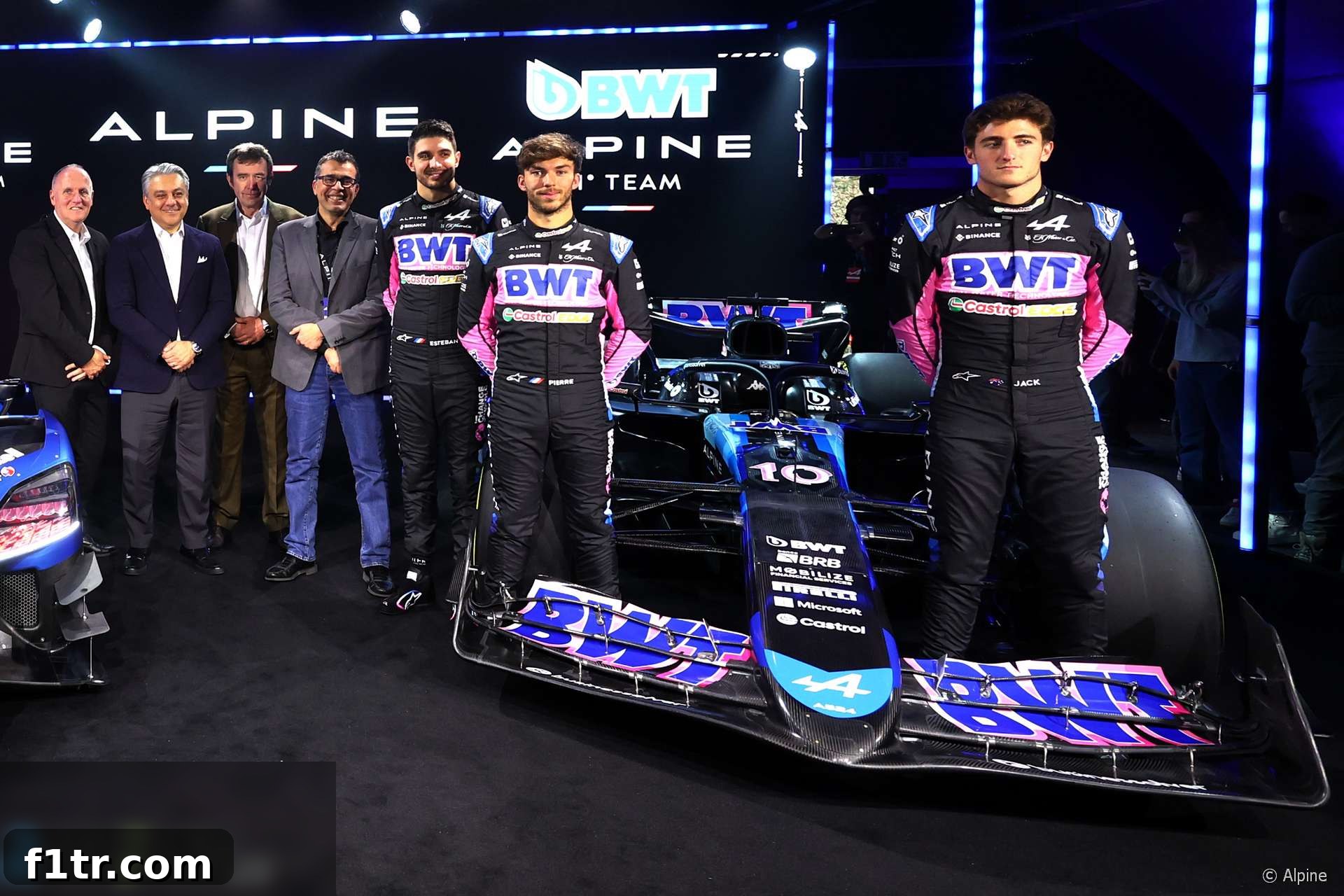
The Alpine Formula 1 team is embarking on a pivotal journey into the 2024 season, characterized by a significant shift in its car design philosophy and a pragmatic new leadership approach. Under the guidance of Team Principal Bruno Famin, who assumed full responsibility last year amidst a comprehensive organizational overhaul, the team is deliberately refraining from setting concrete on-track targets. Instead, the focus is squarely on fundamental improvements across all facets of their operations, signaling a long-term commitment to building a sustainable winning foundation.
Famin’s appointment came at a turbulent time for Alpine. He stepped into the role of Team Principal, succeeding Otmar Szafnauer, and his tenure began alongside the departures of long-standing Sporting Director Alan Permane and Technical Director Pat Fry. This high-profile leadership shake-up underscored a clear intent from Alpine’s parent company, Renault, to recalibrate its Formula 1 aspirations and redefine its strategic direction. The changes were not merely superficial but indicative of a deeper evaluation of the team’s processes, culture, and ultimate competitiveness within the highly demanding world of F1.
Today marked a significant milestone with the official presentation of the new A524 chassis at the team’s historic Enstone base. This car represents a radical departure from its predecessor, the A523, which failed to meet expectations in the 2023 campaign. This philosophical change in design signifies a bold commitment to innovation, even if it means acknowledging a potentially steep learning curve. The team openly anticipates that it may take several races into the season to fully understand and extract the optimum performance from this completely new package. This patience is a stark contrast to previous seasons where immediate results were often prioritized, highlighting the shift in Famin’s strategic outlook.
Famin emphasizes that the transformation extends far beyond the new car’s aerodynamics and mechanical components. Extensive changes are being implemented behind the scenes, impacting everything from engineering workflows to manufacturing processes. These systemic improvements are critical, yet they require time to mature and yield tangible benefits. “There’s a lot of expectations, we are excited, for sure, it’s a brand new car, but to me there is no optimism,” Famin candidly told media, including RaceFans, at today’s launch event. “We know that the road is long. We know that we have a lot to do. We know where we want to go – to fight in front. But we know that the road is long. We have a lot of things to improve everywhere across the company.” This statement perfectly encapsulates the realistic, yet determined, mindset permeating the team.
The lessons from the 2023 season weigh heavily on Alpine. The team entered that year with ambitious goals, hoping to significantly close the performance gap to the sport’s top three constructors. However, the reality proved far more challenging, with Alpine ultimately concluding the championship in the lower half of the constructors’ standings. This disappointing outcome served as a crucial catalyst for the profound introspection and strategic realignment that has since taken place. It underscored the urgent need for a more fundamental approach to development and highlighted areas where the team was falling short of its own lofty expectations. The competitive nature of modern Formula 1 means that stagnation is regression, and Alpine’s performance dip in 2023 served as a harsh, but necessary, wake-up call.
“We are fundamentally optimistic because we are not so bad even if ’23 was disappointing,” Famin continued, explaining the underlying motivation. “And when I see everything which can be improved, I say okay, there is room for improvement. But we know where we are and we know that the field is closer and closer.” This nuanced perspective acknowledges both the inherent potential within the team and the formidable challenge posed by a field that is becoming increasingly competitive. Every team on the grid is relentlessly pushing the boundaries of performance, making any gains hard-won and crucial for progression.
Famin has meticulously charted a clear and comprehensive path to recovery for the team, ensuring that every department and individual is aligned with this unified vision. “We are all on the same road map. We have all the same mid-term goals and we know that as we are now in the third year of the regulation the cars will be closer and closer. Fighting for Q2 and Q3, it will be a matter of thousandths of a second and every single thing will be important,” he elaborated. This understanding of the marginal gains philosophy, where every millisecond and every process refinement contributes to overall performance, is at the core of Alpine’s current strategy. In an era of highly stable technical regulations, incremental improvements become paramount, and the ability to find those minute advantages can often determine success or failure in qualifying and race performance.
His emphasis on realism over unfounded hope is unwavering: “So no optimism, we are conscious of where we are and everything we need to improve. But we have a project, we have the budget, we have very talented people in Enstone and in Viry and the challenge is to give them the opportunity to use this talent to improve the car and to improve the car we need to improve the process, gaining agility, gaining efficiency.” This statement highlights Alpine’s key assets: substantial financial backing from Renault, world-class facilities in Enstone (chassis development) and Viry-Châtillon (power unit development), and a dedicated workforce. The challenge, as Famin sees it, is not a lack of resources or talent, but rather the optimization of processes to unlock that talent’s full potential. Developing greater agility means quicker decision-making and adaptation, while enhanced efficiency implies maximizing output with available resources. Both are crucial for an F1 team aiming to climb to the top.
Having fallen considerably short of its ambitious objectives last year, Famin has made the executive decision not to publicly declare any specific on-track targets for the upcoming season. Instead, the singular, overarching goal is to demonstrably elevate the team’s overall level of performance. “For me a good 2024 season will be a season where we will be able to see improvement,” he stated, redefining the metrics of success. This shift in focus signals a maturity in approach, moving away from potentially unrealistic expectations towards a more introspective and developmental outlook. The team understands that chasing arbitrary grid positions without the foundational capabilities to support them is ultimately counterproductive.
Famin clarified that “improvement” encompasses far more than just lap times or championship points. “Where I say improvement I’m not taking only about [on] the track. Of course, being able to seize any opportunity on the track to achieve a good result like we did even if the overall result was bad last year, our drivers knew to seize the opportunity and it was good, we need to do that more often.” While on-track results remain important, and the drivers’ ability to capitalize on fleeting chances is valued, Famin’s vision extends much deeper. He recognizes that sporadic strong performances, while encouraging, do not equate to sustained success unless backed by robust, consistent operational excellence.
The true measure of a successful 2024, in Famin’s eyes, lies in the foundational changes being implemented. “But even more than that is making improvement in the way we work at the factories, developing our process, developing our people, building a machine able to develop a winning Formula 1 [car]. And that’s really the goal. We need to make a step that way in ’24 and that will be a successful season to me.” This holistic definition of success underscores a profound strategic shift. It’s about cultivating a culture of continuous improvement, investing in human capital through skill development and training, and refining every operational process at both the Enstone chassis facility and the Viry-Châtillon engine plant. The ultimate aim is to forge an organization that is inherently capable of consistently designing, developing, and deploying a race-winning Formula 1 car, rather than simply hoping for one. This transformation requires patience, disciplined execution, and a clear, shared vision from every member of the Alpine team. The 2024 season, therefore, is not just about the car on the track, but about the fundamental evolution of the entire entity striving for Formula 1 glory.
Formula 1
- Verstappen loathes F1’s new generation of cars – but what do his rivals reckon?
- The ‘throwback weekend’ is back in fashion. But it’s a flawed concept – especially for F1
- Is Formula 1’s double race cancellation a blessing in disguise?
- Todt admits Schumacher crashed on purpose – but did it really cost him two titles?
- 25 of the most memorable radio exchanges from the ‘Max and GP show’
Browse all Formula 1 articles