Max Verstappen’s GT3 Triumph: A Testament to His All-Time Greatness, Say F1 Rivals
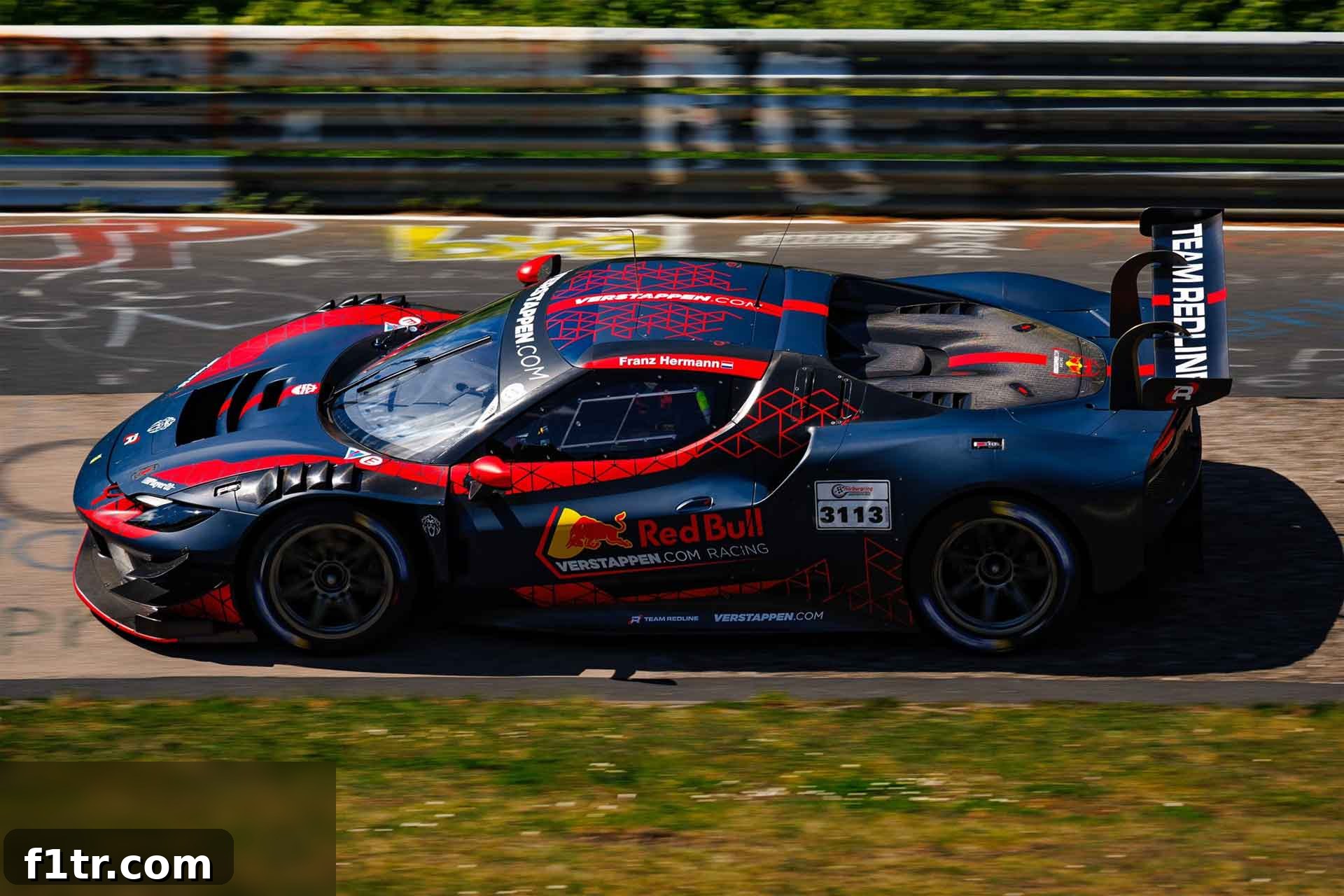
In a compelling display of raw talent and racing versatility, Max Verstappen’s recent victory in a GT3 race at the iconic Nürburgring Nordschleife has sent ripples through the Formula 1 paddock. The Red Bull superstar, already a multiple F1 world champion, proved his mettle once again outside his primary discipline, sharing the win with Chris Lulham on the notoriously demanding 20-kilometre circuit. This impressive feat has led his championship rivals, notably Lando Norris and George Russell, to unequivocally state that Verstappen’s ability to excel across different motorsport categories solidifies his position as one of the all-time greats.
Verstappen’s Versatility: A Mark of a True Racing Maestro
Max Verstappen’s foray into GT3 racing and subsequent triumph on the challenging “Green Hell” isn’t merely a side hobby; it’s a profound statement about his intrinsic skill set. While Formula 1 demands unparalleled precision, speed, and adaptation to the pinnacle of single-seater technology, GT3 racing, especially on a circuit like the Nordschleife, introduces a completely different dynamic. Drivers must contend with heavier cars, different tire characteristics, multi-class traffic, and the sheer unpredictability of a track that punishes even the slightest error. Verstappen’s immediate success in this environment underscores his exceptional car control, race craft, and adaptability – qualities that transcend specific machinery or regulations.
Lando Norris, a fierce competitor and peer of Verstappen, was quick to acknowledge the significance of this achievement. “I think after you win four world championships, you have a bit more right to just go and choose what you want to do,” Norris commented, highlighting the earned privilege that comes with such an illustrious F1 career. However, he swiftly pivoted to the broader implication of Verstappen’s multi-disciplinary success: “I don’t know how much it adds to your greatness or not, but the fact he can go into any series and be probably the best, I think does show how good he is and how great he is.” This sentiment from a direct competitor speaks volumes about the respect Verstappen commands.
Norris: Verstappen is “Born to be the Best”
Norris’s admiration for Verstappen goes deeper than just acknowledging a recent victory. He articulated a belief shared by many within the motorsport community: “I’ve said it many times: I think he’s born to be, and will forever be, one of the best ever, if not the best in Formula 1. So I think for anyone to have a chance of going up against him and beating him is pretty slim at times.” This declaration positions Verstappen not just as a current dominant force, but as a generational talent whose name will be etched alongside legends. The ability to seamlessly transition from the high-downforce, open-wheel environment of F1 to the heavier, closed-cockpit dynamics of GT3 racing, and still deliver a winning performance, is indeed a rare trait that few drivers throughout history have possessed.
The Nürburgring Nordschleife itself plays a crucial role in validating such claims of greatness. Known colloquially as “The Green Hell” due to its treacherous nature and unforgiving layout, the Nordschleife is a true test of a driver’s courage, skill, and endurance. Its 73 corners, vast elevation changes, and minimal run-off areas demand absolute concentration and respect. A victory here, regardless of the machinery, is always a badge of honor, and for an F1 champion to conquer it in a different class only amplifies the achievement.
George Russell’s Envy: The Pursuit of Driver Freedom
The sentiment wasn’t limited to Norris. George Russell, another rising star in Formula 1, expressed a relatable sense of longing. “I think we’re all pretty jealous of it,” Russell admitted, referring to Verstappen’s freedom to engage in other forms of racing. This “jealousy” stems from the highly restrictive contracts F1 drivers typically have, often prohibiting them from participating in other motorsport events due to injury risks and focus on their primary F1 commitments. For aspiring champions like Russell, the path to such freedom is clear but arduous: win multiple world championships.
Russell articulated the dream scenario for many F1 drivers: “Having this freedom, of firstly doing what you love in Formula 1, but then also being able to go out and race other things and just enjoy it at your leisure — I don’t think it’s quite that straightforward for other people doing it. But you have that right when you win four world championships.” This highlights a fascinating dichotomy in elite motorsport: while F1 represents the pinnacle, its demands often confine drivers to a single discipline. Only once a driver has achieved monumental success and secured their legacy, like Verstappen, do the doors to other racing adventures truly open without significant contractual hurdles or team resistance.
For drivers earlier in their careers, the risks associated with multi-class racing are simply too high. An injury sustained in an alternative series could jeopardize an F1 season, a championship bid, or even an entire career. Therefore, the ability for Verstappen to freely pursue his passion for virtual and real-world endurance racing, alongside his F1 duties, is indeed a testament to his established position and the trust his team places in him. It speaks to a level of security and accomplishment that Norris and Russell are currently striving to achieve.
Defining Motorsport Greatness: Beyond the F1 Grid
The conversation ignited by Verstappen’s GT3 win prompts a deeper reflection on what truly defines an all-time great in motorsport. Is it solely the number of Formula 1 titles, or does a broader display of talent across different disciplines contribute to a driver’s legendary status? Historically, some of the most revered names in racing, such as Jim Clark, Graham Hill, and even more recently Fernando Alonso, have proven their versatility across F1, endurance racing, and other categories. Alonso’s double Le Mans victory and participation in the Indy 500 while still active in F1 notably enhanced his already formidable reputation.
Verstappen’s success in GT3, particularly on a circuit as demanding as the Nordschleife, reinforces the argument that true driving genius transcends specific car types or series. It suggests that the innate ability to extract the maximum from any machine, adapt to varying conditions, and consistently perform at the highest level is the ultimate benchmark. This versatility not only entertains fans but also showcases a deeper understanding of racing dynamics and vehicle control that might not always be evident in the homogenized environment of modern F1.
The Future of F1 Drivers in Multi-Class Racing
As Formula 1 calendars expand and seasons become more physically and mentally demanding, the opportunities for F1 drivers to engage in other series might seem to diminish. However, the examples of Verstappen and Alonso suggest that for those at the very top, the desire to explore other racing challenges remains strong. For champions who have already proven their F1 pedigree, these alternative races offer a different kind of thrill, a chance to race for pure enjoyment, and an opportunity to further burnish their legacy.
Norris himself mused about his own future: “If I could go and do it more, maybe I would. But I don’t know about my future still. I still see a time when I’ll just want to leave Formula 1 and go do other things — go play golf and have some fun elsewhere.” This highlights the human element behind the racing helmets; even the most dedicated drivers envision a life beyond F1, one where they can pursue other passions, whether it’s more racing or something entirely different. For Verstappen, the current reality allows him to combine both, an enviable position that few achieve.
Conclusion: Max Verstappen’s Enduring Legacy
Max Verstappen’s GT3 victory at the Nürburgring Nordschleife is far more than just another win; it’s a powerful affirmation of his exceptional talent and versatility. For his rivals like Lando Norris and George Russell, it underscores what they already knew: Verstappen possesses a rare blend of skill and determination that places him among motorsport’s elite. Their “jealousy” is not of his success alone, but of the freedom his achievements have afforded him – the freedom to explore his passion for racing in its myriad forms, untethered by the constraints that often define an F1 career.
As Verstappen continues to rewrite the record books in Formula 1, his exploits in other racing categories serve as crucial evidence of his all-encompassing greatness. It’s a testament to a driver who is not only born to be one of the best in F1 but also possesses the innate ability to conquer any challenge the world of motorsport throws his way. His journey reminds us that while championships are important, true legendary status is often forged by demonstrating unparalleled skill and adaptability across the full spectrum of racing disciplines.