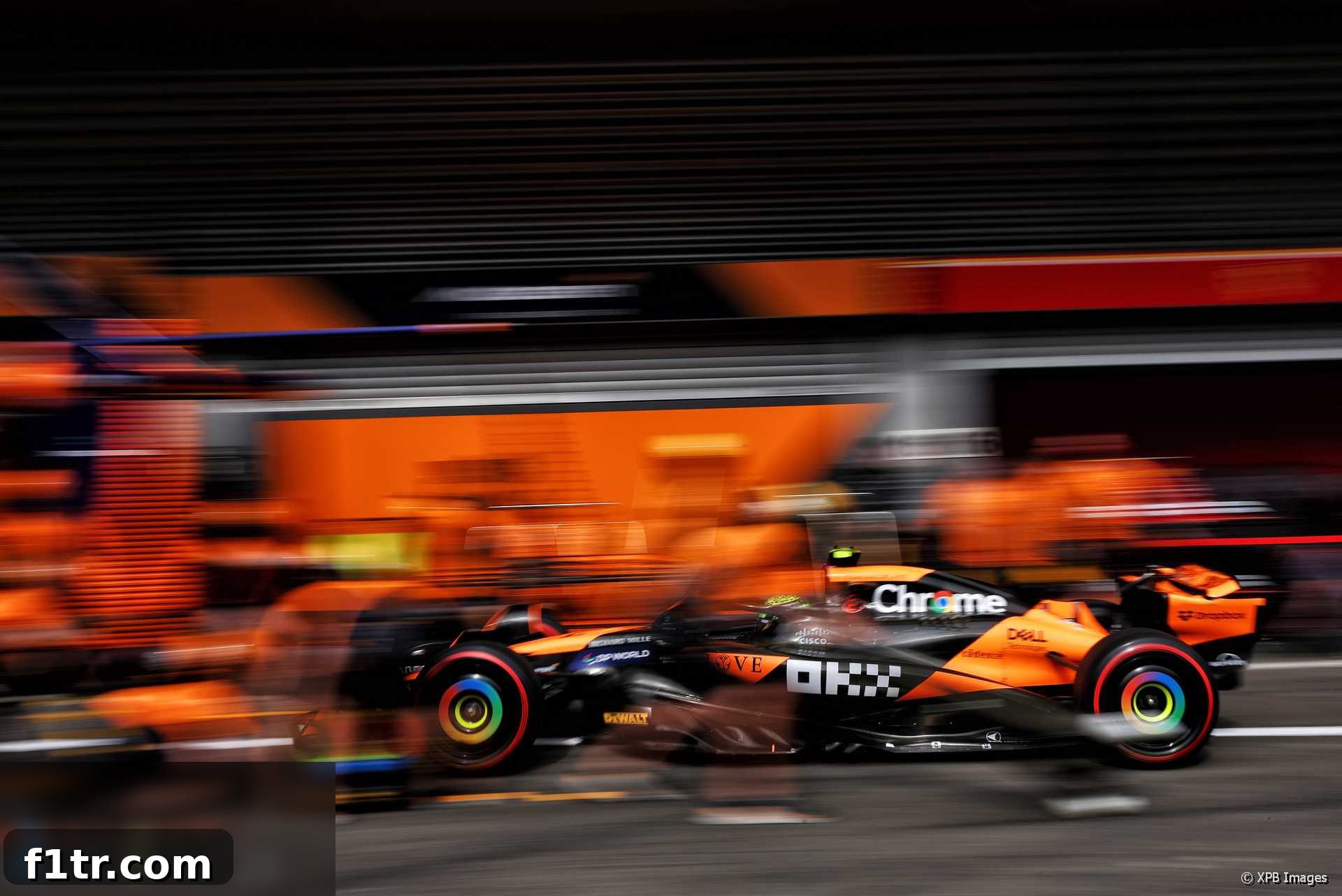
Lando Norris Leads Spa Practice Amidst McLaren Discomfort and Looming Rain Threats
Despite topping the Friday practice session at the iconic Spa-Francorchamps circuit, McLaren’s Lando Norris has openly admitted a profound lack of comfort with his car. This surprising revelation from the British driver, who was the fastest on track, casts an intriguing shadow over McLaren’s prospects for the Belgian Grand Prix weekend, especially with unpredictable weather forecasts.
Norris’s impressive lap time placed him two-tenths clear of his highly-regarded teammate, Oscar Piastri, securing a McLaren 1-2 at the top of the timesheets, ahead of championship leader Max Verstappen in third. On paper, it was a dominant display from the Woking-based team, signaling their continued upward trajectory in the 2024 season. However, Norris’s post-session comments suggest that raw pace doesn’t always translate to driver confidence or a perfectly balanced machine.
Unpacking Norris’s “Uncomfortable” Performance at Spa
In the high-stakes world of Formula 1, driver comfort is paramount. It’s not merely about physical ease, but a deep, intuitive connection with the car that allows a driver to push the limits with full confidence. For Norris to be quickest yet articulate feelings of discomfort highlights the razor-thin margins and the nuanced feedback F1 drivers experience. “It’s still tough, still close,” Norris told the official F1 channel after the session, acknowledging the fierce competition. “Red Bull are very quick at the minute.”
His specific concern was the car’s handling around the legendary Spa circuit, known for its challenging high-speed corners like Eau Rouge and Blanchimont, interspersed with long straights. “I’ve just not felt very comfortable today with the car,” he elaborated. “Hopefully I just wake up tomorrow and feel a bit more comfortable with it. But we’re trying to improve a few things.” This sentiment suggests a struggle to extract the car’s full potential consistently, or perhaps an unpredictable nature that prevents him from truly “nailing” laps repeatedly.
The Paradox of Speed and Sensation
The paradox of Norris’s situation — fastest yet uncomfortable — speaks volumes about the extreme demands placed on F1 drivers. Often, a car that is inherently fast can also be on a knife-edge, requiring a specific, aggressive driving style that might not feel natural or consistent to the driver. This ‘peakiness’ can make it difficult to replicate performance lap after lap, or to adapt quickly to changing track conditions. Norris’s desire to “get in a bit more of a rhythm and feel a bit better out there” points to a quest for consistency and predictability, crucial elements for maximizing performance over a full race distance and in intense qualifying sessions.
The mental aspect of Formula 1 driving cannot be overstated. A lack of comfort can erode confidence, leading to hesitations that, even if microscopic, translate into lost tenths on the stopwatch. While Norris’s raw talent allowed him to top the practice times despite this feeling, sustaining such performance without genuine comfort is a monumental task. It suggests that while the McLaren MCL38 undeniably possesses speed, optimizing its setup to match Norris’s preferences and maximize his confidence will be the team’s top priority overnight.
McLaren’s Recent Trajectory: From Struggle to Contender?
McLaren’s season has been one of significant resurgence, particularly after a series of major upgrades introduced earlier in the year, notably at Silverstone. These developments transformed the MCL38 from a midfield runner into a genuine podium contender, often challenging Red Bull and Ferrari. This rapid improvement has raised expectations, and moments like topping practice sessions are now seen as a testament to the team’s engineering prowess.
However, each circuit presents a unique challenge, and Spa-Francorchamps is a demanding test of a car’s aerodynamic efficiency and mechanical grip. The fact that both Norris and Piastri were at the sharp end of the grid suggests the car’s fundamental package is strong. Piastri’s close proximity to Norris, just two-tenths adrift, indicates that the car’s potential is accessible, even if Norris is struggling to find his optimal rhythm. This gives McLaren data to analyze, comparing the two drivers’ feedback and telemetry to pinpoint areas for improvement.
The Battle Against the Reigning Champions
While McLaren’s Friday performance was commendable, the presence of Max Verstappen just behind them serves as a stark reminder of Red Bull’s formidable pace. Verstappen’s third place, likely achieved without fully revealing Red Bull’s true performance, suggests that the reigning champions remain the benchmark. McLaren’s goal will be to convert their practice pace into a strong qualifying performance and, crucially, a competitive race. Overcoming the Red Bull challenge requires not just raw speed, but also a car that is perfectly balanced and predictable under all circumstances – precisely what Norris seems to be seeking.
The Spa Setup Conundrum: A Dance of Downforce and Speed
Spa-Francorchamps is infamous for its demanding layout, which requires a delicate balance in car setup. The circuit features long, high-speed straights where low downforce is crucial for maximizing top speed, and a series of challenging, high-speed corners like Pouhon and Blanchimont that demand significant aerodynamic grip. Finding the optimal compromise is a perennial headache for engineers and drivers alike. A car optimized for straight-line speed might struggle in the corners, while one with too much downforce will be vulnerable on the Kemmel Straight.
Norris touched upon the limited scope for drastic changes overnight. “I don’t think it’s a lot,” he noted regarding potential setup overhauls. “We’re always able to come to a circuit now and be within millimetres of margin straightaway.” Modern F1 teams arrive at circuits with extensive simulations and a highly refined base setup, minimizing the need for radical adjustments. The work often revolves around fine-tuning and micro-adjustments based on real-world data and driver feedback. This means any discomfort Norris is feeling might be subtle, requiring precise tweaks rather than a complete overhaul of the car’s philosophy.
Fine Margins: Why Overnight Setup Changes Are Limited
The era of dramatic overnight setup transformations in Formula 1 is largely a thing of the past. Teams now leverage sophisticated simulation tools, advanced CFD (Computational Fluid Dynamics), and extensive simulator work to arrive at a race weekend with a highly optimized baseline. This meticulous preparation means that the car’s fundamental characteristics are largely established before Friday practice even begins. Any changes from that point onwards are typically incremental, aimed at perfecting the balance for specific track conditions or driver preferences.
Norris’s comment about working “within millimetres of margin” perfectly encapsulates this reality. Engineers will focus on minute adjustments to wing angles, suspension settings, tire pressures, and brake balance to eke out extra performance or improve driver feel. For Norris, finding that elusive comfort might come down to a small adjustment that suddenly unlocks confidence, allowing him to attack corners with greater conviction and consistency. It’s a testament to the hyper-optimized nature of F1 that such small changes can have a significant impact on a driver’s perception and, ultimately, their lap times.
The Looming Rain Threat: A Strategic Dilemma for Qualifying
Adding another layer of complexity to McLaren’s weekend is the high risk of rain expected to hit the Belgian circuit for Saturday’s crucial qualifying session. Spa-Francorchamps is notorious for its unpredictable weather, often seeing different parts of the track experiencing varying conditions simultaneously. Rain introduces a whole host of challenges, from drastically reduced grip and visibility to the critical decision of tire choice (intermediates vs. full wets).
The potential for a wet qualifying session followed by a dry race on Sunday presents a significant strategic dilemma for Norris and McLaren. This “wet qualifying, dry race” scenario forces teams to make a critical compromise on their car’s setup, specifically regarding downforce levels. More downforce generally provides better grip and stability in wet conditions, which is advantageous for qualifying well. However, too much downforce will severely penalize the car’s straight-line speed in a dry race, making it vulnerable to overtakes and potentially slower overall.
Balancing Wet Qualifying with a Dry Race: The Ultimate Gamble
“Generally for the rain, you want to edge towards the high downforce,” Norris explained, outlining the conventional wisdom. “But I don’t think that’s maybe a direction to go in anyway. But I don’t know just yet. So I’ll sit down with my guys and we’ll talk about it.” This statement reveals the intricate strategic discussion that will take place within the McLaren garage. The team must weigh the importance of a strong grid position, achievable with a wet-optimized setup, against the imperative of race pace, which might dictate a drier setup.
The decision involves a complex risk-reward calculation. A poor qualifying in wet conditions could leave Norris starting far down the grid, making a strong race recovery difficult even with a dry-optimized car. Conversely, a car optimized for a wet qualifying might secure a high grid slot, only to struggle desperately for pace in a dry race, potentially losing positions rapidly. Factors such as the predicted intensity and duration of the rain, the likelihood of further rain on Sunday, and McLaren’s overall race pace compared to rivals will all play a role in this high-stakes decision. The team’s strategists, engineers, and Norris himself will need to collaborate closely to navigate this classic F1 gamble, hoping to strike the perfect balance for what promises to be a thrilling and unpredictable Belgian Grand Prix weekend.
Teammate Dynamics: Piastri’s P2 and McLaren’s Overall Potential
The fact that Oscar Piastri finished just behind Norris in second place during practice is a significant data point. It suggests that while Norris might be wrestling with certain aspects of the car, the MCL38’s raw performance is clearly there. Piastri, in his rookie season, has consistently impressed, adapting quickly to Formula 1 and often matching or even outpacing his more experienced teammate. His comfort level with the current setup, or his ability to adapt to its nuances, will provide crucial comparative data for McLaren’s engineers.
This internal benchmark is invaluable. By comparing the telemetry and feedback from both drivers, McLaren can gain a clearer understanding of what might be causing Norris’s discomfort and how to address it. It reinforces the idea that the car has potential, and the challenge lies in optimizing it for both drivers, or at least understanding the divergent needs. A strong performance from both drivers is vital for McLaren’s Constructors’ Championship aspirations, and Piastri’s consistent pace ensures the team has two strong contenders on track.
Looking Ahead: The Stakes for McLaren and Norris at Spa
The Belgian Grand Prix remains a pivotal race in the Formula 1 calendar, offering significant points and bragging rights. For McLaren, a strong showing at Spa would solidify their position as front-runners and validate the significant progress they have made this season. For Lando Norris, overcoming his reported discomfort to deliver a top performance would be a testament to his skill and adaptability, further enhancing his reputation as one of F1’s brightest talents.
The combination of a potentially tricky car setup, the legendary demands of Spa-Francorchamps, and the ever-present threat of rain sets the stage for a dramatic weekend. McLaren’s ability to fine-tune the MCL38, manage the strategic decisions surrounding the weather, and convert practice pace into race results will be under intense scrutiny. As Norris and his team deliberate on the best path forward, the Formula 1 world watches with anticipation, eager to see how these challenges unfold on one of motorsport’s most revered stages.
Further Reading: Insights from the F1 Paddock
- The Strategic Brilliance Behind Formula 1 Car Setup Choices
- Navigating the Unpredictability: F1 Racing in Wet Conditions
- From Simulation to Track: The Evolution of F1 Engineering
- Driver Psychology: How Mental Fortitude Shapes F1 Performance
- McLaren’s Ascent: A Detailed Look at Their 2024 Season Upgrades