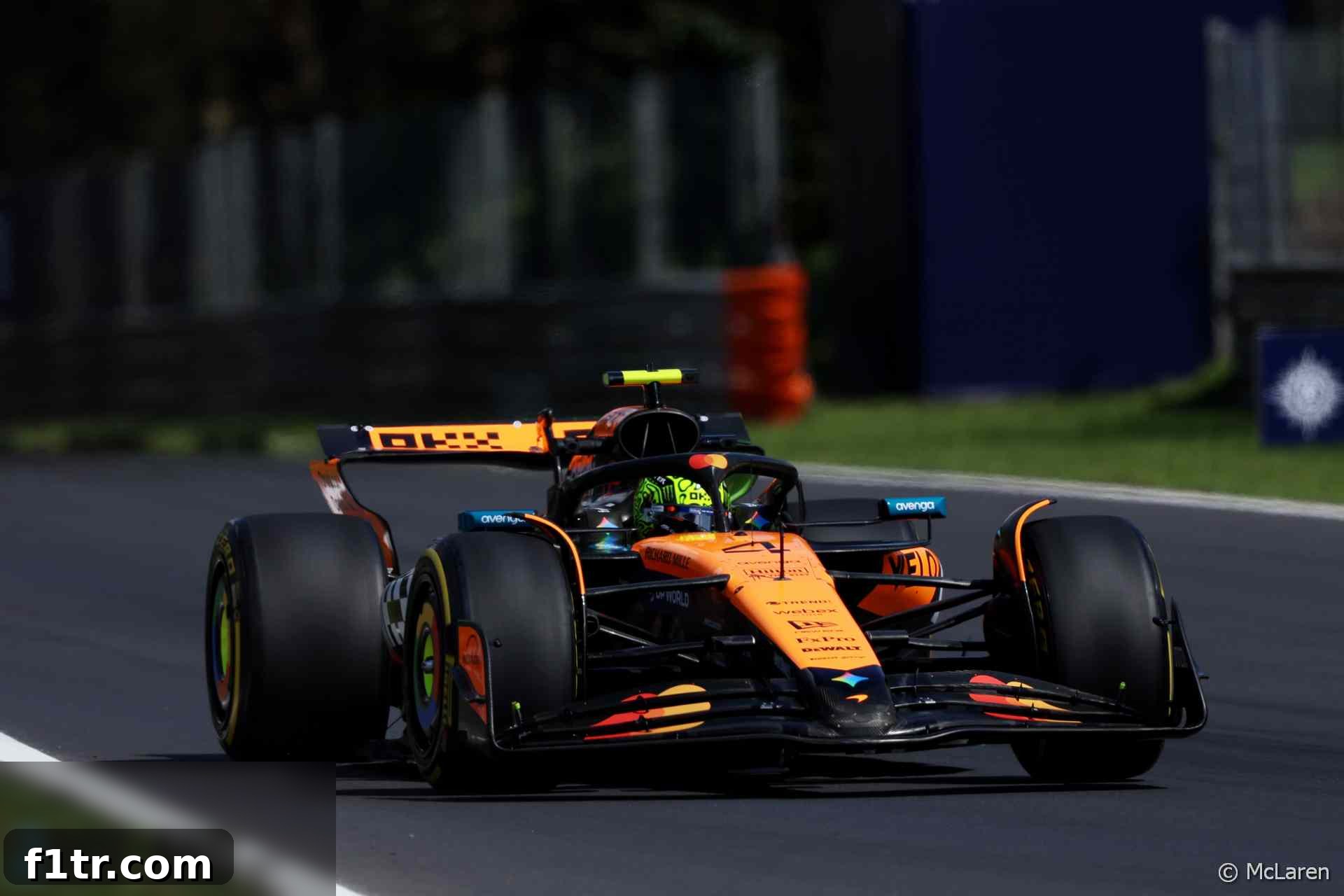
McLaren emerged as the fastest team during Friday practice sessions at Monza, a crucial indicator of pace ahead of the Italian Grand Prix. However, pace-setter Lando Norris conveyed a cautious optimism, acknowledging that their significant margin over the competition, which was evident in the previous round, appeared to have considerably narrowed on the legendary ‘Temple of Speed’. This shift sets the stage for a potentially thrilling and closely contested weekend.
Just last week at Zandvoort, McLaren celebrated its fifth consecutive win, showcasing a formidable performance that placed them firmly at the top. Norris and his teammate Oscar Piastri demonstrated exceptional speed, clocking times a quarter of a second faster than their closest rival, Max Verstappen, in what was a dominant qualifying display. That victory underscored a period of strong momentum for the Woking-based outfit, with their car seemingly perfectly suited to the high-downforce demands of the Dutch circuit.
Monza’s Unique Demands: A Low-Downforce Conundrum
Monza, a track revered for its long straights and minimal high-speed corners, presents an entirely different aerodynamic challenge compared to Zandvoort. Here, teams prioritize minimal drag and high top speeds, necessitating a low-downforce setup. This stark contrast in circuit characteristics often reshuffles the competitive order, and Norris’s comments suggest McLaren is feeling the effects of this shift more acutely than anticipated.
In the crucial second practice session, Norris found himself only a tenth of a second clear of both Charles Leclerc and Carlos Sainz of Ferrari. This narrow gap, particularly against their Italian rivals on home turf, signals a much tighter battle than what McLaren experienced previously. Norris articulated this change, stating, “This is like the complete opposite downforce level to Zandvoort where we were just easily quickest and it felt pretty amazing. Here it’s quite the opposite.”
The Shift in Performance: Why Low Downforce Matters
Norris further elaborated on the team’s performance dynamics, acknowledging that the current scenario wasn’t entirely unexpected. “It’s not a surprise, this is probably what we were expecting, that kind of thing,” he explained to the official Formula 1 channel. “But I definitely think we don’t perform quite to the same level in these kind of low-downforce conditions as we do when we’re at high-downforce. So the competitors catch up, it looks a bit closer and that makes our life a bit trickier.”
This statement offers crucial insight into the McLaren MCL38’s characteristics. While the car has shown exceptional prowess and efficiency in high-downforce configurations, its adaptability to ultra-low-downforce tracks like Monza appears to be a relative weakness. In essence, the intrinsic aerodynamic efficiency that gives them an edge in cornering heavy circuits is less pronounced when straight-line speed is paramount. This allows other teams, whose cars might be less efficient overall but excel in drag reduction, to close the performance gap.
The “trickier” environment Norris describes isn’t just about raw speed; it impacts strategy, tire management, and the margin for error. When several cars are within a tenth of a second, qualifying becomes a knife-edge affair, and race-day overtakes, pit stop timing, and defensive driving gain immense significance. Every millisecond counts, and the luxury of having a dominant performance buffer is no longer available.
McLaren’s Friday Adjustments and Piastri’s Absence
Norris was the sole McLaren driver to participate in both Friday practice sessions. Oscar Piastri missed the first practice (FP1) to allow Alexander Dunne, a promising young driver, to gain valuable track time as part of the team’s development program. While this offers an opportunity for a junior driver, it also means Piastri had less time to acclimate to the challenging Monza circuit and its specific low-downforce setup, potentially putting him at a slight disadvantage heading into Saturday.
Despite this, Norris found encouragement in the team’s ability to fine-tune the car between FP1 and FP2. “For us to still be P1, I thought was good,” he commented, reflecting on the day’s outcome. “I thought we improved some stuff from FP1 to FP2, but it’s just a bit close so I just need to try and make the gap a bit bigger, a little bit more comfortable.”
The ability to make tangible improvements between sessions demonstrates McLaren’s engineering capability and commitment to optimizing their package, even on a circuit that doesn’t perfectly suit their car’s inherent strengths. This iterative process of data analysis and setup changes is vital for maximizing performance, especially when facing such tight competition. Norris’s goal to “make the gap a bit bigger” underlines the team’s ambition to regain some of the comfort zone they enjoyed at Zandvoort, even if a quarter-second lead might be an unrealistic target at Monza.
The Road Ahead: Qualifying and Race Prospects at Monza
As the weekend progresses, the focus will shift sharply to qualifying, where every hundredth of a second will be critical. The close proximity of Ferrari, particularly on their home soil, adds an extra layer of intensity. The Tifosi will be roaring, eager to see their beloved Scuderia challenge for pole position and a potential victory. Red Bull, with Max Verstappen, also remains a constant threat, even if their practice times didn’t immediately put them at the very front of the low-downforce battle. Their ability to extract performance when it truly matters cannot be underestimated.
Monza is notorious for its slipstreaming battles and strategic nuances. Qualifying runs often see drivers working together to gain tow, and the race itself is frequently a high-speed chess match involving tire degradation, pit stop timing, and navigating through traffic. A narrower performance window across the top teams means that small mistakes, whether by drivers or strategists, will be heavily penalized, while flawless execution could be the key to victory.
McLaren’s challenge will be to find those “small things to improve” that Norris mentioned. This could involve minute aerodynamic adjustments, optimizing brake balance for the heavy braking zones, or perfecting the gear ratios for maximum acceleration out of the chicanes. The team’s engineers will work tirelessly overnight, scrutinizing every data point to unlock further pace and make Norris’s life “a little bit more comfortable” when it counts.
Conclusion: A Gripping Italian Grand Prix on the Horizon
While McLaren showed promising pace by topping the Friday sessions, Lando Norris’s candid assessment highlights the tightening competition at Monza. The transition from high-downforce Zandvoort to the low-downforce ‘Temple of Speed’ has undeniably brought the field closer, setting the stage for a compelling Italian Grand Prix. McLaren still finds itself in a strong position, but the battle for supremacy will require impeccable execution and further improvements. The stage is set for a gripping qualifying session and a potentially thrilling race where margins will be razor-thin and every decision pivotal.
Further Reading: Insights from the 2025 Italian Grand Prix
- No change to McLaren’s team orders after Monza review – Stella
- Bearman did not deserve penalty for Sainz collision at Monza, says Vowles
- Transcript: Hamilton seeking final tenths as he closes gap to Leclerc
- McLaren can clinch F1’s earliest title win since 1988 with as little as fifth place
- How did Verstappen know about Norris’ slow stop in Italy? Red Bull told him
Browse all 2025 Italian Grand Prix articles