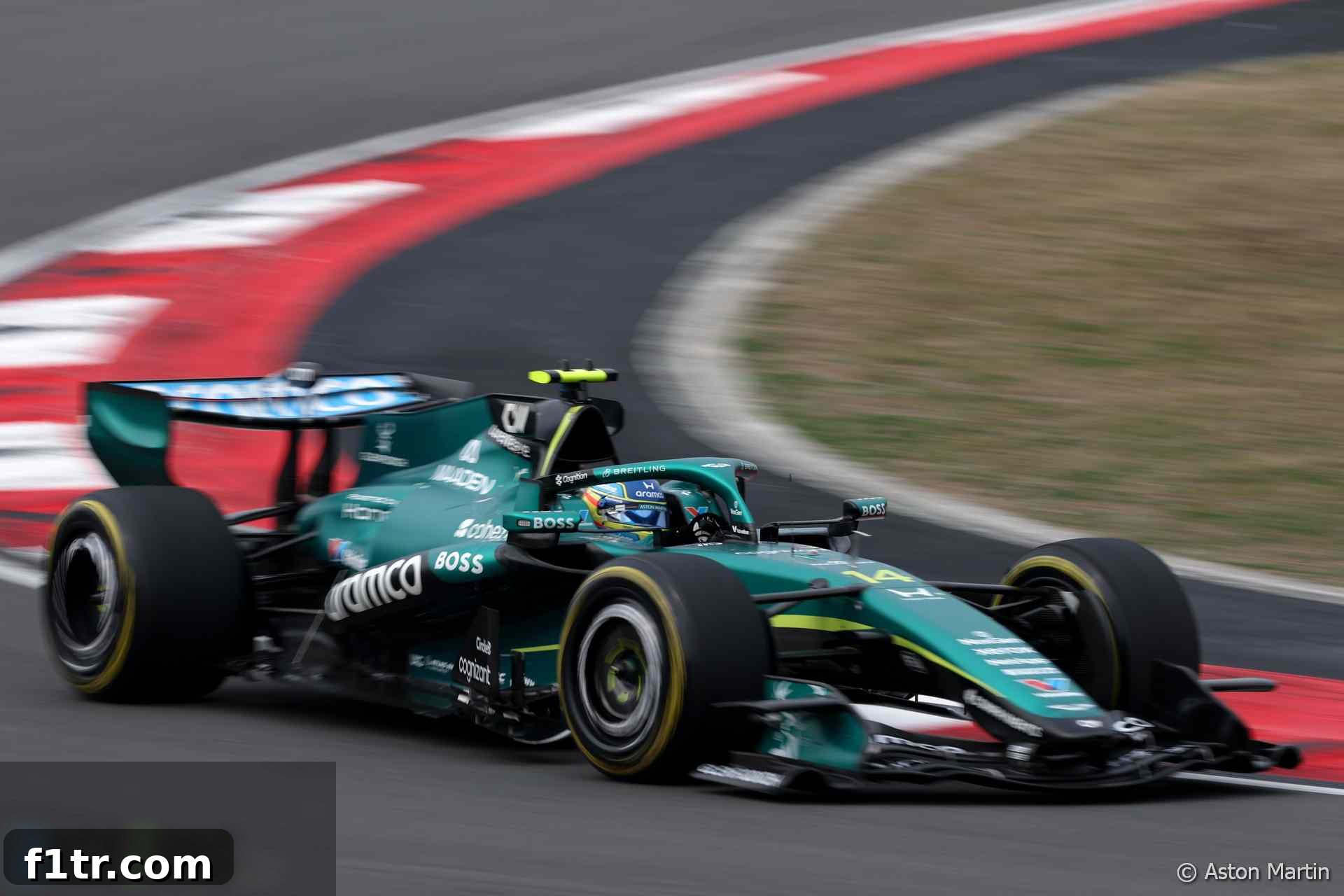
The 2026 Chinese Grand Prix proved to be a weekend of profound struggle for two-time world champion Fernando Alonso, culminating in a disheartening retirement and a moment that saw him lose five places in a single, agonizing lap. What began with the promise of points quickly unraveled into a desperate battle against a car plagued by severe mechanical issues, leaving both Alonso and his Aston Martin team searching for answers.
Fernando Alonso’s Chinese Grand Prix Nightmare: A Battle Against a Troubled Aston Martin
From the outset, the Shanghai International Circuit presented a formidable challenge, but for Fernando Alonso, the true adversary emerged from within his own machinery. The Spanish veteran, renowned for his tenacity and ability to extract every ounce of performance from his cars, found himself in an unenviable position during the Chinese Grand Prix, where a series of unfortunate events and a critical car issue conspired to deliver one of his most trying races in recent memory.
A Promising Opening Undone: The Race Begins
Alonso’s race began with a glimmer of hope. Leveraging his immense experience and sharp race craft, he managed to climb as high as 10th position by the end of the opening lap. Fans and pundits alike would have noted this early gain as a testament to his enduring skill, positioning the Aston Martin driver within the points-scoring positions early on. However, this initial success proved to be a fleeting illusion. As the pack settled and the tires began to warm, the competitive landscape shifted dramatically. By the second lap, Alonso found himself on the defensive, unable to hold off the charge of three rival drivers who swiftly dispatched him, pushing him further down the order and setting an ominous tone for the remainder of his race.
This early slide was a precursor to the true difficulties that lay ahead. The raw pace and stability that Alonso typically relies on seemed absent, foreshadowing the profound challenges he would face as the Grand Prix unfolded. The early exchanges hinted at a broader issue with the Aston Martin, one that would soon manifest itself in a spectacular and concerning fashion.
The Strategic Gamble: Safety Car Period and Missed Opportunity
A pivotal moment arrived early in the race with the deployment of the Safety Car. Such periods are often crucial decision points, where teams weigh the advantages of fresh tires against track position. For Alonso and Aston Martin, the choice was made not to pit, a decision that briefly saw him rise to 11th place as others opted for new rubber. This move, while seemingly logical at the time to maintain track position, proved to be a double-edged sword, especially considering the car’s underlying performance issues.
The team’s reasoning behind this strategic call likely hinged on maintaining their track presence and perhaps hoping for another Safety Car or a disruption that would negate the tire disadvantage of those who pitted. However, in the high-stakes world of Formula 1, such gambles carry significant risk. As the Safety Car prepared to withdraw, Alonso’s car was on older tires, leaving him vulnerable against a host of competitors who had taken advantage of the neutralized period to bolt on fresh, grippier rubber. The stage was set for a dramatic and unenviable defense, one that would severely test both Alonso’s skill and the Aston Martin’s capabilities.
The Devastating Second Lap: A Cascade of Overtakes
What unfolded during the restart was a stark and brutal demonstration of the consequences of the team’s strategy and the car’s limitations. As the Safety Car peeled into the pits, Alonso’s race engineer urgently instructed him to “use energy” as they accelerated towards the first corner. Yet, despite his best efforts and the deployment of available energy, the Aston Martin simply lacked the pace and grip to defend. The immediate aftermath of the restart saw five drivers effortlessly surge past him, with all but one benefiting from the superior performance of their newly fitted tires.
The first to make a move was Arvid Lindblad, who, remarkably, was still on his original set of hard tires. This early overtake signaled the Aston Martin’s severe lack of traction and defensive capability, as even a competitor on older tires could find a way past. This was a worrying sign of the fundamental issues Alonso was grappling with. The struggle intensified almost immediately.
As they rounded Turn Three, the formidable presence of Max Verstappen appeared on Alonso’s outside. The Red Bull driver, known for his clinical overtakes, relegated the Aston Martin another position with ease. The stark contrast in performance was painfully evident, as Verstappen pulled away, leaving Alonso further adrift from the front-runners. The rapid succession of lost places painted a grim picture for the Spanish driver.
The relentless assault continued as Alonso braked for Turn Six. This time, it was Carlos Sainz Jnr in the Williams who emerged on his outside. Sainz executed a textbook overtake, passing well before the apex with a decisive move that Alonso had no answer for. The sight of another car gliding past with apparent ease must have been immensely frustrating for a driver of Alonso’s caliber, highlighting the severe performance deficit of his AMR26.
Moments later, the second Red Bull of Isack Hadjar joined the fray, demonstrating the raw power and aerodynamic efficiency of his machine. Hadjar capitalized on Alonso’s vulnerability, smoothly passing him on the inside as they reached Turn 11. The continuous stream of cars leaving Alonso in their wake underscored the perilous position he found himself in, caught in a rapid descent through the field.
The final blow of this agonizing sequence came from Sergio Perez, who claimed the inside line for Turn 14. This decisive move completed Alonso’s one-lap slump, pushing him down to a demoralizing 16th place. What had started with a promising top-ten position had, within a mere handful of corners after the Safety Car restart, evaporated into a struggle for survival at the tail end of the field. It was a harrowing demonstration of how quickly fortunes can change in Formula 1, especially when car performance is compromised.
Reflecting on this devastating lap, a frustrated yet remarkably composed Alonso remarked with a chuckle, “Well, I hope this lap was broadcasted.” This comment, laden with a mix of irony and perhaps a subtle plea for transparency, suggested his desire for the world to see the impossible task he was facing. It was a candid acknowledgment of the car’s struggles, a performance that he couldn’t hide and felt should be witnessed by all. The immediate humiliation wasn’t over either, as Perez’s team mate, Valtteri Bottas, caught up and passed him on the very next lap, solidifying Alonso’s descent to the back of the grid.
Battling More Than Competitors: The Crippling Vibrations
However, the loss of positions was merely a symptom of a far more serious problem plaguing Alonso’s Aston Martin: a rapidly escalating issue with power unit vibrations. What began as a mere annoyance quickly transformed into a race-ending mechanical failure, exerting a significant physical toll on the veteran driver.
The first signs of trouble emerged even before the race truly got underway, during the Safety Car period. Alonso’s communication with his team painted a grim picture: “Vibrations are higher today than yesterday,” he warned, indicating a known issue that had worsened considerably. This early alert highlighted a growing concern within the cockpit, one that would only intensify as the race progressed. The vibrations were not just a minor discomfort; they were a significant impediment to control and a potential threat to the car’s integrity.
Around the halfway point of the race, the situation became critical. The vibrations had escalated to an unbearable level, forcing Alonso to relay an urgent message to his race engineer: “I think we have to pit soon, vibrations are way too high.” This wasn’t merely a strategic request for new tires; it was a desperate plea from a driver whose physical endurance was being pushed to its limits. The severity of the issue was such that Alonso later reported the vibrations were so profound his hands and feet were hurting, making it excruciatingly difficult to maintain control of the car, let alone compete effectively. Driving an F1 car at such speeds requires immense precision, and a high level of vibration directly impacts a driver’s ability to feel the car, apply consistent throttle, and brake accurately. It becomes not just a performance issue, but a safety concern.
The team responded by bringing him in for a tire change, hoping to assess the situation and perhaps alleviate some of the strain. However, the problem persisted, deeply rooted within the power unit. Upon rejoining the track, the gap to the leaders had widened considerably, and Alonso soon found himself being lapped by the dominant race leader, Andrea Kimi Antonelli. The indignity of being lapped, coupled with the unrelenting physical agony from the vibrations, forced Alonso to make the ultimate call. He radioed to his team, requesting to pit once more, a clear indication that the battle was unwinnable. He did not return to the track, his race ending prematurely in a retirement that spoke volumes about the underlying issues with his Aston Martin.
A Season of Challenges and Unanswered Questions for Aston Martin
Fernando Alonso’s retirement from the Chinese Grand Prix marks a significant setback for both the driver and Aston Martin in the 2026 Formula 1 season. While individual races can be outliers, this particular event highlighted a worrying trend of reliability and performance issues that the team needs to address urgently. For a driver of Alonso’s caliber, renowned for his consistent points scoring and ability to maximize any package, such a premature exit due to mechanical failure is not only frustrating but also damaging to championship aspirations.
The sequence of events – from the questionable Safety Car strategy to the catastrophic loss of positions and the debilitating power unit vibrations – points to a confluence of factors that Aston Martin must dissect. Was the strategy flawed, or was it an attempt to compensate for an inherent lack of pace? How did the power unit vibrations escalate to such a critical level without a more proactive intervention? These are the difficult questions the team will undoubtedly be grappling with in the coming days and weeks.
For Alonso, a driver who has seen it all in Formula 1, this race was a testament to the immense mental and physical fortitude required to compete at the highest level, even when the car is actively fighting against him. His candid remarks and the sheer determination to continue despite the pain underscore his unwavering commitment. However, every driver has a limit, and the Chinese Grand Prix pushed Alonso well past his.
Looking ahead, Aston Martin faces a crucial period of introspection and development. Ensuring the reliability and performance consistency of the AMR26 will be paramount if they wish to contend for meaningful points and support Alonso’s ambitions. The Chinese Grand Prix will be remembered not just for the race winner, but for the dramatic and unfortunate saga of Fernando Alonso’s struggle against his own machinery, a stark reminder of the unpredictable and unforgiving nature of Formula 1.
2026 Chinese Grand Prix
- What led Stroll to call his Aston Martin “the worst piece of s*** I’ve ever driven”
- Stats: Antonelli is 12th Formula 1 driver to score a ‘hat trick’ with his first win
- “Leclerc just backed Lewis up”: How Russell saw the fight between the Ferraris
- Verstappen reduced his pace unnecessarily due to communications error
- ‘Just an easy pass with Overtake’: Every radio message from Antonelli’s first F1 win
Browse all 2026 Chinese Grand Prix articles