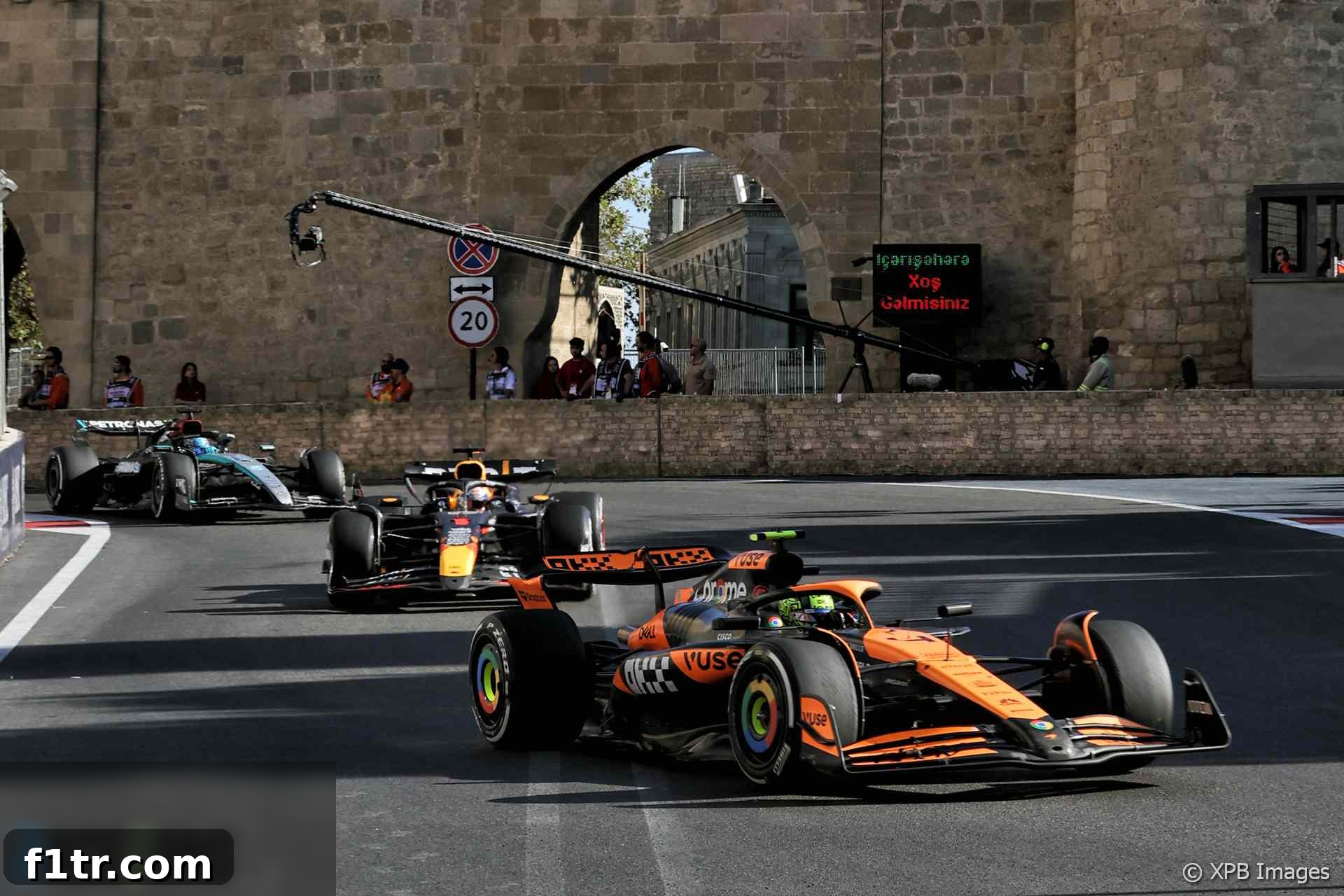
In a move that sparked immediate controversy and drew the attention of motorsport’s governing body, Lando Norris formally alerted the FIA to a potential rule infringement by his formidable championship rival, Max Verstappen, during the climactic final moments of the Azerbaijan Grand Prix. This incident, occurring as the race concluded under Virtual Safety Car conditions, has ignited widespread debate across the Formula 1 paddock and among fans, raising critical questions about the interpretation and enforcement of safety regulations at the highest level of motorsport.
Advert | Become a Supporter & go ad-free
The highly anticipated Azerbaijan Grand Prix concluded amidst palpable tension and uncertainty, not just for the race results but also for the actions of several drivers on track. At the heart of this unfolding drama is Max Verstappen, who now finds himself embroiled in an official investigation by the FIA. He is one of four drivers singled out for allegedly overtaking competitors while the Virtual Safety Car (VSC) procedure was active, an event that unfolded just as the checkered flag was waved, adding an unusual layer of complexity to the race’s conclusion.
The Critical Incident: VSC and Overtaking at Race End
The Virtual Safety Car was deployed on the penultimate lap of the Azerbaijan Grand Prix, a direct consequence of a dramatic collision involving Sergio Perez and Carlos Sainz Jnr. This incident necessitated immediate action from race control to ensure the safety of marshals and medical personnel on track. Crucially, the VSC conditions remained in effect as the leading cars approached and ultimately crossed the finish line, bringing the race to an end. This meant that while Verstappen was still under VSC regulations, he crossed the line approximately 40 seconds after Norris, who finished immediately ahead of him on track.
During this critical phase, Norris meticulously adhered to the VSC protocols, maintaining the prescribed reduced speed and staying behind George Russell, who was positioned just ahead of him. However, it was at this juncture that Verstappen rapidly closed the gap, catching up to both Norris and Russell. What followed became the subject of intense scrutiny and the core of Norris’s complaint to the FIA.
Verstappen’s controversial maneuver saw him first overtake Norris on the approach to Turn 18. He then proceeded to pass Russell just before the tight right-hand kink at Turn 19. Norris, keenly aware of the regulations and his own adherence to them, immediately reported Verstappen’s actions to his race engineer, Will Joseph, highlighting the perceived breach of protocol.
“Max is overtaking everyone,” Norris communicated with a degree of disbelief over the team radio. “It’s still a VSC, right? I don’t know if it still matters or not, but it’s still a VSC.” This immediate reaction underscores the confusion and potential rule ambiguity that arose from the race ending under VSC conditions. Following these overtakes, Verstappen peeled off into the pits ahead of Russell and Norris, who maintained their order until they too entered the pit lane, their positions on track now a matter for the stewards to consider.
Norris’s Justification: Prior Experience and Safety Concerns
Speaking after the race, Norris elaborated on his decision to query Verstappen’s driving with his team. His concern was rooted in his understanding of the VSC rules and his own recent experience with race conditions. Just the previous day during qualifying, Norris had been forced to abandon a crucial lap when yellow flags were displayed, demonstrating his strict adherence to safety protocols. This personal experience likely shaped his perspective on Verstappen’s actions.
“I just had ‘VSC’ on my dash with yellow lights, similar to what I had yesterday,” he explained to reporters. “Obviously there was a crash, there was paramedics on-track, things like that, which normally means no overtaking.” Norris’s statement highlights the primary objective of the VSC: to ensure the safety of marshals, medical personnel, and drivers in the event of an incident. Overtaking under such circumstances is generally strictly prohibited precisely because of the inherent dangers. “But he was overtaking. So I just questioned it, I quizzed it to my team, because I didn’t think you’re allowed to overtake, but, maybe I’m wrong.” This candid admission from Norris indicates that while he was confident in his understanding, he also acknowledged the possibility of a nuanced interpretation of the rules, particularly as the race ended.
Verstappen’s Defense: Race End and Precedents
In response to the accusations, Max Verstappen staunchly denied any wrongdoing. He presented a clear counter-argument, suggesting that his actions were permissible given the specific context of the race’s conclusion. “I didn’t pass under the Virtual Safety Car,” he asserted in an interview with Sky Sports. Verstappen’s core argument rests on the timing: “We crossed the line, the race is finished, and there are a lot of examples in the past, this year as well, when we have done exactly the same thing. So for me I’m a bit surprised.”
Verstappen’s defense implies that once the checkered flag is waved, the conditions of the VSC, particularly concerning overtakes, might be interpreted differently or might cease to apply in the same stringent manner as during active racing laps. His reference to “a lot of examples in the past” suggests a historical precedent that drivers have followed without penalty, creating an expectation of similar treatment. This divergence in interpretation between Norris and Verstappen highlights a critical area of potential ambiguity in the FIA’s regulations that requires definitive clarification.
Advert | Become a RaceFans supporter andgo ad-free
The FIA’s Role and the Nuances of VSC Regulations
The Virtual Safety Car is a crucial safety tool in Formula 1, designed to neutralize a race temporarily without deploying the full Safety Car. When the VSC is deployed, drivers must reduce their speed and maintain a specific delta time to ensure a safe environment for incident recovery. Overtaking is generally forbidden under VSC conditions to prevent dangerous situations arising from drivers operating at different speeds or vying for track position during a period of reduced visibility or potential hazards. The FIA’s investigation will delve into the precise wording of the sporting regulations regarding VSC procedures, especially when a race concludes under such conditions.
The situation at the Azerbaijan Grand Prix is complex because the VSC was active at the exact moment the race officially ended. This raises questions about whether the cessation of active competition, marked by the checkered flag, instantaneously nullifies the more restrictive VSC overtaking rules. The FIA stewards will need to carefully review telemetry data, radio communications, and past precedents to determine if Verstappen’s actions constituted a breach. Penalties for VSC infringements typically range from time penalties added to a driver’s race time to points deductions, depending on the severity and intent.
This incident underscores the paramount importance of clarity in the sporting regulations. Drivers rely on precise rules to navigate high-stakes racing, and any ambiguity can lead to confusion, protests, and an erosion of confidence in the consistency of officiating. For championship contenders like Norris and Verstappen, every point is crucial, making the interpretation of such rules even more significant. The FIA’s ruling in this case will not only decide the fate of these drivers but also set a precedent for future race endings under VSC.
Beyond Verstappen: Multiple Drivers Under Scrutiny
It is important to note that the investigation extends beyond Max Verstappen. Three other drivers, Nico Hulkenberg, Pierre Gasly, and Esteban Ocon, are also under investigation for similar alleged infringements – overtaking under VSC conditions after the race had finished. This suggests that the confusion surrounding VSC protocols at the race’s conclusion was not an isolated issue but potentially a broader misunderstanding or a grey area in the rules that multiple drivers exploited or misjudged.
The collective nature of these investigations indicates a systemic issue that the FIA must address. If several experienced drivers found themselves in similar situations, it points towards a need for clearer guidelines or better communication during such critical race phases. The outcome of these investigations could have implications for the final race classifications and, potentially, the drivers’ championship standings, emphasizing the far-reaching impact of these rule interpretations.
Advert | Become a RaceFans supporter andgo ad-free
Implications for Sporting Integrity and Future Races
The integrity of Formula 1 relies heavily on consistent and transparent rule enforcement. Incidents like these, where a potential breach occurs at the very end of a race, challenge both the drivers’ understanding and the FIA’s ability to maintain fairness. The championship battle, especially between fierce competitors like Lando Norris and Max Verstappen, is always intense, and any perceived unfair advantage, intentional or otherwise, can quickly become a significant point of contention.
A clear and decisive ruling from the FIA is essential. Not only will it bring closure to the Azerbaijan Grand Prix controversy, but it will also establish a clear benchmark for driver conduct under VSC conditions, particularly when the checkered flag is imminent. This clarity is vital for preventing similar incidents in future races and ensuring that all competitors operate under the same, unambiguous set of rules. The decision will undoubtedly be closely watched by teams, drivers, and fans worldwide, as it could reshape interpretations of crucial safety regulations for years to come.
2024 Azerbaijan Grand Prix
- Verstappen: “Important” for FIA to clarify legality of McLaren’s ‘mini DRS’ wing
- Hamilton explains suspension set-up change behind “miserable” Baku weekend
- Piastri needs “crazy” results to become title contender despite Baku win
- FIA taking new look at flexing bodywork amid intrigue over McLaren’s rear wing
- Norris knew Verstappen broke VSC rules in Baku because he did the same in Melbourne
Browse all 2024 Azerbaijan Grand Prix articles