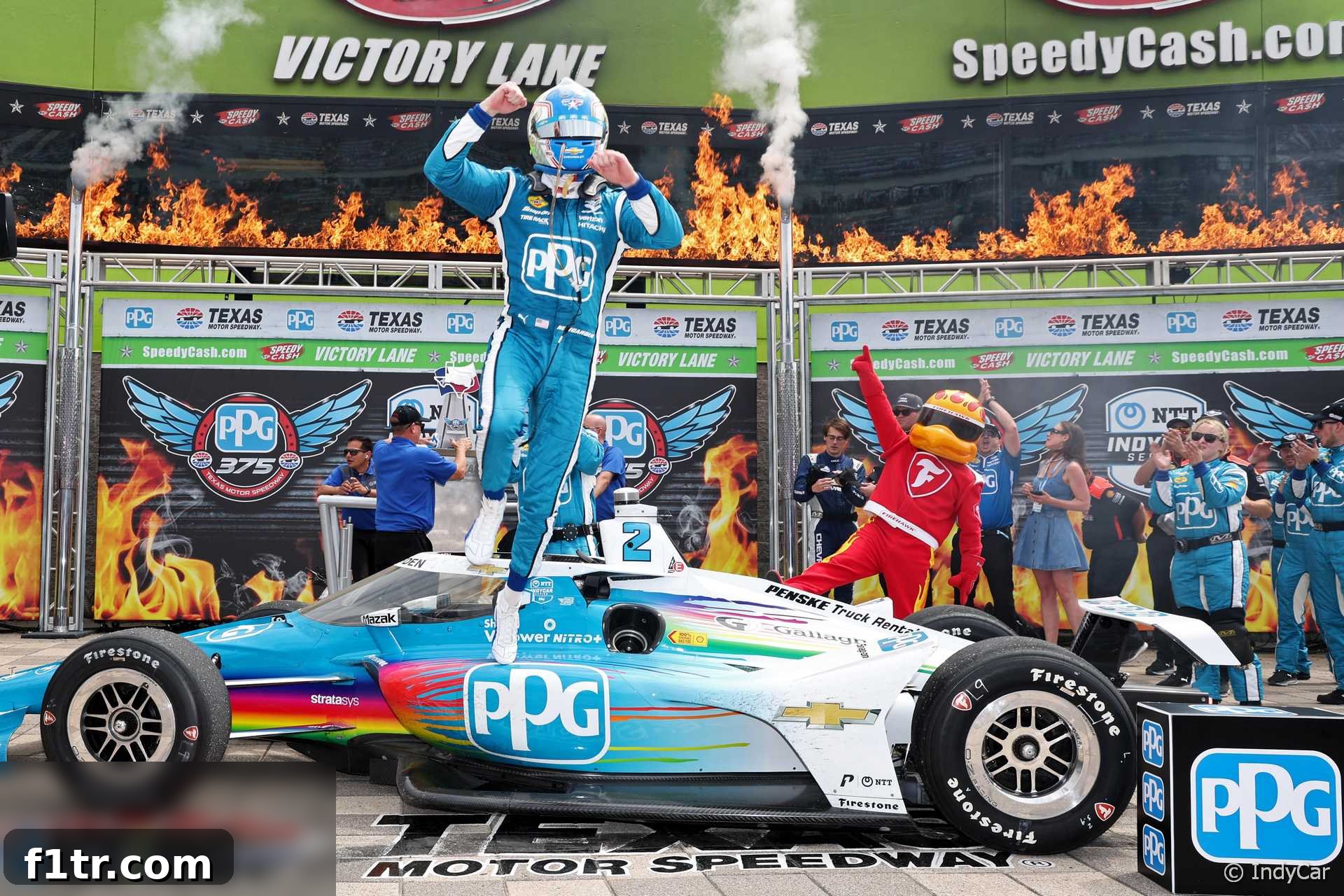
In a breathtaking display of skill and strategy, Josef Newgarden emerged victorious in Sunday’s Texas 375 at Texas Motor Speedway, narrowly holding off a relentless Pato O’Ward in a spectacular head-to-head, wheel-to-wheel showdown. The race, a testament to IndyCar’s captivating allure, kept fans on the edge of their seats until the very last lap.
Advert | Become a Supporter & go ad-free
Newgarden Secures Back-to-Back Texas Triumph After Thrilling Battle
The highly anticipated Texas 375 culminated in a nail-biting finish, with Newgarden masterfully defending his position against a surging O’Ward. This hard-fought win marks Newgarden’s second consecutive victory at the challenging 1.5-mile superspeedway, a track that has seen its share of criticism in recent years for oscillating between uninspiring processional events and dangerous pack racing. However, Sunday’s race delivered an unforgettable spectacle, demonstrating the true potential of IndyCar racing at this iconic venue.
Texas Motor Speedway Delivers a Pulsating Race
This year, several crucial factors combined to transform the Texas Motor Speedway experience, silencing its critics and producing one of the most exciting races of the season. Special practice sessions dedicated to laying down rubber on the outer groove of the corners significantly expanded the racing line, promoting multi-lane action. Furthermore, a wider range of aerodynamic parts available to teams allowed for diverse car setups, fostering competitive strategies. Coupled with changeable weather conditions throughout the day, these elements conspired to create a truly pulsating event, brimming with overtakes, strategic gambles, and unexpected twists.
With the looming threat of severe weather in the Dallas-Fort Worth area, race organizers wisely brought the start time forward by 15 minutes, ensuring the action could unfold without major interruptions. Pole-winner Felix Rosenqvist and veteran Scott Dixon initially traded the lead, setting a swift pace. However, it wasn’t long before the race’s eventual protagonists, Josef Newgarden and Pato O’Ward, assertively interjected themselves into the lead fight, signaling their intentions for victory early on.
Early Incidents and Pit Lane Drama Unfold
Takuma Sato’s 2023 season debut, a much-anticipated event for Chip Ganassi Racing, came to an abrupt and unfortunate end on lap 48. The experienced Japanese driver, navigating the challenges of his first start with the new team, sought to give Devlin DeFrancesco and Will Power ample room on his inside as they battled for position. However, as he drifted wide exiting Turn Two, he inadvertently found himself in the marbles – the accumulation of tire rubber and debris off the main racing line. This treacherous surface caused his car to lose grip, spinning violently before broadsiding the inside retaining wall, ending his day prematurely.
Given that nearly all competitors were nearing the end of their first stint, Sato’s incident triggered a collective dive into pit lane for routine service. This pivotal moment, however, introduced its own set of dramas. Alexander Rossi, who had been running comfortably within the top five, suffered severe misfortune. As he peeled out of his McLaren pit box, his path intersected with Kyle Kirkwood, who swerved in, making contact with Rossi’s right-front. The impact inflicted substantial damage to Rossi’s suspension, forcing him to spend six crucial laps in the garage for repairs.
Advert | Become a RaceFans supporter andgo ad-free
Adding further insult to injury, race officials deemed Rossi at fault for an unsafe release, issuing him a drive-through penalty – a decision that visibly frustrated the 2016 Indy 500 winner. Kirkwood, despite seemingly escaping the initial contact less damaged, fared little better in the long run, with a right-rear suspension failure effectively ending his race not long after the incident, highlighting the fine margins and unforgiving nature of superspeedway racing.
O’Ward’s Mid-Race Surge and Strategic Crossroads
As the race progressed into its second round of green flag pit stops, Pato O’Ward truly came roaring to life. Coinciding with the sun breaking through the cloud cover and bathing the track in warmth, the number five McLaren Chevrolet transformed into an absolute rocket ship. O’Ward seized the lead with incredible pace, driving away from the field and, at one stage, nearly putting a lap on Newgarden, showcasing a dominant turn of speed that momentarily seemed insurmountable. His car’s performance in these specific conditions was a testament to both driver skill and engineering prowess.
However, the fluid nature of IndyCar racing dictates that fortunes can change in an instant, and so it did with 72 laps remaining. Felix Rosenqvist, O’Ward’s teammate, lost control as he too ventured into the marbles out of Turn Four, culminating in a significant crash through the dogleg. This incident brought out the caution flag and prematurely ended what had been a highly promising run for the Swedish driver, who had been a contender throughout the race.
Ironically, this very incident erased a commanding six-second advantage that O’Ward had meticulously built over Newgarden, fundamentally resetting the race. It also put six previously lapped cars back on the lead lap, setting the stage for renewed competition. Both O’Ward and Newgarden pitted during this caution, initially maintaining their top positions. However, a crucial strategic divergence occurred while the field was still circulating under the Safety Car: Newgarden opted for a second, quick pit stop to top up his fuel tank, sacrificing track position but gaining the advantage of a full tank. O’Ward, conversely, chose to stay out, prioritizing track position above all else.
Chaos Reigns: Multiple Cautions and Lead Changes
The ensuing restart with 57 laps to go ignited a mad scramble among the leaders. With a blend of fuel-saving strategies and fierce determination to maintain track position, the lead changed hands rapidly and frequently. Veterans like Scott Dixon, Romain Grosjean, Alex Palou, Colton Herta, and Scott McLaughlin all rejoined the fray, each taking turns at the front in a breathtaking display of close-quarters racing. This unbelievable scrap, however, came to an abrupt halt when rookie Sting Ray Robb hit the wall out of Turn Two, skidding along the inside wall in a hard impact. This brought out yet another caution with 41 laps remaining, further compressing the field and intensifying the strategic considerations.
As the green flag waved once more, O’Ward, having pitted along with Newgarden and McLaughlin to sacrifice track position for fresh tires during the previous caution, tore his way through the field from fifth place to reclaim the lead on his new rubber. His aggressive charge showcased the raw pace advantage new tires offered. But soon afterwards, the race was marred by a terrifying multi-car crash in Turn Three, taking out Devlin DeFrancesco and Graham Rahal, highlighting the inherent dangers of racing at such high speeds.
Advert | Become a RaceFans supporter andgo ad-free
DeFrancesco’s incident began when he sustained damage after contact with the Turn Two wall. He then dropped down to the apron in Turns Three and Four, losing control before drifting back up onto the racing line directly in front of Rahal. The RLL driver had barely a fraction of a second to react and brake before hitting the wayward car, sending him momentarily airborne before striking the barriers with considerable force. Mercifully, and to the relief of everyone watching, both drivers were quickly assessed and confirmed to be okay, a testament to the safety advancements in IndyCar racing.
The Climax: Newgarden vs. O’Ward – A Battle for the Ages
The final ten laps delivered an absolutely enthralling spectacle, transforming the Texas 375 into a true heavyweight boxing match. O’Ward led the field back to the green flag, but his lead was short-lived as Alex Palou drove past him into Turn Three, demonstrating his own formidable pace. Just a few laps later, however, Josef Newgarden executed a decisive move, taking both Palou and O’Ward to seize the lead. From that moment, Newgarden clung fiercely to the front, masterfully protecting the inside line as O’Ward, with an insatiable hunger for victory, tried everything in his arsenal to repass him on the high side of the track. The two drivers were in a league of their own, pushing their cars and each other to the absolute limit.
Adding another layer of drama to the closing stages, Romain Grosjean, who had been running on the fringes of the lead battle and scrapping intensely with David Malukas, experienced heartbreaking misfortune. On the penultimate lap, likely in turbulent air from the cars ahead, he lost control. His car spun out dramatically in Turn Two and slid down to the inside wall, effectively ending his promising run in fifth place and bringing out the final caution of the day.
As the final caution flag waved, Newgarden was just ahead of O’Ward, a position that secured his dramatic second consecutive win at Texas Motor Speedway. O’Ward, despite his fierce efforts, had to settle for his second consecutive runner-up finish, a testament to his consistent performance. However, there was a significant consolation for the young Mexican driver: he assumed the IndyCar Series championship lead after two intense races, setting himself up as a formidable contender for the season title.
Podium Finishes and Championship Implications
The shared dominance of Newgarden and O’Ward throughout the Texas 375 was staggering; collectively, they led an astonishing 214 of the 250 laps run, a clear indicator of their superior pace and strategic execution. Alex Palou rounded out the podium with a strong third-place finish, showcasing his consistency and ability to capitalize on late-race opportunities. David Malukas, who had a tantalizing window of opportunity to take his maiden IndyCar win, still came home with an incredibly impressive fourth-place finish, marking a career-best performance for the young driver.
The Scotts, Dixon and McLaughlin, demonstrated resilience and strong race craft, finishing fifth and sixth respectively. This was a particularly impressive recovery for McLaughlin, who had been mired in the midfield during the early stages of the race, battling his way back through a competitive field. Colton Herta secured a solid seventh place, while Marcus Ericsson finished eighth, albeit one lap down. Ericsson’s finish meant he dropped to second in the championship standings, now trailing O’Ward by seven points. Helio Castroneves put a wretched qualifying effort firmly behind him to climb through the field and finish ninth, proving his enduring class, and Callum Ilott rounded out the top ten, showcasing consistent form.
Romain Grosjean, despite his late-race accident, was credited with a respectable 14th place finish. Among the rookies, Agustin Canapino was the highest finisher in 12th, ahead of Benjamin Pedersen in 15th, both demonstrating promising debuts on the challenging oval. Although the race witnessed several high-speed impacts and significant crashes, a huge relief for everyone involved was that every driver walked away from their respective incidents without any serious injuries, highlighting the remarkable safety standards of modern IndyCar racing.
The IndyCar Series now takes a two-week break before returning for the iconic Grand Prix of Long Beach, where the championship battle is sure to intensify further on the demanding street circuit.
Advert | Become a RaceFans supporter andgo ad-free
IndyCar
- IndyCar driver McLaughlin cleared of injury after crashing through barrier at Barber
- Schumacher says his IndyCar feels like ‘an F2 car, just with better tyres’
- IndyCar “way faster than Formula 1” in some corners, says Grosjean
- FIA to award more F1 superlicence points to IndyCar drivers from 2026
- Schumacher to race full-time in IndyCar with RLL in 2026
Browse all IndyCar articles