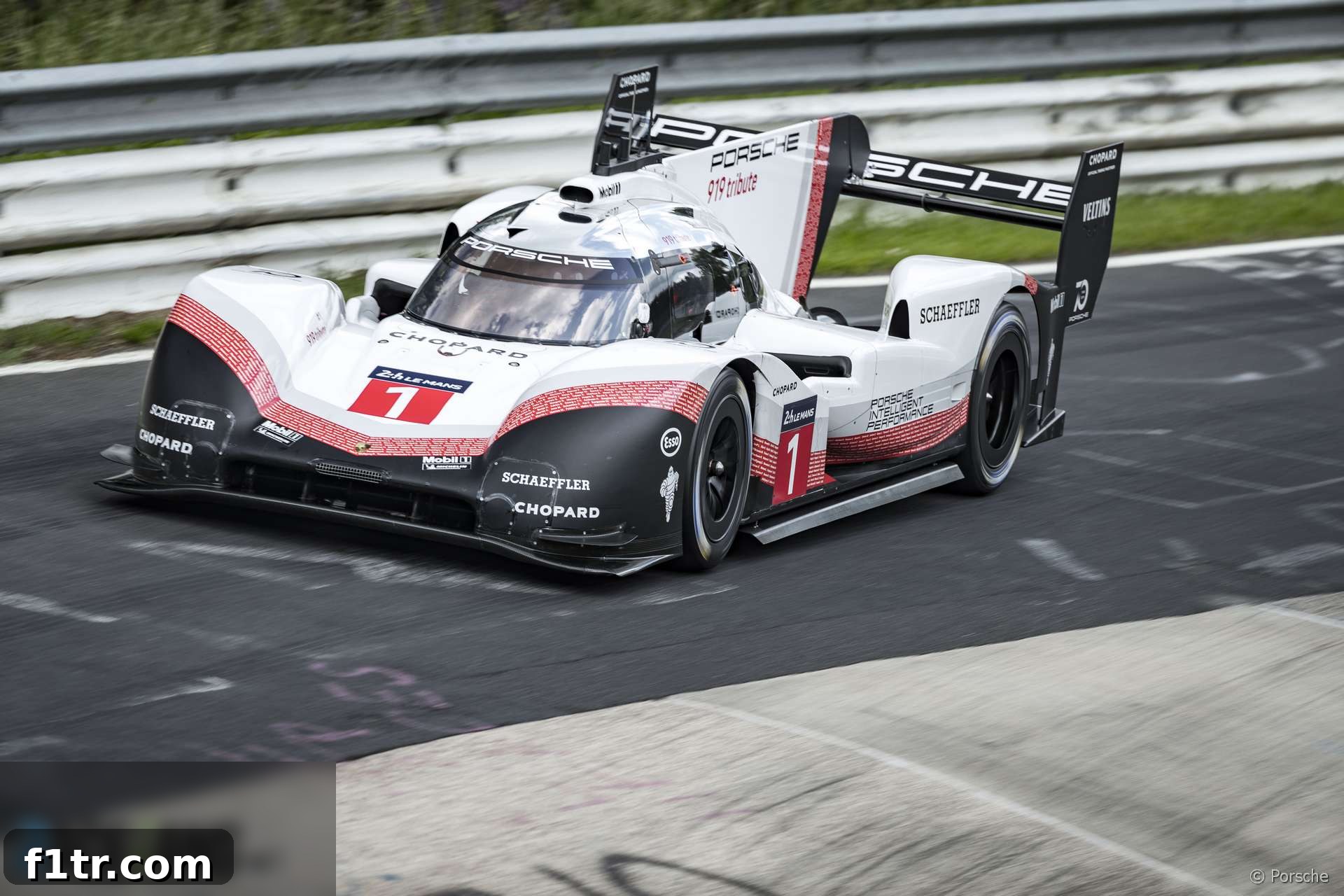
The legendary Nürburgring Nordschleife, a track synonymous with ultimate automotive performance, witnessed a historic moment recently when Porsche shattered its long-standing lap record. The incredible feat was achieved by the unrestricted Porsche 919 Evo, a derivative of its Le Mans-winning LMP1 machine. However, despite the awe-inspiring achievement and the immense prestige associated with holding the Nordschleife record, Mercedes-AMG Petronas Formula 1 Team principal Toto Wolff has unequivocally stated that his team will not attempt to challenge this benchmark with their Formula 1 car.
Wolff’s remarks came after Porsche’s audacious “919 Tribute Tour” saw the 919 Evo, driven by Timo Bernhard, complete the daunting 20.8-kilometre circuit in a staggering 5 minutes and 19.55 seconds. This monumental lap obliterated the previous outright record of 6 minutes and 11.13 seconds, set by Stefan Bellof in a Porsche 956 sports car way back in 1983 – a record that had stood for 35 years. The sheer margin of improvement captivated the motorsport world, pushing the boundaries of what was thought possible on the “Green Hell.”
When pressed by journalists, including RaceFans, about whether Mercedes harbored any ambition to stake their claim on the record with their cutting-edge F1 machinery, Wolff admitted that the thought had crossed his mind, particularly after witnessing Porsche’s incredible time. Speaking during an FIA press conference at the Red Bull Ring, Wolff expressed his admiration, stating, “It’s funny that you say that, I thought about that this morning when I saw the time. It’s obviously incredible what they have achieved to do. Five minutes 19 is almost a minute faster than what Bellof did in a sports car.”
The Allure and The Reality: F1 on the Nordschleife
The idea of a modern Formula 1 car tackling the Nürburgring Nordschleife conjures images of unparalleled speed and visceral excitement. It’s a dream scenario for many motorsport enthusiasts, pitting the pinnacle of open-wheel racing technology against the most demanding circuit in the world. However, Wolff, ever the pragmatist, quickly grounded the discussion in reality. “It would be interesting to put a Formula One car on the Nordschleife and trying to see what it does but it’s probably more a nice fling than a realistic idea that somebody is going to finance,” he elaborated. When directly asked if Mercedes could afford such an undertaking, his answer was a resounding, succinct “No.”
Wolff’s personal history with the Nordschleife adds a layer of understanding to his cautious stance. He referenced a significant crash he experienced on the legendary track during his own racing career, quipping, “It’s one and a half minutes faster than what I thought of doing and it ended up in tears.” This anecdote highlights the inherent dangers and unforgiving nature of the Nordschleife, even for seasoned professionals, making the prospect of unleashing a highly strung F1 car there a daunting one. The Mercedes team principal relayed conversations with his engineers, who described the 919 Evo’s lap as “just unbelievable, it’s like flying a spaceship around the track.” This sentiment perfectly encapsulates the otherworldly performance achieved by Porsche.
Unleashing the Beast: The Porsche 919 Evo’s Technical Mastery
To truly appreciate the Mercedes decision, one must understand the machine that set the new benchmark: the Porsche 919 Evo. This car was not just an LMP1 prototype; it was an LMP1 prototype unleashed from the shackles of endurance racing regulations. After its successful campaign in the World Endurance Championship, which included multiple Le Mans victories, Porsche embarked on the “919 Tribute Tour” to showcase the car’s ultimate potential without any rulebook constraints.
The modifications made to the 919 Evo were extensive. Porsche engineers dramatically increased its aerodynamic downforce by nearly 53% compared to its WEC-spec counterpart. This was achieved through a larger front diffuser, an enormous multi-element rear wing, and active drag reduction systems. Crucially, fuel flow restrictions were removed, allowing the turbocharged V4 engine to produce an astounding 720 horsepower. The hybrid system was also recalibrated for maximum power delivery, boosting the combined output to over 1160 horsepower. Furthermore, significant weight reduction contributed to a dry weight of just 849 kg. The result was a car that represented the absolute pinnacle of hybrid prototype technology, free to exploit every design and engineering advantage for pure speed.
The Nordschleife: The Ultimate Proving Ground
The Nürburgring Nordschleife, often referred to as “The Green Hell” by Jackie Stewart, is unlike any other racing circuit in the world. Stretching over 20 kilometers through the Eifel mountains, it features more than 150 corners, dramatic elevation changes exceeding 300 meters, and a terrifying blend of blind crests, high-speed straights, and technical sections. It demands absolute precision, courage, and a car capable of handling diverse conditions.
Modern Formula 1 cars, while incredibly fast, are meticulously engineered for specific conditions: smooth, purpose-built Grand Prix circuits with ample run-off areas and relatively consistent surfaces. Their low ground clearance, stiff suspension, and highly sensitive aerodynamics are optimized for these environments. The Nordschleife, with its undulating tarmac, aggressive kerbs, and close proximity to Armco barriers and trees, would present unprecedented challenges. An F1 car’s delicate suspension would be severely tested, its sophisticated aerodynamics might struggle with the constant changes in gradient and direction, and the sheer lack of suitable run-off zones would pose a significant safety risk in the event of a high-speed incident. The last time Formula 1 raced on the full Nordschleife was in 1976, and the cars of that era bore little resemblance to today’s technologically advanced machines.
The Financial and Strategic Calculation for Mercedes
Mercedes’ decision is ultimately a pragmatic one, rooted in financial prudence and strategic alignment. Attempting a Nordschleife lap record with an F1 car would entail colossal costs. Beyond the significant expense of transporting and staffing the operation, the team would need to potentially modify the car for the unique demands of the circuit, which could include revised suspension setups, enhanced brake cooling, and specialized tire compounds – all diverting precious resources from their primary objective: winning Formula 1 championships.
Furthermore, the risk-reward ratio for such an endeavor is skewed. The financial outlay, coupled with the ever-present danger of a costly accident on such an unforgiving track, would be immense. The potential marketing return, while significant, might not justify the scale of the investment and the associated risks for a team whose brand identity is already firmly established at the pinnacle of global motorsport. For Mercedes, a world-beating F1 team, their priorities lie in perfecting their race performance, developing next-generation technology for the hybrid era, and securing constructors’ and drivers’ titles. A Nordschleife record, while a prestigious feather in the cap, does not directly contribute to these core objectives in the same way it did for Porsche, which used the “919 Tribute Tour” as a farewell and a showcase of unrestrained engineering prowess.
It’s also worth noting that the Porsche 919 Evo’s speed was so extreme that it even surpassed Mercedes’ own pole position time set at Spa-Francorchamps during the previous year’s Belgian Grand Prix. This illustrates the raw, unrestricted pace the 919 Evo commanded, highlighting that its performance was truly in a league of its own, even against regulated F1 cars on their optimal tracks.
Beyond the Record: The Spirit of Innovation
While Mercedes’ decision is understandable, the discussion around a potential F1 Nordschleife attempt underscores a broader fascination with pushing the boundaries of automotive engineering. Porsche’s 919 Evo project was a magnificent demonstration of what can be achieved when engineers are given free rein, serving as an inspiration for technological advancement across the industry. It sparked debate, ignited passion, and provided invaluable insights into extreme performance capabilities.
Ultimately, the Nürburgring Nordschleife remains a singular challenge, a definitive test of machine and driver. While Mercedes-AMG F1 may not be taking up the gauntlet to challenge Porsche’s incredible record, the hypothetical scenario continues to fuel the imaginations of fans and engineers alike, reminding us of the endless pursuit of speed and the relentless spirit of innovation that defines motorsport.
2018 F1 season
- F1 feared “death knell” for Drive to Survive after Ferrari and Mercedes snub
- McLaren staff told us we were “totally crazy” to take Honda engines in 2018 – Tost
- ‘It doesn’t matter if we start last’: How Red Bull’s junior team aided Honda’s leap forward
- Honda’s jet division helped F1 engineers solve power unit problem
- McLaren Racing losses rise after Honda split
Browse all 2018 F1 season articles