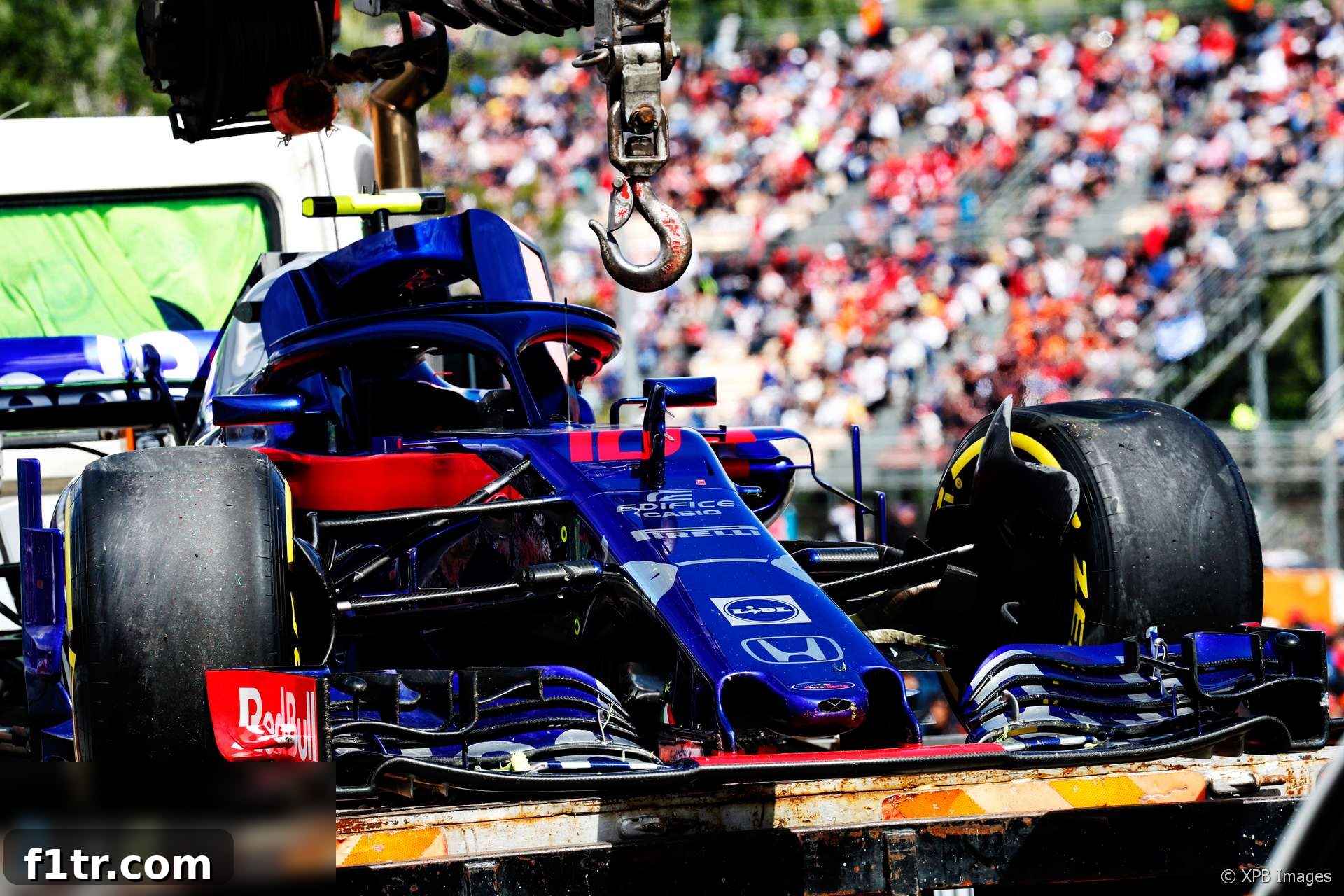
Pierre Gasly unequivocally rejected Romain Grosjean’s explanation for the dramatic multi-car collision that occurred during the opening lap of the Spanish Grand Prix, an incident which prematurely ended the races of both drivers, as well as Nico Hulkenberg.
The incident quickly became a focal point of post-race analysis and debate within the Formula 1 paddock. Following a thorough review by the race stewards, Grosjean was ultimately deemed responsible for the crash, resulting in a three-place grid penalty for the subsequent race weekend. The Haas driver’s car spun wildly into the path of oncoming traffic after he lost control, leading to an unavoidable impact with the two trailing drivers.
Advert | Become a Supporter & go ad-free
In the immediate aftermath of the calamitous event, Grosjean offered a defence of his actions, stating publicly that his reaction to the spin – specifically, his decision to apply throttle – was a natural human reflex that he believed would help him regain control and potentially mitigate the impact on other drivers. He asserted that this action was intended to reduce the chance of other competitors colliding with his out-of-control vehicle. However, after meticulously reviewing extensive footage of the crash from multiple angles and numerous times, Gasly expressed a firm belief that Grosjean could have indeed avoided involving other drivers in his misfortune, suggesting that alternative actions were available to prevent the wide-reaching consequences.
“I’ve watched the video 50 times,” Gasly revealed, underscoring the depth of his analysis and his conviction regarding the incident. He acknowledged the inherent difficulty of making split-second decisions in the high-pressure environment of Formula 1, stating, “I think it’s always easier to judge afterwards because as a driver when everything is happening and you have one [or] two tenths to take a decision things are different. When you look at it 50 times and you take 10 minutes to think about what he could have done differently it’s always easier.” This statement acknowledges the human element but also sets the stage for a critical examination of Grosjean’s specific choices.
Gasly then elaborated on his detailed observation of the sequence of events. “He lost the car first time, then it kind of came back,” he explained, describing the initial moment of instability. “At that time I think he was a bit too optimistic and he was thinking ‘OK I can actually race again’, like he thought that the car would stick and it will be fine.” This critical assessment points to Grosjean’s apparent misjudgment of the situation, believing he had recovered sufficiently to continue racing aggressively. It was this moment of misplaced optimism, according to Gasly, that led to the subsequent and more damaging chain of events.
The crucial error, in Gasly’s view, was Grosjean’s decision to re-apply the throttle. “I think he came back on the throttle and he lost it a second time and he stayed on the throttle at that time,” Gasly stated. He further hypothesized on what could have been a safer, albeit less ideal for Grosjean’s own race, course of action: “But probably if he would have been more patient when it recovered, would have been a bit wider, he could have braked, maybe flat-spotted the four tyres and then it would not have been ideal for his race but at least he would have not ruined Nico’s race and mine.” This detailed breakdown suggests that Grosjean had a window of opportunity to take corrective action – specifically, braking hard and accepting a compromised race – which would have prevented the entanglement of other cars. Flat-spotting tires, while detrimental to performance, would have been a far better outcome than a triple DNF.
Gasly concluded his analysis with a reflection on the benefit of hindsight but firm belief in alternative, safer choices. “It’s always easier to have a look after but probably there were other options which would have been better for him and also us with Nico.” This reiterates the core argument that Grosjean’s actions, while perhaps instinctive, were not the only or best options available in a safety-critical moment on track. The expectation in Formula 1 is not just to be fast, but also to race responsibly and minimize danger to competitors when an incident occurs.
Beyond the technical analysis of the crash, Gasly also touched upon the matter of sportsmanship and inter-driver communication. He revealed a lack of direct contact from Grosjean regarding the incident: “I didn’t speak about him and he didn’t speak to me about it as well. I think [in] such a situation I would have at least apologised. But I’m fine, it’s not a big deal.” This comment, while downplaying the emotional impact on Gasly, subtly highlights a perceived lapse in professional etiquette. An apology, even if the incident was unintentional, is often seen as a gesture of respect and acknowledgement among drivers, especially when their actions lead to the elimination of others from a race.
Adding another layer of complexity to the narrative, the Toro Rosso driver disclosed a critical software problem with his car that directly contributed to his slow start, inadvertently placing him in the precarious position where he became a victim of Grosjean’s incident. “I had a small issue when I up-shifted to second gear,” Gasly explained, pinpointing the technical glitch. “The first getaway was really good, then after to second gear we had a software issue which made the up-shift really slow and I lost massive acceleration.” This significant loss of power and pace immediately after the start put Gasly at a severe disadvantage, altering his track position and making him vulnerable.
Describing the immediate consequences of this technical setback, Gasly continued, “From there I got a bit squeezed into turn one and there was no point to risk, I was pretty close to Perez and Charles on the left, was a bit stuck in the middle. It was not the greatest start.” This paints a vivid picture of a driver who, through no fault of his own, found himself in a compromised position, unable to accelerate effectively and hemmed in by other cars. This lack of clear track and rapid acceleration meant he was unable to react or steer clear of Grosjean’s spinning Haas, making the collision almost inevitable from his perspective. It underscores how small technical failures can have significant, race-ending consequences in the tightly packed opening laps of a Grand Prix.
Fortunately, Gasly confirmed that his team, Toro Rosso, acted swiftly to address the fault. The technical issue was thoroughly investigated and successfully replicated during subsequent testing sessions, allowing the engineers to diagnose and implement a permanent fix. This proactive approach ensures that such an untimely software glitch does not recur and compromise future race starts for the young driver, highlighting the relentless pursuit of perfection and reliability characteristic of Formula 1 teams.
The Spanish Grand Prix incident served as a stark reminder of the fine margins and inherent dangers in Formula 1 racing. While Grosjean’s ‘reflex’ explanation ignited debate, Gasly’s detailed analysis from a driver’s perspective offered a compelling counter-argument, emphasizing the responsibility drivers hold to minimize risks to others, even when their own race is compromised. The unwritten code of conduct among competitors, often reinforced by gestures like an apology, plays a vital role in maintaining respect within the paddock. Furthermore, Gasly’s revelation about his car’s software glitch underscores how an intricate combination of human error, instinct, and unforeseen technical issues can converge to create dramatic and race-altering moments, reminding everyone of the complex interplay of factors in motorsport’s elite category. Lessons learned from such incidents continually drive improvements in both driver training and car technology, aiming to make the sport safer while preserving its thrilling competitive edge.
Advert | Become a RaceFans supporter andgo ad-free
2018 F1 Season: Key Moments and Further Insights
The 2018 Formula 1 season was a year filled with intriguing storylines, intense rivalries, and significant developments, making the Spanish Grand Prix crash involving Gasly and Grosjean just one of many memorable events. That season saw Mercedes and Ferrari battling fiercely for supremacy, while teams like Toro Rosso and Haas were pushing hard to consolidate their positions in the midfield. Honda’s journey as an engine supplier, particularly with its renewed partnership with Toro Rosso, was also a major narrative, showcasing a path of continuous improvement and adaptation in the highly competitive world of F1 engine development.
For more detailed information and related articles from the 2018 F1 season, explore the links below. These pieces delve into various aspects of that year, from technical innovations and team strategies to driver performances and the overarching championship battle, providing a comprehensive look at a pivotal period in recent F1 history.
- F1 feared “death knell” for Drive to Survive after Ferrari and Mercedes snub
- McLaren staff told us we were “totally crazy” to take Honda engines in 2018 – Tost
- ‘It doesn’t matter if we start last’: How Red Bull’s junior team aided Honda’s leap forward
- Honda’s jet division helped F1 engineers solve power unit problem
- McLaren Racing losses rise after Honda split
Browse all 2018 F1 season articles