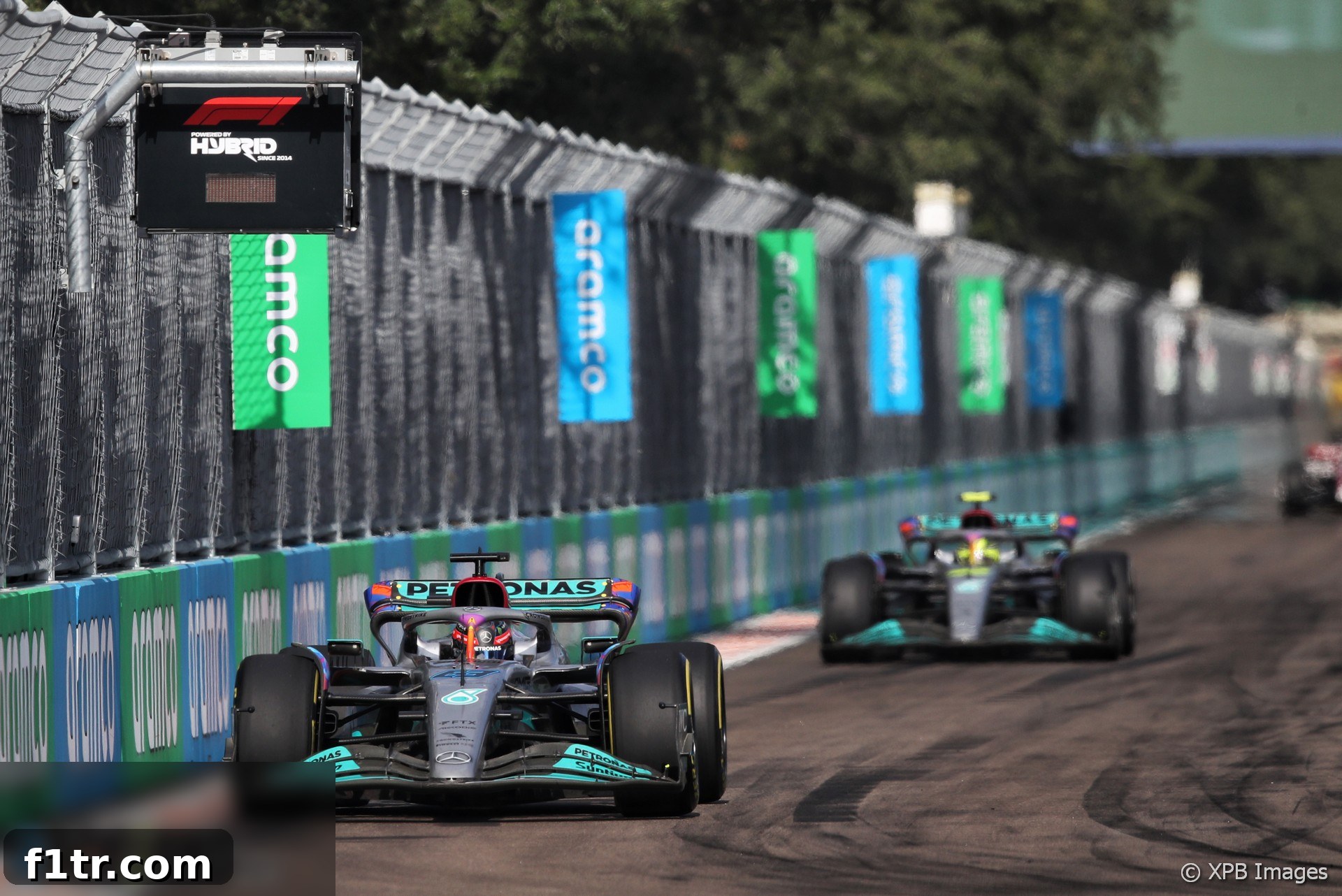
The inaugural Miami Grand Prix delivered a captivating spectacle, rich with strategic dilemmas and on-track drama that ultimately shaped the outcome for several contenders. Among the most scrutinized decisions was that made by Lewis Hamilton and his Mercedes-AMG Petronas F1 Team during a crucial Safety Car period. Hamilton, a seven-time world champion, found himself at the heart of a strategic gamble, ultimately deciding against an extra pit stop – a choice that sparked considerable debate and played a pivotal role in his race classification.
The race had been unfolding with its own unique challenges on the new Miami International Autodrome circuit, pushing teams and drivers to their limits. When the Safety Car was deployed, it presented a classic Formula 1 strategic crossroad. Hamilton had already completed his mandatory tyre change, running on a set of hard compound tyres that were still relatively fresh. However, his teammate George Russell, who had started on a different tyre strategy, seized the opportunity presented by the Safety Car. Russell made his pit stop, effectively gaining a “free” change onto new tyres with minimal time loss, a move that would prove instrumental in his charge through the field.
For Hamilton, the decision was far less straightforward. He had the option to follow Russell into the pits for a fresh set of tyres, but doing so would mean relinquishing track position and dropping behind his teammate. The allure of new, faster rubber had to be weighed against the immediate cost of losing places on the track. In the intense heat of the moment, with adrenaline high and information fragmented, Hamilton engaged in a critical radio exchange with his race engineer, Peter Bonnington, and chief strategist James Vowles. This conversation, portions of which were broadcast during the race, offered a rare glimpse into the complex decision-making process that unfolds in milliseconds during a Grand Prix.
The Weight of Decision: Hamilton’s Strategic Dilemma
Reflecting on the pivotal moment after the race, Lewis Hamilton shed light on the immense pressure drivers face when tasked with such critical strategic calls. “When you’re out there, you don’t have all the information,” Hamilton explained. “You don’t know where everyone is and where you’ll come out. You don’t have the picture that they have on the screen.” This lack of complete data, coupled with the high stakes, transforms strategic choices into what Hamilton described as a “gamble.” He confessed, “I don’t like that. So I was like, ‘you guys make the decision’. But either way, we were just a bit unfortunate with the Safety Car today.” This statement perfectly encapsulates the intricate balance between driver intuition and team analysis, highlighting why a centralized strategy unit is vital in modern F1. The driver’s role is to execute, but sometimes the weight of the decision falls squarely on their shoulders, even with limited insight.
The Mercedes drivers had embarked on the Miami Grand Prix with divergent tyre strategies from the outset. Hamilton commenced the race on the medium compound tyres, aiming for a longer first stint before switching to the harder, more durable compound. George Russell, in contrast, opted to start on the hard tyres, a choice that initially seemed less aggressive but ultimately afforded him greater flexibility later in the race, especially under unexpected circumstances like a Safety Car period. This strategic divergence meant that when the Safety Car was deployed, their respective positions on the track and the state of their tyres created vastly different scenarios for each driver.
Hamilton’s post-race analysis suggested a degree of hindsight regret regarding his initial tyre choice. “George obviously did a great job in that first stint,” he acknowledged. “He was on the better tyre to start with, the hard tyre was the best tyre.” While acknowledging Russell’s strong performance, Hamilton pondered, “So in hindsight, maybe we could have started on the hard tyre.” Nevertheless, he commended Russell for his recovery and securing valuable points for the team, adding, “But again, he did a great job to recover from his position and get the points. So we got fifth and sixth today, it’s good points for the team.” This demonstrated a pragmatic acceptance of the race outcome, focusing on the team’s overall performance despite personal disappointment.
Toto Wolff on the “Rock and a Hard Place” Decision
Mercedes Team Principal Toto Wolff provided further context to Hamilton’s difficult situation, describing it as being “between a rock and a hard place” when the Safety Car emerged. “The Safety Car clearly came out at a situation that wasn’t favourable for him and [was] favourable for George,” Wolff explained. Russell’s fortune lay in his strategic window: “George had a window, no one behind him, he was able to switch on a practically new medium [tyre].” This allowed Russell to capitalize fully on the Safety Car’s timing, emerging with a significant tyre advantage. For Hamilton, the options were fraught with risk. “Lewis had to decide ‘do I keep the position on the hard, or do I go on a soft?’, which would have been also tricky.” Wolff emphasized the finely balanced nature of the choice, concluding, “So that was probably a 50-50 decision and at the end it didn’t work out for him. But it’s not the first time that he’s been unlucky this season with the Safety Car.” Wolff’s comments underscore the capricious nature of Safety Car periods, which can arbitrarily reward or penalize drivers irrespective of their performance up to that point.
The incident at Miami was a stark reminder of how rapidly fortunes can shift in Formula 1. A Safety Car period, while designed to manage on-track incidents safely, often introduces an element of strategic lottery that can redefine the race order. Teams invest heavily in sophisticated simulation models and real-time data analysis to predict these scenarios, but ultimately, the timing of such disruptions remains unpredictable. For Mercedes, navigating these moments with two highly competitive drivers adds another layer of complexity, demanding transparent communication and robust decision-making processes to ensure fairness and maximize team points. The Miami Grand Prix delivered a masterclass in this high-stakes strategic chess match, leaving fans and pundits alike to dissect the ‘what ifs’ long after the chequered flag.
The 2022 season, particularly for Mercedes, was characterized by significant challenges with their W13 car. Struggling with porpoising and a lack of outright pace compared to rivals, every point gained was hard-fought. The Miami GP, therefore, represented an opportunity to maximize their performance, and while fifth and sixth positions offered solid points, the strategic misstep for Hamilton highlighted the fine margins they were operating within. The pursuit of optimal strategy became even more critical when raw pace wasn’t consistently available. The debriefs following such races are intensive, aiming to extract every lesson to better prepare for future unpredictable scenarios.
Inside the Cockpit: Hamilton’s Team Radio During the Safety Car Period
The raw, unedited exchanges between Lewis Hamilton and his Mercedes pit wall offer invaluable insight into the intense pressures and rapid calculations made during a Safety Car period. When the Safety Car was deployed, Hamilton had already completed a significant number of laps on his hard compound tyres, though fewer than George Russell had on his own set before his pit stop. The following transcript captures the immediate reaction and subsequent discussions:
| Bonnington | So have incident exit turn nine. |
| Bonnington | So VSC, VSC. |
| Bonnington | So keep delta positive. Keep on that delta. Go strat mode one. |
| Bonnington | Incident exit turn eight, between turn eight and turn nine. So staying out, staying out. |
| Bonnington | Stay tight on the delta, tight on the delta. |
| Bonnington | Make sure you stay on top of the PU cooling. |
| Bonnington | So there’s debris all over exit turn eight so just pick your way through. |
| Bonnington | So car is stopped on the left-hand side but debris everywhere. |
| Hamilton | Tyres at risk? |
| Bonnington | So Safety Car, Safety Car. |
| Bonnington | So just let us know what you think about these tyres. We’ve got 16 laps remaining. |
| Bonnington | So George has pitted, he’s 12 seconds behind, he’s on a set of new hard. We would box and end up behind George. George was still posting green lap times on that hard tyre after 40 laps. |
| Hamilton | How many have I done? |
| Bonnington | 19, so you’re halfway though. He was still posting good times on hard. |
| Hamilton | And that’s the only… |
| Bonnington | I think once you wear the gauge down on them they look pretty look. |
| Hamilton | Is he behind me then on new? |
This initial exchange reveals Bonnington providing crucial real-time updates on the incident, the transition from VSC (Virtual Safety Car) to a full Safety Car, and the emerging strategic implications. Hamilton’s question about his tyres and George’s pit stop immediately highlights his strategic awareness and concern about his competitive position. Bonnington’s explanation that Russell, on new hard tyres, would be behind Hamilton but on potentially much faster rubber, sets the stage for the next critical decision point.
As the Safety Car period continued, the Mercedes team, particularly chief strategist James Vowles, had to make a swift recommendation. The clock was ticking, and the window for a decision was closing rapidly. The advice from the pit wall leaned towards Hamilton staying out, balancing the benefit of track position against the disadvantage of older tyres. The responsibility for the final call, however, was relayed to Hamilton, as the team tried to empower their driver while providing their best analysis:
| Vowles | Lewis it’s James, we advise staying out, but we’ll leave it to your decision, we have to make it now. |
| Bonnington | He’s on medium. |
| Hamilton | I’m going to be at a disadvantage, aren’t I? |
| Bonnington | You’ve got Perez on exit. So delta. |
| Hamilton | So who is directly behind me? |
| Bonnington | It’s going to be George and then Ocon. |
| Hamilton | How much faster is that tyre? |
| Bonnington | We think probably three, four tenths but this tyre seems to work better when it’s got a bit of gauge of it. We have one more chance to pit if you think you want to do it. |
| Bonnington | So Perez… |
| Hamilton | You tell me man, don’t leave it to me. Do you think I can… I don’t want to lose a position. |
| Bonnington | Okay, recommend staying out. |
| Hamilton | I will lose the position to George [unclear] |
| Hamilton | Is there damage on the back of my car? |
| Bonnington | We don’t think so. |
| Hamilton | There’s an AlphaTauri behind me? |
| Bonnington | Affirm, a lap down, car is backmarker. |
| Bonnington | Go HPP3 position four. You have a little bit more margin on the brakes if you want to wake that front up. |
| Bonnington | So marshals still clearing debris at the incident. Do what you can just to keep the PU cool. |
| Bonnington | Those brakes look better now. |
| Bonnington | So lapped cars may now overtake, it’s just Tsunoda car behind. |
| Bonnington | Just remember 10 car lengths. |
| Bonnington | So Safety Car is going to be in this lap. |
This second part of the transcript vividly illustrates Hamilton’s internal conflict. His direct plea, “You tell me man, don’t leave it to me,” underscores his desire for clear guidance amidst the chaos. The team’s final recommendation to stay out was based on their calculations of track position and tyre degradation, believing the “hard” tyres, though older, still offered decent performance. Ultimately, Hamilton adhered to the team’s advice, a decision that, while strategically logical in theory, did not yield the desired result on track as Russell, on fresher rubber, managed to overtake him after the restart.
Beyond the Race: The Long-Term Impact of Strategy
The Miami Grand Prix served as a stark reminder that in Formula 1, while driver skill and car performance are paramount, strategic acumen and a touch of luck with external factors like Safety Cars can often be the decisive elements. For Mercedes, the lessons learned from this particular scenario would undoubtedly feed into their ongoing strategic development and communication protocols. The fine line between an inspired strategic call and a missed opportunity is what makes F1 so compelling, keeping fans on the edge of their seats until the very last lap.
This strategic moment in Miami was more than just a single race incident; it was a microcosm of the challenges faced by top teams and drivers in a sport defined by relentless innovation and unpredictable variables. It highlighted the symbiotic relationship between driver and team, where trust, communication, and real-time data analysis converge to shape destinies on the track. As the season progresses, every team refines its approach, hoping to minimize the impact of adverse luck and maximize the gains from calculated risks, ensuring that such high-stakes decisions remain a core part of Formula 1’s appeal.
Become a RaceFans Supporter and Go Ad-Free
RaceFans is powered by its passionate community of readers. Your generous contributions enable us to continue delivering high-quality, independent motorsport journalism, hosting insightful analyses, and developing new features for enthusiasts worldwide. By contributing a modest amount, such as £1 per month or £12 per year (or its equivalent in your local currency), you become an integral part of our mission.
As a valued RaceFans Supporter, you unlock an enhanced browsing experience, completely free from advertisements. Join our community today and immerse yourself in the world of Formula 1 without interruption. Discover more about the benefits and sign up through the links below:
- Become a RaceFans Supporter
- RaceFans Supporter FAQ
Exploring More from the 2022 Miami Grand Prix
- Why TecPro barriers weren’t used at Miami chicane where Sainz and Ocon crashed
- Miami’s track surface is ‘a safety issue and does not offer good racing’ – Russell
- Miami Grand Prix draws F1’s largest live US television audience
- Alpine complain they had no say over penalty which cost Alonso points
- Red Bull wary of Ferrari’s high-speed cornering strength in Barcelona
Browse all 2022 Miami Grand Prix articles