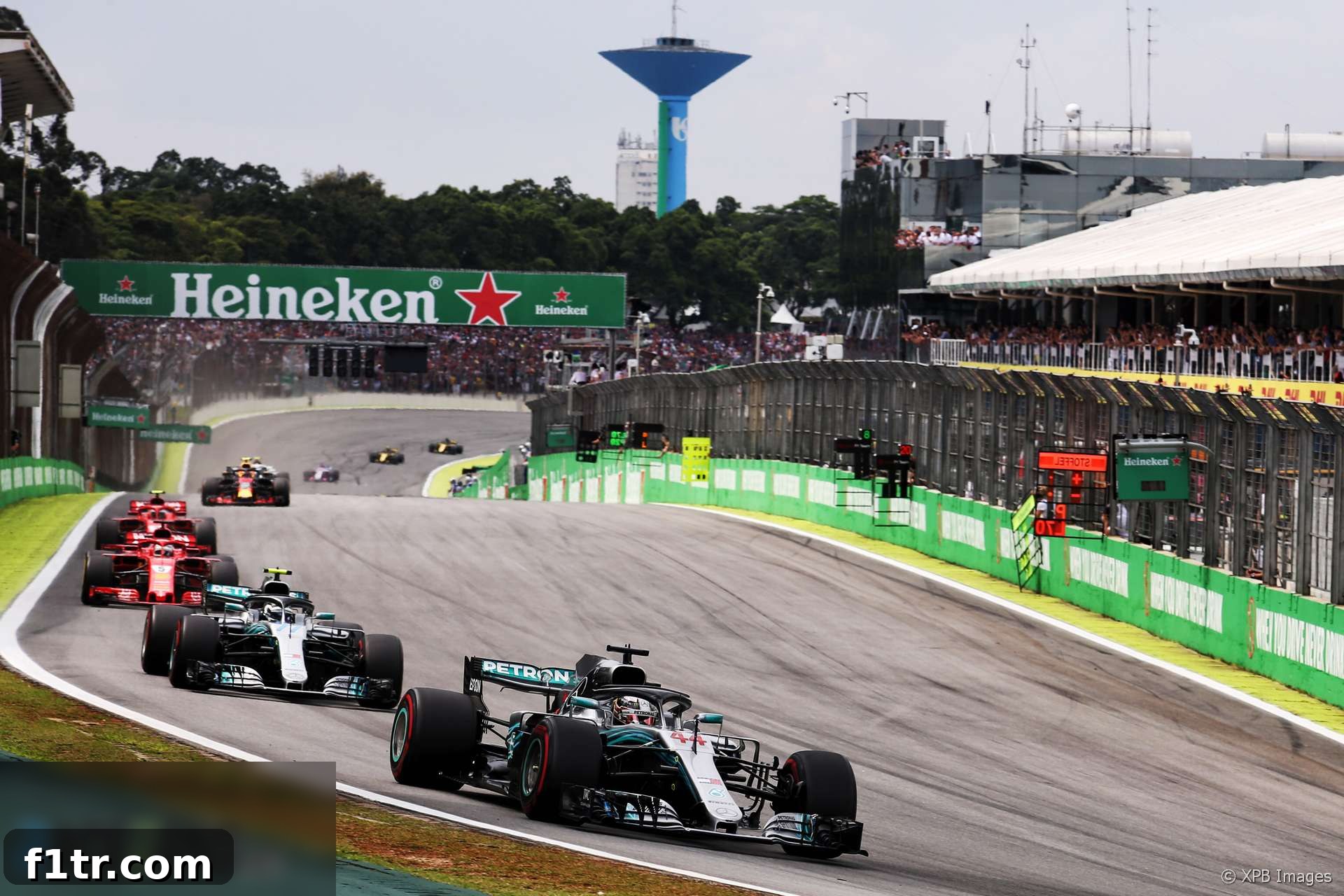
The Mercedes-AMG Petronas Formula 1 Team has etched its name into the annals of motorsport history, securing an extraordinary fifth consecutive Formula 1 Constructors’ World Championship. This monumental achievement, unparalleled in the modern era, was officially sealed with a commanding performance at the Brazilian Grand Prix, where drivers Lewis Hamilton and Valtteri Bottas delivered the crucial points needed to move the Silver Arrows decisively out of reach of their formidable rivals, Scuderia Ferrari.
This remarkable streak of success positions Mercedes as one of the most dominant forces in the sport’s illustrious history, a testament to their unwavering commitment to excellence across every facet of their operation. Since the introduction of the V6 hybrid turbo engine regulations in 2014, Mercedes has been the benchmark, a titan undefeated in the constructors’ battle, showcasing a blend of engineering brilliance, strategic acumen, and exceptional driving talent that has consistently outmaneuvered the competition.
A Historic Five-Year Reign of Dominance
The 2018 Formula 1 season culminated in Mercedes achieving this unprecedented five-year clean sweep of the constructors’ title, a feat that firmly cements their legacy. Their journey began with the seismic shift in regulations in 2014, which saw the sport transition to a highly complex V6 hybrid power unit. Mercedes not only embraced this challenge but mastered it, developing an engine that provided a significant performance advantage from the outset. This technological superiority, combined with an aerodynamically efficient chassis and a meticulously organized team structure, laid the foundation for an era of unparalleled supremacy.
Each championship title in this sequence – 2014, 2015, 2016, 2017, and 2018 – tells a story of relentless innovation and fierce competition. While the early years of the hybrid era saw Mercedes establish a clear lead, subsequent seasons, particularly 2017 and 2018, presented increasingly robust challenges from Ferrari. Yet, each time, Mercedes found a way to respond, to adapt, and ultimately, to prevail, showcasing their resilience and the depth of talent within the team.
The Decisive Brazilian Grand Prix: Sealing the Deal
The Autódromo José Carlos Pace in Interlagos, Brazil, became the theatre for Mercedes’ coronation. Heading into the penultimate race of the 2018 season, the constructors’ championship battle remained intensely poised. Ferrari, driven by the formidable Sebastian Vettel and Kimi Räikkönen, had pushed Mercedes hard throughout the year, demonstrating flashes of brilliance and moments where they appeared to hold an advantage. However, consistency, reliability, and superior strategic execution proved to be Mercedes’ winning formula.
In a thrilling Brazilian Grand Prix, which saw its fair share of drama and unpredictable turns, Lewis Hamilton delivered a masterful performance. Despite qualifying on pole, his race was far from straightforward. The unpredictable weather conditions, combined with intense pressure from rival teams, tested his composure. However, Hamilton, already crowned the 2018 Drivers’ Champion prior to this race, drove with the assuredness of a champion, ultimately securing valuable points that were pivotal for the team’s objective.
Valtteri Bottas, Hamilton’s teammate, also played a crucial role in the team’s success. While Bottas endured a challenging season in terms of individual race victories, his consistent points finishes were invaluable to the constructors’ standings. In Brazil, his performance, alongside Hamilton’s, ensured that the necessary points buffer was created, officially pushing Mercedes beyond Ferrari’s reach. The culmination of months of hard work, engineering prowess, and strategic decisions all boiled down to that moment in Brazil, where the team’s collective effort paid off spectacularly.
The Architects of Success: Drivers and Team Leadership
At the heart of Mercedes’ prolonged dominance have been their exceptional drivers. Lewis Hamilton, arguably one of the greatest drivers of all time, has been the spearhead of this era. His unparalleled speed, race craft, and ability to perform under immense pressure have been instrumental in securing not only his individual drivers’ championships but also providing the bulk of the points for the constructors’ title. Hamilton’s dedication to development and his synergy with the team have created a formidable force.
Valtteri Bottas, who joined the team in 2017, seamlessly integrated into the Mercedes setup, providing consistent support and a strong points tally. While often in Hamilton’s shadow, Bottas’s role as a reliable number two driver cannot be understated. His ability to qualify strongly, secure podiums, and execute team strategies was vital in maintaining the pressure on Ferrari and ensuring that Mercedes capitalized on every opportunity.
Beyond the cockpit, the leadership of figures like Team Principal Toto Wolff and Technical Director James Allison has been paramount. Their vision, management style, and ability to foster a culture of excellence and innovation have driven the team forward. The synergy between the factory in Brackley and the engine facility in Brixworth created a seamless operation, ensuring that both chassis and power unit development were perfectly synchronized, giving Mercedes a holistic advantage over their rivals.
The Hybrid Era: A Mercedes Masterclass
The V6 hybrid turbo regulations ushered in a new chapter for Formula 1, emphasizing not just raw power but also efficiency, energy recovery, and complex systems integration. Mercedes, with its vast resources and deep engineering expertise, seized this opportunity to establish an early and significant lead. Their power unit, consistently regarded as the class leader, provided a foundation of performance that other teams struggled to match.
This engine advantage was complemented by an exceptional chassis design. Mercedes cars have consistently demonstrated remarkable aerodynamic efficiency, mechanical grip, and tire management capabilities. The combination of a powerful engine and a well-balanced car allowed their drivers to extract maximum performance on a wide variety of tracks and conditions, contributing significantly to their five consecutive constructors’ championships. Their ability to remain competitive and adapt to evolving regulations and rival advancements year after year underscores their engineering depth and strategic foresight.
Looking Back and Forward: A Legacy Secured
Mercedes’ achievement of five consecutive constructors’ titles places them in an elite club of Formula 1 legends. It evokes comparisons to McLaren’s dominant era in the late 1980s and Ferrari’s golden age with Michael Schumacher in the early 2000s. Such sustained success requires not only immense talent and resources but also an unwavering focus, continuous improvement, and the ability to withstand immense pressure from world-class competitors.
This championship victory is not just a triumph for Mercedes as a brand but also a landmark for the sport, demonstrating the pinnacles of technical and human performance that Formula 1 can achieve. As the dust settles on the 2018 season, Mercedes stands tall, having written a magnificent chapter in Formula 1 history. The bar for future success has been set incredibly high, inspiring both their rivals to intensify their efforts and new generations of fans to witness the relentless pursuit of perfection in motorsport.
Stay Connected with the World of Formula 1
For those passionate about Formula 1 and eager to keep up with the latest news, analyses, and exclusive content, connecting with motorsport communities is essential. Don’t miss out on any updates from RaceFans as the F1 season unfolds and new stories emerge:
- Join RaceFans on Facebook
- Follow RaceFans on Twitter
- Get daily email updates from RaceFans
Explore More from the 2018 F1 Season
The 2018 Formula 1 season was packed with unforgettable moments, intense rivalries, and significant developments that shaped the championship. Delve deeper into the events and stories that defined this remarkable year, including insights into team strategies, driver performances, and key technical innovations:
- F1 feared “death knell” for Drive to Survive after Ferrari and Mercedes snub
- McLaren staff told us we were “totally crazy” to take Honda engines in 2018 – Tost
- ‘It doesn’t matter if we start last’: How Red Bull’s junior team aided Honda’s leap forward
- Honda’s jet division helped F1 engineers solve power unit problem
- McLaren Racing losses rise after Honda split
Browse all 2018 F1 season articles