McLaughlin Dominates Milwaukee Mile Race 2 as Palou Survives Scare and Power Falters in Championship Showdown
The second exhilarating race weekend at the historic Milwaukee Mile concluded with Team Penske’s Scott McLaughlin delivering a masterclass performance, securing a commanding victory. However, the true drama unfolded in the background, shaping the thrilling championship battle as points leader Alex Palou endured a terrifying car failure before the start, while his closest rival, Will Power, squandered a golden opportunity to significantly close the gap.
McLaughlin’s third win of the season was a testament to his consistent pace and strategic execution, but the overarching narrative was dominated by the fortunes of the championship protagonists. Palou, who arrived at Milwaukee with a healthy points advantage, faced a near disaster that threatened to derail his title charge entirely. Moments before the green flag, his Chip Ganassi Racing Honda suffered a critical mechanical issue, bringing the formidable machine to a grinding halt on the grid. The immediate uncertainty surrounding his car’s fate sent shockwaves through the pit lane and the stands, setting a tense tone for the highly anticipated race.
Advert | Become a Supporter & go ad-free
The Ganassi crew sprang into frantic action, rushing the stricken car back to the pit lane for extensive repairs. Despite their heroic efforts, the clock ticked relentlessly, and Palou re-joined the race a staggering 30 laps down. This unforeseen setback immediately put his championship lead at severe risk, opening a crucial window for Will Power to capitalize and narrow the points deficit dramatically. The tension was palpable across the paddock and among fans, as the potential shift in the championship dynamic loomed large. Palou’s return, though many laps down, was a testament to the team’s resilience, but it meant his race was now one of survival and damage limitation, rather than contention.
Power’s Missed Opportunity: A Costly Spin
For much of the first half of the race, Will Power seemed poised to seize the moment. Running among the leaders, the Australian driver displayed strong pace and precise positioning, appearing well on track to significantly reduce Palou’s lead. The championship narrative was writing itself – Power closing in, Palou fighting from the back. The stakes were incredibly high, with every position gained or lost having immense implications for the season finale. Power meticulously navigated the various caution periods and restarts, keeping himself in prime contention.
However, fate, or perhaps a lapse in concentration under immense pressure, intervened during the race’s fourth restart on Lap 131. In a crucial and uncharacteristic error, Power spun his Team Penske Chevrolet, dropping him from a contending position and sending him spiraling to the rear of the field. The incident was further compounded when his team called him into the pits to replace a damaged front wing, costing him an additional lap. What looked like a golden opportunity to dramatically cut into Palou’s lead rapidly turned into a desperate damage limitation exercise. Despite his valiant efforts to recover, meticulously passing other drivers and benefitting from late caution periods, Power could only manage to climb back to a 10th-place finish. While a top-ten result is commendable from such a predicament, it meant he would head to the season finale in Nashville a still significant 33 points behind Palou. This was a far wider gap than he could have achieved, potentially reducing it to single digits, highlighting the immense cost of that single, unforced error in a high-stakes championship battle.
McLaughlin’s Clinical Drive to Victory
While the championship contenders faced their individual battles and setbacks, Scott McLaughlin maintained his composure and relentless focus at the front of the field. Following the final restart on Lap 239, the New Zealander expertly managed the remaining laps of the race, demonstrating superior car control and strategic acumen to hold off a formidable charge from Chip Ganassi Racing’s veteran, Scott Dixon. Dixon, a master of strategy, tire management, and late-race surges, had meticulously picked off both Colton Herta and Alexander Rossi in the closing stages, placing his Honda firmly in McLaughlin’s mirrors and threatening to steal the victory.
However, despite Dixon’s relentless pressure and probing attacks, McLaughlin showcased immense composure and unwavering pace, never allowing the veteran to mount a serious offensive for the lead. He hit his marks consistently, defended expertly, and managed his tires to perfection, ensuring his Team Penske Chevrolet remained out of reach. This clinical and dominant performance secured McLaughlin his third victory of the year, further cementing his reputation as a formidable force and a rising star in the NTT IndyCar Series. His win was a clear demonstration of his ability to perform under pressure and convert strong qualifying pace into race day success, adding another significant triumph to his growing career tally.
Intense Battles and Other Notable Performances
The fight for the remaining podium positions and top-ten finishes was equally intense and packed with action. Behind third-placed Colton Herta, who drove a solid and consistent race for Andretti Autosport, showcasing strong pace throughout, Santino Ferrucci delivered another stellar performance. For the second consecutive day at the Milwaukee Mile, Ferrucci secured a commendable fourth-place finish, demonstrating impressive form and consistency for AJ Foyt Racing. He achieved this by executing a decisive and well-timed pass on Alexander Rossi with just six laps remaining, showcasing his late-race prowess and ability to extract maximum performance from his car.
Marcus Ericsson, driving for Andretti Autosport, also capitalized on Rossi’s fading performance towards the finish, executing his own pass to demote the McLaren driver to sixth and secure a valuable fifth place. Rossi, despite his late-race struggles, was notably the sole McLaren driver to see the checkered flag. His two teammates, Nolan Siegel and yesterday’s race winner Pato O’Ward, both retired prematurely before the 90-lap mark due to recurring gearbox problems, marking a challenging weekend for the Arrow McLaren contingent in terms of reliability and overall performance. Rinus VeeKay, piloting for Ed Carpenter Racing, brought his Chevrolet home in a respectable seventh place, showcasing the team’s steady progress. He finished ahead of Andretti Autosport’s Kyle Kirkwood in eighth and Juncos Hollinger Racing’s Romain Grosjean in ninth, who both drove strong, clean races. Will Power, despite his earlier setback, rounded out the top ten, a testament to his recovery drive after rejoining the lead lap during the final caution period – a small victory in what could have been a much worse day for his championship aspirations.
Advert | Become a RaceFans supporter andgo ad-free
Early Race Carnage and Caution Periods
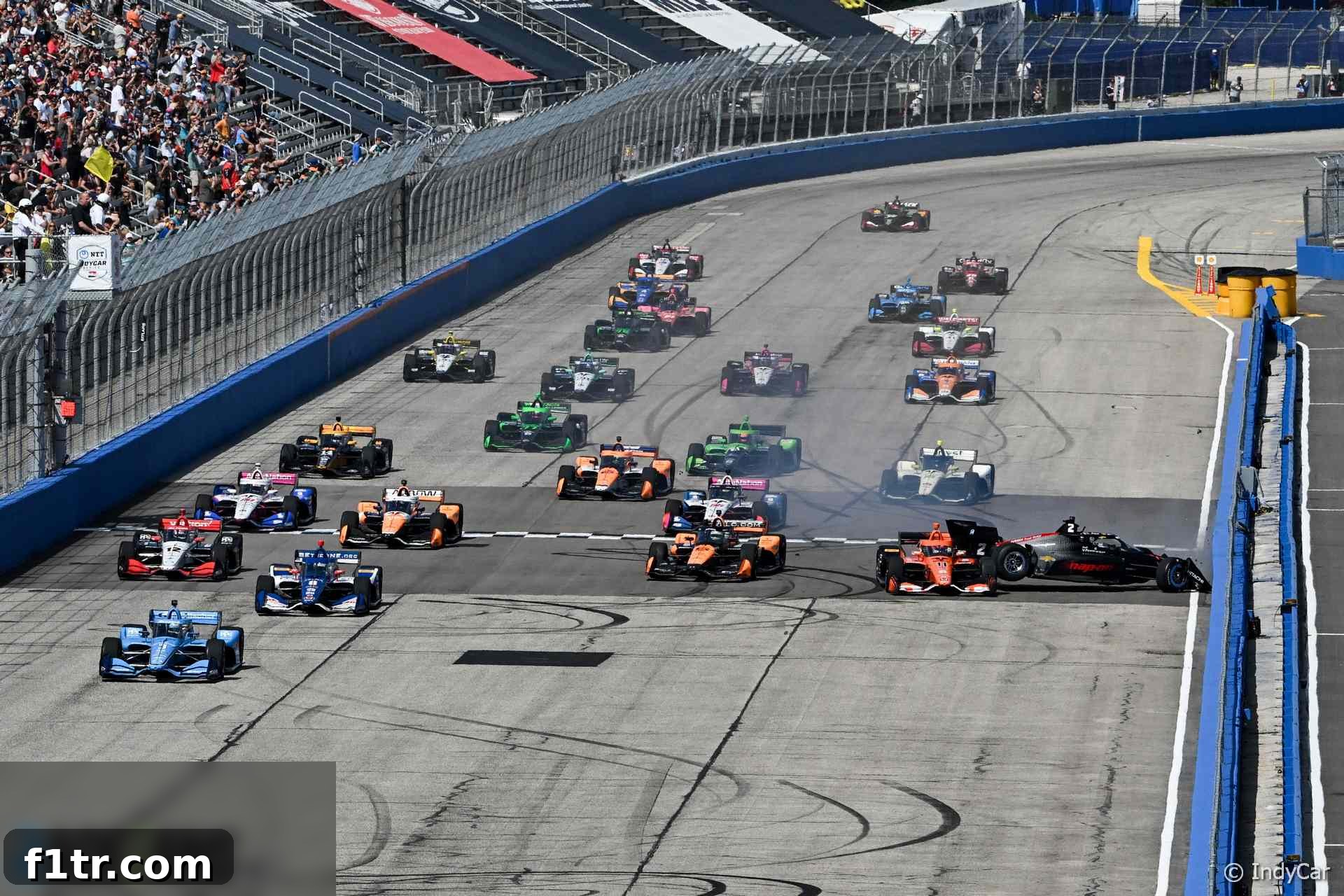
The dramatic events began even before the race officially got underway, with Palou’s mechanical failure dictating the first five laps under caution as his car was retrieved and worked on in the pits. When the highly anticipated two-wide start was finally initiated on lap six, the excitement was short-lived as it was immediately waved off due to another multi-car incident. Unfortunately, Linus Lundqvist of Chip Ganassi Racing realized the caution too late, leading to a chain reaction.
He inadvertently tapped his teammate Marcus Armstrong, sending Armstrong careening into the pole-sitter, Josef Newgarden. The unfortunate sequence of events saw Newgarden, who had secured pole position with a stellar qualifying run and was hoping for a strong championship challenge, slammed into the barrier, ending his race prematurely in heartbreaking fashion. Armstrong’s day also concluded on the spot, creating a chaotic start to an already tense race. This multi-car incident highlighted the inherent dangers and split-second decisions required in oval racing, underscoring how quickly fortunes can change for even the most experienced drivers. The series of incidents – Palou’s initial breakdown, the early multi-car crash, and Power’s spin – punctuated the race with several critical caution periods. These cautions not only reset the field multiple times, leading to intense restart battles, but also played a significant role in tire strategy and fuel management. Teams had to adapt quickly to the changing conditions, making split-second decisions on when to pit and which tire compounds to use. McLaughlin, in particular, demonstrated exceptional skill in navigating these restarts, consistently maintaining his lead and avoiding the chaos unfolding behind him, a critical factor in his eventual victory.
Championship Implications and Nashville Showdown
Ultimately, Alex Palou was classified 19th, a disappointing 29 laps down, a result that could have been catastrophic for his championship hopes. However, due to Power’s own misfortune, the damage was significantly mitigated. Reflecting on the tumultuous day, Palou commented with a degree of pragmatism, “It was not a great day but it could have been a lot worse. And could have been a lot better.” This assessment perfectly encapsulates the fine margins and unpredictable nature of championship racing.
Despite the immense adversity he faced at the start, Palou still holds a 33-point lead over Will Power heading into the season finale. This buffer, while substantial, is by no means insurmountable, especially given the double points that can often be awarded in final races, or the sheer unpredictability inherent in IndyCar racing, particularly on a street course like Nashville. The stage is now perfectly set for a thrilling showdown in Nashville, where both drivers will undoubtedly push to their absolute limits to claim the coveted NTT IndyCar Series title. The tension will be immense, with every pass, every pit stop, and every decision potentially deciding the championship in a winner-take-all scenario. Fans can expect a nail-biting conclusion to what has been an extraordinary season.
Race Result
| P. | No. | Driver | Team | Engine |
|---|---|---|---|---|
| 1 | 3 | Scott McLaughlin | Penske | Chevrolet |
| 2 | 9 | Scott Dixon | Ganassi | Honda |
| 3 | 21 | Colton Herta | Andretti/Curb-Agajanian | Honda |
| 4 | 13 | Santino Ferrucci | Foyt | Chevrolet |
| 5 | 23 | Marcus Ericsson | Andretti | Honda |
| 6 | 7 | Alexander Rossi | McLaren | Chevrolet |
| 7 | 18 | Rinus VeeKay | Carpenter | Chevrolet |
| 8 | 22 | Kyle Kirkwood | Andretti | Honda |
| 9 | 32 | Romain Grosjean | Juncos Hollinger | Chevrolet |
| 10 | 12 | Will Power | Penske | Chevrolet |
| 11 | 29 | Felix Rosenqvist | Meyer Shank | Honda |
| 12 | 27 | Christian Lundgaard | RLL | Honda |
| 13 | 4 | Kyffin Simpson | Ganassi | Honda |
| 14 | 16 | Jack Harvey | Coyne | Honda |
| 15 | 28 | Katherine Legge | Coyne/WR | Honda |
| 16 | 25 | Christian Rasmussen | Carpenter | Chevrolet |
| 17 | 20 | Conor Daly | DRR-Cusick | Chevrolet |
| 18 | 26 | Sting Ray Robb | Foyt | Chevrolet |
| 19 | 10 | Alex Palou | Ganassi | Honda |
| 20 | 8 | Linus Lundqvist | Ganassi | Honda |
| 21 | 24 | Pietro Fittipaldi | RLL | Honda |
| 22 | 30 | David Malukas | Meyer Shank | Honda |
| 23 | 14 | Graham Rahal | RLL | Honda |
| 24 | 5 | Pato O’Ward | McLaren | Chevrolet |
| 25 | 6 | Nolan Siegel | McLaren | Chevrolet |
| 26 | 11 | Marcus Armstrong | Ganassi | Honda |
| 27 | 2 | Josef Newgarden | Penske | Chevrolet |
Advert | Become a RaceFans supporter andgo ad-free
IndyCar News and Features
Stay up-to-date with the latest developments and insights from the electrifying world of IndyCar racing. Explore more articles covering driver news, race analysis, and championship updates:
- IndyCar driver McLaughlin cleared of injury after crashing through barrier at Barber
- Schumacher says his IndyCar feels like ‘an F2 car, just with better tyres’
- IndyCar “way faster than Formula 1” in some corners, says Grosjean
- FIA to award more F1 superlicence points to IndyCar drivers from 2026
- Schumacher to race full-time in IndyCar with RLL in 2026
Browse all IndyCar articles