McLaren’s Stance: Unpacking Norris’s Repercussions After Singapore
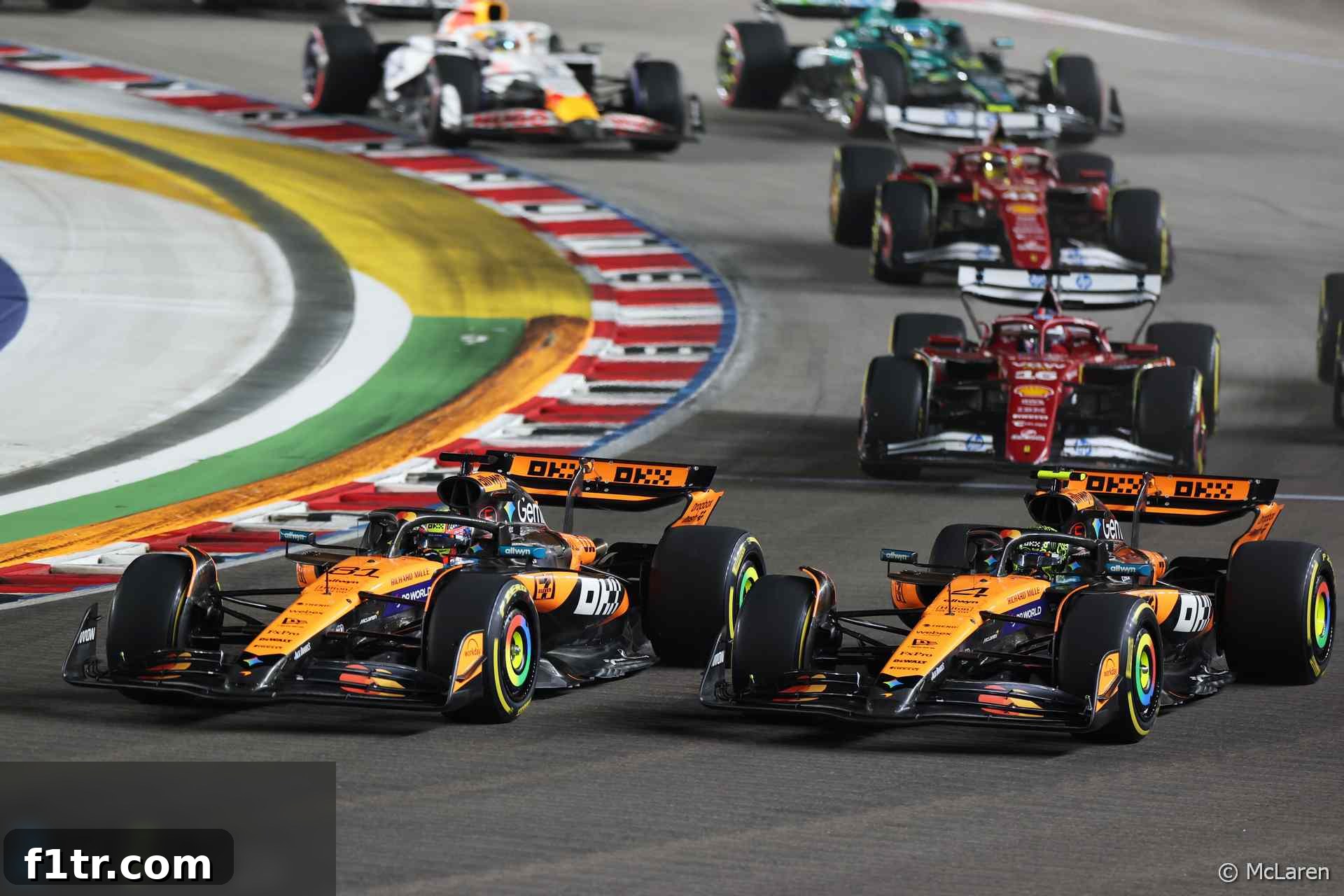
Following a dramatic Singapore Grand Prix, McLaren found themselves in a familiar yet complex position, celebrating a triumphant 10th constructors’ championship while simultaneously grappling with an internal flashpoint between their two rising stars, Lando Norris and Oscar Piastri. The team’s immediate focus was understandably on their remarkable on-track performance and championship milestone, rather than delving into the intricacies of a forceful first-lap encounter that left both drivers, and the team, pondering the boundaries of competitive racing.
Initially, team principal Andrea Stella and Racing CEO Zak Brown were keen to emphasize the team’s overall success. Their post-race comments largely downplayed the incident, preferring to frame it as an inevitable outcome of intense, multi-car racing in tight quarters. “It was tough racing, but when you’ve got three or four cars all stacked up, that’s going to happen every once in a while,” Brown stated immediately after the race. He suggested a deeper review would occur later, labeling it simply as “hard racing.”
Advert | Become a Supporter & go ad-free
Advertisement Placeholder
During the race itself, Piastri’s engineer, Tom Stallard, conveyed the team’s decision not to intervene. “We can see Lando has to avoid Verstappen so we won’t take any action during the race,” Stallard explained, adding, “we can review further afterwards.” This initial assessment, however, was met with clear frustration from Piastri. His swift retort, “That’s not fair. If he has to avoid another car by crashing into his team mate, then that’s a pretty shit job of avoiding,” highlighted the immediate disagreement and underlying tension between the drivers.
The Shift in Stance: Why McLaren Waited
What appeared to be a closed case in Singapore took an unexpected turn days later when Lando Norris, speaking in Austin, revealed McLaren’s change of heart. “There are and will be repercussions for me to the end of the season,” Norris disclosed, emphasizing that he had not “got away with anything.” This announcement sparked considerable discussion and speculation: Why did McLaren decide to take action now, having initially chosen not to intervene during the heat of the moment in Singapore? The delay suggests a more profound, strategic evaluation of the incident and its potential implications for team dynamics and future performance.
One of the most immediate and obvious solutions for such incidents, which McLaren has employed several times in the past, is a position swap between drivers. Last year, Norris notably let Piastri by in Hungary, while Piastri returned the favor for Norris in Brazil. This season, a similar scenario unfolded in Monza, with Piastri again allowing Norris to pass. In Singapore, a position swap, either immediately or on the final lap, could have rectified the situation without significant risk to the team’s overall race strategy, particularly against rivals like Max Verstappen. McLaren might have been hesitant to allow one of their cars to drop back from Verstappen, potentially missing an undercut opportunity through the pits. However, a post-race or last-lap swap would have mitigated this risk, making their initial inaction and subsequent decision to impose “repercussions” all the more intriguing.
Advert | Become a RaceFans supporter andgo ad-free
Advertisement Placeholder
This suggests that McLaren’s view of the incident evolved after a thorough post-race analysis. Perhaps additional data, driver testimonies, or a clearer understanding of the potential long-term impact on team cohesion led to their revised stance. The decision to implement consequences that extend “to the end of the season” points towards something more nuanced and far-reaching than a simple in-race penalty. McLaren, a team known for its meticulous approach and emphasis on internal harmony, likely sought to balance immediate justice with strategic long-term goals, ensuring fair competition while safeguarding their championship ambitions.
Unpacking the “Repercussions”: What Could Be in Store for Norris?
Norris’s revelation that the repercussions would apply “to the end of the season” strongly indicates that McLaren has something more subtle and pervasive in mind than merely a one-off penalty. While a future position swap remains a theoretical possibility, its implementation carries similar strategic risks as in Singapore, and finding a suitable, fair opportunity across the remaining races could prove challenging. Moreover, for a position swap to be truly equitable, the drivers ideally need to be in comparable championship positions, running side-by-side or closely matched in points, making arbitrary swaps less impactful or even detrimental.
Instead, McLaren is likely exploring ways to subtly rebalance advantages or opportunities that are routinely distributed within a Formula 1 team. These could manifest in various operational decisions that, while not immediately obvious, can significantly influence a driver’s performance and championship standing. The goal would be to foster a sense of fairness and re-establish a clear understanding of the team’s boundaries for aggressive inter-team racing, without compromising overall team performance.
Operational Adjustments and Strategic Disadvantages
One primary area for such adjustments could be the allocation of qualifying run order. Which driver gets the first choice for their qualifying runs can be a crucial strategic advantage. Running first provides clean air, while running later allows for slipstreaming benefits. McLaren could decide to grant Piastri first choice for the remainder of the season, potentially disadvantaging Norris in a subtle yet impactful way. This would shift a routine team decision, typically shared or rotated, to favor one driver over the other as a direct consequence of the Singapore incident.
Another significant factor is the distribution of car upgrades. Historically, in 2023 and early 2024, Lando Norris often received new parts before Oscar Piastri, a common practice for teams to prioritize their leading driver in championship contention. However, this dynamic shifted earlier this year, aiming for more equitable development. As a repercussion, McLaren might prioritize Piastri for any remaining upgrades for the rest of the season. While McLaren has brought fewer updates recently, with a major regulatory shift looming for next season, any preferential treatment in this crucial development phase could still impact a driver’s performance. This would serve as a clear message about adherence to team conduct.
Advert | Become a RaceFans supporter andgo ad-free
Advertisement Placeholder
Race operations, particularly pit stop strategy, offer another avenue for consequences. Typically, the leading driver gets priority in deciding when to pit, a tactical advantage Norris benefited from in races like Singapore and Monza. As part of the repercussions, Norris might be required to forfeit this first-call advantage, allowing Piastri to dictate strategy or attempt an undercut. However, this approach carries its own risks for the team, especially given McLaren’s recent struggles with slow pit stops. Any decision that puts the team at a tactical disadvantage for the sake of internal discipline must be carefully weighed against the broader objective of maximizing championship points.
McLaren’s Balancing Act: Fair Play vs. Championship Ambition
Whatever specific measures McLaren ultimately implements, this development signals a new phase in their diligent efforts to manage competition between their highly talented drivers. McLaren has consistently advocated for a philosophy of fair, yet firm, internal competition, a stance that has garnered both praise and criticism from rival drivers and commentators alike. The challenge lies in fostering an environment where both drivers can push each other to excel, without allowing the internal rivalry to compromise the team’s overall performance or its pursuit of constructor and driver championship points.
The stakes are particularly high for McLaren as Max Verstappen continues to dominate, often taking crucial points from both McLaren drivers. In such a competitive landscape, McLaren simply cannot afford any erosion of trust between Norris and Piastri, nor can they tolerate avoidable points losses due to intra-team incidents. Unlike some rivals, who might adopt a more ‘gloves-off’ approach, McLaren’s strategy prioritizes a balanced ecosystem where drivers are expected to race hard but intelligently, always with the team’s ultimate success in mind. The “repercussions” are not just about penalizing an action; they are about reinforcing a fundamental team principle and ensuring that both drivers understand the boundaries and consequences of aggressive racing, especially against a teammate.
This careful management is crucial not only for the remainder of the current season but also for the long-term stability and success of McLaren. Maintaining a strong, cohesive team environment, where drivers can trust each other on track, is paramount for sustained competitiveness in Formula 1. The message from McLaren is clear: while fierce competition is encouraged, it must always be within the framework of team interest and mutual respect.
2025 Singapore Grand Prix
- What are McLaren’s “repercussions” for Norris and why did they wait to apply them?
- Hamilton “had no choice” about cutting corners when brakes failed in Singapore
- Norris reveals he faces ‘repercussions to the end of the season’ over Piastri clash
- Russell denies Verstappen a ‘full set’ of wins, Hamilton breaks Schumacher record
- ‘Good shout on staying out’: Did Verstappen consider a second pit stop in Singapore?
Browse all 2025 Singapore Grand Prix articles