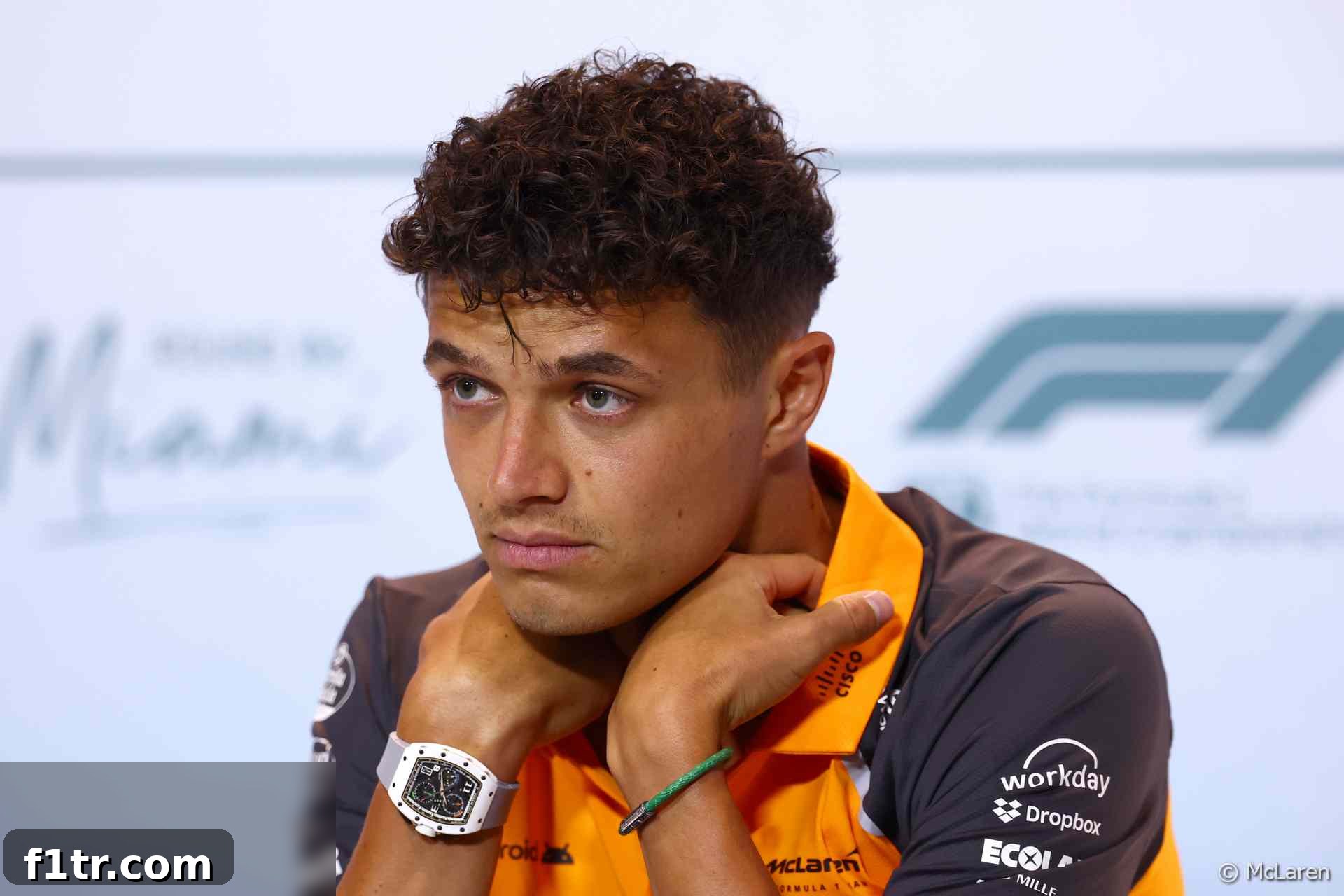
Lando Norris, one of Formula 1’s brightest talents, has openly addressed the difficulties he is encountering with McLaren’s latest challenger, the MCL39. Despite the team’s planned upgrades, Norris emphasizes he isn’t passively waiting for external solutions to his current struggles. This candid admission comes as his teammate, Oscar Piastri, appears to have adapted more seamlessly to the car, underscored by Piastri’s impressive third Grand Prix victory of the season at the recent round, which saw him seize the championship lead from Norris.
Lando Norris’s Current Struggles with the MCL39: A Deep Dive into Driver Feedback
Having qualified a modest sixth and tenth in the last two races, Lando Norris points to specific, subtle nuances in the MCL39’s handling that are preventing him from extracting its full potential. “There are just certain things which don’t allow me to feel what I need to feel,” Norris explained ahead of the high-profile Miami Grand Prix. He elaborated on the critical importance of this ‘feel,’ stating, “Those things are what allow me to drive to the level that I can drive at, to get pole positions and to drive at the highest level in racing.”
In the cutthroat world of Formula 1, where the margins between success and mediocrity are often measured in fractions of a second, these “small things” are anything but insignificant. Norris articulated this precisely: “We’re talking about small things, it’s not like it’s impossible to drive all of a sudden. It’s just, when we’re talking about qualifying, split by hundredths of a second, thousandths of a second, that’s what I’m complaining of and nothing more than that.” This highlights the immense pressure and precision required at the pinnacle of motorsport. A tiny instability under braking, a slight lack of responsiveness in the steering, or an unpredictable characteristic through a high-speed corner can strip a driver of the confidence needed to push the car to its absolute limit. For a driver of Norris’s caliber, who has consistently demonstrated the ability to extract every ounce of performance when comfortable, this lack of harmonious connection with the machine is a significant hurdle.
The psychological impact of not having that innate connection with the car cannot be overstated. When a driver doesn’t feel the car communicating effectively, it can lead to hesitation, reduced aggression, and ultimately, a dip in performance. Norris thrives on precision and feedback, allowing him to dance on the edge of grip. If the MCL39 isn’t providing that consistent, predictable dialogue, it directly hinders his ability to consistently hit those optimal lap times and maintain the relentless pace required to challenge for wins and championships.
The Piastri Paradox: Teammate Adaptation and Car Suitability
A key aspect of Norris’s current challenge is the stark contrast with his teammate, Oscar Piastri. While Norris wrestles with the MCL39, Piastri has not only adapted but excelled, securing multiple victories and leading the championship standings. Norris himself suspects that Piastri is “maybe more naturally able to adapt” to the changes introduced to their car since last year. This brings to light a fundamental aspect of Formula 1: how different driving styles and inherent sensitivities can make one car perfectly suited to one driver while presenting a puzzle to another.
Norris acknowledges the professional imperative to adapt: “I also think it’s a driver’s job to adapt to whatever car they get given.” However, he quickly points out the inherent compromises. While drivers must be versatile, the team also bears the responsibility of developing a car that allows both its drivers to perform at their best. “But there’s compromises. The team are also there to try and help you get the most out of the car,” Norris elaborated. He doesn’t dwell on the reasons for Piastri’s easier adaptation, viewing it as less productive than focusing on his own performance. “It’s clear there have been some changes and whether it’s just suited Oscar or Oscar’s able to do it a better job at adapting, then that’s not for me to kind of know or try and figure out or waste my time on.”
The reality, as Norris sees it, is that the current situation has “hurt me a little bit more and I’m not being able to perform at the level that I was at the end of last season, which I think is the best level that I have been at.” This comparison to his peak form at the close of the previous season underscores the severity of his current struggle. When a driver who consistently pushes for podiums and wins feels he’s operating below his optimal level, it’s a clear indicator of underlying issues with the car’s characteristics or how it interacts with his specific driving style. It highlights the delicate balance between driver and machine, and how a slight shift in the car’s DNA can have profound implications for performance.
Beyond Upgrades: Norris’s Proactive Dual Approach to Improvement
McLaren has indicated that planned upgrades for future races are expected to help Norris regain his confidence and optimal performance. Norris expresses cautious optimism, stating, “I certainly think it will help” when these new components are introduced. However, he is far from content to simply wait. His mindset is one of proactive engagement and continuous personal improvement, even as the team works on car development.
“I don’t honestly know the exact timeline of things, there’s also a mixture of things that will probably slowly come and be implemented over time,” he noted, acknowledging the incremental nature of F1 development. Crucially, Norris emphasizes his commitment to independent work: “I also don’t want to just rely on that myself. There’s also things I’m trying to work on separately and hopefully that’s a better fix than waiting for the bits to come.” This proactive stance likely involves a rigorous self-assessment, extensive simulator sessions to understand and potentially adapt to the car’s current quirks, detailed data analysis with his engineers, and perhaps even slight adjustments to his physical and mental preparation. It’s a testament to his dedication and understanding that in Formula 1, success is a multi-faceted endeavor, requiring both cutting-edge machinery and relentless personal development.
Norris views this period as a collaborative challenge, underscoring the team’s commitment. “But it’s good that we’re working as a team and the team are working hard to try and understand these things because it’s been clear that there have been some differences from last year in how the car works and how it acts and then how I’m able to get lap time out of it and perform.” This highlights the essential partnership between driver and team in Formula 1. Driver feedback is paramount for engineers to diagnose issues, understand performance discrepancies, and design effective solutions. The differences from the previous year’s car are clearly substantial enough to impact Norris’s ability to extract lap time, necessitating a comprehensive approach from both driver and constructor.
The Championship Picture and Future Outlook for McLaren
The current scenario for Lando Norris and McLaren is set against the backdrop of an intensely competitive Formula 1 season. While Oscar Piastri’s impressive run has elevated McLaren into a championship-contending position, Norris’s struggles underscore the delicate balance of performance and adaptation required at the highest level. McLaren’s trajectory, from a challenging start in recent years to a consistent front-runner, showcases their engineering prowess. However, maintaining this competitive edge requires continuous evolution and the ability to extract peak performance from both drivers.
The championship battle is a marathon, not a sprint, and every point counts. While Piastri’s lead is a significant boost for McLaren, having both drivers consistently at the front is crucial for team constructors’ standings and overall championship aspirations. Norris’s ability to overcome these current handling difficulties will be vital for McLaren to capitalize fully on their car’s potential throughout the season. The upgrades, when they arrive, are not just about individual performance but about strengthening the team’s overall challenge against formidable rivals. The focus remains on strategic development and ensuring both cars are optimally suited for consistent top-tier performance.
Patience, Perseverance, and the Pursuit of Peak Performance
In closing, Lando Norris’s approach to his current predicament is marked by maturity and a clear understanding of the demands of Formula 1. “So there’s a mixture of things, but I’m confident. I have to be a little bit patient with certain things, some things are bigger than others, it takes time some of these things so I’ll just keep my head down.” This statement reflects the resilience and mental fortitude required of elite athletes. He acknowledges that some solutions are complex and time-consuming, necessitating a steady, focused effort rather than instant fixes.
Norris’s talent is undeniable, and his past performances clearly demonstrate his capability to fight for pole positions and race victories. The challenge now lies in aligning the MCL39 with his unique driving style and sensitivities, either through car development or his own adaptation – or, most likely, a combination of both. His proactive engagement, coupled with McLaren’s commitment to continuous improvement, paints a hopeful picture for the remainder of the season. The journey to reclaiming his “best level” will be a testament to his perseverance and the strength of the McLaren team’s collaborative spirit, as they collectively strive to maximize their championship potential.
2025 Miami Grand Prix
- Nothing for Ferrari to learn from Miami team orders episode – Vasseur
- Hamilton proud of Ferrari as ‘we’re taking a beating from media and people’s comments’
- McLaren legality never in doubt says Piastri as FIA’s post-race check clears car
- Albon did not disobey team orders in Miami says Vowles after Sainz’s complaint
- McLaren score their most emphatic win since Hamilton’s 2008 Silverstone triumph
Browse all 2025 Miami Grand Prix articles