Advert | Become a Supporter & go ad-free
Formula 1 Dominance: Unpacking Eras of Unrivaled Success and Their Impact
Formula 1, renowned globally as the pinnacle of single-seater motorsport, is fundamentally a dynamic interplay of engineering ingenuity, strategic brilliance, and exceptional driving talent. Distinct from many other championships that employ a spec series format, F1 operates as a constructors’ battle. This crucial distinction means that not all cars on the grid are designed and built to the same specifications, leading to inherent performance differences that are often substantial.
Given this engineering-centric philosophy, it is a consistent pattern in most Formula 1 seasons for one team to establish itself as the dominant force. This leading constructor frequently collects a disproportionate number of victories – often four, five, six, or even more races than any competitor – rendering the Constructors’ Championship a predictable outcome long before the season’s conclusion. However, the true narrative of F1 dominance unfolds when such success transcends a single season, evolving into sustained periods of supremacy. Over the past four decades, Formula 1 has repeatedly witnessed these eras where a single team, often spearheaded by a generational driver, has monopolized wins and titles for multiple consecutive seasons, leaving rivals struggling to close what often appears to be an insurmountable performance chasm.
Historical Eras of F1 Supremacy: A Legacy Forged in Innovation and Talent
The rich tapestry of Formula 1 history is punctuated by distinct periods of concentrated success, each leaving an indelible mark on the sport’s identity. These eras not only define generations of fans but also vividly illustrate the cyclical nature of technological innovation, strategic excellence, and human talent.
McLaren’s Golden Age: The Late 1980s and Early 1990s
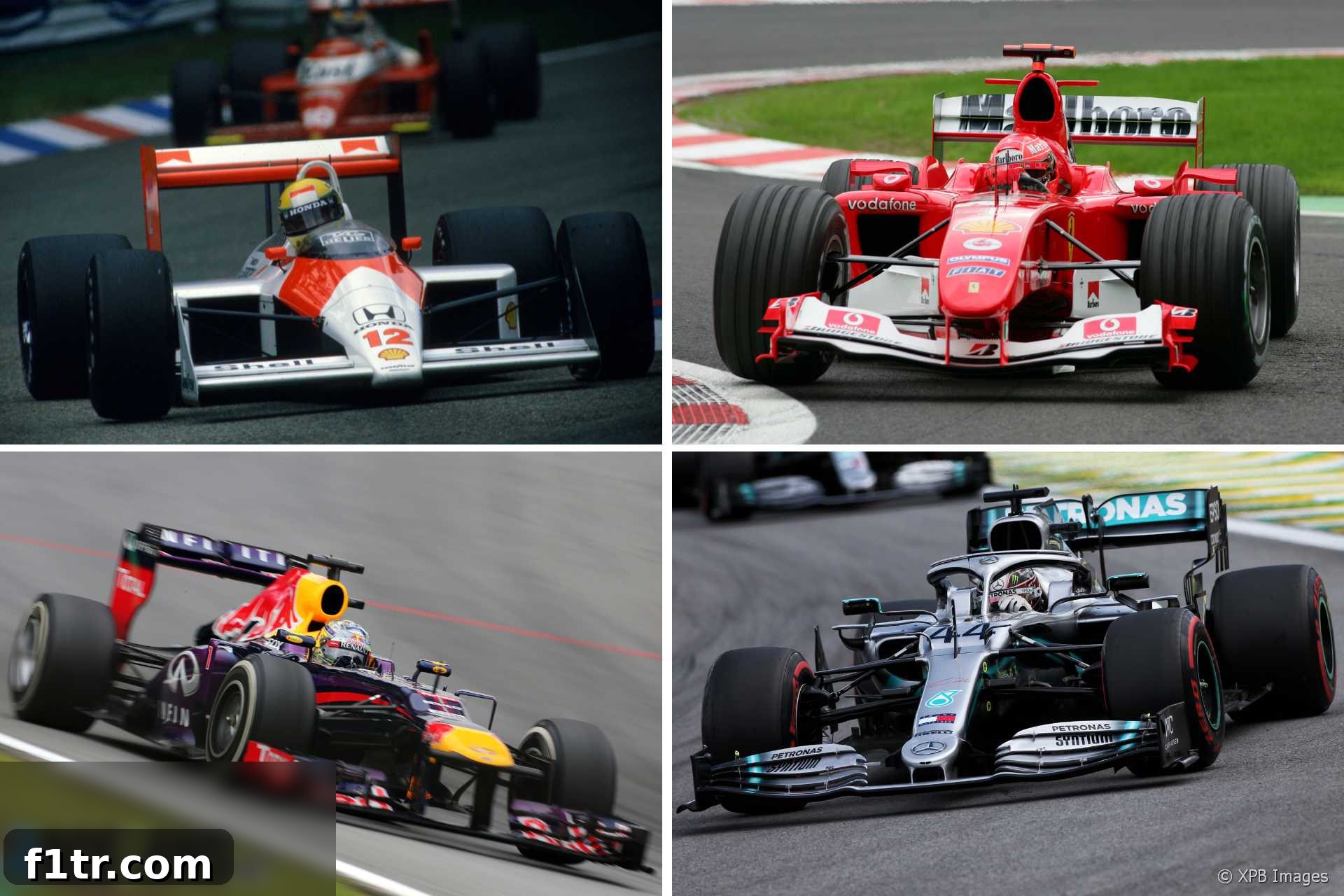
The late 1980s and early 1990s were unequivocally dominated by the legendary McLaren team. Their 1988 season, featuring the iconic MP4/4 chassis, remains arguably the most dominant single-season performance in F1 history. This engineering masterpiece, powered by a potent Honda turbo engine, won an astonishing 15 out of 16 races that year, setting a benchmark for superiority that is yet to be truly surpassed. With two of the sport’s all-time greatest drivers, Alain Prost and Ayrton Senna, at the wheel, McLaren secured an incredible four successive drivers’ and constructors’ championship titles between 1988 and 1991. This era was characterized not just by the sheer speed and reliability of their cars but also by the intense and often dramatic rivalry between Prost and Senna, which arguably propelled both drivers and the team to unprecedented levels of performance. Their relentless pursuit of perfection and the seamless integration of chassis, engine, and driver proved to be an unbeatable combination for several years, establishing McLaren as a formidable force.
Ferrari and Michael Schumacher: The Unstoppable Red Reign (2000-2004)
As the 1990s drew to a close, a new and formidable era began with the ascendance of Ferrari and Michael Schumacher. This partnership, meticulously crafted by figures like Jean Todt, Ross Brawn, and Rory Byrne, transformed the Scuderia into an almost mythical force. Between 2000 and 2004, Schumacher and Ferrari established an unprecedented period of dominance, achieving a historic five consecutive drivers’ and constructors’ titles. This relentless streak saw Schumacher rewrite the sport’s record books, becoming the most successful driver in Formula 1 history at that point, while Ferrari solidified its status as the most decorated team. Their success was a powerful testament to unparalleled teamwork, strategic brilliance, and Schumacher’s extraordinary talent, unwavering dedication, and ruthless consistency. The F200x series of cars were engineering marvels, consistently outperforming rivals across diverse tracks and conditions. After a relatively less dominant year in 2005, Schumacher mounted a determined challenge for an eighth world title in 2006, ultimately being narrowly beaten by Fernando Alonso, signaling the end of one of F1’s most iconic and impactful periods of supremacy.
Red Bull Racing and Sebastian Vettel: The Aerodynamic Advantage (2010-2013)
The Formula 1 landscape underwent significant technical regulation changes for the 2009 season, particularly impacting aerodynamic design. This shift created a fertile ground for Red Bull Racing, under the visionary engineering leadership of Adrian Newey, to rise to prominence. After a dramatic and intensely competitive 2010 season where Sebastian Vettel clinched his maiden world title in a thrilling final race, the combination of Vettel and Red Bull became virtually unstoppable. From 2010 through 2013, they secured an impressive four consecutive drivers’ and constructors’ championships. Newey’s innovative aerodynamic designs, which maximized downforce and efficiency, were perfectly complemented by Sebastian Vettel’s driving style, which seamlessly adapted to the blown diffuser and flexible wing concepts of the era. The team’s operational excellence and strategic acumen ensured that the RB series of cars were often in a class of their own, particularly on high-downforce circuits. Their reign underscored how a complete package – encompassing driver, car design, and team strategy – could achieve sustained and overwhelming success, before the radical shift to the V6 turbo-hybrid regulations brought their unparalleled run to an end, paving the way for the next dominant force.
Mercedes-AMG Petronas F1 Team and Lewis Hamilton: The Hybrid Era’s Defining Force (2014-2021)
The introduction of the V6 turbo-hybrid power unit regulations in 2014 marked the beginning of what many consider to be the most comprehensive and technologically driven period of domination in Formula 1 history: the Mercedes era. From 2014 right up to 2021, the Mercedes-AMG Petronas F1 Team achieved an astonishing and unprecedented eight consecutive constructors’ titles. During this period, their early and profound advantage in power unit technology, combined with an exceptionally engineered chassis, unparalleled operational efficiency, and the sublime talent of Lewis Hamilton, created an almost invincible package. Lewis Hamilton secured six drivers’ championships under the Mercedes banner, transforming him into the most statistically successful driver of all time, surpassing even Michael Schumacher’s long-standing records. His teammate, Nico Rosberg, also famously clinched the 2016 championship in a fierce and dramatic internal battle, further highlighting the sheer strength, depth, and competitive spirit within the Mercedes team. This era not only showcased technological superiority but also impeccable team management, driver development, and adaptability, setting new benchmarks for consistency and excellence in the sport’s modern era.
The Resurgence of Red Bull Racing: Max Verstappen’s Ascendancy (2022-Present)
Following a tightly contested and historic 2021 season, Red Bull Racing has emphatically returned to the pinnacle of Formula 1. With the formidable talent of Max Verstappen at the helm, the team has achieved remarkable success, securing the last two drivers’ titles in a style reminiscent of their earlier dominant periods. The RB18 and its formidable successor, the RB19, have demonstrated exceptional performance, particularly under the current ground-effect aerodynamics regulations which reward precise engineering and efficient airflow management. The RB19, in particular, proved to be an almost unstoppable force in the early rounds of recent seasons, leading many observers to conclude that Formula 1 is currently in the midst of another Red Bull-dominated era. The potent combination of Adrian Newey’s enduring design brilliance and Max Verstappen’s raw speed, aggressive racing style, and unwavering consistency presents a formidable challenge to all competitors, once again raising pertinent questions about the future competitive balance and spectacle of the sport.
Advert | Become a RaceFans supporter andgo ad-free
The Double-Edged Sword of Dominance: Impact on Viewership and the Sport’s Spectacle
Does Sustained Dominance Harm Formula 1’s Appeal?
Every time a single team rises to become the clear, undisputed number one, a persistent and often impassioned debate resurfaces regarding whether such sustained domination risks damaging the sport’s fundamental appeal. The intrinsic allure of any competitive sport thrives on unpredictability, suspense, and the exhilarating unknown. When the outcome of a race or an entire championship appears largely predetermined before the weekend even begins, it can undeniably strip the event of its inherent tension and excitement. For casual viewers, or those new to the sport, a conspicuous lack of competitive variety at the front of the grid might indeed act as a deterrent, fostering a perception of boredom or a predictable, less engaging spectacle.
Concerns over team dominance are far from new in Formula 1. During the peak of the Michael Schumacher and Ferrari era in the early 2000s, a series of significant rule changes were specifically introduced into the sport. These adjustments were a direct and deliberate attempt to shake up the competitive order, inject more unpredictability into the races, and curb Ferrari’s overwhelming advantage. More recently, during Mercedes’ unparalleled run of success in the hybrid era, even their own team principal, Toto Wolff, openly acknowledged the potential downside. He admitted that long-term dominance by any single team “damages the spectacle” of the sport, candidly recognizing the potential negative impact on fan engagement and the broader appeal of Formula 1.
The Paradox of Viewership: Growth Amidst Periods of One-Sidedness
However, despite these legitimate concerns and the historical attempts to level the playing field, a fascinating paradox emerged during Mercedes’ and Lewis Hamilton’s record-breaking period. While Hamilton and Mercedes consistently swept up race wins and championships, becoming the most statistically successful team and driver combination in F1 history, global viewing figures for Formula 1 actually began to increase. This significant upward trend, particularly noticeable in crucial emerging markets like the United States, suggested that dominance might not be the sole or even primary determinant of viewership. Factors such as the dramatic narratives captured by popular documentary series like Netflix’s “Drive to Survive,” enhanced social media engagement, and strategic global marketing initiatives spearheaded by Formula 1 management itself, likely played a significant role in broadening the sport’s appeal far beyond its traditional motorsport enthusiast base. Currently, F1 continues to enjoy some of the strongest viewership figures it has ever recorded, including reaching an all-time high in the United States, thereby defying the conventional wisdom that dominance automatically translates to declining interest.
This intriguing situation naturally raises a crucial question for every fan: How does the dominance of a particular team or driver truly affect your personal viewership and sustained interest in Formula 1? Have you ever found yourself gradually turned away from the sport by the repetitive sight of the same faces on top of the podium week after week, longing for more varied competition? Or, conversely, are you actually drawn further into the sport, captivated by the sheer excellence of a team performing at a clearly superior level than all its rivals, appreciating the opportunity to witness history being made and records being broken? Perhaps, for you, the ebb and flow of dominance makes no significant difference to your enduring interest in F1, as you find enjoyment and excitement in other aspects of the racing, such as intense midfield battles, groundbreaking technical innovation, compelling driver narratives, or the sheer spectacle of Grand Prix weekends.
Fan Perspectives: How Does Dominance Affect Your F1 Engagement?
You Say: Analyzing Fan Sentiment on Dominance
Understanding the collective fan perspective is paramount for the long-term health and growth of Formula 1. In a recent poll asking “How has the dominance of a team in Formula 1 previously affected your viewership?”, the results provided insightful data into the diverse reactions across the F1 community.
How has the dominance of a team in Formula 1 previously affected your viewership?
- My F1 viewership greatly increased due to one team dominating (2%)
- My F1 viewership slightly increased due to one team dominating (0%)
- My F1 viewership has been unaffected by one team dominating (54%)
- My F1 viewership slightly reduced due to one team dominating (28%)
- My F1 viewership greatly reduced due to one team dominating (16%)
Total Voters: 245
The results of this poll indicate a complex and varied fan response. For a significant majority of participating fans (54%), team dominance has not substantially altered their viewing habits, suggesting a consistent loyalty to the sport regardless of who is winning at the front. However, a considerable portion of the fanbase (a combined 44%) reported a reduction in their viewership, with 28% citing a slight reduction and 16% experiencing a great reduction due to dominance. Conversely, a smaller segment (a combined 2%) found their interest actually enhanced by the presence of a dominant team, perhaps appreciating the spectacle of flawless performance. These findings highlight the nuanced relationship between competitive balance and fan engagement, underscoring that while many core fans remain steadfast, a substantial number do desire more varied and unpredictable outcomes at the sharp end of the grid.
The debate surrounding dominance in Formula 1 is ongoing and multifaceted, with no universally accepted answers. Formula 1 continually strives to strike a delicate balance through its evolving technical and sporting regulations. The aim is to foster innovation and reward exceptional performance, while simultaneously promoting competitive racing and preventing single-team strangleholds that might, for a segment of its vast global fanbase, diminish the thrilling spectacle that defines Grand Prix racing. As the sport continues to evolve, so too will its strategies for maintaining an engaging, exciting, and ultimately fair environment for millions of enthusiasts worldwide.
Advert | Become a RaceFans supporter andgo ad-free
Further Debates and Polls on Formula 1’s Future
The ever-evolving dynamics of Formula 1 are a constant source of discussion and analysis among fans and experts alike. Here are other thought-provoking debates and polls that delve into the sport’s ongoing evolution, current challenges, and future direction:
- What must Formula 1 fix with its new rules – and what should it leave unchanged?
- ADUO: Do F1 teams who fall behind deserve to get help to catch up?
- F1 is considering doubling its sprint races. Do you want more or fewer?
- Will this be a fight or a rout? 20 questions for the 2026 Formula 1 season
- Which Formula 1 team has the best-looking car – and the worst – for the 2026 season?
Browse all debates and polls