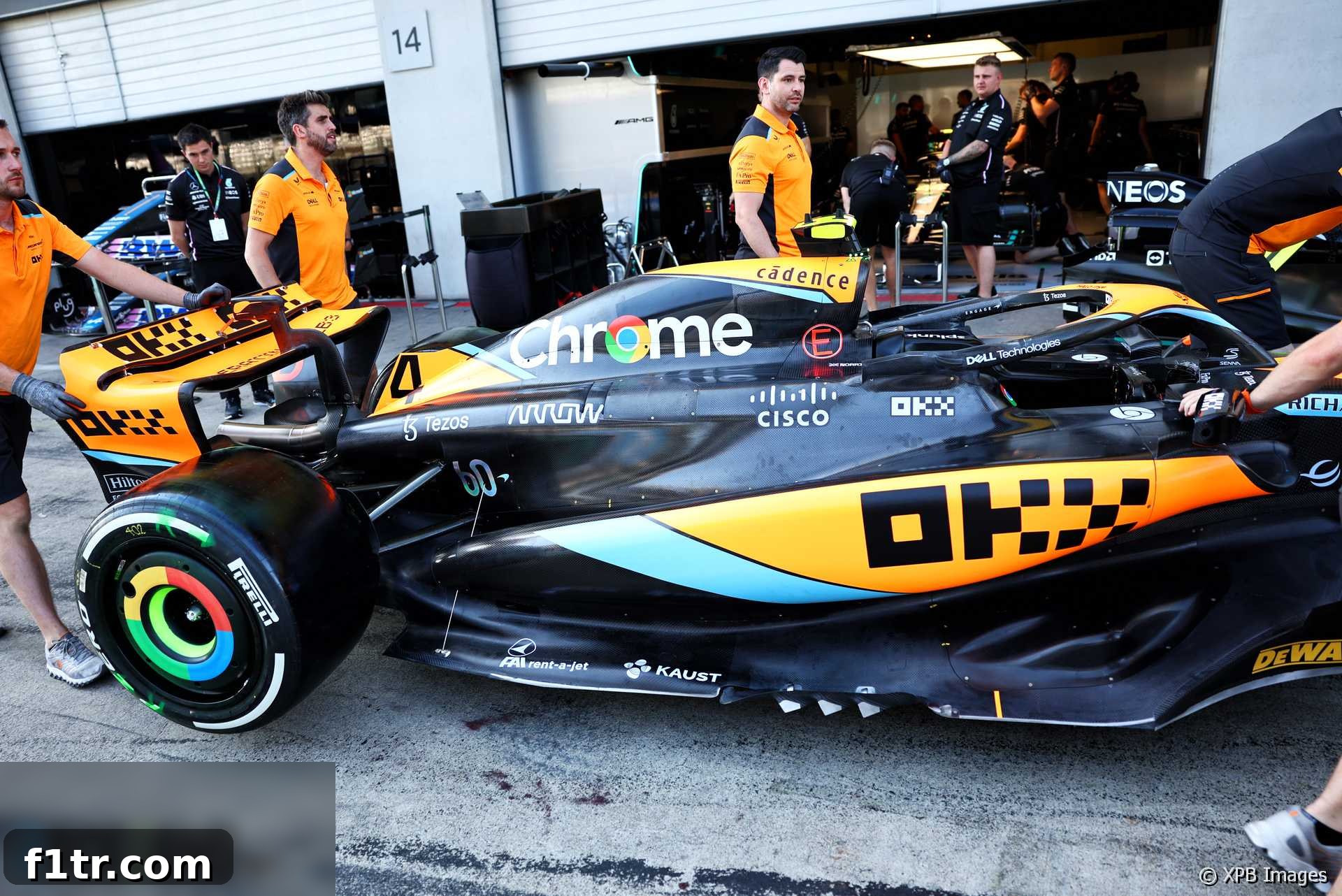
In a significant strategic maneuver, McLaren has fast-tracked a crucial upgrade package for its MCL60 Formula 1 car, deploying it for the Austrian Grand Prix – one race earlier than initially projected. However, the immediate beneficiary of this accelerated development is limited to star driver Lando Norris, underscoring the team’s focused effort to maximize points in a tightly contested season.
The Woking-based squad had originally earmarked the British Grand Prix at Silverstone as the debut event for this substantial performance enhancement, intending to equip both their drivers with the new specification. Yet, the relentless push behind the scenes paid dividends, allowing for the early production of sufficient components. This enabled Norris to incorporate a significant portion of the upgrade onto his car for the challenging Red Bull Ring circuit, a development he confirmed with cautious optimism ahead of the weekend.
“We weren’t meant to have any of this really for this weekend; it was all meant to come for Silverstone,” Norris revealed. “So the fact we’ve got some of it, not even all of it, is already going to be a good step forward.” His statement reflects the immense pressure on F1 teams to continuously innovate and gain even marginal advantages, highlighting the dedication required to pull forward such complex developments against aggressive timelines.
The decision to introduce the McLaren F1 upgrade prematurely for the Austrian Grand Prix was not made lightly and was heavily influenced by the unique format of the event. As a sprint race weekend, the Austrian GP offered a coveted opportunity for a greater points haul than a standard race weekend. A strong performance in both the sprint and the main Grand Prix could yield double the usual points, a tantalizing prospect for McLaren as they fight to climb the Constructors’ Championship standings amidst fierce competition.
“With it being a sprint race, there’s maybe some opportunity to get points if you can, if it’s enough of a step, two times,” Norris explained, shedding light on the team’s strategic thinking. “Which is why we pushed everyone so much, and the team were able to deliver on getting some bits here earlier.” This intensive effort from the entire factory, from design to manufacturing, exemplifies the high-stakes environment of Formula 1 where every point can dramatically alter a team’s fortunes and financial standings.
McLaren’s 2023 season began with an acknowledgment of their car’s shortcomings. At the launch of the MCL60 just four months prior, the team candidly admitted that the car would not start the season in its “intended state.” This frank admission set the stage for a season of aggressive F1 car development. Prior to Austria, the MCL60 had seen limited performance-focused updates. Aside from a revised floor introduced at the Azerbaijan Grand Prix, most changes had been track-specific adjustments, optimized for particular circuits rather than delivering fundamental performance gains.
“This is our first upgrade of the season, really, that’s done out of performance,” Norris emphasized, drawing a clear distinction. “We obviously had an upgrade in Baku, but it wasn’t a performance-deliver.” He further clarified, “This is the updated version of what we had there. So it’s been quite a while, feels like it’s been a very long time. But at the same time, the team did a good job. We wanted to make sure things were done correctly and done in the right way. So I want to say I have confidence that it’s a decent step.” This nuanced explanation from Norris highlights the difference between minor tweaks and a comprehensive upgrade designed to fundamentally alter the car’s aerodynamic characteristics and overall speed.
The journey to this significant McLaren upgrade has been protracted, reflecting the inherent complexity of Formula 1 car development. Norris elaborated on the genesis of the current package, stating, “This is kind of what we would have wanted in Baku. Everything we’ve got now is a bit of a trail on from what we learned over the winter, and then what we had for Baku, we did the floor, and a lot of it’s a different philosophy of designing things.” This revelation suggests a fundamental shift in McLaren’s aerodynamic philosophy and design approach, moving beyond incremental changes to a more radical evolution. Understanding how different parts of the car interact, from the floor’s aerodynamics to the sidepod contours and engine cover design, is crucial for unlocking lap time. This “different philosophy” likely refers to a new conceptual direction for generating downforce and managing airflow, potentially influenced by learnings from rival teams or internal wind tunnel breakthroughs, aiming to bring the MCL60 closer to its true performance potential.
The early introduction of the upgrade for Lando Norris exclusively underscores his critical role as the lead development driver for McLaren. His astute feedback is invaluable in correlating wind tunnel and simulation data with real-world track performance. Equipping only one car with the full suite of upgrades allows for a direct comparison against the older specification driven by his teammate, providing clear data points on the effectiveness of the new components. This strategy, while potentially frustrating for the other driver, is a common and necessary practice in F1 to streamline data analysis and accelerate development cycles, especially when parts availability is limited. It allows engineers to isolate the impact of new components and fine-tune their integration before a wider rollout.
The pressure on McLaren to deliver a truly competitive package has been immense throughout the 2023 F1 season. After a challenging start, where they often found themselves battling in the midfield rather than at the front, this substantial upgrade represents a pivotal moment. The team’s aspiration to return to consistent podium contention and challenge the established front-runners hinges significantly on the success and scalability of these development cycles. The meticulous nature of F1 engineering means that such a significant upgrade isn’t merely about adding new parts; it involves comprehensive recalibration of the car’s setup, balance, and driver understanding to fully extract its potential. Every detail, from the revised floor geometry to the sidepod shaping and engine cover contours, contributes to the intricate aerodynamic dance that determines ultimate speed and efficiency on track.
While Lando Norris expressed confidence in the “decent step” this upgrade represents, the F1 paddock is a brutal and unforgiving testing ground. Rivals are constantly developing, and the competitive landscape can shift rapidly with each race. The true measure of this upgrade’s success will be evident in the lap times and race performance throughout the Austrian Grand Prix weekend and, crucially, in the subsequent races as McLaren aims to bring the full package to both cars and consolidate any gains. The team’s ability to maintain this development momentum will be key to their aspirations for the remainder of the 2023 season and building a stronger foundation for future campaigns. The stakes are incredibly high, not just for points in the Constructors’ Championship, but for the morale of the team and their long-term trajectory in the pinnacle of motorsport.
Further Reading: 2023 Austrian Grand Prix Insights
- Mercedes Left Scratching Heads by Lack of Performance at Austrian GP
- Verstappen’s Determination to Grab Every Point Makes Him a Record-Breaker
- Austrian GP Track Limits Farce Was Avoidable Like ‘IndyGate’ and Spa 2021 – Brown
- Alpine Now “Definitely Beatable” for McLaren After Upgrade – Brown
- Paddock Diary: 2023 Austrian Grand Prix
Explore All 2023 Austrian Grand Prix Articles