The exhilarating atmosphere of the Miami Grand Prix intensifies this weekend as it proudly hosts a sprint race for the very first time in its nascent history. The Miami International Autodrome, purpose-built around the iconic Hard Rock Stadium, appears almost custom-made for the modern sprint format, promising a spectacle of high-octane racing and unparalleled entertainment for the throngs of fans descending upon South Florida.
Despite securing a crucial pole position in sprint qualifying, Max Verstappen, the reigning world champion, expressed genuine surprise following what he described as a somewhat untidy final lap in his Red Bull. This unexpected result, coupled with Charles Leclerc starting alongside him after a superb rebound from an early practice setback, sets the stage for a potentially dramatic 19-lap sprint. The question looms: will Verstappen face more pressure for victory in Miami than he did during the recent Shanghai sprint, where he comfortably cruised to a win?
Weather Update for the Sprint Showdown
Early week forecasts had hinted at a small but significant risk of rain over the Miami Gardens area before the sprint race. However, as race day approaches, that risk has notably diminished, making a dry race highly probable. This stability in weather conditions is welcomed by teams and drivers, allowing for more predictable car setups and tire management strategies.
Conditions are expected to closely mirror those experienced during Friday’s practice sessions, with ambient temperatures hovering just under a warm 30°C. The expansive, open environment of the Hard Rock Stadium campus leaves drivers particularly exposed to the area’s prevailing winds, a factor that many drivers noted during yesterday’s practice. Gusts can significantly affect a car’s aerodynamic balance and braking points, requiring heightened concentration and adaptability. While challenging, drivers are unlikely to face anything more severe than what they’ve already navigated, ensuring the focus remains on pure racing performance in this initial competitive outing of the weekend.
The Critical First Lap: A Dash to Turn One
The Miami International Autodrome has witnessed only two previous Formula 1 race starts. The run from pole position to the critical first corner measures a mere 250 metres, ranking it among the shortest sprints to Turn 1 on the entire calendar. This short distance puts immense pressure on drivers for a perfect getaway, demanding exceptional reaction times and precise clutch control from the moment the lights go out.
Unsurprisingly, on both previous occasions, the pole-winner successfully maintained their lead through the opening lap. Last year’s Grand Prix saw the top three starters impressively retain their positions. Max Verstappen’s pole position is strategically located on the racing line, on the left-hand side of the grid, offering him a slight advantage. However, this also presents Charles Leclerc with a potential opportunity to make an aggressive dive up the inside should Verstappen experience even the slightest hesitation off the line. Yet, given the world champion’s consistent ability to hold his lead from the start, such an outcome remains a long shot.
While the very front of the field often demonstrates disciplined starts in Miami, the tight and slow first corner, immediately followed by Turns 2 and 3, poses a significant risk for drivers further back in the pack. This sequence of corners creates a notorious bottleneck effect, where the close proximity of cars, combined with potentially cold tires and reduced visibility, can lead to chaos. Historical incidents underscore this danger: in 2023, Nyck de Vries collided with Lando Norris’s McLaren into Turn 1, and in 2022, Fernando Alonso clipped Lewis Hamilton at Turn 2 while battling for seventh place. Managing this initial congestion without incident is paramount for any driver aspiring to score points in the sprint.
This year, however, de Vries’ successor in the now-rebranded RB team finds himself in a far more advantageous position. Starting an impressive fourth, Daniel Ricciardo carries high hopes of securing a top-eight finish and his inaugural points of the season. Reflecting on the importance of a clean start, Ricciardo commented, “Just from a Turn 1, first lap [perspective], being involved in a bit of chaos – obviously staying a bit cleaner at the front is always like a breath of fresh air. So I’m sure second row will help our cause in getting some points.” His strong qualifying performance has set the stage for a potentially pivotal race for the Australian veteran.
Sprint Strategy: The Tyre Conundrum
As is customary with any sprint race in Formula 1, the primary strategic decision for teams revolves solely around which tyre compound to fit their cars for the brief 19-lap encounter. This singular choice, devoid of pit stop considerations, dictates a car’s performance window and potential for attack or defense throughout the race. In the previous sprint race in Shanghai, a notable 19 out of 20 drivers opted for the medium compound, with only George Russell making a calculated gamble on the softs – a brave decision that ultimately paid off handsomely for the Mercedes driver.
Pirelli has supplied the same trio of compounds for the Miami Grand Prix weekend. However, the conditions in South Florida are markedly warmer and more humid than those encountered in Shanghai. Pirelli’s official expectation is that the medium compound will once again be the overwhelmingly popular choice, offering the best balance of performance and durability over the short sprint distance. Nevertheless, the tire manufacturer anticipates that a few more drivers further down the starting order might be tempted to gamble on the softs. This increased willingness stems from Russell’s successful deployment of softs in Shanghai, particularly on a circuit that places more sustained and demanding loads on its tires than Miami. The high temperatures in Miami, however, could accelerate soft tire degradation, making any such gamble a high-stakes decision that could either yield significant gains or lead to a rapid fall through the field.
Overtaking Opportunities on the Miami Circuit
With an impressive 97 on-track overtakes recorded across the first two years of the Miami Grand Prix, averaging 48.5 passes per Grand Prix, the Miami International Autodrome has firmly established itself as a circuit where genuine overtaking is not just possible, but frequent. The track’s design is almost custom-built to cater to the modern DRS era of racing, featuring three key overtaking zones strategically placed at the end of the three DRS activation sections. These zones are located into Turn 1, Turn 11, and the lengthy Turn 17 at the conclusion of the long back straight, providing ample opportunities for drivers to exploit aerodynamic advantages and challenge their rivals.
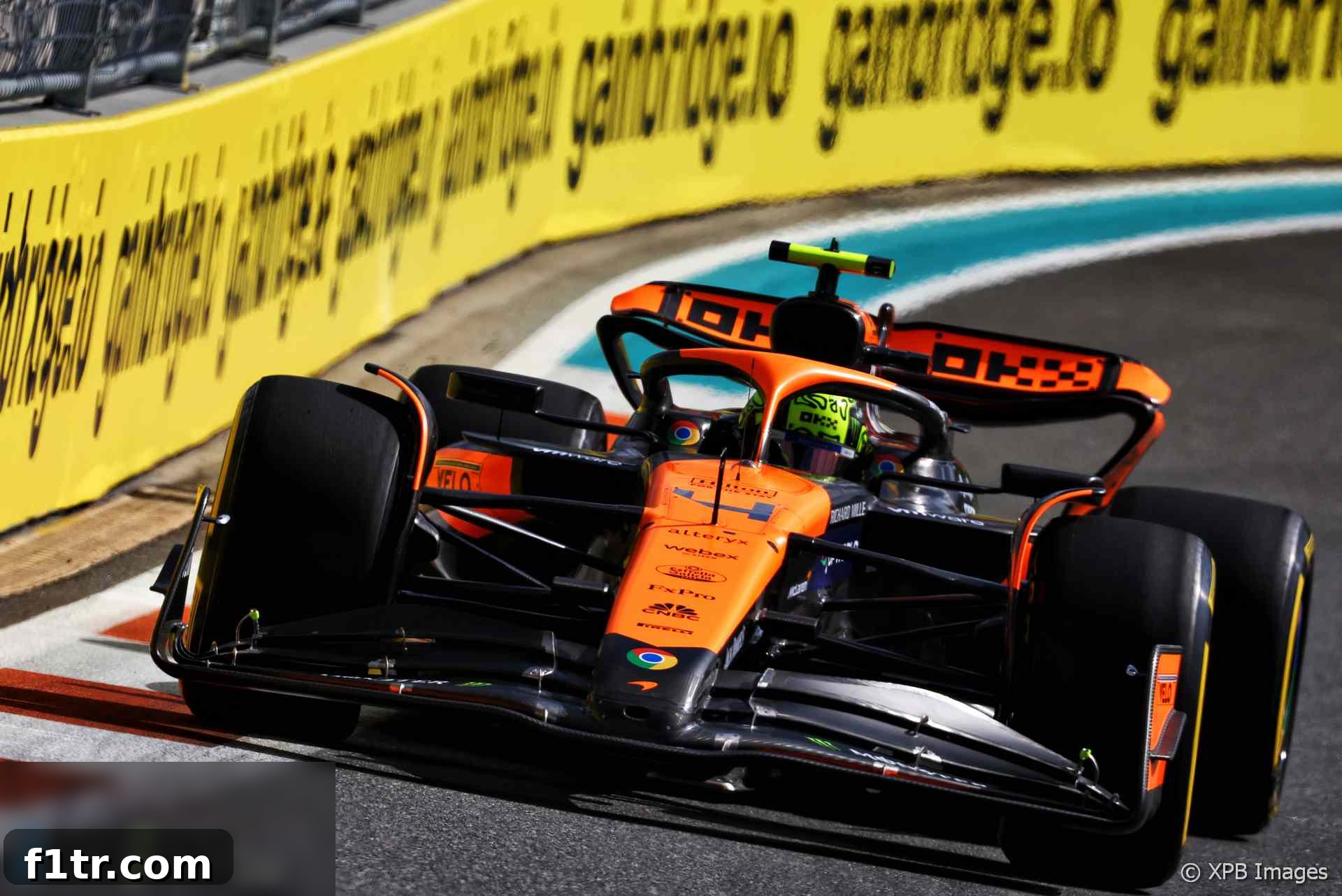
Given that the sprint race format eliminates the complexity of pit strategy, significant pace differences between drivers are primarily down to car performance and setup. A prime example is Lando Norris, who starts from ninth position but demonstrated the fastest overall time yesterday on medium tires in his fully updated McLaren. His teammate, Oscar Piastri, only has a selection of the new parts, underscoring the potential advantage Norris might wield. As Max Verstappen vividly illustrated last year by winning the Grand Prix from a similar starting position, navigating through the field in Miami is certainly achievable for a driver with a significant pace advantage in their machine.
The crucial question then becomes: just how quick is the upgraded McLaren? While most teams have struggled to lap within a second of their best times from last year at this track, McLaren managed to get within three-tenths of a second despite both drivers having somewhat compromised laps during SQ3. This suggests a substantial performance leap. If this newfound pace translates effectively to race conditions, Norris could pose a serious threat not only in the sprint but also in the main Grand Prix if he qualifies higher this afternoon. The sprint race will undoubtedly offer fascinating insights into the true potential of McLaren’s updated package and its ability to challenge the front-runners.
Safety Car Dynamics: Navigating the Miami Gauntlet
Despite the temporary nature of the Miami International Autodrome, characterized by its unforgiving barriers and limited run-off areas, the circuit has seen a relatively low number of Safety Car deployments. Across two previous Grands Prix in Miami, there have been just two Safety Car interventions, both of which occurred during the inaugural race in 2022. Remarkably, last year’s Grand Prix ran entirely caution-free, a statistic that might surprise some given the circuit’s layout and inherent risks.
Incidents like Charles Leclerc’s spin in practice serve as a stark reminder of how easily drivers can get caught out and stuck in the narrower sections of the circuit. Any stoppage on track, particularly if a car is stranded in an unsafe position, carries the significant risk of prompting a Safety Car intervention. However, it is universally acknowledged that the single biggest risk period for a Safety Car remains the opening lap. During this chaotic initial phase, with a compressed field, cold tires, and high adrenaline, the likelihood of contact and subsequent incidents is at its peak. Should drivers successfully navigate the demanding first 5.4 kilometers without major drama, it is highly probable that the remainder of the sprint race will run under green flag conditions until the chequered flag, allowing for uninterrupted racing action.
Drivers to Watch: Key Battles and Redemption Stories
While Mercedes’ George Russell and Lewis Hamilton will start outside the top ten, it is perhaps challenging to argue that these two experienced campaigners are truly “out of position,” given their car’s current performance envelope. However, Lando Norris, starting from ninth, is almost certainly poised to move forward. His impressive pace shown throughout the earlier phases of sprint qualifying, particularly before the final SQ3 session, strongly suggests that the updated McLaren has the raw speed to climb the order.
An obvious and compelling candidate to keep a close eye on is Daniel Ricciardo. Starting a remarkable fourth, this is the highest any RB car has qualified on any grid so far this season, marking a significant milestone for the team and for Ricciardo personally. All eyes will undoubtedly be on the charismatic Australian to see if he can maintain his strong position, potentially challenging for a podium, and crucially, secure his first points of the season. This race could be a turning point for his championship campaign.
Equally as intriguing, if not more so, will be the performance of Ricciardo’s teammate, Yuki Tsunoda, who starts significantly further back in 15th position. Tsunoda’s attempt to progress through SQ2 with just a single push lap unfortunately did not pay off. His sole flying lap was deleted due to a track limits infringement, a decision that proved costly. However, it’s worth noting that even if the lap time had been valid, he would have started in the same position. Interestingly, in the earlier practice session, Tsunoda was eighth-quickest overall and a tenth of a second faster than Ricciardo, who will start 11 places ahead of him on the grid. This suggests that Tsunoda possesses genuine pace. The challenge for him now is to minimize the gap to his teammate and make significant progress through the field by the time they reach the chequered flag, proving his potential and demonstrating his race craft under pressure.
2024 Miami Grand Prix Related Articles
- McLaren had superior pace before Verstappen’s damage in Miami – Norris
- Sainz ‘struggles to understand’ why he got penalty when Perez didn’t
- Alonso’s unusual brake problem and more unheard Miami team radio
- McLaren’s Miami upgrade success points to even stronger form in coming races
- Norris expects more wins this year and believes “100%” in 2025 title bid
Browse all 2024 Miami Grand Prix articles