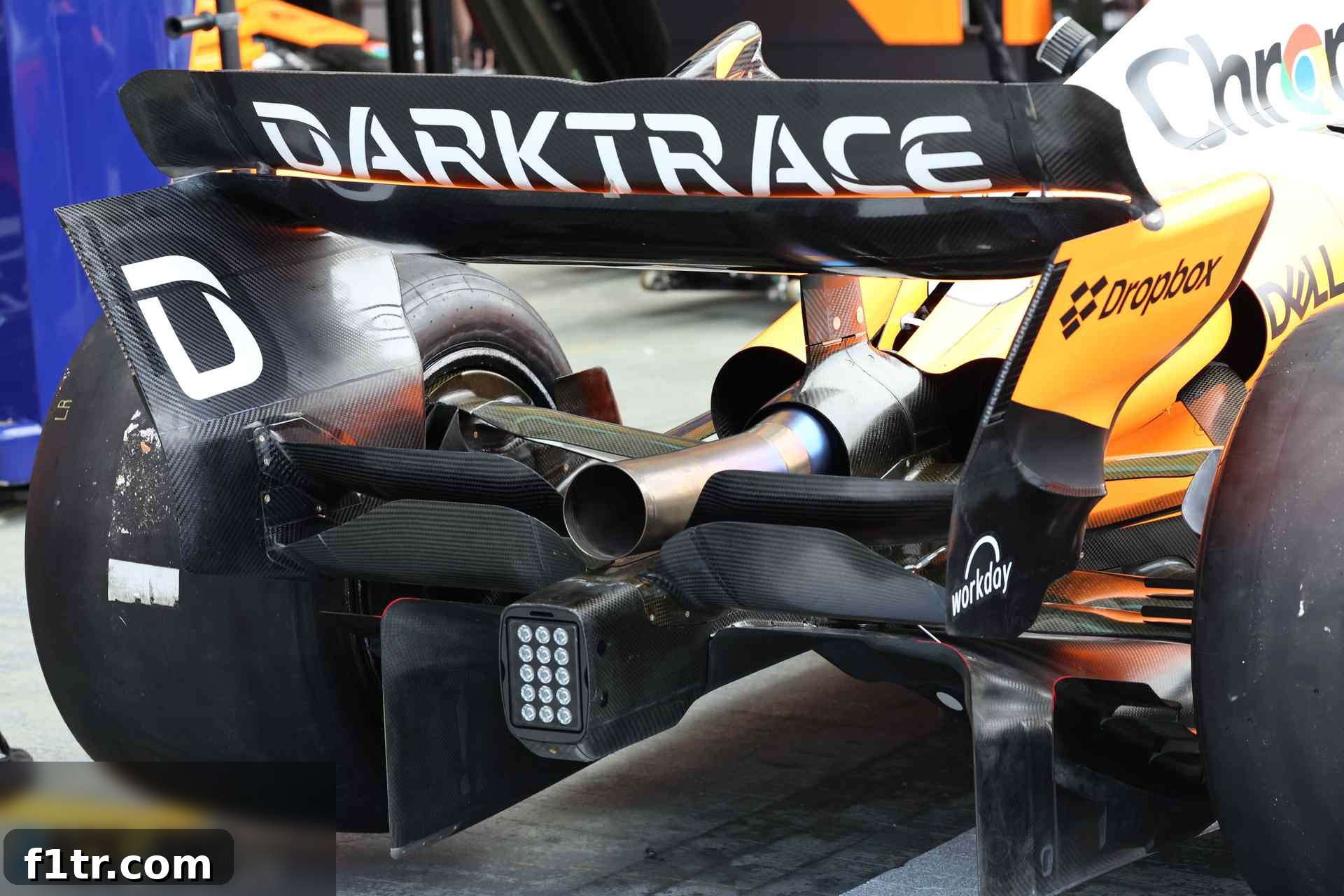
McLaren Adjusts Controversial Rear Wing Amidst F1 Legality Scrutiny
Advert | Become a Supporter & go ad-free
In the high-stakes world of Formula 1, where every millisecond counts, the fine line between groundbreaking innovation and regulatory infringement is constantly being tested. McLaren, one of the sport’s most storied teams, recently found themselves at the heart of such a debate. The Woking-based outfit has confirmed its intention to modify the design of its rear wing, a decision that comes after intense scrutiny and questions raised by rival teams regarding the component’s legality under the stringent FIA technical regulations.
The controversy surrounding McLaren’s MCL38 rear wing initially flared during the high-speed Azerbaijan Grand Prix weekend. Eagle-eyed observers and rival engineers noticed compelling footage suggesting that the edges of the DRS (Drag Reduction System) flap on the McLaren car exhibited an unusual degree of deformation at high speeds. This phenomenon, colloquially dubbed a ‘Mini DRS’ effect by some, sparked immediate speculation across the paddock. The concern was that such a design could provide an illicit aerodynamic advantage, effectively bending the rules to achieve higher top speeds on the straights, thereby gaining an unfair competitive edge.
The Heart of the Matter: Aerodynamic Legality and Flexibility Tests
Formula 1’s technical regulations are meticulously crafted to ensure fair competition and prevent uncontrolled performance escalation. A crucial aspect of these rules pertains to aerodynamic components, particularly their rigidity. While designs are permitted to deflect to a certain degree under load – a natural characteristic of any material under immense aerodynamic forces – there are strict limits to this flexibility. The FIA conducts rigorous deflection tests to ensure that wings and other aero parts remain within prescribed tolerances. Any component that demonstrates excessive flex, especially when that flex contributes to an aerodynamic advantage not explicitly allowed by the regulations, could be deemed illegal.
In response to the escalating speculation, the FIA released a statement, clarifying its position. The governing body noted that no official complaints had been lodged by any team against the designs of their rivals. It further emphasized that any wing is considered compliant with the rules if it successfully meets the allowed dimensions and passes the mandatory flexibility tests. This seemingly neutral stance, however, did little to quell the underlying tension within the paddock, as the visual evidence of the McLaren wing’s behavior continued to fuel discussions among competitors.
McLaren’s Proactive Stance Amidst Rising Speculation
Despite the FIA’s initial statement confirming no official complaints, and amid a backdrop of growing anticipation that the governing body might be preparing to revise the relevant regulations, McLaren decided to take a pre-emptive step. The team officially confirmed that they would not run the controversial rear wing in its original form again. This decision, described by McLaren as proactive, aims to put an end to the ongoing debate and demonstrate their commitment to fair play, even as they firmly maintain the legality of their initial design.
In their statement, McLaren articulated: “Whilst our Baku rear wing complies with the regulations and passes all FIA deflection tests, McLaren have proactively offered to make some minor adjustments to the wing following our conversations with the FIA.” This carefully worded response highlights a critical aspect of Formula 1—the constant dialogue between teams and the regulatory body. It suggests that while the wing technically passed the tests at the time, the spirit of the rule or the potential for a future rule clarification prompted McLaren to make a strategic concession.
Intriguingly, McLaren also hinted that the behavior observed on their car might not be an isolated incident, suggesting that similar aerodynamic characteristics could be present on other competitors’ vehicles. “We would also expect the FIA to have similar conversations with other teams in relation to the compliance of their rear wings,” the team added. This statement opens up the possibility of a broader review by the FIA, potentially impacting multiple teams and ensuring a more consistent interpretation and enforcement of aerodynamic flexibility rules across the grid.
Rival Reactions: Ferrari’s Frustration and the Pursuit of Fairness
The controversy naturally elicited strong reactions from rival teams, particularly those vying for competitive positions against McLaren. Frederic Vasseur, the pragmatic team principal of Ferrari, weighed in on the issue even before McLaren’s official announcement. Expressing his trust in the FIA to handle the situation appropriately, Vasseur did not mince words regarding the visual evidence of the McLaren wing’s deformation.
Advert | Become a RaceFans supporter andgo ad-free
“I’m not complaining about this. I think it’s more than borderline. We all saw the video and the pictures of this,” Vasseur stated, clearly indicating his belief that McLaren’s design pushed the boundaries of what is considered acceptable within the regulations. His frustration stemmed from the immense effort and precision required to gain even the slightest advantage in Formula 1, often measured in mere hundredths of a second.
Vasseur drew a poignant comparison to a previous race in Monza, where incredibly tight margins separated the top cars. “It’s a bit frustrating when, if you remember perfectly the situation in Monza, we had five cars in two hundredths of a second and you move from P1 and P2 to P5 and P6 for two hundredths of a second. In Baku we arrive 10 laps in a row side-by-side turn one, you can imagine that we have a bit of frustration.” This anecdote powerfully illustrates the impact a perceived aerodynamic advantage can have, particularly on circuits where top speed and drag reduction are paramount. For rivals who invest heavily in R&D to find compliant performance gains, witnessing another team potentially operating in a grey area can be incredibly vexing.
Strategic Implications: Low vs. High Downforce Tracks
Vasseur also touched upon the strategic implications of McLaren’s wing design, speculating on its utility across different types of circuits. He suggested that McLaren was unlikely to deploy the controversial wing at upcoming high-downforce tracks, such as the Singapore street circuit where F1 was scheduled to race that weekend, or indeed at Zandvoort. This assessment is rooted in the fundamental principles of aerodynamics in F1.
“We had a look at the previous events and it was only on the low-downforce tracks,” Vasseur observed. On circuits characterized by long straights and fewer high-speed corners, like Baku, reduced drag translates directly into higher top speeds and significant lap time gains. A flexible DRS flap that can flatten out more effectively at high speeds would be immensely beneficial here. Conversely, on high-downforce tracks with numerous tight corners and short straights, maximum downforce and aerodynamic stability are prioritized over raw straight-line speed. An overly flexible wing, even if it offers drag reduction, might compromise stability and grip through corners, making it a net disadvantage.
The Ongoing Dance Between Innovation and Regulation
The McLaren rear wing saga is a microcosm of the eternal struggle in Formula 1: the relentless pursuit of performance through innovation, constantly pushing the boundaries of what is technically possible, juxtaposed against the FIA’s imperative to maintain a level playing field and ensure sporting integrity. Teams frequently seek to exploit any ambiguity in the regulations, leading to periods of intense debate and, occasionally, rule clarifications or outright bans. Historically, F1 has seen numerous such controversies, from the double diffusers to flexible bodywork of past eras, each instance highlighting the ingenuity of engineers and the vigilance required from the regulators.
The FIA’s role in this dynamic is crucial. It must not only react to perceived infringements but also proactively refine regulations to anticipate future innovations. The decision by McLaren to make adjustments, even while maintaining their initial compliance, reflects a mature understanding of this relationship. It avoids a protracted legal battle or a forced rule change, allowing the sport to move forward with clearer parameters for aerodynamic design.
Looking Ahead: Ensuring Fair Competition in Formula 1
This incident serves as a timely reminder of the extreme competitive environment in Formula 1, where minuscule gains can dictate championship outcomes. As the sport continues to evolve with new regulations and technological advancements, the scrutiny on car components will only intensify. The collaborative (albeit sometimes tense) process between teams and the FIA in resolving such technical ambiguities is vital for the long-term health and credibility of the sport. Ultimately, McLaren’s adjustment signifies not just a change to a piece of aero, but a reinforcement of the principles of fair competition that underpin Formula 1.
Miss nothing from RaceFans
Get a daily email with all our latest stories – and nothing else. No marketing, no ads. Sign up here:
Advert | Become a RaceFans supporter andgo ad-free
2024 Singapore Grand Prix
- Ricciardo’s brake woe and why Perez thought he had an engine problem: Singapore GP radio
- ‘Perez is only quicker when he has DRS’: How Hulkenberg’s Haas beat a Red Bull – again
- Mercedes explain “clear mistake” strategy call which left Hamilton “so angry”
- “Sometimes I wonder why I do this”: How Hamilton endured a slog to sixth in Singapore
- F1’s rules need surgery as well as sticking plaster after fastest lap controversy
Browse all 2024 Singapore Grand Prix articles