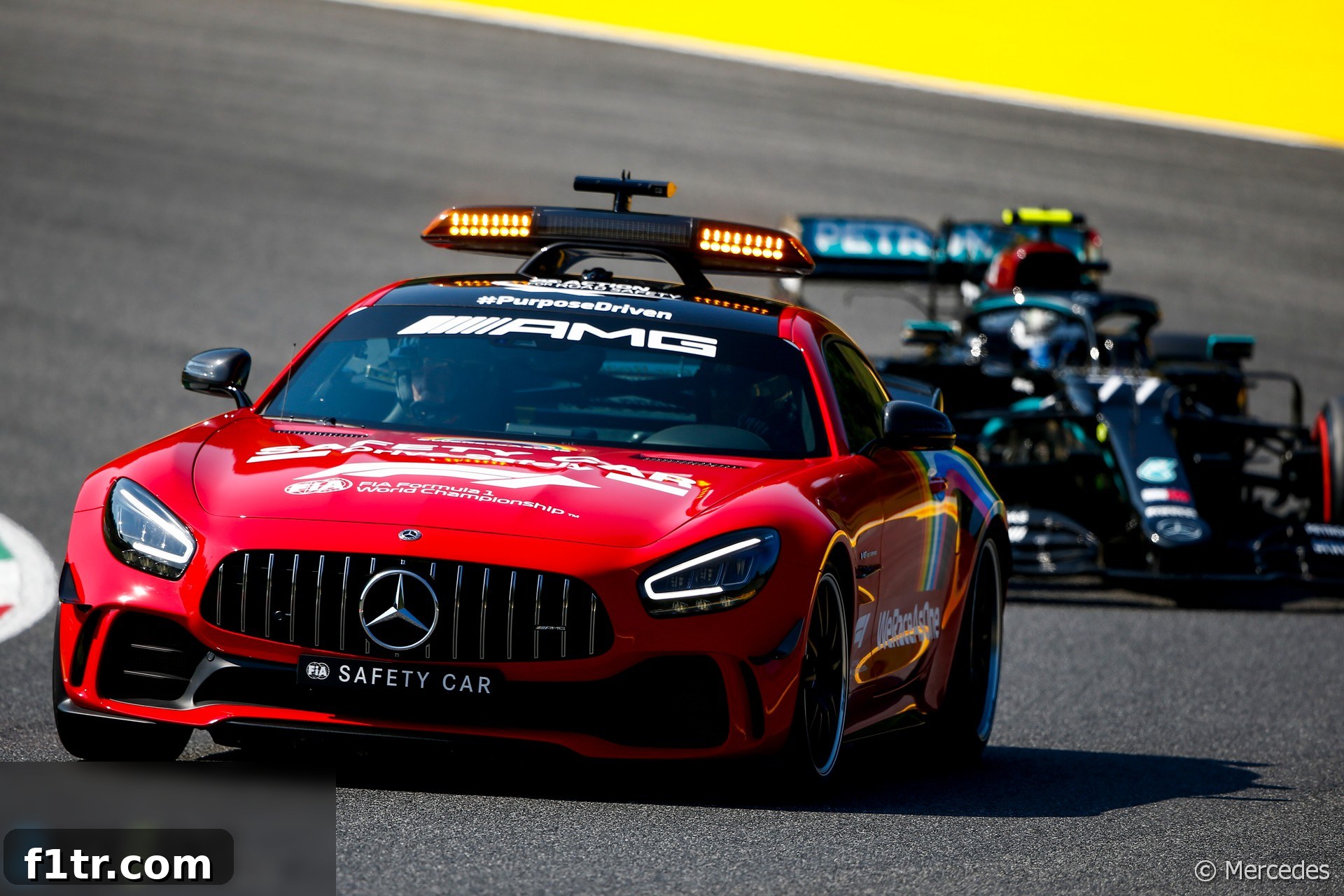
In the high-octane world of Formula 1, where split-second decisions and razor-thin margins dictate success, safety protocols are paramount. Yet, even with the most advanced systems in place, incidents can spark intense debate, particularly concerning the procedures governing race restarts. Following a dramatic and chaotic pile-up during the Tuscan Grand Prix, Formula 1 Race Director Michael Masi found himself at the center of such a discussion, firmly stating there was no immediate need to alter the sport’s Safety Car restart rules.
Advert | Become a Supporter & go ad-free
The incident at Mugello, a circuit making its Formula 1 debut, unfolded during the race’s sole Safety Car restart. A shocking multi-car collision effectively eliminated four drivers from the race, while an additional eight drivers, alongside the initial four, received formal warnings for their involvement in the ensuing chaos. This significant mishap immediately triggered calls from several prominent drivers for a thorough review and potential modification of the existing restart regulations. However, speaking after the race on Sunday evening, Masi was unequivocal: “I don’t think there’s any need to review the Safety Car restart rule.”
Understanding the Tuscan Grand Prix Crash
The Tuscan Grand Prix, held at the picturesque Mugello circuit, was notable for its triple-header of standing starts, two of which followed Safety Car periods. It was after the first Safety Car deployment, initiated following a collision involving Max Verstappen and Pierre Gasly on the opening lap, that the calamitous restart occurred. As the Safety Car prepared to return to the pits, the pack of F1 cars bunched up, creating a perilous concertina effect.
The core of the drivers’ concerns revolved around the timing of the race director’s decision to signal the restart. Race leader Valtteri Bottas, driving for Mercedes, was positioned between Scarperia and Palagio – turns 10 and 11 – when the crucial instruction to restart the race was issued. Many drivers argued that this timing, coupled with Bottas’s strategy to control the pace, led to an unacceptable compression of the field at high speed on the main straight, dramatically increasing the risk of an accident. Masi, however, firmly rejected this viewpoint, dismissing it as “quite offensive” to suggest that safety was compromised.
Michael Masi’s Defense of Current Procedures
Masi’s stance is rooted in the assertion that the established protocol for initiating a Safety Car restart was meticulously followed at Mugello, just as it is at every other circuit on the F1 calendar. He emphasized the structured, multi-phase process designed to ensure both safety and fairness during a restart. This standardized procedure is a critical element of F1’s operational framework, providing predictability and consistency for all competitors and teams.
“The first phase is that we advise all teams through the messaging system, which is also what’s seen on the graphics, that the Safety Car is in this lap,” Masi elaborated. “So that therefore prepares all of the teams to advise their drivers accordingly.” This initial notification is crucial, giving teams a heads-up to prepare their drivers for the impending restart, allowing them to adjust engine modes, tire temperatures, and mental focus.
He continued: “From there, the next point is that – at a predetermined point at each circuit generally – the Safety Car boards are withdrawn, however the yellow flags continue to be displayed. Then, once the Safety Car is clear of the circuit, the yellow flags are withdrawn and the green flag is displayed at the control line only. And that’s really the phases of it.” This detailed explanation highlights the sequential nature of the restart, designed to progressively inform drivers of the changing status of the track, moving from a fully neutralized state to full racing conditions.
The ‘Concertina Effect’ and Driver Concerns
The drivers’ primary concern stemmed from the so-called ‘concertina effect’ – where the leading car dictates the pace, often slowing down significantly before accelerating, causing a ripple effect down the field. This can lead to cars at the rear of the pack having to brake heavily, sometimes unexpectedly, especially if visibility is compromised or if they are anticipating the green flag at a different point. At Mugello, the issue was compounded by Bottas’s decision to wait until the last possible moment to accelerate, a tactic aimed at preventing rivals from gaining a slipstream advantage.
Many drivers felt that releasing the ‘Safety Car in this lap’ message while Bottas was still navigating turns, rather than on a straight, contributed to the uncertainty. This, they argued, created a dangerous scenario where some drivers anticipated an immediate acceleration while others were still preparing for it, leading to the devastating chain reaction. The warnings issued to twelve drivers underscore the collective confusion and misjudgment that characterized the incident, highlighting the fine line between aggressive racing and dangerous driving in such high-pressure situations.
F1’s Approach to Safety and Rule Management
Michael Masi’s role as Race Director is incredibly demanding, requiring him to make critical decisions that balance the integrity of the race, the spectacle for fans, and, most importantly, the safety of all participants. His resistance to changing the Safety Car restart rule suggests a belief in the robustness of the existing framework, emphasizing driver responsibility within those parameters.
F1 has a long-standing commitment to enhancing safety, evolving its regulations, car designs, and circuit layouts significantly over decades. However, the dynamics of a racing restart remain one of the most unpredictable elements of the sport. While the procedures are clearly defined, the execution relies heavily on the interpretation and reactions of dozens of drivers in high-speed, high-stress environments. The incident at Mugello served as a stark reminder of these inherent challenges, even under seemingly routine conditions.
The debate surrounding Safety Car restarts often focuses on whether the rules themselves are flawed, or if the interpretation and application of those rules by drivers, or indeed by race control, lead to incidents. Masi’s firm stance suggests that, from the perspective of the governing body, the framework is sound, and any issues arising are more related to the specific circumstances of a race or individual driver actions rather than systemic deficiencies in the regulations.
Advert | Become a RaceFans supporter andgo ad-free
Looking Ahead: Constant Scrutiny in F1
While Masi dismissed immediate rule changes, the scrutiny on Safety Car restart procedures remains a constant in Formula 1. Every incident, no matter how infrequent, prompts a re-evaluation of best practices. The sport continues to evolve, and with it, the discussions around how to maintain thrilling racing while upholding the highest standards of safety. The Tuscan Grand Prix crash, despite Masi’s assurances, will undoubtedly serve as a critical reference point in future safety briefings and rule discussions, reinforcing the need for absolute clarity and strict adherence to protocols from every competitor on the grid.
The intricate balance between giving the race leader control over the restart pace and ensuring the safety of the entire field is a perpetual challenge. Whether through subtle adjustments in communication, more explicit guidelines for drivers, or continued enforcement of existing rules, Formula 1 is a sport that never stops learning and adapting. The discussions ignited by the Mugello incident are a testament to this ongoing commitment, ensuring that even without immediate rule changes, the pursuit of perfection in safety remains relentless.
2020 F1 season
- Grosjean to make F1 test return tomorrow for first time since Bahrain horror crash
- Pictures: Wrecked chassis from Grosjean’s Bahrain fireball crash to go on display
- Bottas vs Rosberg: Hamilton’s Mercedes team mates compared after 78 races each
- F1 revenues fell by $877 million in Covid-struck 2020 season
- Hamilton and Mercedes finally announce new deal for 2021 season
Browse all 2020 F1 season articles