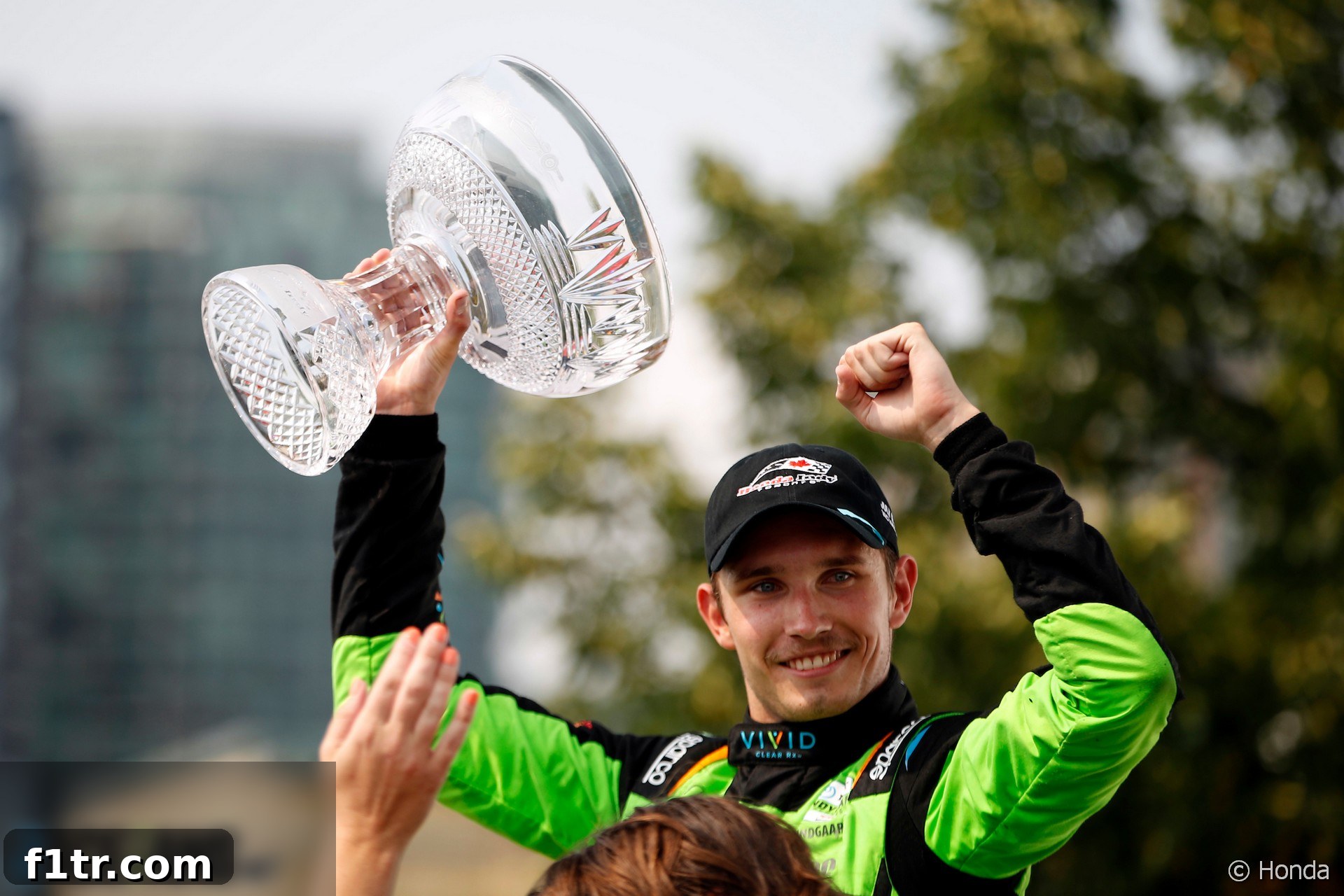
Lundgaard Conquers Toronto for Maiden IndyCar Victory, Palou’s Heroic Recovery Extends Championship Lead
The streets of Toronto witnessed a historic moment in IndyCar racing as Christian Lundgaard, driving for Rahal Letterman Lanigan Racing (RLL), converted his first career pole position into a spectacular maiden victory. This triumph marked the end of a challenging three-year win drought for RLL, injecting fresh momentum into the team and solidifying Lundgaard’s burgeoning career in the NTT IndyCar Series.
Advert | Become a Supporter & go ad-free
The 21-year-old Dane demonstrated remarkable poise and speed throughout the highly competitive race, ultimately crossing the finish line a commanding 11 seconds ahead of championship leader Alex Palou. Palou’s second-place finish was arguably one of the drives of the season, a testament to his skill and tenacity. Starting from a challenging 15th position, Palou meticulously carved his way through the field, overcoming significant damage to his car – including a broken nose cone and a severely askew front wing – during the final third of the race. His ability to maintain pace and fend off rivals with a compromised machine was nothing short of extraordinary. Completing the podium was Colton Herta, who started just one spot ahead of Palou. Herta’s drive was not without drama, as he narrowly made it to the finish line, running out of fuel just as he sprinted past the chequered flag, a common high-stakes occurrence in IndyCar’s strategic fuel management.
Early Chaos and Strategic Plays on the Streets of Toronto
The Honda Indy Toronto race began with immediate drama, as the field was neutralised almost as soon as it got underway. Lundgaard, having secured a dominant pole position, executed a perfect start, leading the pack ahead of Scott McLaughlin and Pato O’Ward into the first corner. However, the tight confines of the temporary street circuit quickly claimed multiple victims further down the grid. A significant pile-up erupted at the first turn, involving a total of eight cars and sending shockwaves through the paddock. The incident underscored the unforgiving nature of street course racing, where even the slightest misjudgment can have catastrophic consequences for multiple competitors.
Among those caught in the chaos, Ryan Hunter-Reay, Benjamin Pedersen, Jack Harvey, and newcomer Tom Blomqvist were all forced to retire on the spot, their races ending prematurely. The severity of the incident highlighted the intense competition and inherent risks of the series. Alexander Rossi, Sting Ray Robb, and Santino Ferrucci were also entangled in the multi-car shunt but managed to continue, albeit a lap down, facing an uphill battle for any meaningful points. A notable display of quick thinking came from Graham Rahal at the very back of the field; expertly avoiding the escalating crash, he smartly engaged reverse, navigated away from the wreckage, and rejoined the race without sustaining any damage, a move that would prove crucial for his eventual top-ten finish.
The race remained under caution for an extended period, spanning nine laps, as marshals worked diligently to clear the scattered debris and safely remove the damaged vehicles from the track. This lengthy yellow flag period gave teams time to strategize and drivers a chance to compose themselves after the tumultuous start. When racing finally resumed on lap 10, Lundgaard immediately reasserted his authority, quickly building a lead of just over a second over McLaughlin by the end of the lap. His choice of softer alternate tyres proved to be a decisive advantage in these early stages, allowing him to pull away from the Penske driver, who was on the harder primary compound tyres. This early demonstration of pace on the alternate compound was a clear indicator of Lundgaard’s confidence and the RLL team’s astute tyre strategy.
Tyre Strategies Unfold and Mid-Race Tensions Rise
As the first stint progressed, Lundgaard maintained his lead, carefully managing his tyres. He was the first among the front-runners to make his initial pit stop, diving into the pits at the end of lap 19. His crew swiftly fitted a fresh set of primary tyres, signalling a shift in strategy. Pato O’Ward followed suit a lap later, also switching to the primary compound. This meant that all drivers on track were now running either on the primary tyres they had started on or the same compound fitted during their first stop. Scott McLaughlin, finding himself in clear air, struggled to significantly extend his lead over Marcus Ericsson, who was running second at this point, unable to push his gap beyond 2.5 seconds. The varying tyre degradation rates and strategic pit windows kept everyone on their toes.
By lap 31, Alex Palou’s remarkable climb through the field was well underway. He had skillfully advanced to sixth place, eventually making a decisive move past Colton Herta to claim fifth. Out front, McLaughlin, now on primary tyres, began to find a rhythm and steadily pull away from Ericsson. His lead grew to a comfortable five seconds by the time he made his first pit stop at the end of lap 35. Opting for the faster alternate tyres for his second stint, McLaughlin rejoined the race in fifth position, immediately behind the former leader, Lundgaard, setting the stage for a thrilling battle.
Advert | Become a RaceFans supporter andgo ad-free
Once the initial cycle of pit stops had concluded and the field settled, Christian Lundgaard reassumed the lead, now holding a healthy six-second advantage over Scott McLaughlin. Pato O’Ward settled into third place, with Kyle Kirkwood just ahead of Marcus Ericsson in fourth. However, the race was far from over, and drama was quick to resurface. Just before the halfway point, Romain Grosjean brought out the second caution period of the race. Grosjean’s incident occurred when he appeared to clip the inside barrier at turn ten, sending his car into a violent crash against the pit wall, ending his race prematurely and once again shuffling the strategic deck for the remaining competitors.
Under this caution, Kyle Kirkwood, strategically positioned, was the highest-placed driver to make a pit stop, which in turn promoted Marcus Ericsson to fourth place. The race restarted on lap 46, but the yellow flags were almost immediately waved again, highlighting the unpredictable nature of Toronto’s circuit. This time, Helio Castroneves was hit from behind by Kirkwood as they approached the final corner, causing Castroneves to spin. In the ensuing chaos, Alex Palou, despite his incredible drive, lost a handful of places as he took evasive action to avoid the spinning cars. Castroneves, attempting a spin-turn to recover, stalled his car, leading to his unfortunate retirement from the race. This incident also proved pivotal for Palou, as it caused the significant front-wing damage that he would heroically manage for the remainder of the race.
Palou’s Valiant Fight and Lundgaard’s Unstoppable Charge to Victory
When the pit lane reopened under the second caution, race leader Lundgaard capitalised on the opportunity, pitting for a fresh set of primary tyres. He was joined by Pato O’Ward from third and Marcus Ericsson from fourth, all making their strategic stops. This sequence of events temporarily promoted Scott McLaughlin into the lead, with veteran Scott Dixon in second, and Rinus VeeKay in third – all three still running on alternate tyres, betting on their speed for the upcoming green flag period. The tension was palpable as the race resumed on lap 52, with McLaughlin at the helm, closely pursued by Dixon and VeeKay.
Despite his damaged nose cone and the right-hand side of his front wing running precariously close to the ground, Alex Palou continued his remarkable recovery, moving up into fourth place. His car, clearly compromised, was a testament to his exceptional car control and unwavering focus. McLaughlin eventually made his final pit stop from the lead at the end of lap 61, rejoining the race almost at the very back of the field in 15th position, a calculated risk that aimed for maximum attack in the closing laps. Scott Dixon followed suit, pitting on the very next lap. This sequence allowed Christian Lundgaard to make a decisive move, overtaking Palou at the hairpin, reclaiming the lead of the race, a position he would not relinquish.
With his car in prime condition and a clear track ahead, Lundgaard began to pull away decisively from Palou’s wounded machine. Over the remaining laps, the young Dane showcased a dominant performance, extending his lead to over ten seconds by the 80th lap. His pace was relentless, a clear indicator of a driver in supreme control. Meanwhile, Palou, despite his significant damage, found himself under intense pressure from a train of cars behind him. Colton Herta, in particular, was pushing hard, trying to exploit Palou’s compromised vehicle and force the championship leader into a mistake. The battle for second and third was fierce, a nail-biting spectacle unfolding behind Lundgaard’s dominant run.
From that point, Christian Lundgaard expertly managed the remaining laps, bringing his RLL car home to cross the finish line at the end of the 85th tour. This momentous victory marked his first-ever triumph in the prestigious IndyCar series, a career-defining moment that broke a significant drought for his team. Despite the relentless pressure and the visible damage to his car, Alex Palou held off the charging pack behind him with incredible skill and determination, securing a phenomenal second place, 11 seconds adrift of the winner. Colton Herta completed the top three, rounding off an action-packed podium. His last-lap fuel scare only added to the drama of a thrilling race.
Championship Implications and Looking Ahead to Iowa
The race saw further significant performances throughout the field. Scott Dixon, ever consistent, claimed fourth place, just ahead of Josef Newgarden in fifth. Scott McLaughlin, recovering remarkably from his late pit stop strategy, salvaged a strong sixth position, showcasing his impressive racecraft. Marcus Armstrong achieved his best finish of the season in seventh, a promising result for the young driver. Pato O’Ward finished eighth, followed by Graham Rahal, whose clever manoeuvre at the start paid dividends, securing ninth. Felix Rosenqvist rounded out the top ten, completing a competitive outing.
The closing stages also saw more drama with fuel strategies. Will Power and Marcus Ericsson were both forced to make unscheduled pit stops on the penultimate lap for fuel. This costly stop dropped Ericsson to 11th, while Power, whose engine had to be restarted after running dry, plummeted to 14th at the chequered flag, highlighting the fine margins in IndyCar racing and the critical importance of fuel management on a demanding street circuit.
Alex Palou’s heroic recovery to second place in Toronto carries immense weight for the championship battle. His impressive drive means he further extends his championship lead over his closest rival, Scott Dixon, to a formidable 117 points, putting him in a commanding position as the season progresses. Christian Lundgaard’s victory not only marked a personal milestone but also propelled him to seventh in the championship standings, a testament to his growing prowess in the series. The NTT IndyCar Series now shifts its focus to a thrilling doubleheader event next weekend at Iowa Speedway, promising another dose of high-speed action and intense competition on the short oval circuit. Fans can anticipate more strategic battles and wheel-to-wheel racing as drivers continue their quest for championship glory.
Advert | Become a RaceFans supporter andgo ad-free
IndyCar Toronto Race Results:
| Position | Car | Driver | Team | Engine |
|---|---|---|---|---|
| 1 | 45 | Christian Lundgaard | RLL | Honda |
| 2 | 10 | Alex Palou | Ganassi | Honda |
| 3 | 26 | Colton Herta | Andretti | Honda |
| 4 | 9 | Scott Dixon | Ganassi | Honda |
| 5 | 2 | Josef Newgarden | Penske | Chevrolet |
| 6 | 3 | Scott McLaughlin | Penske | Chevrolet |
| 7 | 11 | Marcus Armstrong | Ganassi | Honda |
| 8 | 5 | Pato O’Ward | McLaren | Chevrolet |
| 9 | 15 | Graham Rahal | RLL | Honda |
| 10 | 6 | Felix Rosenqvist | McLaren | Chevrolet |
| 11 | 8 | Marcus Ericsson | Ganassi | Honda |
| 12 | 78 | Agustin Canapino | Juncos Hollinger | Chevrolet |
| 13 | 21 | Rinus VeeKay | Carpenter | Chevrolet |
| 14 | 12 | Will Power | Penske | Chevrolet |
| 15 | 27 | Kyle Kirkwood | Andretti | Honda |
| 16 | 7 | Alexander Rossi | McLaren | Chevrolet |
| 17 | 14 | Santino Ferrucci | Foyt | Chevrolet |
| 18 | 77 | Callum Ilott | Juncos Hollinger | Chevrolet |
| 19 | 51 | Sting Ray Robb | Coyne/RWR | Honda |
| 20 | 18 | David Malukas | Coyne/HMD | Honda |
| 21 | 106 | Helio Castroneves | Meyer Shank | Honda |
| 22 | 28 | Romain Grosjean | Andretti | Honda |
| 23 | 29 | Devlin DeFrancesco | Andretti | Honda |
| 24 | 30 | Jack Harvey | RLL | Honda |
| 25 | 60 | Tom Blomqvist | Meyer Shank | Honda |
| 26 | 20 | Ryan Hunter-Reay | Carpenter | Chevrolet |
| 27 | 55 | Benjamin Pedersen | Foyt | Chevrolet |
Advert | Become a RaceFans supporter andgo ad-free
More IndyCar Insights
- IndyCar driver McLaughlin cleared of injury after crashing through barrier at Barber
- Schumacher says his IndyCar feels like ‘an F2 car, just with better tyres’
- IndyCar “way faster than Formula 1” in some corners, says Grosjean
- FIA to award more F1 superlicence points to IndyCar drivers from 2026
- Schumacher to race full-time in IndyCar with RLL in 2026
Browse all IndyCar articles