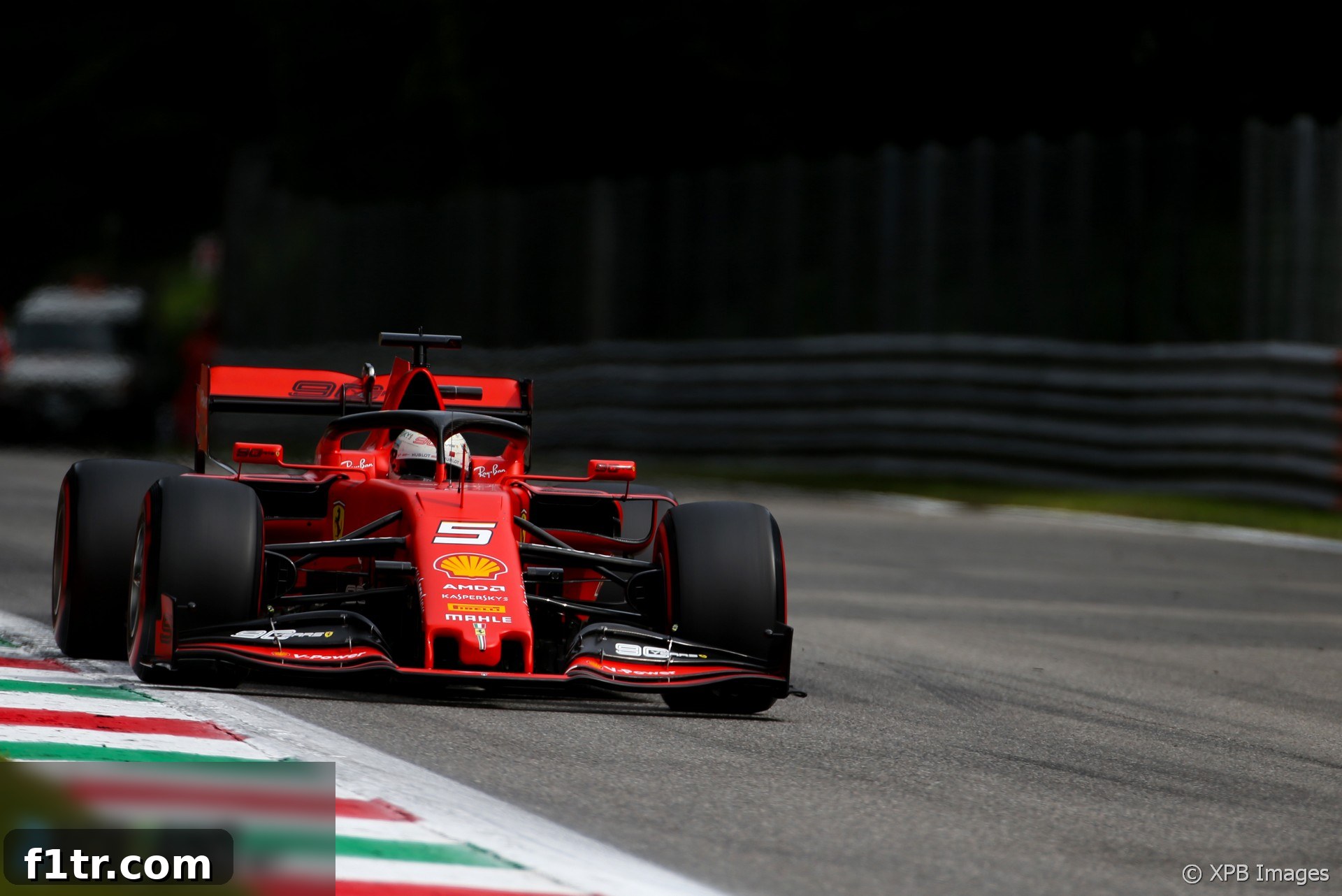
In a pivotal moment that could have dramatically altered the starting grid for the 2019 Italian Grand Prix, Sebastian Vettel narrowly avoided a significant penalty for allegedly exceeding track limits at the iconic Parabolica corner during the crucial Q3 session. After an intensive review, the race stewards ultimately ruled that the four-time world champion had not definitively strayed beyond the defined track boundaries. This critical decision allowed Vettel’s only valid lap time to stand, preventing a substantial drop in his starting position and igniting widespread discussion about the complexities of track limits enforcement in elite motorsport.
The Drama Unfolds: Vettel’s Monza Q3 and the Parabolica Incident
The 2019 Italian Grand Prix qualifying session at Monza was, by all accounts, a masterclass in strategic chaos and high-stakes racing. Q3, the final and most critical phase of qualifying, devolved into a spectacle as drivers maneuvered for a crucial aerodynamic slipstream, or ‘tow,’ on Monza’s long, high-speed straights. It was amidst this frantic scramble for pace that Sebastian Vettel found himself under intense scrutiny following his approach to Parabolica, the circuit’s sweeping, high-speed final right-hand corner, which is notoriously vital for carrying momentum onto the main straight.
As Vettel pushed his Ferrari SF90 to its absolute limits, television replays and trackside cameras showed his car appearing to momentarily run wide, with a wheel potentially crossing the white line that marks the track’s edge. In modern Formula 1, strict adherence to these lines is paramount; even a fractional excursion can lead to a lap time being invalidated. The prospect of such a penalty loomed large, threatening to negate what was a strong individual lap for the German driver and severely jeopardizing his starting position for what is effectively Ferrari’s home race, the “Gran Premio d’Italia” at the revered Temple of Speed.
The Stewards’ Meticulous Review: A Question of Doubt
Immediately after the session, the stewards launched a thorough investigation into Vettel’s lap. Their task was to ascertain with absolute certainty whether an infringement had occurred. This process involved an exhaustive examination of every available piece of evidence: multiple camera angles, including onboard footage and various trackside views, along with telemetry data. The challenge inherent in such decisions lies in the extreme precision required – even the smallest margin of error in judgment can have significant consequences for a driver’s weekend.
The official stewards’ report detailed their findings: “The stewards reviewed multiple camera angles, some of which appeared to show that the tyres were not in contact with the white line of the track edge.” This statement alone highlights the inherent ambiguity. The unique perspective of each camera, coupled with the immense speed of an F1 car, can create optical illusions or make definitive judgments incredibly difficult. What one angle might suggest, another might contradict, or at least leave room for interpretation.
Crucially, the report continued: “However other angles appeared to show that part of the front ‘wheel’ (when viewed from above) may have been within the bounds of the white line. This cast an element of doubt which is considered significant enough to give the “benefit of doubt” to the driver in question.” This application of the “benefit of doubt” rule proved decisive. In instances where conclusive proof of an infringement cannot be established beyond reasonable doubt, motorsport’s judicial process dictates that the competitor should not be penalized. This principle safeguards against unfair sanctions based on ambiguous or inconclusive evidence, especially when fractions of an inch and split-second decisions are involved.
Implications: How the Decision Shaped Vettel’s Grid Position
The stewards’ ruling that Sebastian Vettel’s lap would stand was a momentous relief for both the driver and the iconic Ferrari team. Had his lap been deleted, Vettel would have faced a punitive loss of several grid positions, a setback that would have severely handicapped his prospects for the race. Starting further down the order at Monza, a circuit where effective overtaking is challenging despite the long straights due due to the high-speed nature and critical dependency on slipstream, would have placed him at a considerable disadvantage. Recovering positions on this legendary track often requires aggressive strategies and a degree of luck.
For a team steeped in the history and tradition of Formula 1, like Ferrari, performing well at their home Grand Prix is about more than just championship points; it’s a matter of national pride and an opportunity to celebrate with the fervent Tifosi. Losing grid slots due to a track limits infringement would have been a profoundly disappointing outcome, adding unwelcome pressure to a season that had already presented its fair share of challenges for the Scuderia and its star driver, Sebastian Vettel.
The Chaotic Q3 Session and Ferrari’s Missed Opportunity
Vettel’s qualifying fortunes were further complicated by the extraordinary and somewhat farcical events of Q3. In a collective strategic miscalculation involving multiple teams, a significant number of drivers, including Vettel, failed to complete a second flying lap. This bizarre scenario unfolded as drivers deliberately slowed on their out-laps, attempting to create a sufficient gap to the car ahead to capitalize on the slipstream advantage down Monza’s long straights. The resulting traffic jam and slow pace meant that many cars simply did not cross the start/finish line before the chequered flag was waved, effectively ending their Q3 with only one recorded lap.
Vettel himself had initially slowed to allow his teammate, the emerging talent Charles Leclerc, to pass him, hoping to benefit from Leclerc’s tow. This tactical gamble, while a common strategy at Monza, ultimately backfired for many that day, leaving Vettel’s single, valid lap as his sole representative effort. “I was happy with the car which was really good, and I was also pleased with my lap today, but I cannot be happy with how qualifying went,” Vettel candidly admitted after the session. His frustration was palpable, a testament to the collective strategic misjudgment that hampered Ferrari’s overall qualifying performance.
He further elaborated on the Q3 debacle: “At the end of Q3, most of us didn’t make it through to the second attempt. The lap I did on my own without a tow was good. I think we went out late and then obviously you look for a tow, but it’s clear we waited too long, so in the end there was no margin.” This insight perfectly illustrates the razor-thin margin between strategic brilliance and a costly tactical error in Formula 1 qualifying, particularly at a circuit where the slipstream effect holds such immense power over lap times.
The Enduring Debate: Track Limits in Formula 1
The incident involving Sebastian Vettel at Parabolica is not an isolated event; rather, it serves as a vivid illustration of the broader, persistent debate surrounding track limits in Formula 1. For many years, the sport’s governing body, the FIA, has grappled with the challenge of consistently and fairly enforcing these crucial boundaries. The fundamental principle is straightforward: drivers must remain within the confines of the circuit at all times. However, translating this principle into universally applicable and easily enforceable rules in the high-speed, high-stakes environment of F1 racing proves remarkably complex.
Different circuits employ a variety of methods to deter drivers from gaining an unfair advantage by running wide. Some circuits feature traditional gravel traps, which effectively punish errors by causing drivers to lose significant time or even retire. Others utilize aggressive kerbs, designed to unsettle cars if taken too wide, or simply rely on the white lines painted on the asphalt. The latter, while offering maximum safety by providing extensive run-off areas, often gives rise to controversies precisely like Vettel’s, where the precise distinction between “on track” and “off track” becomes incredibly nuanced and open to interpretation.
The FIA and its team of race stewards continuously strive for consistency and clarity in their rulings. However, the dynamic nature of motorsport, coupled with the relentless technological advancements in car design and sophisticated tracking systems, ensures that the debate over track limits remains a constant feature of the sport. Drivers consistently advocate for clear, unambiguous rules, while stewards must navigate high-speed scenarios, multiple camera perspectives, and an array of data that doesn’t always provide a definitive, black-and-white answer. The “benefit of doubt” rule, while serving as a crucial safety net against unfair penalties, simultaneously underscores the inherent difficulty in making absolute judgments within milliseconds.
Sebastian Vettel’s 2019 Season: A Contextual Perspective
The 2019 Formula 1 season was a period of considerable challenge and transition for Sebastian Vettel and the Ferrari team. While the SF90 demonstrated undeniable flashes of raw speed, particularly on power-sensitive circuits like Monza, it frequently struggled with consistency and was often outmaneuvered by the dominant Mercedes W10. The Italian Grand Prix represented a critical opportunity for Ferrari to rally at their spiritual home, to satisfy the passionate Tifosi, and to reaffirm their competitive standing. Charles Leclerc, Vettel’s younger and increasingly formidable teammate, had already begun to emerge as a genuine force, securing victories and pushing Vettel hard throughout the season.
Within this context, the Parabolica incident and its ultimate resolution transcended a mere lap time; it was symbolically significant. It represented a moment where Vettel, under immense pressure from his team, his country, and his own high standards, successfully navigated both the physical demands of the challenging track and the intricate, often subjective, layers of F1 regulations. The stewards’ decision to grant him the benefit of doubt allowed him to maintain a more competitive starting position, potentially influencing his race outcome and contributing to the compelling narrative of a season where every point, every position, and every decision mattered immensely for the trajectory of both drivers and the team.
Conclusion: The Fine Line Between Performance and Penalty in F1
Sebastian Vettel’s near-penalty at Parabolica during the 2019 Italian Grand Prix Q3 remains a potent reminder of the razor-thin margins that define success and failure in Formula 1. It vividly showcased the meticulous, yet inherently challenging, work undertaken by race stewards in interpreting complex regulations under immense pressure. The judicious application of the “benefit of doubt” principle ultimately served its crucial purpose, ensuring that a driver was not unfairly penalized based on inconclusive visual evidence or subjective interpretation.
Beyond the immediate relief and impact for Vettel, this incident significantly contributed to the ongoing discourse surrounding track limits – a topic that continues to evolve as circuit designs are modified, cars become relentlessly faster, and tracking technology grows more sophisticated. It powerfully reinforces the fundamental truth that in Formula 1, success is not solely about possessing outright speed; it is equally about unparalleled precision, unwavering adherence to the rulebook, and, at times, the critical interpretation of those rules by the sport’s highest judicial authorities. The chaotic Q3 of the 2019 Monza Grand Prix will long be remembered not just for its infamous slipstream strategies, but for the dramatic moment Sebastian Vettel teetered on the precipice of a penalty, ultimately pulling back from the brink through the judicious application of motorsport law.
Related Articles on the 2019 F1 Season
- Ocon: Crying in the Melbourne car park at 2019 grand prix was my career low
- McLaren Racing reports reduced £71 million loss in 2019
- Kvyat: Hockenheim podium last year was “my biggest achievement” so far
- How the FIA’s new encrypted fuel flow meter targets Ferrari’s suspected ‘aliasing’ trick
- “He smashed my office door”: 23 must-see moments from ‘Drive to Survive’ season two
Browse all 2019 F1 season articles for more insights and news.