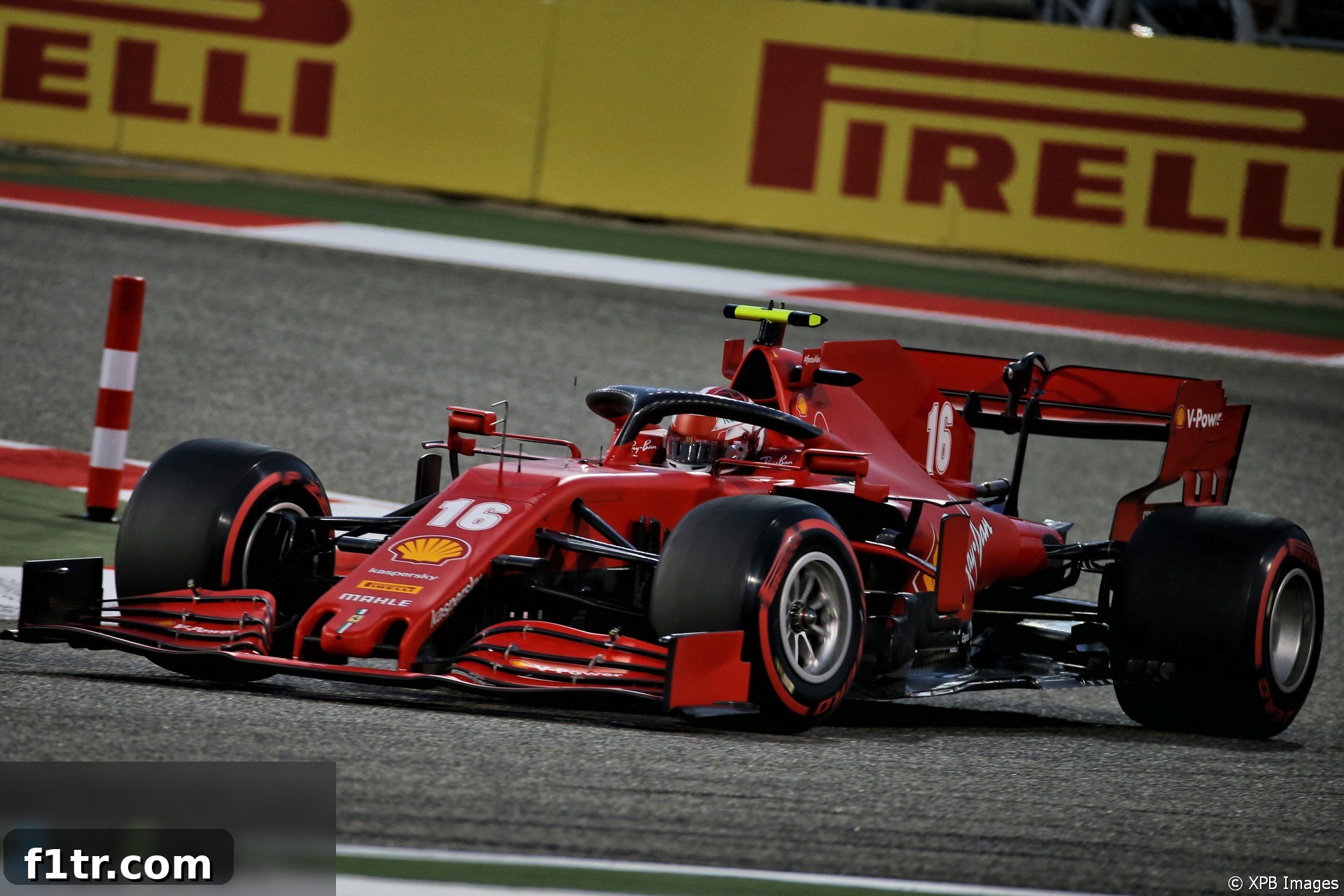
Charles Leclerc, the highly talented Ferrari driver, delivered an exceptional performance during the qualifying session for the Sakhir Grand Prix on the unique Bahrain Outer circuit. What made his impressive fourth-place grid position even more remarkable was his candid revelation: he significantly improved his racing line and overall pace by meticulously studying the onboard camera footage of rival driver Pierre Gasly. This fascinating insight into the intricate world of Formula 1 strategy and driver adaptation highlights the constant pursuit of marginal gains and the unexpected sources of inspiration that can propel a driver to the front.
Advert | Become a Supporter & go ad-free
Leclerc’s P4 qualifying result not only equaled his best performance of the challenging 2020 season but also underscored his raw speed and unwavering commitment to extracting every ounce of performance from his Ferrari SF1000. While he humbly refrained from labeling his final Q3 effort as a “perfect lap” – a term rarely uttered by the perfectionists of Formula 1 – he readily admitted to making substantial progress in all the critical areas he had targeted. This improvement was particularly evident during his sole flying lap on fresh tyres in the decisive Q3 session, a high-stakes moment where precision and confidence are paramount.
Unlocking Speed: The Gasly Onboard Revelation
The genesis of Leclerc’s breakthrough moment came after the final practice session. In the relentless pursuit of speed, Formula 1 drivers and their teams analyze vast amounts of data, but sometimes, the simplest observation can yield the greatest rewards. For Leclerc, this came in the form of reviewing Pierre Gasly’s onboard footage. Gasly, known for his aggressive yet precise driving style, had found a unique way to tackle a specific section of the Bahrain Outer circuit, and Leclerc was quick to notice.
Leclerc specifically pointed to the entry of Turn 7 as the area where he gained a significant chunk of time. “I was very quick there,” he explained, “I did such a huge step from final practice to quali there in terms of driving, using a lot more the track in entry on the kerb on the right, looking at Pierre Gasly’s onboard actually after final practice. So thanks Pierre.” This moment of humility and sportsmanship from Leclerc showcased the mutual respect among competitors and the continuous learning curve that even the most elite drivers undergo. By observing Gasly’s daring use of the kerb on the right at Turn 7’s entry, Leclerc adapted his own approach, pushing the limits of the track and finding crucial tenths that contributed to his impressive qualifying position.
Deconstructing a High-Stakes Qualifying Lap
Leclerc’s Q3 lap was a testament to his bravery and skill, a delicate dance on the very edge of performance. Reflecting on his crucial effort, he painted a vivid picture of the intense experience: “I was scared because I braked very, very late into the first corner but managed to make the corner anyway and had a very good exit too.” This daring approach to Turn 1, a high-speed braking zone, demonstrated his commitment to extracting every possible fraction of a second, pushing the limits of both the car and his own abilities.
However, even an exceptional lap is rarely without its challenges. Leclerc recounted a moment of apprehension midway through: “I think I got a snap in turn four and then I thought ‘oh my god, I don’t know if the tyres are going to last until the end of the lap’.” A snap of oversteer, particularly on a circuit that punishes tyre degradation, can be disastrous, potentially costing crucial time or even ending a lap prematurely. Yet, Leclerc’s ability to catch the car and maintain his composure under such immense pressure speaks volumes about his refined driving skills and mental fortitude.
Beyond the learned technique at Turn 7, another critical area of improvement for Leclerc was the notoriously tricky final corner. This specific turn had proven to be a consistent struggle for him throughout the entire qualifying session. “The last corner, which I’ve been struggling with during the whole quali, I finally managed to do it well also in my last lap. So I’m extremely happy,” he stated. Conquering a challenging corner, especially one that leads directly onto the main straight, is vital for lap time, as a strong exit guarantees maximum speed for the following long run. This successful execution in the high-pressure environment of Q3 highlighted his persistence and his capacity to refine his technique under the most demanding circumstances.
Strategic Acumen: The Early Q3 Gambit
In the frantic atmosphere of Q3, where only the fastest ten drivers compete for pole position, strategy plays an equally critical role alongside raw pace. Drivers typically try to time their runs towards the end of the session, hoping to benefit from track evolution as more rubber is laid down. However, Leclerc, armed with only one set of fresh tyres for the final shootout, opted for a bold, counter-intuitive approach: he chose to go out immediately at the start of the session.
His decision was a calculated one, driven by two key considerations. Firstly, he anticipated the notorious traffic congestion that often plagues the closing moments of Q3, especially on a shorter circuit like the Bahrain Outer layout. “First, I was expecting the traffic to be a mess at the end of the session,” he explained. Avoiding traffic ensures a clean, uninterrupted run, free from distractions or compromises to one’s ideal racing line. Secondly, Leclerc emphasized the importance of mental clarity: “Second I just had the ideas clear and I just wanted to get out on track and do the job.” This speaks to his confidence and his desire to execute his plan without overthinking or being influenced by the unfolding session.
Looking back at his choice, Leclerc felt fully vindicated. “To be honest I don’t think I could have done anything better going later in the session. So I’m really happy about today.” This conviction underscores his strategic maturity and his ability to make high-pressure decisions that pay off. His early run allowed him to set a competitive time before the track became too crowded, securing a formidable fourth-place start and demonstrating that sometimes, going against the conventional wisdom can be the smartest play.
The Unique Challenge of the Bahrain Outer Circuit
The Bahrain Outer Circuit presented a distinct challenge to the drivers, differing significantly from the traditional Grand Prix layout. Characterized by its short lap length and numerous high-speed sections, it placed an immense premium on precision, braking accuracy, and seamless corner exits. On such a condensed track, even the smallest error could have a disproportionately large impact on lap time, while minor gains, like those Leclerc found through Gasly’s onboard, were amplified.
The nature of this circuit also meant that track evolution was a constant factor, with lap times improving as more rubber was laid down. However, the short lap length also contributed to the potential for significant traffic issues, making clean air for a flying lap a precious commodity. Leclerc’s performance, therefore, wasn’t just about raw speed but also about his ability to master the nuances of this unique circuit and to adapt his strategy accordingly.
The Art of Learning: A Cornerstone of F1 Success
Charles Leclerc’s anecdote about learning from Pierre Gasly’s onboard footage is a powerful reminder of a fundamental truth in Formula 1: no driver, however talented, operates in a vacuum. The sport thrives on continuous learning, adaptation, and an intense competitive spirit that often includes gleaning insights from rivals. Drivers constantly analyze each other’s lines, braking points, and throttle applications, whether through telemetry data shared within teams or, as in this case, publicly available onboard camera footage. This collaborative yet competitive environment pushes everyone to improve, fostering innovation and refinement in driving techniques.
Leclerc’s openness in acknowledging Gasly’s indirect contribution not only speaks to his character but also illustrates the dynamic nature of F1. It’s a sport where every fraction of a second counts, and intelligence, adaptability, and a willingness to learn from any source are just as crucial as raw talent behind the wheel. Such instances highlight that even in a sport focused on individual achievement, there’s an underlying network of shared knowledge and mutual influence that propels the collective performance forward.
Conclusion: A Masterclass in Adaptability and Strategy
Charles Leclerc’s qualifying performance at the Sakhir Grand Prix was a multi-faceted display of driving excellence. It encapsulated his inherent talent, his relentless pursuit of improvement, and his strategic prowess. From meticulously studying a rival’s onboard camera to making bold strategic decisions in Q3, Leclerc showcased a complete package that belies his relative youth in the sport. His ability to overcome challenges within his lap, to adapt his driving style based on new information, and to confidently execute his strategy under immense pressure cemented his status as one of Formula 1’s brightest stars. As the 2020 season drew to a close, this performance stood out not just for the strong grid position, but for the fascinating glimpse it offered into the mind of an elite driver constantly striving for perfection. It was a clear demonstration that in Formula 1, sometimes the biggest gains come from the most unexpected sources.
Advert | Become a RaceFans supporter andgo ad-free
2020 Sakhir Grand Prix
- Leclerc will choose his fights better to avoid more “silly” first-lap crashes
- 2020 Bahrain and Sakhir Grand Prix Star Performers
- Sakhir performance risked making me look a fool, admits Bottas
- Perez makes his case for 2021 chance with masterful recovery drive for first win
- Perez breaks Webber’s record with 190-race wait for first win
Browse all 2020 Sakhir Grand Prix articles