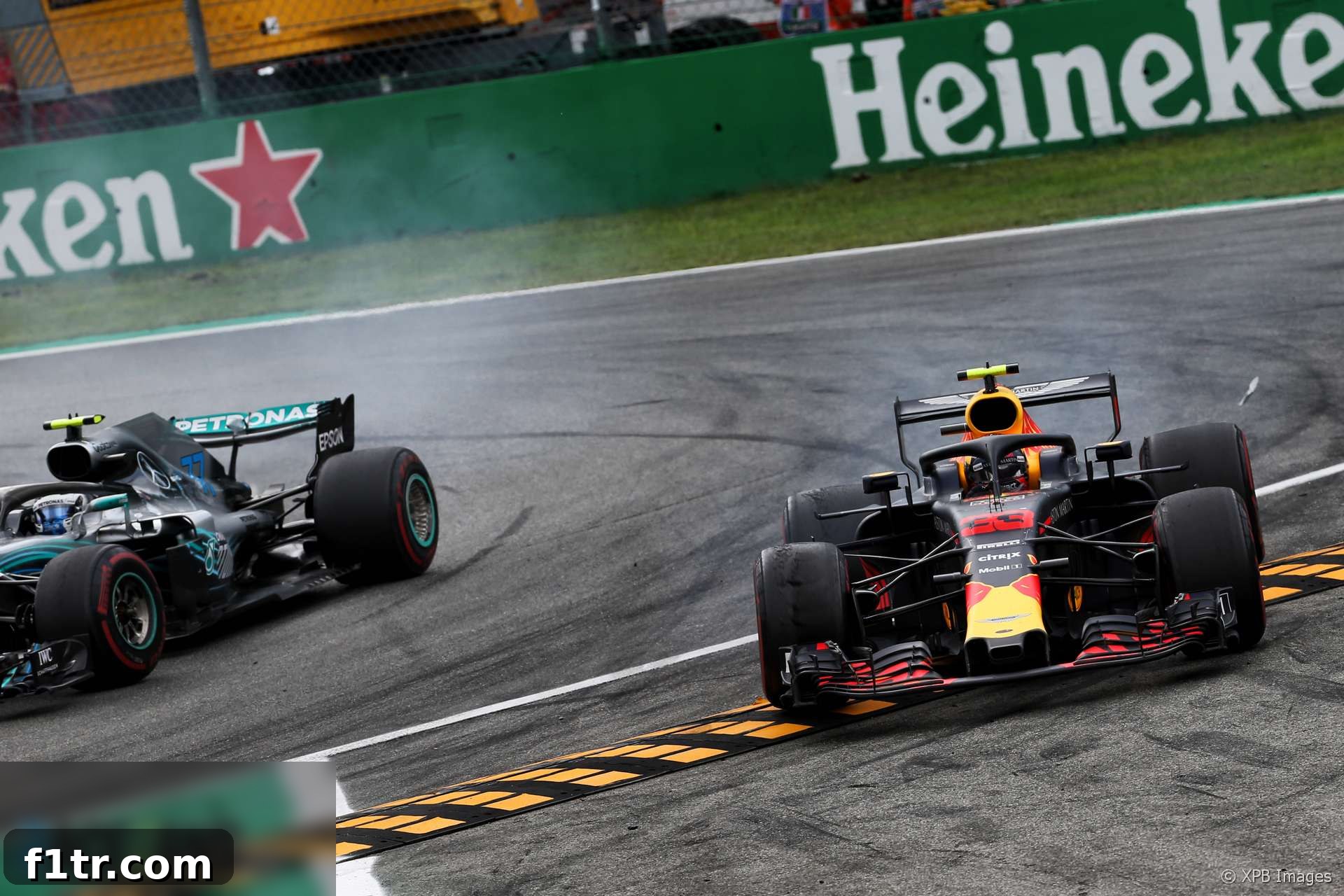
The exhilarating atmosphere of the Italian Grand Prix at Monza often brings with it moments of high tension, close racing, and contentious decisions. One such instance during the race saw Max Verstappen, the Red Bull Racing driver, receive a one-off warning for cutting the chicane. This action occurred as he fiercely defended his position against the challenging Mercedes of Valtteri Bottas, sparking immediate discussion about track limits and the nuanced application of Formula 1 regulations.
The incident in question unfolded early in the race when Bottas, pushing hard in his Mercedes, began to close in on Verstappen. As the two formidable competitors approached Turn 2 – the second chicane, known for its tight entry and exit – Verstappen left the confines of the track, seemingly gaining an advantage by straightening his line through the corner. This defensive maneuver, while effective in keeping Bottas at bay, quickly caught the attention of both the Mercedes pit wall and the FIA race control.
Advert | Become a Supporter & go ad-free
Valtteri Bottas was swift to relay his observations to his race engineer over the team radio. “I think he gained a small advantage,” Bottas communicated, articulating his immediate concern regarding Verstappen’s track excursion. His engineer promptly affirmed the observation, replying, “Yeah copy he left the track and gained an advantage.” This exchange highlighted the real-time vigilance of both drivers and teams in monitoring the conduct of their rivals on track, especially when positions are hotly contested.
Following the race, FIA Race Director Charlie Whiting confirmed the Red Bull driver had indeed been warned for his actions. Whiting elaborated on the specific protocol that was in place for such instances at Monza, a circuit notorious for its chicanes where drivers might be tempted to cut corners for various reasons, be it evasive action, defensive tactics, or simply an error. According to Whiting, teams had been explicitly advised prior to the Grand Prix that their drivers would receive a single warning – often referred to informally as a “joker” – if they cut the track in this manner to retain a defensive advantage. However, any subsequent or repeated infractions would incur a penalty, demonstrating a clear escalation in enforcement.
Whiting further clarified the rationale behind this “joker” system, explaining its distinction from other track limit infringements. “The ‘joker’ is cutting the chicane, not actually gaining a place, but staying in front by virtue of cutting the chicane, which is an advantage of sorts,” Whiting told gathered media, including RaceFans. This statement is crucial in understanding the FIA’s philosophy: the intent was not to penalize an instantaneous, minor defensive maneuver that prevented an overtake, provided it wasn’t egregious. The advantage gained was deemed subtle – merely maintaining position rather than overtly improving it or gaining significant time.
The Race Director also provided examples to illustrate the boundaries of this rule. He stressed that while a single warning was given for minor infractions, there were limits. “We told the teams we would give them one ‘free’ one. Unless of course he cut the chicane the first time and gained five seconds and kept it, then we wouldn’t let him have that,” Whiting stated. This highlighted that the severity and impact of cutting the chicane were critical factors. A blatant and substantial time gain would immediately warrant a penalty, irrespective of whether it was the driver’s first offense. In Verstappen’s case, his action was judged to be within the parameters of the “one-off” scenario. “But this one he just stayed in front of Bottas and he could, in theory, do that every lap. He wouldn’t gain a position but stay in front,” Whiting concluded, emphasizing the defensive, non-position-gaining nature of Verstappen’s move.
The incident also offered a glimpse into the communication strategies within the Red Bull Racing team. After Verstappen cut the corner, his team radioed him with reassuring words: “He was nowhere near a pass then Max, didn’t need to worry.” This message could be interpreted in several ways. It might have been an attempt to calm their driver, indicating that Bottas wasn’t truly in a position to complete the overtake, thus implying Verstappen’s chicane-cutting was perhaps unnecessary or an overreaction. Alternatively, it could have been a confirmation that the minimal advantage gained was unlikely to trigger a severe penalty, aligning with the “joker” rule explained by Whiting.
Interestingly, this chicane-cutting incident was not the only point of contention involving Verstappen and Bottas during that Italian Grand Prix. Later in the race, the two drivers were involved in a separate on-track clash at the very same corner, which resulted in Verstappen receiving a five-second time penalty. This penalty ignited a furious radio outburst from the Dutch driver, who claimed the stewards were “killing racing” with their decisions. Such passionate reactions are not uncommon in the high-stakes world of Formula 1, where drivers operate at the absolute limit and often feel the heat of the moment intensely.
Despite the fiery comments, Charlie Whiting adopted a pragmatic and understanding stance regarding Verstappen’s outburst. “I don’t think you can take too much from comments made in the heat of battle,” he remarked. This acknowledgment highlights the FIA’s understanding of the immense pressure and adrenaline that drivers experience during a race. While rules and regulations must be upheld, there’s also an acceptance that raw emotions can lead to strong statements which don’t always reflect a driver’s considered opinion. This approach by the race director helps maintain a balance between strict enforcement and empathy for the competitive environment of Formula 1.
The saga surrounding Max Verstappen’s chicane cut at Monza, and the subsequent discussions, serves as a microcosm of the continuous challenge faced by Formula 1 regulators: how to enforce track limits fairly and consistently without stifling the aggressive, wheel-to-wheel racing that fans crave. The “joker” system for chicane cutting demonstrated a flexible approach, designed to allow for minor infractions that don’t overtly compromise fairness, while still having mechanisms to penalize deliberate or significant rule-breaking. This delicate balance is vital in maintaining the integrity of the sport while ensuring that it remains an enthralling spectacle for millions worldwide.
Ultimately, the incident underscored the importance of clear communication between the FIA, teams, and drivers regarding track limits and penalty structures. While drivers will always push boundaries, understanding the precise parameters of acceptable behavior is crucial for fair competition. The events at Monza that day, involving two of the sport’s most competitive drivers and the experienced guidance of the race director, offered a valuable lesson in the complexities of modern F1 officiating and the fine line between aggressive racing and exceeding the bounds of the rulebook.
Advert | Become a RaceFans supporter andgo ad-free
2018 F1 Season Insights
Delve deeper into key moments and stories from the 2018 Formula 1 season, a year that shaped rivalries and unveiled technological advancements. Explore narratives that impacted teams and drivers alike, offering a comprehensive look back at a memorable championship campaign.
- F1 feared “death knell” for Drive to Survive after Ferrari and Mercedes snub
- McLaren staff told us we were “totally crazy” to take Honda engines in 2018 – Tost
- ‘It doesn’t matter if we start last’: How Red Bull’s junior team aided Honda’s leap forward
- Honda’s jet division helped F1 engineers solve power unit problem
- McLaren Racing losses rise after Honda split
Browse all 2018 F1 season articles