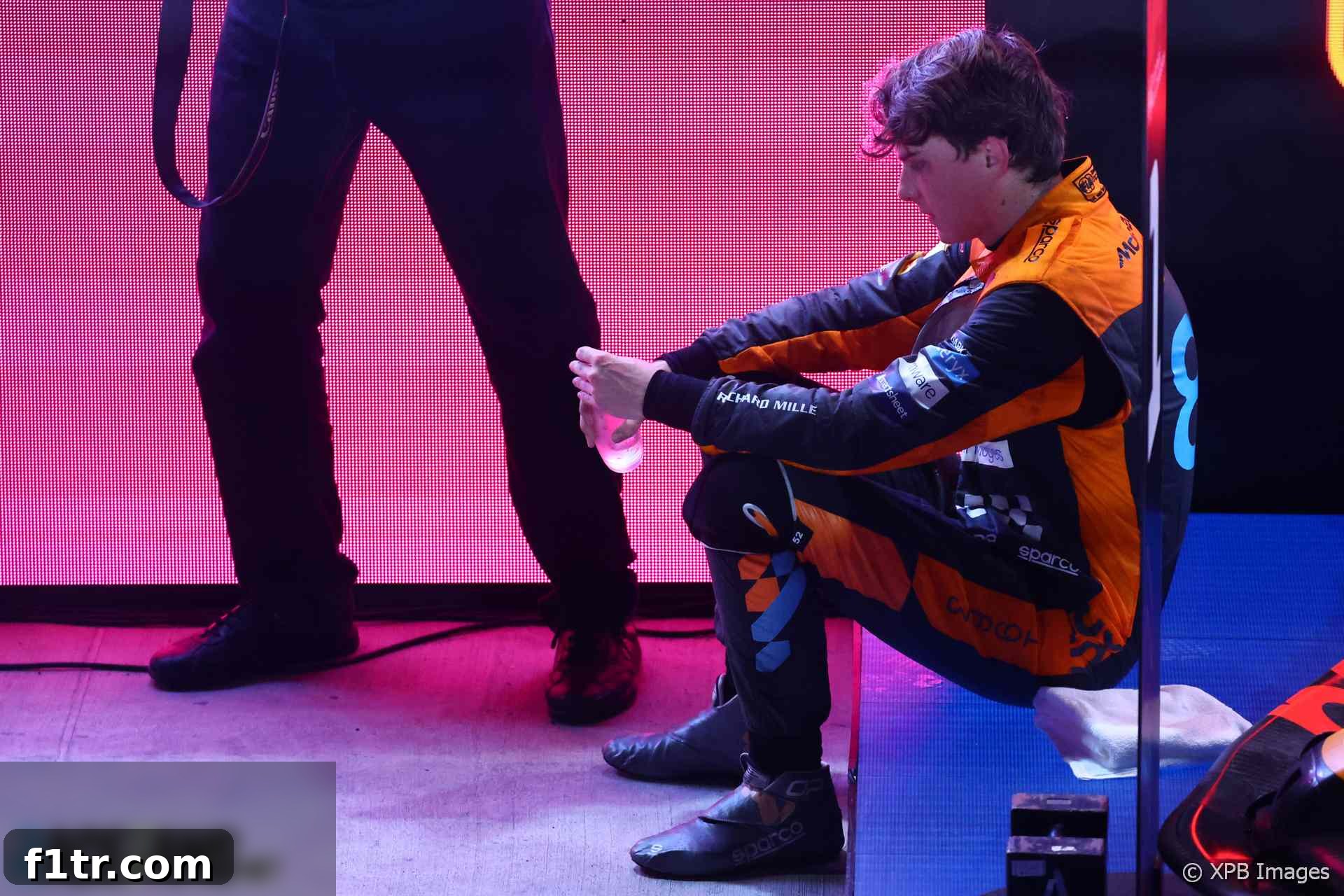
The aftermath of the Qatar Grand Prix revealed a stark reality: a procession of visibly exhausted drivers, pushed beyond their physical limits by the relentlessly punishing conditions. This race, held under the sweltering desert night sky, quickly transcended mere sporting spectacle, becoming a profound test of human endurance against the elements. As the weekend unfolded at the meticulously revamped Losail International Circuit, it laid bare both the triumphs of motorsport and the critical considerations for athlete welfare in extreme environments.
Thursday: Navigating the Desert Labyrinth
My journey to the 2023 Qatar Grand Prix weekend began with an immediate challenge, even before the engines roared to life. The Losail International Circuit, having undergone extensive refurbishment since Formula 1’s last visit over a year prior, promised a state-of-the-art facility. However, navigating its new layout alongside media colleagues proved to be the first hurdle. With an inexplicable absence of clear signposting leading to the circuit, our media convoy eventually stumbled upon an entrance via an obscure, unpaved side road. What awaited us was less a designated Formula 1 media car park and more a vast, dusty wasteland, raising initial concerns about the event’s logistical preparedness.
We followed a stream of fellow attendees to what appeared to be a security checkpoint. There, a disinterested policeman greeted our inquiries with three dismissive shrugs before finally, and somewhat reluctantly, waving us through. The adventure continued as a media shuttle then dropped us a considerable distance from the paddock, again with no clear directions or personnel to guide us. Under the unforgiving glare of a 42-degree Celsius sun, we trekked across the sprawling grounds, searching for the elusive paddock entrance, all the while enveloped by the stifling heat. This arduous beginning left little time for appreciating the circuit’s impressive makeover once we finally arrived, as the demands of the media day quickly took precedence.
The day’s schedule commenced with a visit to the Aston Martin garage, where Jessica Hawkins, a trailblazing figure in motorsport, spoke passionately about her recent Formula 1 test. Her softly spoken words conveyed a powerful message about paving the way for more women in the sport, detailing her experience and aspirations. As I scanned the bustling media scrum, a poignant observation struck me: she and I were the only two women present. It was a stark reminder, once again, of the significant journey still ahead for true inclusivity in motorsport.
Later, while heading towards the Alfa Romeo garage for Valtteri Bottas’s media session, I encountered Zhou Guanyu, proudly sporting a custom-designed shirt emblazoned with his name. Stopping briefly to admire his unique attire, he beamed with pride, exclaiming, “I designed it!” His youthful enthusiasm and creative flair offered a brief, charming respite from the day’s logistical frustrations.
My day concluded with a candid and illuminating one-to-one interview with Guenther Steiner, the outspoken Team Principal of Haas. Steiner, known for his directness, offered plenty of insightful commentary on the latest developments in Formula 1, which we eagerly anticipated sharing. Following the interview, the Alpine team kindly organized a karting event, a welcome opportunity for some competitive fun. Despite my best efforts, I managed to qualify 16th out of 30 participants, a result I proudly considered a victory, simply for avoiding the last position.
Friday: Wind, Dust, and Qualifying Drama
Friday, particularly during a sprint race weekend, typically marks the quietest day for written media at an F1 event. It is not mandatory for drivers or teams to engage with journalists after the day’s sessions, a rule that can be particularly frustrating given that sprint qualifying determines the crucial grid positions for Sunday’s main Grand Prix. As I drove into the circuit, a noticeable change in the weather had taken hold. A powerful wind had whipped up, blanketing the roads in a thick layer of dust. Flags flapped aggressively in the turbulent air, and the numerous half-finished construction areas surrounding the Losail circuit bore the brunt of the gusting elements, scattering debris and adding to the already challenging conditions.
Despite the high winds, the first practice session proceeded, followed later that evening by the critical qualifying session. With no support races to fill the gaps, the time between sessions stretched, allowing the track to accumulate even more dust, further complicating the drivers’ challenges. The qualifying session itself was fraught with tension and a touch of confusion. Max Verstappen, in his dominant Red Bull, initially secured pole position. However, a series of lap times were subsequently deleted for track limits infringements, particularly affecting the McLaren drivers. This reshuffle saw George Russell move up to second place, with Lewis Hamilton slotting into third in the other Mercedes, dramatically altering the initial grid lineup.
This post-session upheaval led to a rather surreal press conference. A solitary Max Verstappen, completely unaware of the unfolding drama, joked about the quiet room, observing the sparse attendance of four or five journalists. “Bit quiet in here,” he quipped, prompting my suggestion, “We could all join you on the sofa,” just as George Russell entered. Verstappen, still perplexed, then quizzed, “Wait, what happened to Lando? Who’s third?” I explained the track limits situation, detailing the penalties and their impact. Hamilton then made a brief appearance, disappeared for a television interview, and eventually returned, allowing the session to finally proceed, much to everyone’s relief.
I concluded the evening with a challenging run on the 5.4-kilometre track. Training for a half marathon in aid of Alzheimer’s research, this 30-degree Celsius run proved to be one of the most arduous training sessions I had ever undertaken. The combination of residual heat and the physical demands of the track highlighted the extreme environment the drivers would face in the upcoming races.
Saturday: Pirelli’s Urgent Warning and Championship Triumph
High winds continued to batter Doha as we began our now-familiar trek from the media shuttle to the paddock on Saturday. Suddenly, a collective chime resonated from our phones: a critical alert from Pirelli. They had detected an abnormality in the tyre data from Friday’s sessions, raising serious concerns about the integrity and safety of the tyres on the notoriously harsh Qatar kerbs. In conjunction with the FIA, urgent action was being taken. A press conference was swiftly scheduled with Mario Isola, the head of Pirelli Motorsport, which, as expected, became an intensely busy and well-attended session, underscoring the gravity of the situation.
The sporting action continued amidst the tyre concerns, with Oscar Piastri causing a stir by clinching pole position for the sprint race in his McLaren, a remarkable achievement for the rookie. A few hours later, I made my way to the grid, the anticipation palpable. I paused as Max Verstappen pulled up to his third-placed slot. Here stood the man who, barring an extraordinary and unforeseen development in the upcoming 19 laps, was on the cusp of securing his third Formula 1 World Championship. I took a deliberate moment to truly absorb the significance of the occasion, watching the Red Bull driver as he prepared to exit his car, poised to make history.
As the sprint race got underway, my brief reprieve in the cool, air-conditioned media centre was abruptly cut short. Logan Sargeant, unfortunately, made another error, beaching his Williams in the gravel and necessitating an immediate response from marshals. Heading down to the media pen, which felt like a boiling crucible, I was met by an oppressive wall of heat upon entering the paddock. While momentarily bearable, it was undeniably an extremely warm and uncomfortable environment, further highlighting the physical toll on those trackside.
Conversations with the drivers in the media pen slowly revealed a concerning detail: many of them had learned of Pirelli’s tyre concerns simultaneously with the media. George Russell openly admitted he found out via their drivers’ group chat, suggesting a significant lapse in communication from official channels. The lack of an earlier heads-up evidently displeased several of the drivers, adding another layer of frustration to an already challenging weekend. Leaving the circuit around 1:30 AM the following morning, we were still no closer to understanding the definitive tyre rules and regulations for Sunday’s grueling 57-lap main race. Such last-minute uncertainty, I mused, was certainly not befitting of the pinnacle of motorsport.
Sunday: The Ultimate Test of Endurance
Stepping out of the hotel at 1 PM on Sunday, I was almost physically knocked over by the sheer intensity of the extreme heat. The fierce wind that had dominated the previous days had dropped, and in its place, the humidity had soared, creating an even more oppressive atmosphere. While holding out hope that temperatures might cool down slightly before the evening race, we made our way to the circuit for the usual Sunday morning technical debriefs, preparing for what was expected to be a challenging day.
Returning to the media centre, I spotted a fellow journalist conversing with Esteban Ocon. Offering a smile and a greeting, I approached, eager to glean any crucial information. It was then that the significant news broke: the FIA was set to announce an unprecedented 18-lap tyre limit, meaning every single driver would be mandated to make three pit stops during the race. This last-minute ruling would profoundly impact race strategy and undoubtedly add another layer of complexity and physical demand to an already punishing Grand Prix.
The grid on Sunday was, without exaggeration, the hottest I have ever experienced at any Formula 1 event, far surpassing even the intense humidity of Singapore just a few weeks prior. The pervasive humidity made it genuinely difficult to breathe, leaving everyone—and I mean everyone—visibly struggling. The sense of relief upon returning to the ice-cold sanctuary of the media centre was immense.
I soon left the media centre again to speak with Lewis Hamilton, who, unfortunately, had been involved in a collision with his teammate on the very first lap of the race. Some 56 laps later, the freshly minted three-time world champion, Max Verstappen, had secured his 14th Grand Prix victory of the season. A strong weekend from McLaren saw Oscar Piastri and Lando Norris join him on the podium. However, the scene in the cooldown room was telling: two of the three podium finishers were sprawled out on the floor, testament to the brutal conditions they had just endured.
The drivers began to filter through the media pen, each appearing progressively worse than the last. The first thing I noticed was how few drivers immediately approached the pen. Usually, they are keen to fulfill their media duties quickly and head home. This time, however, their emergence was markedly delayed, a clear indication of their profound physical distress. Lance Stroll, soaked with sweat, wobbled towards us, visibly shaking. To his credit, at the culmination of a weekend riddled with disappointments for him, he generously gave us a significant amount of his time, explaining in vivid detail just how tough the race had been. He even made the alarming admission that he “passed out” at one stage during the race.
Stroll’s experience was far from isolated. Kevin Magnussen reported feeling nauseous throughout, while Esteban Ocon shockingly spent two laps throwing up into his helmet. Charles Leclerc described it as the most punishing race of his career, and George Russell confessed that his body felt like it was simply giving up. Alex Albon suffered from acute heat exhaustion, and Logan Sargeant was forced to withdraw from the race due to intense dehydration, having felt unwell even before the Grand Prix commenced. The severity of the drivers’ conditions was underscored by reports of blurred vision, a dangerous symptom in a sport demanding absolute precision.
We interact with these elite athletes day-in and day-out during race weekends, but this particular occasion felt profoundly different. There was a collective sense of relief that the race was finally over. It’s rare to witness Formula 1 drivers openly admit defeat or weakness, or for that matter, seem genuinely happy to face the media. Yet, with each driver who passed through the pen, I observed a raw vulnerability I had never encountered before. While they are supreme athletes, they are undeniably human beings, and the sight of their struggle left me quite shaken. We instinctively urged several of them to immediately rehydrate with fluids.
Inevitably, some commentators on social media insisted the race should have been red-flagged. While I personally do not subscribe to that extreme view, the undeniable human toll on the drivers certainly leads one to question the wisdom of scheduling a Grand Prix in the middle of a desert, under such exceptionally extreme and hazardous conditions, without adequate measures to mitigate the risks. The Qatar Grand Prix served as a stark, unforgettable reminder of the fine line between sporting challenge and unacceptable risk, prompting important conversations for the future of Formula 1 in extreme climates.
2023 Qatar Grand Prix: Further Insights
- Albon fears Qatar GP conditions risked creating dangerous “wet bulb effect”
- Alonso: New-spec fireproofs and pre-race anthem timing made Qatar heat worse
- Magnussen admits he took “too long to learn” Losail circuit
- Analysis: Sargeant’s Qatar radio reveals his painful struggle to end point-less run
- Alfa Romeo ‘finally understand their upgrade’ Bottas believes as team target Williams
Browse all 2023 Qatar Grand Prix articles