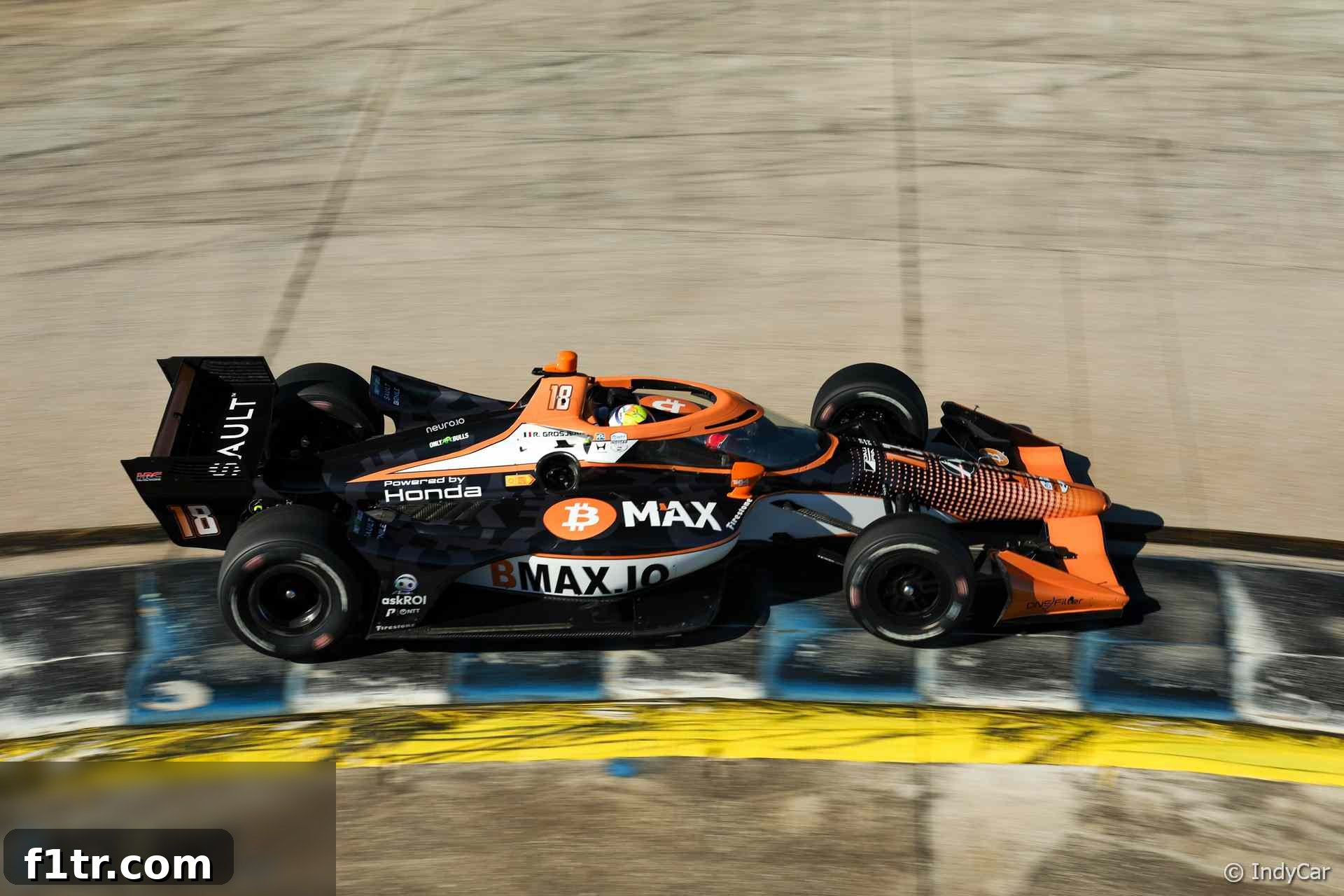
Romain Grosjean, a name synonymous with resilience and raw racing talent, is set to make his full-time return to the NTT IndyCar Series this year. After a season away from single-seater racing in 2023, the veteran driver is eagerly anticipating his reunion with Dale Coyne Racing, the team that initially welcomed him into the thrilling world of American open-wheel competition five years ago. This comeback marks a significant chapter in Grosjean’s illustrious career, offering him a platform to once again showcase his prowess on some of the most challenging circuits in motorsport.
Grosjean’s journey to IndyCar has been anything but conventional. Following a long and often dramatic career in Formula 1, which included a miraculous escape from a fiery crash at the 2020 Bahrain Grand Prix, he sought a new challenge and a fresh start. IndyCar provided that opportunity, captivating him with its competitive spirit and demanding driving style. His initial foray into the series immediately demonstrated his adaptability, with strong performances on road and street courses, quickly endearing him to a new legion of fans. His return to Dale Coyne Racing is a testament to the strong bond he forged with the team and its charismatic leader.
Speaking about his impending return, the 39-year-old former Formula 1 driver expressed his profound affection for the championship and his team. “It’s a championship that I love and that I’ve had a lot of fun in,” Grosjean shared in an interview with Off Track. His admiration for team owner Dale Coyne is also evident. “Dale is a character that I absolutely adore, or love, I don’t know what’s the right word. But I’m just glad to be back there.” This sentiment highlights a genuine connection that goes beyond a mere professional relationship, suggesting a comfortable and productive environment for Grosjean to thrive.
The excitement extends to his new teammate. “We have a good team. I’m excited to be racing along with Dennis Hauger,” Grosjean stated, acknowledging the promise of his younger counterpart. “I think he’s a very fast young kid, and also make the most of my last few years of single-seaters.” This introspection about his career’s twilight suggests a renewed focus on enjoying every moment and extracting maximum performance, both from himself and the machinery. For fans, it promises a season of passionate racing from a driver who has consistently pushed the limits.
Grosjean’s unique position, having raced extensively in both Formula 1 and IndyCar, affords him a distinctive perspective on the differences between the pinnacle single-seater categories. Last year, Grosjean had the opportunity to test an F1 car once again, marking his first time back in Grand Prix machinery since the traumatic Bahrain incident in 2020. This experience only reinforced his understanding of the contrasting driving dynamics and performance characteristics of each series.
F1 Versus IndyCar: A Driver’s Technical Perspective
When comparing Formula 1 and IndyCar, Grosjean highlights fundamental differences in how drivers approach corners and extract lap time. “The biggest difference is that in Formula 1 you focus on not sliding at all and getting on throttle very early to get a really good run out of the corners,” Grosjean explained. This strategy is primarily dictated by the sheer power and aerodynamic sophistication of F1 cars. “You have 1,000 horsepower pushing you, so that’s where you get the lap time.” The massive downforce generated by F1 cars allows them to carry incredible speed through high-speed corners, demanding precise, aerodynamic-dependent driving that minimizes slip angle to maintain peak grip.
IndyCar, with its single-specification chassis and less complex aerodynamics, requires a different approach. “In IndyCar, it’s a bit different. It’s more about the entry speed, the minimum speed and getting on throttle when you can and make it out of corner. I would say driving-wise that’s the difference.” This emphasis on mechanical grip, braking prowess, and managing the car’s balance through the entry and apex of a corner means that IndyCar drivers often utilize more aggressive trail-braking and a greater degree of car manipulation to find the limit. The focus shifts from pure aerodynamic efficiency to maximizing mechanical grip and driver feel.
Grosjean particularly appreciates the adaptability of IndyCar chassis on varied tracks. “My favourite part of IndyCar is how capable it is to do the low-speed corners on a street course with the dampers that we have, the grip that we use.” This versatility is crucial in a series that races on a mix of high-speed ovals, traditional road courses, and tight, unforgiving street circuits. The Dallara IR-18 chassis, coupled with its advanced suspension and tire compounds, allows drivers to extract impressive performance even in the most challenging conditions.
He even offered a specific example to illustrate his point about cornering performance. “If we take Monaco, the last corner, the hairpin, an IndyCar would be way faster than Formula 1 in there,” he added. The iconic Grand Hotel Hairpin in Monaco, one of the slowest corners in motorsport, perfectly exemplifies the difference. F1 cars, with their large dimensions and reliance on aerodynamic flow, struggle more in such tight, low-speed maneuvers. IndyCars, being lighter, narrower, and optimized for mechanical grip, can navigate such corners with greater agility and speed, a testament to their robust chassis and suspension design.
Concerns Over F1’s 2026 Regulations
Beyond his immediate focus on IndyCar, Grosjean also cast an experienced eye over the upcoming changes in Formula 1. The F1 rules for 2026 include significant modifications, most notably a lower minimum weight limit, revised aerodynamic packages, and new power unit regulations aimed at making cars more agile and improving racing. While these changes are intended to enhance the cars’ cornering performance in slow turns and promote closer competition, Grosjean admitted to having some reservations.
“We’ll have to see race one,” he commented, adopting a cautious stance. “On paper I’m a bit worried, but I think the teams will figure it out.” His concern likely stems from the inherent complexity of introducing such radical changes. While the intention to make cars lighter and more nimble is positive, the practical application of new aerodynamic concepts and power unit designs often presents unforeseen challenges that can affect the quality of racing, the reliability of the cars, and the overall spectacle. The history of F1 regulation changes is replete with examples where well-intentioned rules led to unintended consequences.
Despite his worries, Grosjean acknowledged the potential upsides. “I think that the beauty of it is going to change the order quite a lot and we could see a lot of action in the race.” The prospect of a reshuffled pecking order and increased on-track battles is certainly exciting for fans and the sport as a whole. However, he concluded with a pertinent question: “Is it going to be the action that we want to see? That’s the question that we have wait [and see] for the first few races.” This highlights the distinction between mere “action” and genuinely compelling, wheel-to-wheel racing that tests drivers and excites audiences. The motorsport world will undoubtedly be watching closely to see if the 2026 regulations deliver on their promise.
Romain Grosjean’s return to the IndyCar Series promises to be one of the most compelling storylines of the upcoming season. His blend of experience, passion, and unique perspective on the highest echelons of single-seater racing makes him a valuable asset to both Dale Coyne Racing and the series itself. As he embarks on this new chapter, fans eagerly await his insights and his fierce competitive spirit back on track, further enriching the vibrant landscape of motorsport.
IndyCar
- IndyCar driver McLaughlin cleared of injury after crashing through barrier at Barber
- Schumacher says his IndyCar feels like ‘an F2 car, just with better tyres’
- IndyCar “way faster than Formula 1” in some corners, says Grosjean
- FIA to award more F1 superlicence points to IndyCar drivers from 2026
- Schumacher to race full-time in IndyCar with RLL in 2026
Browse all IndyCar articles