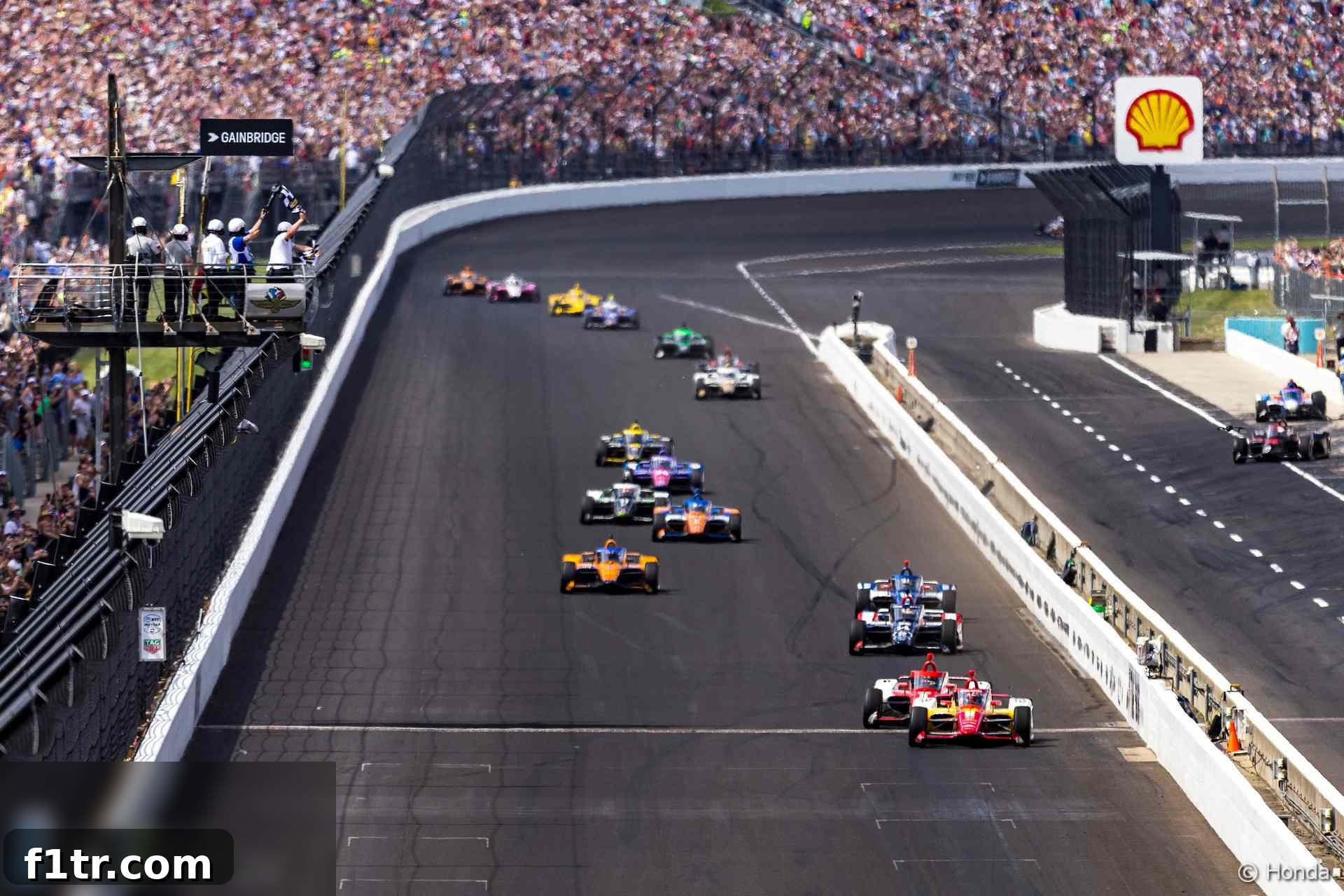
In a pivotal move aimed at bolstering driver safety and ensuring fair competition, IndyCar has enacted significant rule changes just hours before the iconic Indianapolis 500. These new regulations are specifically designed to curtail the increasingly aggressive and perilous defensive maneuvers witnessed in recent editions of the “Greatest Spectacle in Racing.” The series’ proactive stance underscores its commitment to maintaining the thrill of high-speed oval racing while mitigating unnecessary risks for its elite drivers.
Become a Supporter & go ad-free
IndyCar Tightens Defensive Driving Rules for Indianapolis 500 Safety
The Indianapolis 500, renowned for its breathtaking speeds and wheel-to-wheel action, often culminates in dramatic finishes where every inch of track, and every strategic move, can mean the difference between victory and defeat. However, in recent years, drivers have pushed the boundaries of defensive tactics to an extreme, particularly at the exit of the final corner, Turn 4. These maneuvers involve swerving precariously close to the barrier that separates the racetrack from the pit lane entry, a practice deemed increasingly hazardous by series officials.
The Escalation of Risky Maneuvers in Oval Racing
The practice of using the pit lane entry as an extension of the racetrack for defensive purposes has become a contentious issue in IndyCar. Drivers, in a desperate bid to break the slipstream of an attacker or to outright block a passing attempt, would aggressively drift towards the pit wall. This maneuver, while tactically effective, introduces a high degree of risk. At blistering speeds often exceeding 350 kilometers per hour (over 217 mph), even a slight miscalculation or an unexpected aerodynamic disturbance could lead to a catastrophic incident, jeopardizing not only the driver performing the move but also those attempting to overtake.
The unique layout of the Indianapolis Motor Speedway’s Turn 4 exit, with its long run to the start/finish line and the adjacent pit lane entry, creates a natural funnel. This funnel has historically been exploited by drivers looking for every possible advantage. The increasing audacity of these defensive swerves has prompted IndyCar to intervene, recognizing that the inherent dangers now outweigh the competitive spectacle. The potential for high-speed collisions in such a critical zone demanded a clear, definitive regulation to protect the competitors.
A Precedent-Setting Moment: The 2023 Indianapolis 500 Climax
The urgency for these new regulations was vividly highlighted by the climactic final lap of the 2023 Indianapolis 500. It featured one of the most talked-about defensive moves in recent memory, as Josef Newgarden valiantly defended his lead against a charging Marcus Ericsson. In a move that captivated millions of viewers worldwide, Newgarden pulled his car significantly towards the pit lane entrance at the exit of Turn 4, then sharply swerved back onto the main track, narrowly missing the blunt end of the pit lane barrier at incredibly high speeds.
This audacious maneuver, while ultimately securing Newgarden’s victory, sparked considerable debate within the motorsport community regarding track limits, safety, and the spirit of competition. While undeniably dramatic and a testament to Newgarden’s skill and determination under immense pressure, the move underscored the perilous tightrope drivers were walking. It became undeniably clear that without clearer guidelines and stricter enforcement, such extreme tactics could lead to serious consequences, pushing the limits of what is acceptable and safe in high-speed oval racing environments like the Indianapolis Motor Speedway.
The New Rule: Defining Track Limits and Enhancing Driver Safety
In response to these growing concerns and the clear demonstration of risk from the previous year’s event, IndyCar officially announced a critical amendment to its rulebook. The core of this new directive is explicit: drivers must no longer cross the dashed white line that extends from the exit of Turn 4 well before the actual pit lane entrance, unless they are genuinely committing to entering the pit lane for a scheduled stop or to retire from the race. This means any car remaining on the racetrack must strictly adhere to the right-hand side of this dashed line and the pit lane barrier’s end, maintaining a clear separation from the pit entry zone.
The series confirmed this vital clarification in a statement distributed to drivers during a mandatory pre-race meeting on Friday. The official communication detailed: “The dashed white line from the exit of turn four to the pit entry attenuator will be officiated for Sunday’s race. Cars that have left-side tyres past the dashed line will be penalised unless entering the pit lane, for incident avoidance or in an obvious attempt to avoid a closed pit lane and return to the racetrack.” This precise definition removes any ambiguity, establishing a clear and enforceable boundary for competitive driving in a critical area of the track.
The “pit entry attenuator” mentioned in the rule refers to the physical barrier or crash structure specifically designed to absorb impact and safely guide cars into the pit lane. By explicitly linking the dashed line to this attenuator, IndyCar is unequivocally reinforcing the idea that the area beyond this line is no longer considered part of the racing surface for defensive maneuvers. This change is not merely about penalizing drivers; it’s fundamentally about redesigning the acceptable racing line in a high-risk section of the track to enhance overall safety for all competitors.
Penalties for Infraction: A Strict Deterrent for Dangerous Behavior
To ensure strict adherence to the new safety mandate and to discourage any attempts to bypass these critical track limits, IndyCar has outlined a clear and proportionate penalty structure for any driver found in breach of the rule:
- Drive-Through Penalty: For offenses committed during green flag racing conditions, drivers will typically be issued a drive-through penalty. This requires the driver to pass through the pit lane at the mandated speed limit, resulting in a significant loss of track position and valuable time, which can often be race-ending.
- Rear of the Queue: If an infraction occurs during a Safety Car period, the offending driver will be immediately sent to the rear of the running order queue. This penalty, while not involving a time loss under caution, still severely impacts a driver’s strategic position and chances of victory, especially in a tightly bunched field.
- Time Penalty (Post-Race): Should a rule breach be identified and judged after the conclusion of the race, a corresponding time penalty will be applied to the offending driver’s final race time. This penalty will be equivalent to the estimated time lost by driving through the pit lane, ensuring that a competitive advantage is not gained by the illegal maneuver, even if it contributed to a race finish.
This robust and multi-faceted penalty system is meticulously designed to act as a significant deterrent, ensuring that drivers think twice and adhere to the rules before attempting to exploit the pit lane entry area for defensive gains. The consistency and severity of these penalties underscore IndyCar’s commitment to enforcing the new track limits effectively, promoting a safer and fairer racing environment for the prestigious Indianapolis 500.
Clarification on the ‘Restart Line’ at Indianapolis
In addition to the crucial defensive driving rule, IndyCar also provided an important clarification regarding the ‘restart line’ typically employed at the final corner in various motorsport events. The series confirmed that for the upcoming Indianapolis 500, this specific restart line will *not* be applied. This means that following any Safety Car period, drivers will be permitted to resume racing and accelerate as soon as the race condition transitions back to green, rather than being required to wait until they cross a designated line on the track.
This decision aims to preserve the raw, unadulterated excitement and strategic intensity of IndyCar restarts, allowing for immediate competition and dynamic strategic positioning as soon as the green flag waves. While some racing series utilize a restart line to prevent jump starts and organize the field, IndyCar’s choice for the Indy 500 reflects a desire to maximize racing action and maintain the classic “every man for himself” intensity that profoundly defines the event, especially in its thrilling closing stages. This approach ensures that the spectacle of the restart remains an integral part of the Indianapolis 500 experience.
Video: The Thrilling Climax of the 2023 Indianapolis 500
To fully appreciate the context and necessity of these new regulations, revisit the dramatic final moments of last year’s race. The video below captures Josef Newgarden’s controversial yet ultimately victorious defense against Marcus Ericsson, a pivotal moment that directly catalyzed the implementation of these critical rule changes for the 108th running of the Indy 500.
Become a RaceFans supporter andgo ad-free
Explore More IndyCar News and Analysis
Stay updated with the latest developments, driver news, and in-depth race analysis from the thrilling world of IndyCar. Our comprehensive coverage brings you closer to the action and the stories shaping America’s premier open-wheel series.
- IndyCar driver McLaughlin cleared of injury after crashing through barrier at Barber
- Schumacher says his IndyCar feels like ‘an F2 car, just with better tyres’
- IndyCar “way faster than Formula 1” in some corners, says Grosjean
- FIA to award more F1 superlicence points to IndyCar drivers from 2026
- Schumacher to race full-time in IndyCar with RLL in 2026
Browse all IndyCar articles