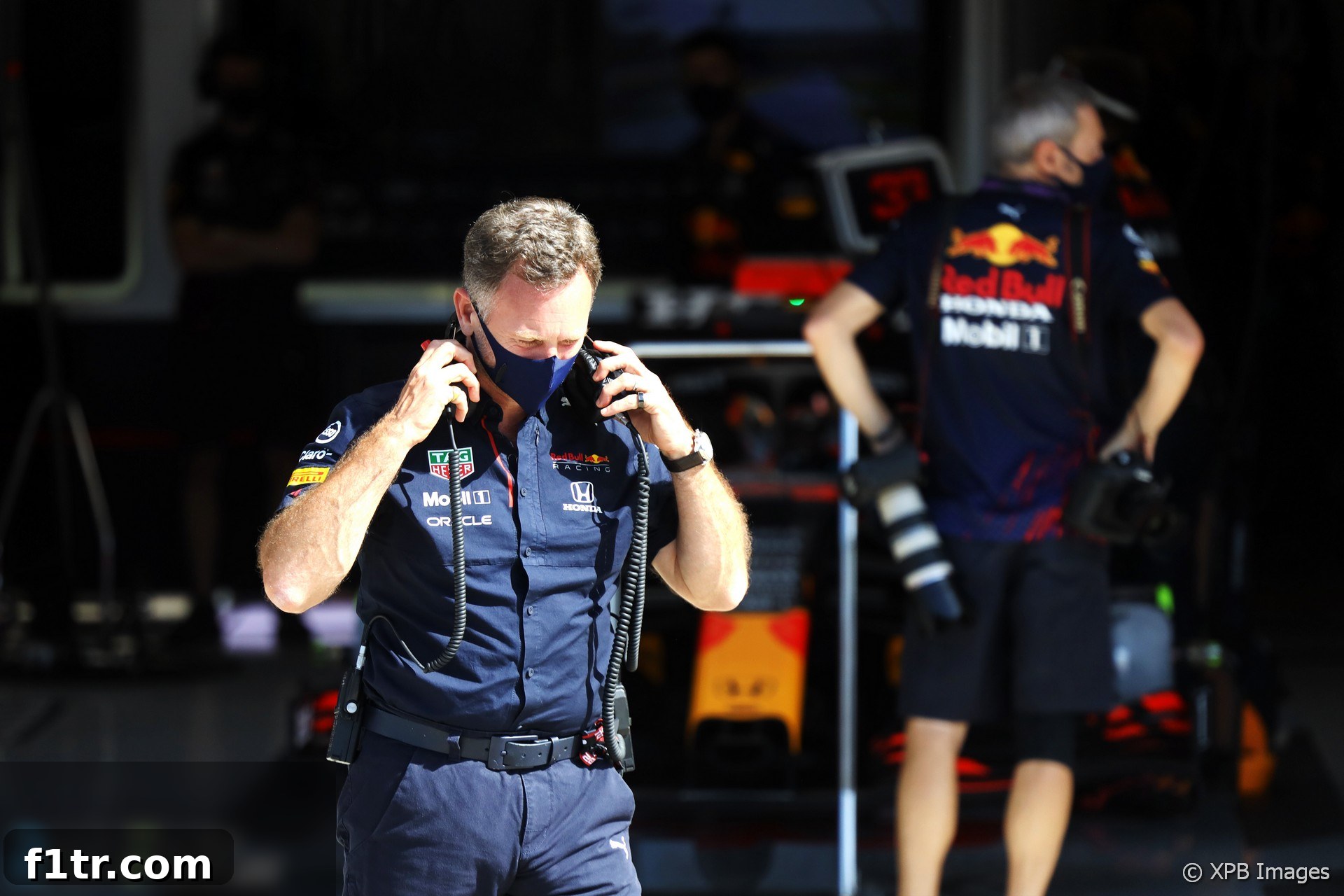
The aftermath of the thrilling yet controversial 2021 British Grand Prix at Silverstone was dominated not just by on-track drama but also by a fiery off-track dispute concerning the conduct of rival team principals. At the heart of the contention was the interaction between Red Bull Racing’s Christian Horner and Mercedes-AMG Petronas F1 Team’s Toto Wolff with the race stewards, following a high-profile collision between championship contenders Lewis Hamilton and Max Verstappen.
Horner’s Outrage: Lobbying the Stewards “Unacceptable”
Red Bull Team Principal Christian Horner minced no words, publicly labelling Toto Wolff’s decision to personally lobby the FIA stewards during the British Grand Prix as “unacceptable.” This strong condemnation came in the wake of the dramatic opening lap incident that saw Verstappen’s race end prematurely and Hamilton receive a ten-second penalty, which he controversially overcame to win the race.
Horner’s concern stemmed from a fundamental belief in judicial impartiality within Formula 1. He articulated a clear conviction that the stewards, tasked with making critical, objective decisions under immense pressure, should be shielded from external influence, particularly during the intensity of a live race. He learned that Wolff had gone to put Mercedes’ case forward following the collision, prompting him to act.
“I saw Toto who was lobbying the stewards, which I heard that’s what he was going there to do,” Horner stated in response to media inquiries. “So I went to make sure that our view was represented because I don’t think it’s right that team principals should be able to go and lobby the stewards. They should be locked away so that they’re not influenced.”
He continued, “For me, that was unacceptable that he had gone up there to lobby the stewards. So I wanted to make sure that there was a balanced opinion given, rather than trying to influence pressure on the stewards to make a menial sentence.” Horner’s perspective underscored a perceived violation of fair play and proper procedure, emphasizing that the integrity of the stewarding process should remain sacrosanct and impervious to direct advocacy from competing teams during critical moments.
Despite being reminded that Race Director Michael Masi had told Wolff to “feel free to go upstairs and visit the stewards” during an intense radio exchange, Horner stood firm on his view. “I don’t think the stewards should be interfered with. They need to be there clear-headed to be able to make those decisions,” he reiterated, maintaining that even an invitation from the Race Director should not supersede the principle of isolating the stewards from team influence during a Grand Prix.
Horner’s visit to the stewards, therefore, was not an attempt to engage in similar lobbying, but rather a defensive measure to ensure neutrality. “I went to see the stewards because I heard that Toto was up there presenting a case and you want it to be fair and balanced but I don’t think anybody should be allowed to see the stewards during the course of a grand prix.”
Wolff’s Rebuttal: A Legitimate Engagement
Mercedes Team Principal Toto Wolff swiftly dismissed Horner’s accusations, vehemently defending his actions as entirely appropriate and a standard part of engaging with race officials. Wolff’s decision to approach the stewards was, by his account, a direct and legitimate response to what he perceived as prior engagement from Horner with Race Director Michael Masi, which had been broadcast globally.
“I was told that there was a rant on the radio to Michael about all the badness in the world,” Wolff explained, framing his subsequent visit as a reactive stance, asserting his team’s right to present its side when a rival was already engaging with officials through public channels. “And then I went up and gave my opinion.”
He underscored his familiarity with the process and the legitimacy of his actions, stating, “I think it’s fair enough. I’ve been to the stewards many times in my life.” This implied that his interaction was not an unusual or nefarious act but rather a legitimate engagement within the sporting framework, a common practice for team principals seeking clarification or offering their perspective on complex racing incidents.
Masi’s Perspective: No Concern Over Direct Communication
Adding another layer to the intricate debate, FIA Formula 1 Race Director Michael Masi offered a distinct perspective, stating unequivocally that he held “no concern” about team principals directly communicating with stewards in person during races. Masi’s stance, therefore, directly contradicted Horner’s assertion of impropriety, effectively validating Wolff’s actions within the established protocol.
Masi highlighted a significant precedent from the previous year’s Italian Grand Prix, where Lewis Hamilton himself engaged with the stewards regarding a penalty during a red flag period. This historical example served to illustrate that such direct interactions, particularly during race suspensions or periods of review, are not unprecedented and fall within accepted operational guidelines.
“If we have an incident after the race, we invite the teams and the drivers to come up and appear before the stewards,” said Masi, outlining the standard procedure. “We had the case in Monza last year when Lewis went and spoke to the stewards to understand and have a look at the whole thing. It’s during the suspension, so that ability exists, there’s no reason not to.” This confirmation indicated that the opportunity for direct dialogue is an inherent part of the FIA’s judicial process.
Regarding the flurry of radio messages he received from both Mercedes and Red Bull following the crash, Masi maintained his composure and professional approach. He acknowledged it as “part of what they do,” a natural outcome of highly competitive teams intensely advocating for their interests. “Everyone’s looking after their own little patch of turf, so to speak, which you’d expect,” he observed, recognizing the inherent passion and drive of team leaders.
He stressed his commitment to treating all teams “equally” and managing communications effectively, sometimes needing to defer specific requests. “There was a couple of times with Mercedes-Benz or with Red Bull at the time where I said ‘just hang five and I’ll get back to you’, which happened earlier, which you probably didn’t hear, you only heard the one that was broadcast.” This offered insight into the constant stream of communication Masi manages during a race, much of which remains unheard by the public.
Masi also remained untroubled by the possibility of the FIA being drawn into the increasingly bitter contest between the two championship rivals. “Whatever sniping might happen between Red Bull and Mercedes behind the scenes is not of concern to us,” he affirmed. “We judge on what happens out there on the sporting field or on the track in our circumstance.” His focus remained squarely on on-track actions and objective rule enforcement, regardless of the verbal sparring between team principals.
The Collision: A Flashpoint in an Intense Championship Battle
The context for this intense off-track debate was the high-speed collision between Lewis Hamilton and Max Verstappen at Copse corner on the opening lap of the British Grand Prix. The incident, which saw Verstappen retire after a 51G impact and Hamilton subsequently win the race despite a ten-second penalty, sent shockwaves through the championship battle. With both drivers locked in one of the most enthralling title fights in recent F1 history, every on-track maneuver and subsequent FIA decision carried immense weight. The severity of the crash, the immediate safety car deployment, and the subsequent penalty review heightened tensions dramatically, transforming a sporting incident into a highly scrutinized event between two formidable teams.
The differing views on the legitimacy of team principals approaching the stewards directly highlighted the escalating pressure felt by all parties involved in the 2021 Formula 1 World Championship. The stakes were incredibly high, not just for the drivers and their teams, but also for the integrity and perception of fairness within the sport’s governing body.
F1 Governance and the Integrity of Stewarding
The incident sparked broader discussions about the governance of Formula 1, particularly concerning the transparency and perceived independence of the stewarding process. While Michael Masi affirmed the FIA’s focus on “what happens out there on the sporting field,” irrespective of “sniping” between teams, the public nature of the disagreement raised questions about how such interactions are managed and perceived by fans and participants alike. Maintaining the integrity of decisions, especially those impacting championship outcomes, is paramount for the sport’s credibility.
The debate between Horner and Wolff underscored the delicate balance the FIA must strike between allowing teams to advocate for their positions and ensuring stewards operate without undue external influence. Clear guidelines and consistent application of rules are crucial to prevent any perception of bias or manipulation, which can erode trust in the sport’s judicial system. The stewards’ role is to interpret and apply regulations impartially, and any perceived external pressure, whether direct or indirect, can compromise this vital function.
The Intensifying Rivalry and its Off-Track Ramifications
The 2021 season was characterized by an escalating and increasingly bitter rivalry between Mercedes and Red Bull. This incident at Silverstone was not an isolated event but rather another flashpoint in a season replete with strategic battles, on-track clashes, and intense verbal exchanges between the two leadership figures. The “us vs. them” mentality permeated every aspect of the championship, making the role of neutral officials like the stewards and the race director even more challenging.
The passionate advocacy displayed by both Horner and Wolff, while perhaps expected from competitive team leaders, pushed the boundaries of traditional F1 etiquette. These off-track skirmishes added a dramatic dimension to an already gripping season, drawing fans deeper into the narrative not just of racing prowess, but also of political maneuvering and psychological warfare between the sport’s dominant forces. Such incidents, while controversial, undoubtedly fueled the immense excitement and global interest in the epic 2021 championship battle.
Conclusion: Balancing Advocacy and Impartiality
Ultimately, the exchange between Christian Horner, Toto Wolff, and Michael Masi at the 2021 British Grand Prix highlighted the perennial challenge in Formula 1: how to balance the intense competitive spirit of teams with the need for objective, impartial decision-making by sporting authorities. While Masi found no explicit fault in the interactions, acknowledging them as part of the sport’s dynamic, Horner’s concerns about lobbying sparked a crucial conversation about the boundaries of advocacy and the sanctity of the stewarding process. This episode served as a vivid reminder of the high stakes involved in Formula 1, where every decision, every word, and every interaction can have far-reaching implications for the championship battle and the perception of fair play within the pinnacle of motorsport.
2021 British Grand Prix Related Articles
- Verstappen reveals “vision problems” since 2021 Silverstone crash with Hamilton
- Who was to blame for Verstappen and Hamilton’s collision at Silverstone?
- Hamilton penalty “harsh” for move within FIA’s overtaking guidance – Allison
- Why Hamilton “wasn’t seen as wholly to blame” for the Verstappen crash
- Sainz convinced he had pace to challenge for podium without British GP setbacks
Browse all 2021 British Grand Prix articles