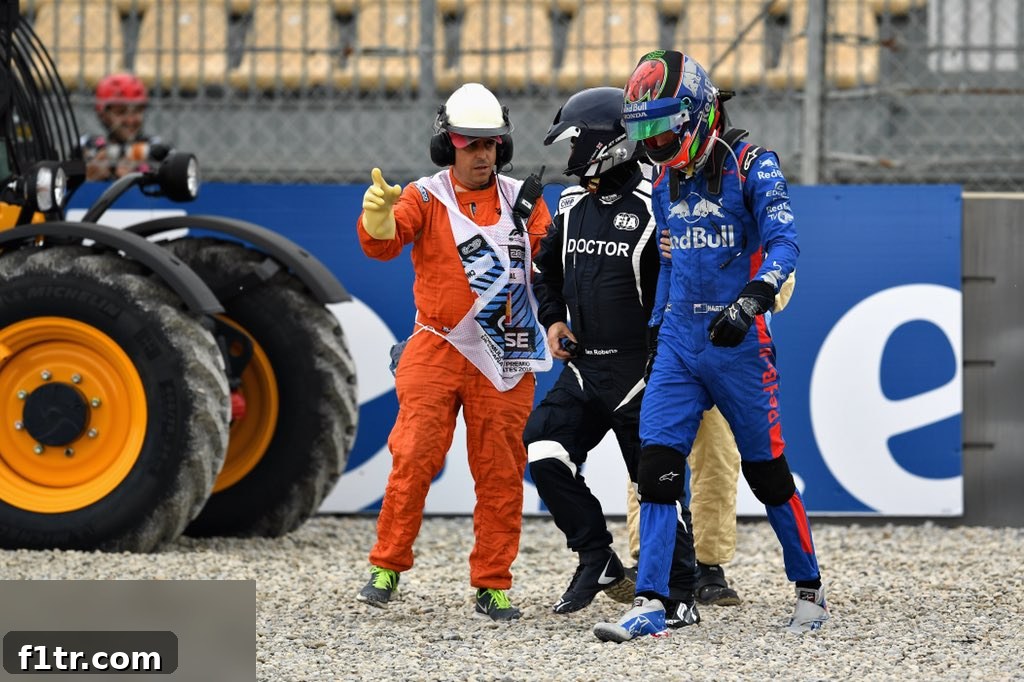
In a dramatic turn of events at the Spanish Grand Prix, Brendon Hartley, the resilient Toro Rosso driver, has been given the green light to compete in Sunday’s main race despite enduring a high-speed crash during the crucial final practice session. The incident, which left his STR13 severely damaged, cast a shadow of uncertainty over his participation, but Hartley’s determination and the swift response of his team and medical personnel have ensured his return to the track.
The harrowing shunt occurred at Turn 9 of the Circuit de Catalunya, a notoriously fast and challenging corner, just moments before the checkered flag brought an end to Saturday morning’s practice. Hartley’s car spun violently, impacting the barrier backwards with considerable force. The immediate aftermath saw the New Zealander extracted from his cockpit and swiftly transported to the circuit’s Medical Centre for mandatory checks. Despite the visible severity of the crash, medical professionals confirmed that Hartley was physically sound and declared him fit to continue, a testament to the ever-improving safety standards in Formula 1.
The physical toll on the car, however, was significant. The Toro Rosso chassis sustained extensive damage, rendering it impossible for Hartley to participate in the critical qualifying session that afternoon. This immediately placed him at a disadvantage, relegating him to the back of the grid for the race. Consequently, Hartley will require a formal dispensation from the race stewards to be allowed to start the Grand Prix, a mere formality given his medical clearance and the precedent set for such situations in Formula 1. This rule ensures that drivers who miss qualifying due to circumstances beyond their control, such as a severe crash, are still given the opportunity to compete, provided their car can be repaired and they are physically able.
Speaking to Sky Sports shortly after the incident, a visibly shaken but remarkably composed Hartley reflected on the impact. “It was a big impact, no doubt about it,” he confirmed, highlighting the forces he experienced. However, his focus was already firmly on the race. “Everyone’s working incredibly hard to get the car fixed for tomorrow, and I’ll be fine. I’m physically fit to drive again.” His immediate concern was clearly for his team and their herculean effort to prepare a race-worthy machine in time, demonstrating the strong bond between a driver and their crew.
Despite the chaotic scene of marshals moving his heavily damaged car, with large sections of bodywork detached, Hartley delivered some encouraging news regarding the core structure of his car. “There’s no chassis damage, which is incredibly important,” he stated, a significant relief for both driver and team. The integrity of the chassis is paramount in Formula 1; a compromised chassis would almost certainly necessitate a complete rebuild around a spare, a far more time-consuming and costly endeavor. “The other bits are replaceable,” he added, simplifying what would be a monumental overnight repair job for the mechanics. While acknowledging the potential implications for newly introduced components on the drivetrain, such as the gearbox or specific engine ancillaries, he remained optimistic. “I don’t know what it means going forward for new parts introduced to the car on the drive train, but I think they should have no problem getting it fixed in time.” This sentiment underscored his confidence in the dedicated team of engineers and mechanics who would undoubtedly work through the night to ensure his car was ready.
The challenge of starting from the back of the grid at the Circuit de Catalunya is immense. The Spanish track is notoriously difficult for overtaking, characterized by its fast, sweeping corners and relatively narrow sections, which often lead to processional races. However, Hartley found inspiration in recent team history. He recalled Daniil Kvyat’s impressive performance for Toro Rosso at the same event just last year, where the Russian driver managed to claw his way up from 19th on the grid to secure a commendable ninth-place finish and valuable championship points. This achievement serves as a potent reminder that points are never out of reach, even from the tail end of the field, with the right strategy and a bit of luck.
“I’m a bit disappointed I didn’t have a crack in qualifying because the car felt really good this morning; quite happy with the balance,” Hartley lamented, expressing his frustration at missing the opportunity to show his pace. The feeling a driver has with their car during practice is crucial, and Hartley clearly felt a strong connection with the STR13’s setup. However, his focus quickly shifted to the main event. “We’ll have to see what we can do from the back. I know Toro Rosso started from last position at this track last year and scored points, so that can certainly be the goal.” This resilient attitude reflects the fighting spirit often seen in Formula 1 drivers, who are always looking for opportunities, regardless of their starting position. A well-executed strategy, combined with potential safety car periods or changing weather conditions, could still offer avenues for Hartley to emulate Kvyat’s feat and salvage points from what began as a highly challenging weekend.
The 2018 Formula 1 season was a significant year for Toro Rosso, marking their first season with Honda power units. This partnership brought with it a steep learning curve and immense development challenges. The team, acting as Red Bull’s junior outfit, played a crucial role in the evolution of the Honda engine, providing vital feedback and enduring the teething problems that are typical of new engine collaborations. Hartley’s commitment, even after a major setback, epitomized the team’s relentless pursuit of performance and reliability during this transitional period. Their efforts would eventually pave the way for Honda’s successful integration into the Red Bull family in subsequent seasons, highlighting the strategic importance of every race weekend, even those fraught with adversity.
The Circuit de Catalunya itself is a staple of the F1 calendar, primarily known as a testing ground due to its diverse range of corners, from high-speed sweeps to technical low-speed sections. Its characteristics mean that any car performing well here typically performs well across many other circuits, making it an excellent benchmark for chassis development. However, for racing, its challenging layout places a premium on qualifying performance and often makes for difficult overtakes. Drivers must maximize every opportunity, relying on tire strategy, DRS zones, and opportunistic maneuvers. For Hartley, starting from the back, a judicious use of tires and an alert response to any on-track incidents will be paramount if he is to navigate through the field and chase that elusive points finish.
Brendon Hartley’s incident serves as a stark reminder of the fine margins in Formula 1, where fortunes can change in an instant. Yet, his rapid medical clearance and unwavering determination to compete underscore the tenacity required to be an F1 driver. With his Toro Rosso mechanics working tirelessly, and Hartley himself mentally prepared for a challenging race, all eyes will be on his efforts to defy the odds and turn a weekend of adversity into one of accomplishment at the Spanish Grand Prix.
2018 F1 season
- F1 feared “death knell” for Drive to Survive after Ferrari and Mercedes snub
- McLaren staff told us we were “totally crazy” to take Honda engines in 2018 – Tost
- ‘It doesn’t matter if we start last’: How Red Bull’s junior team aided Honda’s leap forward
- Honda’s jet division helped F1 engineers solve power unit problem
- McLaren Racing losses rise after Honda split
Browse all 2018 F1 season articles